
Can March in Palma: Palace Architecture and Modern Art
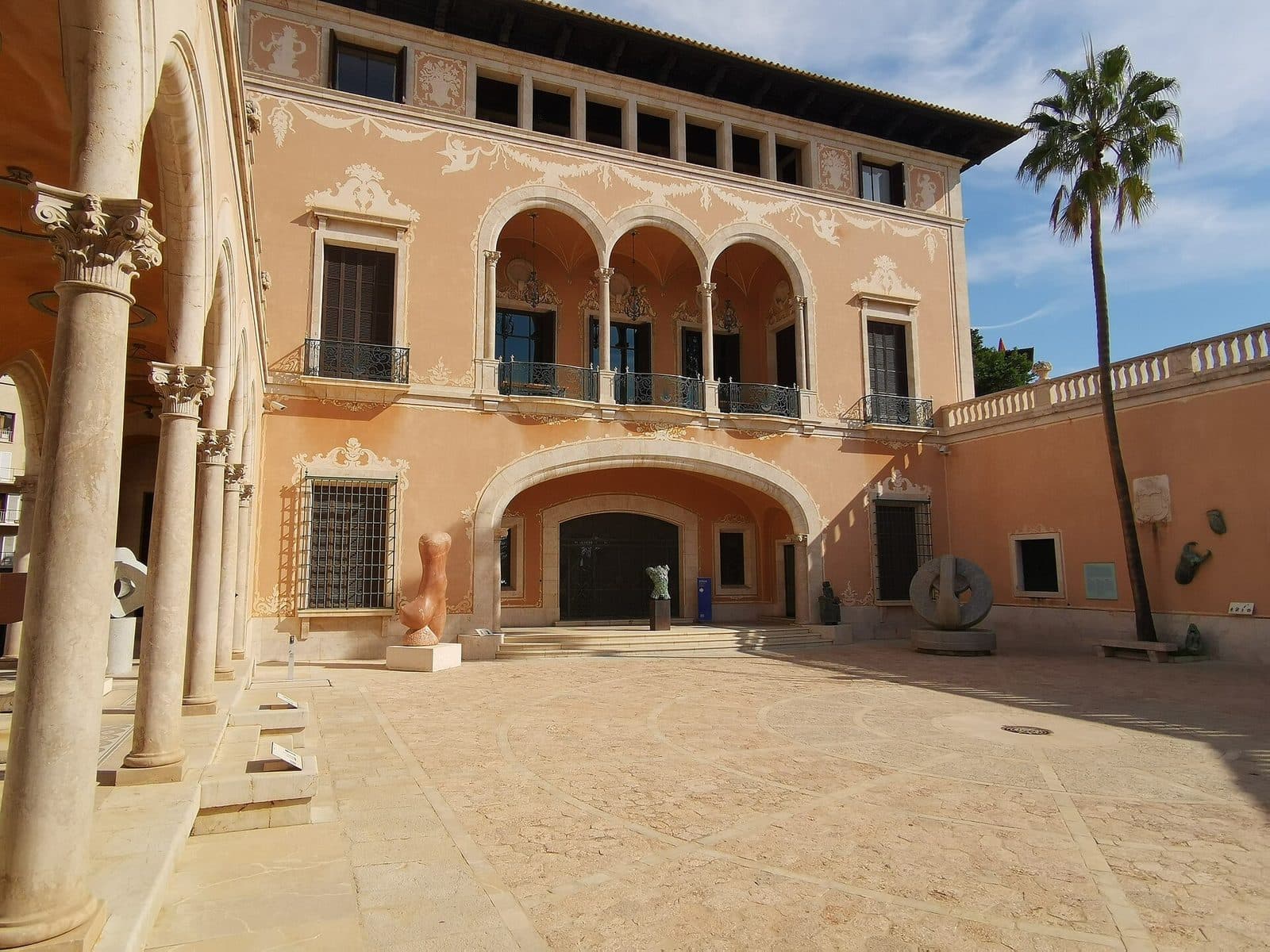

Can March offers a journey into a surprisingly young palace world in the heart of Palma’s historic center. Also known as Palau March, the building was not constructed until the 20th century, yet its richly decorated courtyard, open gallery, and references to Mallorcan and Italian Baroque palaces deliberately make it appear older. This contrast is precisely what makes it so appealing: rather than an aristocratic residence developed over centuries, it is the carefully staged urban home of an influential Mallorcan business family.
The palace stands in the immediate vicinity of the cathedral, Almudaina, and the present-day Parliament of the Balearic Islands. Among these monuments steeped in history, Can March asserts itself not through medieval walls but through the quality of its materials, its decoration, and an architectural design intended to make social status visible. Anyone seeking to understand Palma’s architectural history will find an illuminating counterpart here to Gothic, Renaissance, and Modernisme architecture.
Today, the former family residence serves as the headquarters of the Fundación Bartolomé March Servera and as a museum. The relationship between architecture and art is particularly distinctive: modern and contemporary sculptures are distributed throughout courtyards, garden areas, and palace rooms. The visit therefore appeals equally to art enthusiasts, architecture lovers, and anyone looking to discover a less obvious place among the major monuments of the Old Town.
Can March should not, however, be confused with the Museu Fundación Juan March, which is also located in Palma’s Old Town. Despite their similar names, they are separate institutions with different collections. Palau March focuses on the former family residence, its historicist architecture, the large courtyard, and the artworks displayed by the foundation.
History and Significance
The original intention was less about creating a quiet family home than making an unmistakable social statement. Financier Juan March Ordinas commissioned the residence at one of Palma’s most symbolically important locations: beside La Seu Cathedral, La Almudaina Royal Palace, and the former casino that now houses the Parliament of the Balearic Islands. Anyone building here was deliberately placing themselves at the city’s representative center.
Juan March Ordinas
Juan March Ordinas was born in Mallorca in 1880 and rose from relatively modest circumstances to become one of the island’s wealthiest entrepreneurs. His business activities ranged from trade and real estate to shipping, energy, and finance. In 1926, he founded Banca March. His biography is closely linked to Mallorca’s economic and social history during the first half of the 20th century and has repeatedly been viewed as controversial because of his business methods and political connections.
Against this background, the urban residence can be read not merely as a home but as the architectural expression of an extraordinary social ascent. Its location and lavish design were intended to convey the owner’s status as clearly as the choice of a palace style that drew on older forms of authority and representation.
The Creation of the Palace
The palace was built during the first half of the 20th century. The project was designed by Madrid architect Luis Gutiérrez Soto, one of the most respected Spanish architects of his time. Because of the client’s importance and the scale and complexity of the undertaking, the March residence became one of the outstanding projects of his career.
Gabriel Alomar Esteve also played an important role on the construction site as project manager. Numerous respected artists and specialists contributed to the building’s execution. This explains why Can March does not feel like a formulaic reconstruction of a historic palace: its architecture thrives on carefully coordinated materials, varied decorative techniques, and unusually rich detailing.
The historicist design drew primarily on Mallorcan and Italian Baroque palaces. The result was a 20th-century building that deliberately speaks in much older forms without copying any single model. Instead, it brings together motifs from Mediterranean palace architecture to create a new residence specifically designed for this owner.
From Family Residence to Museum
For decades, the building served as the March family’s home in Palma. It later became the headquarters of the Fundación Bartolomé March Servera. Bartolomé March Servera, a son of Juan March, played a defining role in establishing the foundation and building its art collections. In 2003, the family opened the palace to the public, making the combination of private residence and collection accessible to visitors.
This transformation is crucial to the building’s significance today. Can March preserves not only the rooms and façades of an influential family but also demonstrates how private wealth was translated into architecture and art collections. The palace therefore tells a story of social advancement, the desire for representation, Spanish architecture of the 20th century, and the later transformation of a private home into a cultural institution.
What to See
The courtyard immediately makes clear that Can March was designed to impress. It is not simply a passageway but the palace’s principal reception space. From here, the main façade, open gallery, and elevated terrace garden unfold as a unified composition. The architecture and sightlines were arranged so that the building reveals itself gradually.
The Courtyard
The courtyard is considered one of the most impressive parts of the complex. Its Mediterranean character emerges from the interplay of open space, decorated architecture, and the façades surrounding it. Unlike a plain museum foyer, the visit begins here in the open air, or rather in the transition between outside and inside.
It is especially worthwhile not to move on immediately. From the courtyard, visitors can see how the building adopts historic palace motifs while arranging them theatrically. The façades are not merely boundaries but form a representative backdrop. Columns, openings, galleries, and ornamental elements guide the eye upward and across several levels.
The courtyard therefore fulfills the same purpose as those found in many of Palma’s old urban palaces: it organizes access and creates distance between the street and the residential quarters. At Can March, however, this motif was reinterpreted in the 20th century and combined with the scale of an exceptionally elaborate private residence.
The Main Façade and Open Gallery
The richly detailed main façade rises above the courtyard. Its ornamentation is among the building’s finest features. The open gallery is particularly distinctive, with a rhythm that lightens the palace structure’s otherwise imposing appearance. It recalls Mediterranean loggias while also creating a connection between the interior rooms, courtyard, and cityscape.
Luis Gutiérrez Soto’s historicist approach is especially clear here. Mallorcan and Italian Baroque influences are not presented as isolated showpieces but determine the proportions, openings, and decoration. The building is intended to be read as a palace even though it was created in the modern era.
For architecture enthusiasts, this is precisely the most fascinating point to observe. Can March is neither medieval nor Baroque, although it plays with ideas of both. A closer look reveals a deliberately composed retrospective: history became the architectural language of a new social elite.
The Terrace Garden
Above the courtyard, the terrace garden opens as a viewpoint over the heart of Palma. Its position connects the palace with the surrounding Old Town. The view does not extend into an enclosed park landscape but into the urban setting that was decisive in the choice of the site.
The terrace is therefore not only one of the most pleasant parts of the house but also one of the most revealing. From here, it becomes clear how deliberately Can March was positioned among Palma’s major monuments. The cathedral, Almudaina, and the surrounding representative buildings form the historic framework into which the residence inserts itself.
The sculptures also have a different impact outdoors than they do in an enclosed gallery. Forms, surfaces, and spaces respond to changing daylight and the architecture of the garden. Rather than separating art from the palace, the presentation makes their relationship visible.
The Sculpture Collection
Can March houses a significant part of the foundation’s modern and contemporary sculpture collection. Works are distributed throughout the courtyards, garden areas, and palace interior. Artists represented include Eduardo Chillida, Henry Moore, Auguste Rodin, Barbara Hepworth, Max Bill, Pietro Consagra, Agustín Cárdenas, and Eusebio Sempere. These names embody very different approaches to sculpture, ensuring that the tour is not merely a sequence of individual artworks but a gathering of varied pieces by major sculptors.
The contrast is most powerful where a modern sculpture appears against historicist masonry. Architecturally, the palace attempts to recreate the past, while the sculptures speak the formal languages of the 20th century. The two levels do not compete but instead sharpen each other. The building’s old appearance seems more deliberately staged, while the abstract works gain an additional spatial presence from their unusual setting.
The Former Residential and Reception Areas
Inside, it remains clear that the house was not originally designed as a neutral museum. It was a private residence whose rooms were intended for social representation and family life. The choice of materials and decoration continues the opulence of the courtyard. Visitors therefore move not through interchangeable exhibition halls but through architecture with its own highly distinctive identity.
This background changes how the art is perceived. Doors, sequences of rooms, and decorative surfaces remain part of the experience. Anyone focusing only on labels and individual objects may easily overlook the fact that the building itself is the largest exhibit. It is worth repeatedly shifting your gaze: first to the artwork, then to its placement, and finally to the room surrounding it.
Visiting Can March
Conceptually, the tour begins even before reaching the entrance. Between the cathedral, Almudaina, and parliament, Can March initially appears to be another historic palace in the Old Town. Only an awareness of when it was built changes this impression. It is therefore worth studying the exterior without rushing and then looking in the courtyard for the features that reveal the building as a deliberately designed palace setting.
From the Courtyard to the Terrace
A progression from the large-scale to the small-scale works well during a visit. First, the courtyard, façade, and open gallery establish the architectural framework. The sculptures and their various settings can then take center stage. The terrace garden should not be treated solely as a viewpoint but as part of the overall composition: from there, the close relationship between the residence and the historic center becomes especially clear.
The ideal amount of time depends greatly on your interests. Visitors primarily wishing to see the building and courtyard can move through the palace more quickly. Art enthusiasts may spend considerably longer examining the sculptures, their sightlines, and the contrasts between abstract form and historicist decoration. A fixed time slot would therefore be of little help; Can March accommodates both a focused stop and a more in-depth museum visit.
Current Visitor Arrangements
Before visiting, check the current opening conditions and admission directly with the palace. This is particularly important if Can March is planned as a fixed stop between the cathedral and Almudaina. The foundation also hosts cultural activities and concerts, which may affect access to individual areas.
Its location makes the palace easy to include in a day exploring the Old Town. It can be incorporated into a tour of the monumental center without any additional transfer. Anyone wishing to experience the architecture attentively should not, however, treat the visit as a hurried way to fill a gap: the courtyard, gallery, and terrace only fully reveal themselves when there is enough time to view them from different positions.
Attention Rather Than Completeness
The building’s greatest strength is not the number of rooms that can be quickly checked off a list. What matters is the interaction between three levels: the biography of the March family, the historicist palace architecture, and the modern sculpture. A rewarding tour connects these levels rather than viewing them separately.
A second look at the courtyard at the end of the visit is especially revealing. After seeing the interiors and collection, the decoration, gallery, and spatial organization are usually perceived differently than upon arrival. What initially appeared to be an old urban palace can now be understood as a carefully designed 20th-century building.
Getting There and Parking
From Palma Airport, the route initially follows the Ma-19 into the island’s capital. Palma is 11 kilometers away by road, and the journey takes around 20 minutes. These figures apply specifically to the route into Palma, not directly to the entrance of Can March. The final section leads into the historic center.
Driving into the Old Town
Can March is located in the monumental center near the cathedral and Almudaina. Drivers will generally find it more practical to use a parking garage at the edge of this part of the Old Town rather than search for a space directly beside the palace. The Parc de la Mar parking garage is a suitable starting point for the cathedral, Almudaina, and southern Old Town. Access is available via routes including Avenida de Gabriel Roca and Avinguda d’Antoni Maura.
From the parking garage, the final section is covered on foot into the area above Parc de la Mar. This approach leads toward Can March from the direction where the cathedral and royal palace also dominate the cityscape. It avoids searching for parking in the narrow streets around the building and can easily be combined with a longer walk through the Old Town.
By Bus
Several city-center bus stops are within reach in the Old Town. These include pl. de Cort, pl. d’en Coll, pl. de sa Quartera, and pl. del Mercat. The most convenient option depends on the route used and your starting point. From each stop, the remainder of the journey continues on foot through the center toward the cathedral and Almudaina.
For orientation, the monumental district is more useful than the name Can March alone, as that name is also used by other businesses and buildings in Mallorca. The destination should therefore be entered as Palau March or the museum of the Fundación Bartolomé March Servera near La Seu and La Almudaina.
Walking Through Palma
Within the Old Town, the palace is best included as part of a walking route. Palma’s historic center consists of a network of narrow streets, squares, and representative avenues in which many important buildings stand close together. The transition from the busier center to the cathedral district is already part of the approach to the palace.
Visitors arriving from Plaça de Cort or Plaça del Mercat walk through the Old Town toward the elevated monumental district. From Parc de la Mar, use the cathedral and Almudaina as landmarks. Beside these imposing neighbors, the comparatively young residence is particularly interesting because its claim to historic grandeur can be directly compared with genuine medieval monuments.
Bus lines to Can March at a glance
| Line | Route | Departures/day | First | Last |
|---|---|---|---|---|
| 35 | Aquàrium - Pl. Reina | Catedral | 8 | 07:10 | 13:50 |
| 3 | Pont d'Inca / Joan Carles I | 6 | 07:37 | 09:46 |
| 25 | s'Arenal - Pl. Reina | Catedral | 6 | 09:35 | 12:41 |
| 46 | la Bonanova - Gènova - Sindicat (dreta) | 6 | 07:20 | 09:15 |
| 47 | Gènova - la Bonanova - Sindicat (esquerra) | 6 | 07:30 | 08:53 |
| 20 | Portopí - Son Espases | 2 | 07:17 | 07:19 |
From the official GTFS feeds (TIB/SFM), no real-time data. The figures cover all stops in the town; weekend and holiday services differ — check with the operator before travelling.
Getting there by bus
662-pl. de Cort · 0.1 km as the crow flies
- CCCircular Centre Ciutat · 08:00–08:00 · Daily
663-pl. d'en Coll · 0.2 km as the crow flies
- CCCircular Centre Ciutat · 08:00–08:00 · Daily
664-pl. de sa Quartera · 0.2 km as the crow flies
- CCCircular Centre Ciutat · 08:00–08:00 · Daily
106-pl. del Mercat · 0.3 km as the crow flies
- 3Pont d'Inca / Joan Carles I · 08:00–08:00 · Daily
- 4Ses Illetes - Pl. Columnes · 08:00–08:00 · Daily
- 7Son Gotleu - Son Serra - Sa Vileta / Son Vida · 08:00–08:00 · Daily
- 20Portopí - Son Espases · 06:06–22:40 · Daily
52-pl. del Mercat · 0.3 km as the crow flies
- 4Ses Illetes - Pl. Columnes · 08:00–08:00 · Daily
- 7Son Gotleu - Son Serra - Sa Vileta / Son Vida · 08:00–08:00 · Daily
- 20Portopí - Son Espases · 06:06–22:40 · Daily
- 35Aquàrium - Pl. Reina | Catedral · 06:21–22:41 · Daily
983-Jutjats Nous · 0.4 km as the crow flies
- CCCircular Centre Ciutat · 08:00–08:00 · Daily
453-pl. de la Reina - Catedral · 0.4 km as the crow flies
- 25s'Arenal - Pl. Reina | Catedral · 06:36–21:01 · Daily
105-pl. de Joan Carles I - Catedral · 0.4 km as the crow flies
- 3Pont d'Inca / Joan Carles I · 08:00–08:00 · Daily
- 4Ses Illetes - Pl. Columnes · 08:00–08:00 · Daily
- 7Son Gotleu - Son Serra - Sa Vileta / Son Vida · 08:00–08:00 · Daily
- 20Portopí - Son Espases · 06:06–22:40 · Daily
986-pl. de la Reina - Catedral · 0.4 km as the crow flies
- 35Aquàrium - Pl. Reina | Catedral · 06:21–22:41 · Daily
- CCCircular Centre Ciutat · 08:00–08:00 · Daily
7-pl. de la Reina - Catedral · 0.5 km as the crow flies
- 35Aquàrium - Pl. Reina | Catedral · 06:21–22:41 · Daily
1-Sindicat - Àrea d'intercanvi Sindicat · 0.5 km as the crow flies
- 46la Bonanova - Gènova - Sindicat (dreta) · 08:00–08:00 · Daily
- 47Gènova - la Bonanova - Sindicat (esquerra) · 08:00–08:00 · Daily
1048-pl. de Joan Carles I · 0.5 km as the crow flies
- 25s'Arenal - Pl. Reina | Catedral · 06:36–21:01 · Daily
- 35Aquàrium - Pl. Reina | Catedral · 06:21–22:41 · Daily
Timetable data: official GTFS feeds (TIB/EMT), no real-time — check with the operator before travelling.
Nearby Attractions
Few other locations could illustrate the intention behind Can March more clearly. Just a few steps separate a financier’s private display of power from Palma’s oldest political and religious symbols. The building should therefore not be viewed in isolation; its urban context is part of its history.
La Seu Cathedral and Almudaina
La Seu Cathedral and La Almudaina Royal Palace are the most obvious places to combine with a visit. Both belong to a much older historical layer than Can March. Direct comparison reveals how the 20th-century residence works with inherited ideas of dignity, monumentality, and Mediterranean palace architecture.
This proximity is ideal for a themed walking tour. La Seu represents Palma’s Gothic and ecclesiastical dimension, Almudaina its authority and political history, and Can March the modern social ascent of a business family. Three very different architectural functions stand close together and collectively show how power is expressed through buildings.
Parliament and the Historic Center
The Parliament of the Balearic Islands also forms part of the immediate urban setting. Its building formerly served as a casino and was already a prominent neighbor when the March residence was built. The choice of a site among such institutions was no coincidence but a central element of the residence’s representative purpose.
From here, the route can continue into the rest of the Old Town. Plaça de Cort, Plaça del Mercat, and Plaça Major lead into areas where medieval streets, later urban palaces, and early 20th-century architecture meet. Can March acts as an unusual link within this fabric: formally modeled on older palaces but in reality a work of the modern era.
Parc de la Mar
Below the cathedral and Almudaina, Parc de la Mar opens up views of Palma’s monumental skyline. Combining Can March with a walk through the park allows visitors to experience the palace first within its enclosed Old Town surroundings and then as part of a larger urban ensemble. This change in perspective helps explain the site’s special location.
The park also provides a natural transition between a cultural tour and Palma’s waterfront. Rather than traveling immediately to another district after the museum visit, the surrounding area can be explored further on foot. This is especially worthwhile at Can March because its location, neighboring buildings, and sightlines reveal almost as much about the palace as its interiors do.
The place it belongs to
Palma in the place guidePractical Information for Your Visit
The name is the first potential source of confusion. Here, Can March or Palau March refers to the March family’s former residence in Palma’s cathedral district. It does not refer to the restaurant of the same name in Manacor, Ca’s Patró March at Cala Deià, or a holiday villa with a similar name. The Museu Fundación Juan March is also a different museum in Palma.
Understanding the Palace Correctly
Visitors should not expect a medieval aristocratic palace. The building was created in the 20th century and deliberately uses historic forms. Keeping its construction period in mind reveals more: the ornamentation, gallery, and courtyard then tell not only of Baroque aesthetics but also of how a modern financier sought to inscribe himself into Palma’s historic elite through architecture.
Nor is Can March a neutral exhibition hall. The art is displayed in a former private residence with a strong decorative character, whose architecture sometimes demands as much attention as the exhibited works. The most rewarding approach is to consider both together and observe how the sculptures are positioned in the courtyard, garden, and interior rooms.
Visiting with Children
For families, the courtyard, open gallery, terrace garden, and large-scale sculptures offer particularly accessible points of entry. Rather than trying to explain every art-historical detail, the tour can focus on forms, materials, and contrasts: Which sculpture looks heavy, which looks open, and which looks geometric? Where does the palace backdrop change the impact of a work?
As this is an art collection in a representative residence, quiet observation is appropriate. For children, selecting a few striking works is usually more rewarding than attempting to cover every area in full.
Clothing and Visit Planning
The tour combines interior rooms with the courtyard and terrace area. Clothing should therefore be suitable for both museum spaces and open-air areas. As Can March fits particularly well into a longer walk through the Old Town, comfortable footwear is advisable. The routes around the cathedral and Almudaina are usually covered not only for the palace visit but as part of a broader city walk.
Before setting out, it is advisable to check the current visitor arrangements. This can prevent an event or a change in access to individual areas from affecting the planned tour. Visitors coming primarily for the architecture should also reserve enough attention for the courtyard and terrace rather than focusing exclusively on the interiors.
Local insider tips
See the Courtyard Twice
The courtyard feels different after the tour than it does upon arrival. Looking back once more at the end makes it easier to see how the main façade, open gallery, and terrace garden were designed as a unified reception setting.
Compare Sculpture and Setting
It is worth changing your viewpoint around the sculptures. Works by Chillida, Moore, Hepworth, and Sempere change their impact against the ornamented façade, open courtyard, and garden—their placement is part of the experience.
Keep the Construction Period in Mind
Can March was deliberately designed to resemble an older palace, but it was built in the 20th century. With this knowledge, the Baroque references and rich decoration become evidence of social self-representation.
Find the Right March
For maps and navigation, it is better to use “Palau March” or Fundación Bartolomé March Servera near the cathedral and Almudaina. Several restaurants, villas, and institutions in Mallorca have similar names.
Read the Terrace as a City Map
Do not look only at the view from the terrace garden: the cathedral, Almudaina, and present-day parliament explain why Juan March chose this particular site for his representative urban residence.