
es Camell near Escorca: Mallorca’s Stone Camel
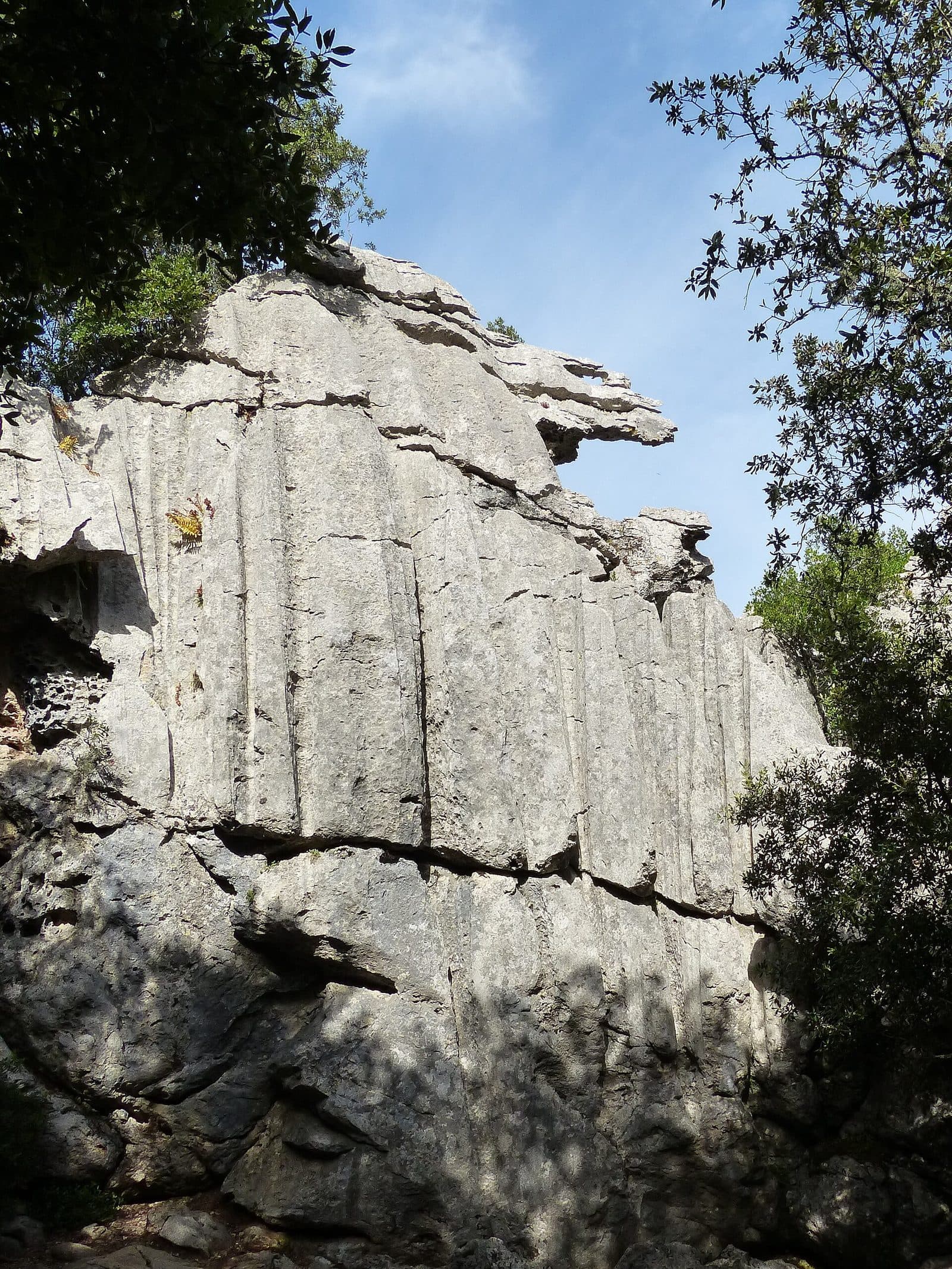

Amid the rugged limestone landscape of Lluc, an animal appears that nobody would expect to find here: es Camell. With its curved back and distinctive head, the natural rock formation near Escorca resembles a resting camel. No sculptor worked on it. Rainwater and erosion carved the silhouette from the predominant limestone.
The rock alone would already make an appealing destination. At least as impressive, however, is the route leading to it, which passes through a compact karst landscape of grooves, fissures, and unusually weathered stone blocks. A short search for the stone camel can thus become a small discovery hike.
The usual starting point is the Santuari de Lluc. The direct, marked route is also suitable for families accustomed to hiking, although steep and stepped sections require care. Anyone choosing the longer circular route through the rock labyrinth should be sure-footed and expect to use their hands for support in a few short places.
History and Significance
Long before people gave the rock its present name, water was shaping its form. Limestone defines the ground and subsoil around Lluc. Rainwater penetrated small irregularities and fissures, gradually dissolved the rock, and deepened existing cracks. Over very long periods, this created the unusual shapes, rock ribs, and rugged surfaces that characterize the route to es Camell.
Formation in the Karst
Es Camell is therefore not a single block that happened to be left here, but part of an extensive karst landscape. Parallel grooves can be seen on bare rock surfaces, etched into the limestone by flowing water. Such limestone pavements, regionally also known as Schratten, make the geological process immediately visible: The rock appears solid, yet everywhere it bears traces of slow dissolution.
Wind and water also shaped larger masses of stone into figures in which the eye seeks familiar outlines. Nearby, even a rocky summit bears a figurative name: On Puig de ses Monges, weathered blocks resemble figures wearing monks’ robes. Es Camell is the best-known and most easily recognizable motif in this world of stone forms.
The Name es Camell
The Mallorcan name simply means “the camel.” Depending on the viewing angle, the figure appears with varying clarity; from a suitable perspective, it looks like a one-humped camel or dromedary. This remarkable resemblance has made the rock a natural landmark on the hiking trails near Lluc.
Its significance lies neither in a historical event nor in human craftsmanship. Instead, es Camell demonstrates on a small scale how water shapes the limestone of the Serra de Tramuntana. Those who reach the rock are not merely standing before a curious silhouette, but in the midst of the geological process that formed the entire surrounding landscape.
What to See
The image only comes together from a little distance. Projections become the head and neck, while the curved mass of stone becomes the back of a resting animal. Standing directly in front of it, however, visitors mainly see the rough surface: washed-out hollows, sharp edges, and darker fissures in the pale limestone. It is therefore worth changing position and viewing the figure from several directions.
Es Camell
The characteristic silhouette is the focal point of the excursion. It appears particularly distinct when the entire rock comes into view against the surrounding mountain landscape. Up close, the supposed animal dissolves once more into separate sections of stone. This very shift between recognizable figure and abstract rock mass is what makes it so appealing.
The rock is not a designed monument with a fixed front. Perception depends on perspective and distance. Rather than immediately moving on, it is worth slowly following the contours with your eyes. The resemblance to a camel often becomes fully apparent only when the head, back, and body appear in a single line.
The Limestone Pavements
Along the route are bare limestone surfaces across which water has carved both fine and deep channels. These limestone pavements give the terrain its distinctive furrowed appearance. In places, tough diss grass, a typical plant of Mallorca’s mountain landscape, grows from small karst holes between the stones.
These structures are not merely a backdrop for the photo opportunity. They explain how es Camell could form. Every channel and washed-out edge is a smaller version of the same process that eventually sculpted the large animal figure. At the same time, the grooves make clear why the terrain demands attention: What looks like a level rock slab from a distance may prove full of fissures and steps up close.
Puig de ses Monges
Puig de ses Monges already stands out near Lluc. It owes its name, the “Mountain of the Monks,” to limestone blocks whose shapes resemble monks’ robes. The rocky summit introduces the landscape around es Camell: Familiar-looking figures seem to emerge everywhere from weathered stone.
The Former Charcoal Kiln
A circular stone foundation beside the trail is described as the remains of a former charcoal kiln. It is also an important landmark because the access route to es Camell branches off here. This inconspicuous circle tells of another use of the mountain landscape: Alongside the natural formations are traces of the people who once produced charcoal in the forests of the Tramuntana.
Visiting es Camell
From the Santuari de Lluc car park, the usual access route first passes the football pitch. The trail then crosses the Torrent de Lluc on a footbridge or bridge and climbs over rocky ground into the karst landscape. This section is already part of the experience, as the enclosed monastery complex recedes and attention increasingly shifts toward bare rock surfaces and weathered blocks.
Route 4 to Cometa dels Morts
The route known as Route 4 or Cometa dels Morts leads directly toward es Camell. Trails in the surrounding area are marked. Nevertheless, the junction at the circular foundation of the former charcoal kiln deserves particular attention: This is where the path turns right toward the rock formation. Anyone simply following the most obvious trail may walk past this junction.
The direct return route does not require a long mountain hike. However, a documented duration is available only for a more extensive circular route through the rock labyrinth: Allow just under two hours for this option. It requires sure-footedness and includes short passages where using your hands can help when negotiating the terrain.
Extension to Cova de la Cometa dels Morts
The hike does not have to end at es Camell. The route can be continued toward Cova de la Cometa dels Morts. This turns a visit to the individual rock into a longer exploration of the karst landscape. Before extending the hike, assess whether there is enough time, water, and sure-footedness for the additional route.
Crowds and Planning Your Day
The Santuari de Lluc can receive many visitors, while the rocky trails behind the monastery may be considerably quieter. One documented winter visit describes only a few encounters in the rock labyrinth, even in good weather. This cannot guarantee quiet trails, but outside the busiest periods at the monastery, the chances of a peaceful hike increase.
No reliable opening hours or admission information are recorded for es Camell. Because access, parking regulations, and trail information may change, checking current details before travelling is recommended. You should also leave enough time on site to return in daylight rather than planning the rock as a rushed detour.
Getting There and Parking
The drive from the centre of the island does not end directly at the rock. Es Camell lies in the karst landscape near Lluc and is reached on foot; the Santuari de Lluc serves as a practical starting point. The stated road distances and driving times refer specifically to Escorca, not to the final walk to the rock formation.
From Palma Airport
From Palma Airport, the route follows Ma-30, Ma-13, and then Ma-2130 to Escorca. The journey covers 52 road kilometres and takes around 64 minutes. This is followed by the local drive toward Lluc; Ma-10 provides access to this part of the Serra de Tramuntana. Because of the winding mountain roads, the final stage should not be calculated like a quick urban drive.
From Central Palma
From central Palma, the route initially follows Ma-13 and then Ma-2130. The road distance to Escorca is 49 kilometres, with a driving time of around 68 minutes. The onward journey to Lluc, the search for parking, and the subsequent hiking trail must also be added.
Parking at Santuari de Lluc
The monastery car park is the usual starting point. From there, the access route begins by the football pitch, crosses the Torrent de Lluc, and continues onto the marked trails. Parking options are also mentioned along the nearby road. As Lluc itself can be very busy, it is advisable to check current parking regulations in advance and not assume that a free space will be available immediately beside the start of the walking route.
Arriving by Bus
For travel by public transport, the Lluc stop is the most practical because the hiking route begins in the area of the sanctuary. Other stops are located within the municipality of Escorca, but they do not automatically eliminate the walk to the appropriate trailhead. Before the excursion, check the timetable, return journey, and available connections, especially if extending the hike to Cova de la Cometa dels Morts.
Bus lines to es Camell at a glance
| Line | Route | Departures/day | First | Last |
|---|---|---|---|---|
| 312 | Lluc - Inca - Muro | 32 | 08:32 | 18:03 |
| 231 | Port de Sóller - Alcúdia | 16 | 10:15 | 19:58 |
From the official GTFS feeds (TIB/SFM), no real-time data. The figures cover all stops in the town; weekend and holiday services differ — check with the operator before travelling.
Getting there by bus
Lluc (19011) · 0.6 km as the crow flies
- 231Port de Sóller - Alcúdia · Daily
- 312Lluc - Inca - Muro · Daily
Menut 1 (19015) · 0.9 km as the crow flies
- 231Port de Sóller - Alcúdia · Daily
Menut 2 (19014) · 0.9 km as the crow flies
- 231Port de Sóller - Alcúdia · Daily
Coll de sa Batalla 2 (19002) · 1.3 km as the crow flies
- 312Lluc - Inca - Muro · Daily
Coll de sa Batalla 1 (19003) · 1.3 km as the crow flies
- 312Lluc - Inca - Muro · Daily
Timetable data: official GTFS feeds (TIB/EMT), no real-time — check with the operator before travelling.
Nearby Attractions
The route to es Camell begins in a place where natural and cultural landscapes meet directly. Lluc belongs to the extensive municipality of Escorca in northwestern Mallorca. Rather than a compact town centre, the surroundings are defined by mountains, gorges, remote settlements, and the important sanctuary.
Santuari de Lluc
The Santuari de Lluc is the obvious cultural counterpart to the karst hike. The buildings and squares of the pilgrimage site lie directly beside the usual starting point. The two destinations can therefore be combined without planning an additional drive: Visit the sanctuary before or afterwards, with the transition into the quiet, rocky landscape behind the football pitch in between.
Enough time should be allowed for both parts. Anyone squeezing es Camell between two other activities underestimates the uneven approach and the appeal of the surrounding landscape. The rock works best as the destination of its own short hike, not as a viewpoint visible directly from the car park.
Cova de la Cometa dels Morts
Cova de la Cometa dels Morts is the logical extension of Route 4. It lies along the same continuing hiking route and provides an opportunity to explore the karst landscape for longer. The combination is particularly appealing to sure-footed hikers who do not want to turn back immediately after the photo stop at es Camell.
Escorca’s Mountain Landscape
Escorca is shaped by the Serra de Tramuntana and accessed by Ma-10, which crosses the mountain range. The drive is therefore already part of the landscape experience, although the winding roads require concentration. Destinations around Lluc are more suitable for the same day than a tightly packed itinerary covering widely separated points across the municipality.
The place it belongs to
Escorca in the place guidePractical Information for Your Visit
The name may sound like an easily accessible curiosity, but es Camell does not stand on a paved viewing area. The approach follows rocky, partly steep and stepped paths. Anyone wearing only street shoes or expecting completely level ground will find the short excursion more demanding than anticipated.
Footwear and Sure-Footedness
Sturdy footwear with good grip is the most important equipment. The grooves and fissures shaped by water can make footing difficult, and the longer circular option includes short scrambling sections. Take particular care on washed-out limestone after rainfall; even in dry conditions, it is worth regularly shifting your attention from the panorama to your next step.
Water and Food
Carry enough water for the hike. This is especially important if the route is extended beyond es Camell. The proximity of the monastery should not obscure the fact that the trail itself crosses rocky terrain and that visitors should not expect refreshments directly at the formation.
Visiting with Children
The direct, marked route is described as suitable for families, provided the children can already walk confidently on uneven terrain. Steep and stepped sections require supervision and attention. This should be distinguished from the circular hike lasting just under two hours, which includes short scrambling passages and should only be chosen if the fitness and sure-footedness of the entire group are suitable.
Navigation and Animals
At the former charcoal kiln, it is worth consciously checking the route because this is where the junction to es Camell is located. Free-roaming goats may appear around the Lluc car park. They are part of the local scene, but should not be a reason to leave food exposed or lose concentration while parking or pulling out.
What Not to Expect
Es Camell has no interior spaces, exhibition, or staged viewpoint. The attraction consists of the natural rock and the route through the karst landscape. This is precisely why it cannot be appreciated during a quick drive-by: Only changes in perspective, some distance, and a careful look at the weathered contours allow the camel to appear in the stone.
Local insider tips
It Becomes a Camel from a Distance
Directly beside the rock, the figure dissolves into individual sections of limestone. Taking a few steps back and shifting to a side angle brings the head, back, and body more clearly into a single line.
Keep Right at the Charcoal Kiln
The circular stone foundation of the former charcoal kiln is more than a historical detail. This is where the important junction turns right toward es Camell, and it can easily be overlooked while hiking.
Do Not Underestimate the Circular Route
The longer route through the rock labyrinth takes just under two hours and includes short scrambling sections. For a simpler family excursion, the direct marked route to es Camell and back is recommended.
Look at the Ground Too
The parallel grooves in the limestone are small versions of the same erosion process that shaped es Camell. In places, tough diss grass grows from the karst holes between the limestone pavements.
Combine It with Lluc
The usual route begins at the Santuari de Lluc. A monastery visit and the rock hike can therefore be combined without an additional drive; nevertheless, enough time should be allowed for the rocky approach to es Camell.