
Santa Ponça, Mallorca: Travel Guide to the Southwest

Places to stay in Santa Ponça
AdTo load the accommodation map by our partner Stay22, we need your consent for marketing cookies. Your consent applies to all marketing content on mallorca.com.
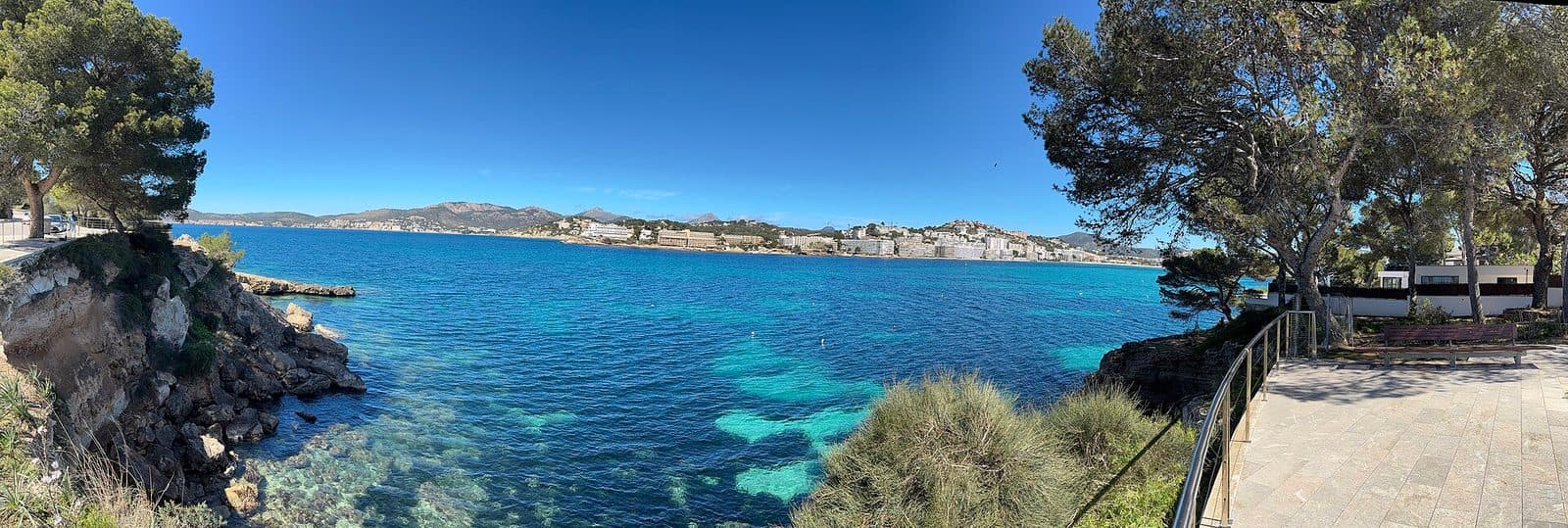
Santa Ponça is a coastal town in southwest Mallorca with far more breadth and everyday life than a first glance at its beach, hotels and promenade might suggest. The town belongs to the municipality of Calvià and is often known outside Mallorca by the Castilian spelling Santa Ponsa. Its centre lies on a broad bay; behind it, apartment complexes, villa neighbourhoods and streets lined with services extend across the hillsides.
Santa Ponça is particularly appealing to visitors seeking an uncomplicated beach holiday combined with restaurants, water sports and short distances. It is an established holiday and residential town that is easy to navigate for precisely this reason: the beach, promenade, excursion boats, restaurants and evening entertainment are all close together.
At the same time, Santa Ponça is not purely a seasonal resort. An international residential population that has grown over many years, businesses operating throughout the year and the fast road connection to Palma give the town a life of its own beyond the holiday months. Anyone looking for a home by the sea will find very different settings—from the lively surroundings of the main bay to quieter apartment and villa streets on the hillsides.
Santa Ponça openly displays its historical reference point in the townscape: this is where King Jaume I began the medieval conquest of Mallorca. A monument on the coast and the major September celebrations keep this event present to this day. The modern seaside resort thus combines a defining moment in the island’s history with a distinctly contemporary, international way of life.
History of Santa Ponça
The landing of Jaume I
Santa Ponça is associated with one of the most consequential events in Mallorcan history. In 1229, King Jaume I of Aragón landed on the coast with his troops. From here, he began the campaign against the Muslim rule then established on Mallorca. The conquest fundamentally changed the island’s political, religious and social structures and brought Mallorca into the dominion of the Crown of Aragón.
The landing is more visible in the town than many other historical events are in modern holiday resorts. The cross on the coast marks the place of remembrance, while the annual September celebrations recreate the events with boats, costumes and a staged confrontation between the Christian troops and the Moors. Here, history does not appear only on a plaque but is publicly presented as part of local identity.
The monument year 1929
To mark the seven-hundredth anniversary of the conquest, the monument crowned by a cross was erected in 1929. Its creation shows how strongly the landing of Jaume I was already regarded as a historical reference point before the town’s development for tourism. The monument gave the event a permanent place on the coast and continues to shape perceptions of the harbour and bay area. Santa Ponça’s historical value therefore lies both in the site itself and in the event’s significance for the entire island.
From coastal area to holiday and residential town
The townscape seen today was shaped primarily by tourism. Santa Ponça has been one of the best-known holiday resorts in the southwest for decades and has attracted particularly large numbers of visitors from Great Britain and Germany. Hotels, apartment complexes, restaurants and leisure businesses were built along the bay, while villas and additional residential developments appeared on the hillsides. Instead of a continuous wall of high-rise buildings, much of the town is characterised by staggered buildings, apartments and houses.
At the same time, the holiday resort developed into an international residential location. Estate agencies, construction and renovation companies, beauty salons and hairdressers, as well as restaurants operating throughout the year, point to a population that does not live here only during the holiday weeks. This dual character—a seaside resort with heavy seasonal visitor numbers and a permanently inhabited coastal community—describes Santa Ponça today more accurately than simply calling it a holiday centre.
Sights in Santa Ponça
Creu de la Conquesta
The Creu de la Conquesta, the Cross of the Conquest, is the town’s most important historical landmark. Erected in 1929, the monument commemorates the landing of Jaume I and stands on the coast near the harbour entrance. Its impact comes less from elaborate architecture than from the interplay between the monument, the sea and the historical setting.
A visit is particularly worthwhile as a peaceful counterpoint to the busy main bay. From here, it is easier to understand why the shape of Santa Ponça’s coastline is so important to the memory of the landing. The cross is also a useful starting point for a walk by the water and reveals more about the town than a tour of the modern shopping streets alone.
Playa de Santa Ponça
The large sandy beach forms the geographical and social centre of Santa Ponça. It lies on a bay and is bordered by a promenade, restaurants and the dense development of the holiday resort. Unlike small natural coves, this beach is designed for a full day by the sea: distances between accommodation, food, the beach and leisure activities remain short.
It is not only the sand itself that is worth seeing, but also the shape of the bay. From the shore, the view opens towards the sea between the developed sides of the coast, while the surrounding hillsides show how far Santa Ponça extends beyond its beachfront centre. This is the liveliest part of town during the peak season; outside bathing hours, the beachfront becomes a spacious area for walking.
Seafront promenade and bay
The promenade is the best route for gaining an initial impression of Santa Ponça. The main bay lies on one side, while restaurants, cafés, bars and entrances to the streets behind it line the other. A walk here quickly reveals that Santa Ponça consists of several tourist and residential areas arranged around the water.
Earlier in the day, the promenade functions more as a route to the beach and boat excursions, while life shifts towards the restaurants in the evening. Anyone wishing to discover more than Santa Ponça’s seaside attractions should therefore walk both by the water and along some of the streets behind the front row. There, the transition from holiday resort to everyday service centre becomes clearer.
Harbour entrance of Santa Ponça
The harbour entrance is historically and scenically significant because the Cross of the Conquest and the memory of Jaume I’s landing are concentrated here. Boats, rocky stretches of coastline and the entrance to the bay give this part of Santa Ponça a different character from the broad main beach.
For a walk through town, the harbour area is particularly valuable because it offers a change of perspective. Instead of looking directly towards hotels and beach activity, the coastline takes centre stage. The route is suitable for visitors who would like to see a specific historical landmark after the beach without planning an extensive museum visit.
Sights in Santa Ponça
The weekly market
Mercadillo de Santa Ponsa
Santa Ponça’s weekly market takes place around Avinguda de s’Hort and is one of the smaller markets in the southwest. Its advantage lies precisely in its manageable size and proximity to the beach, residential areas and the town’s main access roads.
The stalls offer fresh fruit and vegetables, baked goods, olives, cheese, cured meats and Mallorcan olive oil. There are also flowers and plants, spices, nuts, clothing, shoes, leather goods, handicrafts and cosmetic products. The selection therefore combines everyday food with typical market and holiday merchandise. This is not purely a farmers’ market but a mixed weekly market with a clear role in supplying local needs.
The market can be explored in a relatively short time. Less than half an hour is enough for a simple walk around; anyone selecting food or planning to stop somewhere nearby afterwards should allow correspondingly longer. Its compact layout is particularly pleasant for visitors who want to experience a market atmosphere without devoting an entire excursion day to it.
The Mercadillo is also practical for residents because of its location in an easily accessible part of the modern town. The immediately adjoining streets become busier on market days, so arriving early can make it easier to find parking. Afterwards, a market visit can be combined with the main bay or a walk to the promenade without a detour.
Food and drink
Restaurants around the main bay
The densest concentration of restaurants is found around the large beach and promenade. Here, the dining scene is aimed primarily at beachgoers, families and travellers who want to move between the beach and a meal without covering long distances. The range is international and reflects the town’s long-standing British, German and wider foreign presence. Santa Ponça is therefore not a destination where Mallorcan cuisine alone defines the streetscape.
The location of the restaurants has a clear influence on their atmosphere. Directly on the promenade, sea views, outdoor seating and lively daytime activity take centre stage. A few streets farther back, the surroundings are less beach-oriented and more strongly shaped by regular customers, residents and returning visitors. Choosing where to eat therefore depends not only on the menu but also on whether the aim is a quick beach snack, a quieter dinner or a long evening in lively surroundings.
Mallorcan products
Those looking for regional connections will find them in Santa Ponça more through individual products and dishes than through an established tradition of historic taverns. Olives, olive oil, cheese, cured meats, baked goods, nuts and seasonal fruit and vegetables appear both at the market and in everyday shops. The weekly market is therefore a good place to broaden the culinary perspective beyond the tourist restaurant strip.
In culinary terms, Santa Ponça should not be confused with an old wine or market town. Its strength lies in its broad selection and its ability to accommodate different eating habits within a compact coastal town. For residents, this means a wider dining base than is usual in smaller seasonal coves.
Restaurants in the residential and commercial centre
The clientele changes behind the first row of beachfront businesses. Establishments there do not depend solely on passing beachgoers but also cater to residents, workers and international long-term guests. This second layer of Santa Ponça’s dining scene is important for understanding the town, as it consists of more than hotel restaurants and waterfront terraces.
Several establishments remain open outside the peak season as well. This is connected to the established international residential population and ensures that Santa Ponça does not fall completely dormant in winter. The selection becomes smaller and the pace quieter, but food and social meeting places remain part of local life.
Bars and nightlife
Bars, nightclubs and discos are a visible part of Santa Ponça’s attractions. Evening life caters to an international clientele and is significantly more pronounced during the warmer months. Anyone looking for quiet accommodation or a peaceful residential setting should therefore consider the distance from areas with concentrated evening entertainment just as carefully as sea views or proximity to the beach.
Nightlife is not spread evenly across the entire town. A distance of only a few streets can make a considerable difference in character. The main bay and adjoining commercial areas are livelier in the evening, while hillside locations and villa-lined streets are more residential. For visitors, this spatial separation makes it possible to combine the beach, dinner and entertainment without every part of Santa Ponça having the same intensity.
Eating, drinking and staying in Santa Ponça
The best-rated businesses from our directory, ordered by Google rating — not by advertising.
Restaurants
- Estrella de Mar5.0· 40 reviews
- Simars Spice village Indian Tandoori Restaurante & bar5.0· 28 reviews
- Mestizä Chiringo & Cocktail Bar - Tapas & Burger4.9· 661 reviews
- Restaurante BUEN NORTE4.9· 653 reviews
- Adelfas by Jens4.9· 433 reviews
- BURGER CLUB by Il Vivo4.9· 220 reviews
- Cafè des Teix4.9· 188 reviews
- Donde el Paisi Santa Ponsa4.9· 101 reviews
- Bar Rumba4.9· 82 reviews
- Parrilla rey jaime4.9· 30 reviews
- Bistro Mallorca Country Club4.9· 13 reviews
- Donna Vegana4.8· 889 reviews
Cafés and bakeries
- Great Gourmet4.9· 168 reviews
- Penny's tearoom4.9· 34 reviews
- Baguette sandwich shop4.8· 92 reviews
- Gelato & Coffee4.7· 303 reviews
- Maggiolini Gelateria4.7· 87 reviews
- Gelateria Capri Santa Ponça4.7· 54 reviews
- PARadise Cafe4.6· 15 reviews
- Churchills Kandys Cafe Bar4.5· 113 reviews
- Café Mozart - Santa Ponsa4.4· 1010 reviews
- Cafetería Nepenta4.4· 435 reviews
- Cafeteria Puig Major, 174.4· 294 reviews
- Lora Lora4.4· 218 reviews
Bars
- SAMO COCKTAIL BAR5.0· 188 reviews
- Le Gourmand4.9· 710 reviews
- Waina4.9· 367 reviews
- Cafeteria Santa Ponsa4.9· 16 reviews
- The New Acorn4.8· 60 reviews
- Bar la pecherie4.7· 25 reviews
- La Tasca Café4.5· 214 reviews
- Bar Zurich4.5· 28 reviews
- Splash Santa Ponça4.4· 429 reviews
- Boulevard 1174.4· 49 reviews
- Alma Beach & Cocktail Bar - SteakHouse - Thin & Crispy Pizza4.3· 3139 reviews
- Henry‘s Foodclub4.3· 1038 reviews
Hotels and fincas
- Kimpton Aysla Mallorca4.7· 394 reviews
- H10 Casa del Mar4.5· 3070 reviews
- Sentido Fido Punta del Mar Hotel & Spa4.5· 1480 reviews
- Los Pampanos4.5· 30 reviews
- FERGUS Style Cala Blanca Suites4.4· 1749 reviews
- Reverence Life4.4· 1052 reviews
- Pirates Village4.4· 846 reviews
- Hotel Casablanca4.4· 443 reviews
- 4U Miranda Hotel4.4· 216 reviews
- Zafiro Rey Don Jaime4.3· 1714 reviews
- Jutlandia Family Resort4.3· 663 reviews
- Hotel Plaza Santa Ponça4.2· 568 reviews
Activities and excursions
Swimming at the main bay
Playa de Santa Ponça is the obvious choice for a classic beach day. Its location and proximity to restaurants and accommodation make it particularly practical for families and travellers who are not looking for a remote cove. The beach is an organised holiday environment rather than a secluded natural setting, so it can become correspondingly lively during the peak season.
For a short stay, swimming can be combined with a walk along the promenade and a visit to the Cross of the Conquest. Those staying longer can also enjoy the dining and social life around the bay.
Water sports in the bay
Santa Ponça is one of the southwest’s coastal towns with a broad selection of water sports. These include water skiing and parasailing. Boat trips within and beyond the bay are also available. The advantage is the direct connection to the holiday centre: many activities do not require a long journey to another harbour.
The activities appeal both to active holidaymakers and to visitors who prefer to view the coast from a boat. Before taking part, the weather, sea conditions and the respective operator’s terms should be checked. For popular summer activities in particular, it is also advisable to confirm the exact meeting point and return location, as not every excursion uses the same stretch of coastline.
Boat trips along the southwest coast
Trips depart from Santa Ponça and neighbouring coastal towns for coves, rocky coastlines and caves, as well as dolphin-watching tours. These excursions reveal a part of the southwest that is barely visible from roads and promenades. The wooded and rocky stretches of coast look distinctly different from the water than the developed main bays.
When making a selection, it is worth checking the actual departure point. Some excursions advertised as Santa Ponça trips begin in a neighbouring town or collect guests at several stops. For planning the day, the duration of the trip, shaded areas and suitability for small children are also more important than the most extensive possible itinerary.
Golf courses of Santa Ponça
Golf is an established part of the town’s leisure profile. The golf courses near Santa Ponça appeal to holidaymakers as well as residents of the southwest and help ensure that the town does not depend exclusively on beach activity.
Costa de la Calma and Peguera
Santa Ponça is a good starting point for discovering other coastal towns in western Calvià. Costa de la Calma and Peguera are nearby. Comparing these places reveals how differently the southwest coast has developed despite the short distances between them.
Combining them within a single holiday day is particularly worthwhile when swimming is not the only aim. Santa Ponça provides the large bay and historical connection to Jaume I, while the neighbouring towns offer a different perspective and coastal character. A car provides greater flexibility, but the towns are also integrated into the regional bus network.
Beaches in Santa Ponça
5 beaches and coves with their own page belong to Santa Ponça.
Festivals and events
September celebrations
Santa Ponça’s most important recurring festival commemorates the landing of King Jaume I in September. The September celebrations combine a historical focus with an extensive public programme. During this period, the town is not merely a backdrop for entertainment but visibly engages with the event that established its place in the island’s history.
One of the most distinctive parts of the programme is the re-enacted arrival of the king and his Christian fighters by boat. Groups in historical costumes then take part in a staged battle with the Moors on the beach. The performance is not a quiet commemoration but a major public spectacle incorporating the main bay and promenade.
Nit de Foc
The Nit de Foc is one of the loudest and most impressive parts of the festivities. Participants dressed as demons move through the promenade area with fire and firecrackers. The experience is shaped by proximity, noise, sparks and movement and is very different from an ordinary fireworks display viewed from a greater distance.
Families with small children, noise-sensitive people and visitors who wish to avoid flying sparks are advised to watch from a distance. Anyone who wants to stand in the middle of the action should avoid delicate clothing and follow the organisers’ instructions. The event demonstrates particularly clearly that, despite its international holiday clientele, Santa Ponça participates in a Mallorcan festival tradition.
Concerts, market and fireworks
The festival programme also includes concerts, sporting events, a medieval-themed market and other activities over several days. A fireworks display over the bay traditionally provides one of the concluding highlights. The exact programme may change from year to year and should be checked for the relevant visit.
The way the centre is used changes during the festival days. The promenade, beach area and access roads become busier, and events may override the usual daily routine. For visitors, this is an especially lively time to travel; residents and travellers seeking peace and quiet should choose the location and timing of their accommodation accordingly.
Upcoming dates
Getting there and getting around
By car from Palma
Santa Ponça is directly connected to Palma and the southwest by the Ma-1 motorway. From the island capital, the route leads towards Calvià and onward to the coast without a complicated journey across the island’s interior. More time should be allowed during periods of heavy excursion and commuter traffic.
The approach initially leads into a modern town characterised by roundabouts and wider streets. This makes general orientation easier, but the beachfront centre, market area and residential hillsides are not located on the same road. Before setting off, it is therefore worth distinguishing between the main beach, harbour, accommodation and residential address instead of entering only Santa Ponça as a general destination.
Parking in town
Parking is available along the street network and in areas behind the promenade, although demand varies considerably by season. Pressure around the beach and centre increases during the peak season, on market days and during the September festivals. Visitors coming only for a walk can avoid unnecessary circuits by not trying to park directly in the front row by the water.
The market occupies its event area and temporarily changes the usual parking situation there. Larger festival events may also affect access roads or central spaces. Arriving early or choosing a parking space within a short walk of the promenade is therefore recommended for a relaxed visit.
By bus
Santa Ponça can be reached by bus from Palma and other places in the municipality of Calvià. Services from Palma begin at the central Estació Intermodal transport hub, making it possible to organise a journey from other parts of the island with a transfer. Bus options are also available for travellers from the airport, although a transfer may be required depending on the connection.
Within Santa Ponça, the location of the appropriate stop is important. The town extends from the main bay through commercial streets to western and elevated residential areas. A stop at the beach is therefore not automatically the best choice for a villa on the hillside or the harbour area. Current route and stop information displayed on the page helps identify the correct option.
Rail and walking routes
For excursions to other regions of Mallorca, the same hub can serve as a transfer point. However, having a car remains more practical when several scattered destinations along the southwest coast are to be visited in one day.
The beachfront centre is easy to explore on foot. No complicated transfers are required between the main beach, promenade, restaurants and central shopping streets. The situation is different for hillside locations, golf courses and more widely separated residential areas. Depending on the destination, the inclines and size of the town make a bus, taxi, bicycle or car significantly more practical there.
Bus lines to Santa Ponça at a glance
| Line | Route | Departures/day | First | Last |
|---|---|---|---|---|
| 123 | Santa Ponça - Cas Català | 108 | 00:11 | 23:41 |
| 106 | El Toro - Palma | 71 | 06:21 | 22:52 |
From the official GTFS feeds (TIB/SFM), no real-time data. The figures cover all stops in the town; weekend and holiday services differ — check with the operator before travelling.
Getting there by bus
Caló d'en Pellicer 2 (11085) · 0.1 km as the crow flies
- 123Santa Ponça - Cas Català · Daily
Caló d'en Pellicer 1 (11086) · 0.1 km as the crow flies
- 106El Toro - Palma · Daily
- 123Santa Ponça - Cas Català · Daily
Av. Santa Ponça - Gran Via del Port (11181) · 0.3 km as the crow flies
- 106El Toro - Palma · Daily
Santa Ponça oest 1 (11147) · 0.3 km as the crow flies
- 106El Toro - Palma · Daily
- 123Santa Ponça - Cas Català · Daily
Timetable data: official GTFS feeds (TIB/EMT), no real-time — check with the operator before travelling.
Living in Santa Ponça
Everyday life between holiday resort and residential community
Santa Ponça has two clearly recognisable faces. Around the beach and promenade, hotels, restaurants, bars and leisure activities shape the daily rhythm. Behind this first row are residential complexes, villa streets, estate agencies, hairdressers and construction and renovation businesses. This mix of industries shows that the town is permanently inhabited and continuously developed.
The distinction between locations is crucial for everyday life. In the immediate beachfront centre, restaurants and buses are only a short distance away, but there is also more activity in summer and entertainment in the evening. Residential streets higher up or farther from the centre feel more secluded but more often require a vehicle or careful selection of the nearest bus stop. Sea views and tranquillity can therefore come with longer everyday journeys.
International population
Santa Ponça has attracted British and German visitors for many years. A sizeable international residential and expatriate community has developed in the town. This is reflected in the restaurants, services and property market. New arrivals therefore encounter a place where foreign residents are not a marginal phenomenon.
However, the international character does not replace the Mallorcan setting. Santa Ponça belongs to Calvià, participates in municipality-wide structures and hosts the September celebrations, which are closely connected to the island’s history. Local, Spanish-speaking, Catalan-speaking and international ways of life intersect more strongly in everyday life than they would in an isolated holiday complex.
Winter in Santa Ponça
After the peak season, the bay becomes quieter, and some tourist businesses reduce their activity or close temporarily. Nevertheless, Santa Ponça does not go completely into hibernation. The international residential population helps several bars and restaurants operate throughout the year. Estate agencies, construction, renovation and personal services are also not aimed exclusively at summer visitors.
Winter is therefore a good time to assess the town’s residential character. Traffic, beach life and nightlife recede, while distances, hillside locations and genuinely year-round commercial areas become more apparent. Anyone considering a move should not visit Santa Ponça only at the height of summer but should also experience it during a quieter season.
Commuting to Palma
The direct connection via the Ma-1 makes Santa Ponça a generally practical place to live for people who travel regularly to Palma. For a daily commute, however, rush-hour traffic, the exact location of the workplace in Palma and the route from the residential street to the motorway should be considered.
Commuting by bus is possible without a car. Homes within walking distance of a suitable stop and in the more central areas are especially convenient. From more remote hillside or villa locations, simply reaching the connection may add another stage to the journey to work. When choosing a home, the specific micro-location is therefore more important than the town name alone.
Living without a car
Many everyday needs can be handled on foot in the centre and near the main bay, especially when restaurants, the beach, market and bus stops are the main destinations. The regional bus network provides connections to Palma and neighbouring coastal towns. Everyday life without a private vehicle can therefore work for residents who are mainly employed in Santa Ponça or work from home.
It becomes less convenient when regular journeys are required to golf courses, scattered residential areas or several destinations outside Calvià. The town is extensive and rises from the bay into the hills. Before moving without a car, it is therefore important to check not only straight-line distances but the actual walking routes to bus stops, shops and the workplace.
Practical information for your visit
The best time of day
Morning is pleasant for the beach, promenade and Cross of the Conquest because the town feels easier to navigate and the different areas can be connected conveniently. Those primarily interested in restaurants, bars and the lively side of Santa Ponça will gain a fuller impression in the late afternoon and evening. A single short visit therefore always reveals only part of the town’s character.
Light footwear is sufficient for a simple walk around town; sturdy, comfortable shoes are more suitable than beachwear for routes over the hillsides.
Time required for a walk
At least half a day should be allowed for the main beach, promenade and Cross of the Conquest if a break is planned along the way. The weekly market itself can be explored in less than half an hour. Add time on the beach, lunch or a boat trip, and the walk can easily become a full-day visit.
The appeal of a visit comes from the coastal landscape, leisure activities, historical place of remembrance and atmosphere of a large holiday and residential town. Santa Ponça fits easily into an itinerary as a beach or coastal stop.
Market and festival days
On market days, the area around Avinguda de s’Hort is livelier and the usual parking situation changes. The market remains compact, making it easy to visit before going to the beach. For buying regional food, arriving earlier is preferable to visiting shortly before the stalls are dismantled.
Different conditions apply during the September celebrations. The beach and promenade become event spaces, noise and visitor numbers increase, and some routes may be temporarily redirected. This is the most interesting time to visit for the historical spectacle; an ordinary day is better suited to a quiet coastal walk.
Useful combinations
Within Santa Ponça, the market, main bay, promenade and Cross of the Conquest fit well into a shared day plan. A boat trip, by contrast, should be treated as a separate activity because its meeting point and duration determine the day’s rhythm.
Costa de la Calma or Peguera are also suitable follow-on destinations for a day along the coast. Palma can also be combined with Santa Ponça because of the direct road and bus connections, but enough dedicated time should be reserved for the island capital. Santa Ponça is particularly suitable as a base for the southwest and less so as a brief stop on a tightly scheduled tour of the entire island.
Local businesses and services
The best-covered sectors in our directory for Santa Ponça — each with address, contact details and opening hours.
- Restaurant / Gastronomy88 listings
- Real Estate Agency61 listings
- Hotel / Accommodation28 listings
- Construction & Renovation28 listings
- Hairdresser / Beauty28 listings
- Bar, Nightclub & Disco24 listings
Run a business here? Add it to the directory for free and be found on this page. Add your business
Latest news from Calvià
- Palma transport push: plan sought with three neighbours
- Mallorca drive-in cinema brings four films to Port Adriano
- 27 Mallorca towns lack Alcover and La Balanguera
- Calvià labour dispute looms after two-year pay row