
Can Vivot: Palma's Lived-In Noble Palace
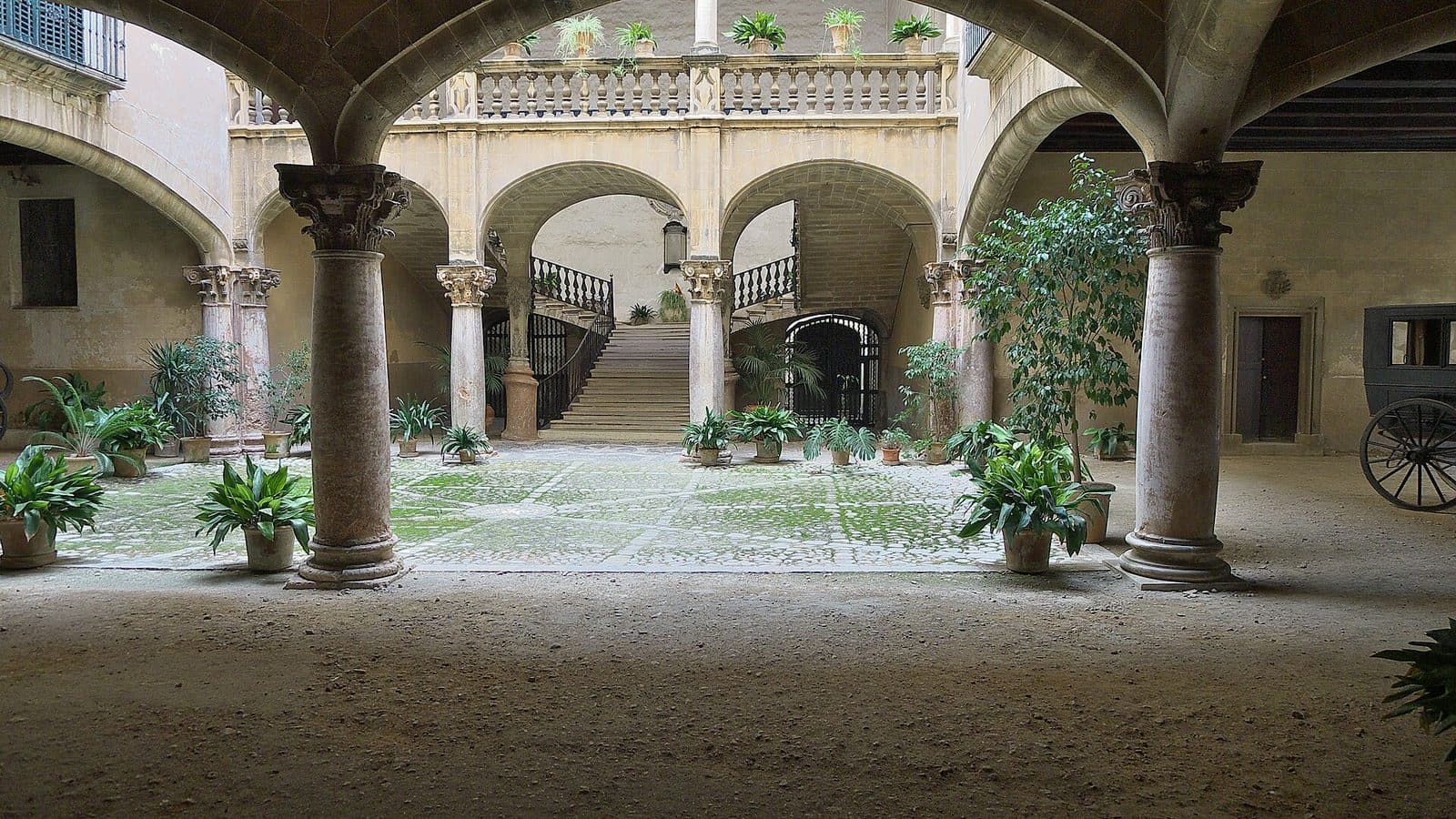
._Patio.jpg)
Behind a wrought-iron gate in Palma's narrow Old Town lanes stands a house that escapes the hurried glance. Can Vivot is neither an emptied architectural monument nor a museum furnished after the fact, but a noble palace that remains inhabited to this day. Furniture, paintings, frescoes, and books still belong to the rooms for which they were once intended. This is precisely what makes a visit so appealing: history is not divided among individual display cases but appears as a coherent setting—in the Baroque courtyard, on the worn steps of the grand staircase, in the library, and in the formal halls. Even a preserved section of a medieval lane forms part of the building.
Can Vivot is especially rewarding for visitors who want to experience Palma's Old Town as more than a backdrop. Architecture enthusiasts can trace building phases from the Middle Ages to the modern era, while art lovers can see historic furnishings in their original setting. Those expecting a large exhibition venue will instead encounter something more intimate: a private home whose owning family has preserved its history over generations.
The palace stands near the church of Santa Eulàlia in Palma's historic center. From the outside, its importance can only be guessed at. Only beyond the gate does the sequence of courtyard, staircase, and living rooms unfold—the feature that makes Can Vivot exceptional among Mallorca's surviving urban palaces.
History and Significance
Medieval Origins
The oldest documented parts of Can Vivot date back to the 14th century. Architectural elements from this early period survive on the façade facing Carrer de Can Savellà and throughout extensive parts of the ground floor. The present palace, however, was not built as a single unified structure but developed through the connection, expansion, and alteration of several neighboring houses over the centuries.
Since the 15th century, the property has been inherited within the family. This unusually long continuity explains why not only the walls and sequence of rooms but also large parts of the historic furnishings have survived. Unlike many former noble residences, Can Vivot was neither completely repurposed nor stripped out for use as a modern museum; parts of the palace still serve as a private residence.
Margalida and the Revolt of the Germanies
One of the most striking episodes begins with two houses in the same block: the Reconada d’en Berard and the Alberg d’en Clapés. Through marriage and inheritance, they came into the possession of Margalida Barthomeu i Valentí, who belonged to one of Mallorca's wealthiest families. Her life story is closely connected with the creation of the later palace.
During the Revolt of the Germanies from 1521 to 1523, the property was looted. Margalida's second husband, Romeu Desclapés i Fuster, sought refuge in the cathedral; Margalida herself escaped disguised as a man and hid in a place on the island. After the revolt ended, Romeu died of the plague. The two sons who initially inherited the property also died while still children, so ownership reverted to Margalida once again.
Following the destruction, the property was remodeled in 1523. Margalida later passed it on to her grandson Gregori de Villalonga i Desclapés, and the combined house subsequently became known as Can Villalonga Gran. The episode shows that Can Vivot's size did not arise solely from a desire for grandeur: inheritances, family ties, and political upheavals shaped the building just as profoundly.
The Baroque Obra Nova
Can Vivot acquired the form that still defines it today during the major renovation carried out between 1683 and 1711. Around 1700, Don Joan initiated the Baroque transformation known as the Obra Nova. The complex of houses that had grown over centuries became a prestigious urban palace with an ordered courtyard, monumental staircase, and sequence of rooms used for social occasions.
What is remarkable is not only the condition of the building but also the unity of its architecture and furnishings. Since this transformation, the ensemble, including its historic interior, has remained largely intact. When Erzherzog Ludwig Salvator von Österreich described the courtyard around 1872, he ranked it among Palma's most beautiful. His judgment reflects a long local tradition: in Palma, the patios of noble houses were not merely passageways but visible expressions of status, taste, and hospitality.
In 1973, Can Vivot was declared a historic-artistic monument; it later received protected status as a Bien de Interés Cultural. Today, a nonprofit association manages, preserves, and presents both its tangible and intangible heritage. At the same time, the palace remains a family home—a tension that creates its distinctive atmosphere.
What to See
The Gate and Baroque Courtyard
The transition from the narrow Old Town lane into the courtyard is one of the most memorable moments of the tour. Beyond the iron gate, the space opens beneath large sandstone arches. Carefully designed paving draws the eye toward the courtyard's architecture, while the pale stone surfaces and open arcades reveal its Baroque order.
Restored horse-drawn carriages stand in the courtyard. They are not invented decoration but belong to the house's documented way of life. Together with the surviving drinking trough and the area of the former mule stable, they recall that an urban palace was also a functioning household: people, animals, carriages, and goods all needed to arrive here long before anyone reached the formal rooms upstairs.
The patio's impact rests precisely on this interplay. It is simultaneously a circulation space, reception area, and architectural stage. Those who merely walk past closed doorways in Palma's lanes often see only a fragment of this culture; at Can Vivot, by contrast, the courtyard can be understood as the heart of a complete noble residence.
The Imperial Staircase
A grand staircase leads from the patio to the principal floor. Its steps bear visible traces of centuries of use. At the top, the staircase divides and reaches the landing by two approaches—the ceremonial form known as an imperial staircase. It stages the journey from the busy ground floor to the house's social rooms and is therefore more than an attractive photo opportunity.
The palace's social order can be read in the staircase: access, stables, and service areas were below, while the piano nobile above held the rooms used for receiving guests and displaying status. The scale of the staircase reveals that arrival and welcome formed part of a carefully designed ceremony.
The Medieval Lane
Among the most unusual architectural remains is a section of a medieval lane preserved inside the complex. It recalls that Can Vivot developed through the connection of several houses. Where a single coherent palace appears today, part of the city's street network originally ran through the site.
This detail makes the building's history immediately understandable: older walls were not entirely removed during later alterations but were incorporated into the growing property. Medieval urban structure and Baroque palace architecture therefore do not stand separately side by side but literally overlap and interlock.
Chapel and Reception Rooms
On the way to the formal rooms, the tour passes the private chapel. Beyond it lie the spaces where the house's social life unfolded. Doors, wall surfaces, furniture, and paintings do not form a stylistic display assembled later but belong to a historically evolved residential setting.
Frescoes and paintings define several interiors. They are joined by original furniture that has remained in place for generations. This fixed setting changes how each object is perceived: a chair, cabinet, or painting is not presented as an isolated collectible but as part of a room where people received guests, read, prayed, and lived.
The palace combines architectural traces dating from the 14th century onward, with the medieval fabric and Baroque transformation standing out most clearly. The various periods have not been smoothed into an artificially uniform style; instead, they show how a large urban residence adapted over time to the needs and expectations of its occupants.
The Library
The library is one of Can Vivot's defining rooms. Historic books remain here among the original furnishings, giving the space a different tone from the grand reception rooms. While the courtyard and staircase feel public, the library offers a closer glimpse of the residents' daily lives and intellectual world.
Its value lies less in any single spectacular object than in the preserved whole. Books, furniture, paintings, and architecture can be viewed together. Can Vivot thus conveys something difficult to recreate in newly arranged museums: the sense that the house cannot be divided into exhibits without losing part of its meaning.
Visiting Can Vivot
A Private House Opens Its Doors
The tour does not begin like a conventional museum visit, with a large entrance hall and freely selectable sections. Can Vivot is a private palace that remains inhabited. Visits are organized and must be arranged in advance or booked for a specific time slot. Before visiting, it is therefore advisable to check current access options directly with the house.
Opening hours and admission details are not recorded in a permanently consistent form. Specific times or prices should therefore not be taken from older travel reports. A confirmed reservation is what matters: it prevents visitors from arriving at a locked gate while also respecting the private character and conservation requirements of the house.
Guided Tour
Guided tours offer the most informative way to visit. According to published information, some are led by members of the owning family who are trained historians. This brings together family tradition, architectural history, and detailed knowledge of the furnishings. Audio guides are also offered for a more independent exploration; the format available on the desired date should be confirmed when booking.
The typical route follows the house's historic progression: from the gate into the patio, past the carriages and former service areas, then up the grand staircase to the principal floor. There, the chapel, reception rooms, frescoes, paintings, furniture, and library take center stage. Because the building itself is the most important exhibit, it is worth looking slowly at transitions, doorframes, floor surfaces, and traces of earlier construction phases.
Time Required and Visitor Levels
It is not useful to give a fixed visit duration without knowing the tour currently booked. The guide, language, group size, and accessible rooms determine the schedule. Can Vivot should therefore not be treated as a quick look into a publicly accessible patio. The explanations are an essential part of the experience and make many inconspicuous details understandable.
Because visits are by appointment, access is distributed differently than at freely accessible attractions. There is therefore no universally quiet time slot; the confirmed appointment is what matters. Visitors who arrive in the Old Town in good time can locate the entrance without rushing through narrow lanes in search of an unfamiliar house number.
Inside, conditions are those of a historic house. According to the available description, Can Vivot has no modern heating; during cooler months, the rooms may feel noticeably colder than the street. In summer, by contrast, the courtyard and massive walls create a different atmosphere from the sunlit squares of the Old Town.
Getting There and Parking
From the Airport to Palma
From Palma airport, the route follows the Ma-19 to Palma. This journey covers 11 road kilometers and takes around 20 minutes. These figures expressly apply only as far as Palma, not directly to the gate of Can Vivot. Traffic on the Ma-19, along the Avenidas, and in the center can affect the rest of the journey.
The final section enters the fine-grained street network of the Old Town near Santa Eulàlia. Narrow lanes, one-way systems, and access restrictions matter more there than the distance itself. Can Vivot should therefore not be regarded as a destination that can conveniently be reached directly by car. It is more practical to leave the vehicle outside the historic core and walk to the palace.
Parking on the Edge of the Old Town
A central parking garage is an option for the shortest possible walk. The garage at Plaça Major is conveniently located for the Old Town but is often busy from midday onward; driving across the center to reach it can also be slow. The garage at Parc de la Mar is useful when combining the visit with the cathedral and the southern Old Town, but it too often fills up from midday onward.
Those wishing to avoid dense city-center traffic can use a parking garage along the Avenidas or one of Palma's park-and-ride options, then continue by public transport or on foot. This extends the journey but avoids searching for a parking space in the narrow streets around Santa Eulàlia. Pay particular attention to yellow markings and restricted access; some Old Town streets may be used only by authorized vehicles.
On Foot and by Bus
Can Vivot lies in a part of Palma best explored on foot. The final lanes are narrow, and the understated façade can easily be overlooked among the rows of houses. The area around the church of Santa Eulàlia serves as a useful landmark; from there, continue into Carrer de Can Savellà.
Several bus stops lie on the edge of this part of the Old Town, including those at Plaça d’en Coll, Plaça de Cort, Plaça de sa Quartera, and Plaça del Mercat. From each, the route continues on foot through the historic center. The best connection depends on the starting point and current timetable; in every case, the final approach to the palace remains a short walk through the Old Town.
Bus lines to Can Vivot at a glance
| Line | Route | Departures/day | First | Last |
|---|---|---|---|---|
| 1 | Portopí - Sindicat | 6 | 07:15 | 09:15 |
| 3 | Pont d'Inca / Joan Carles I | 6 | 07:37 | 09:46 |
| 8 | Son Roca - Sindicat | 6 | 07:24 | 09:50 |
| 31 | Sant Jordi - Sindicat | 6 | 07:25 | 09:25 |
| 46 | la Bonanova - Gènova - Sindicat (dreta) | 6 | 07:20 | 09:15 |
| 47 | Gènova - la Bonanova - Sindicat (esquerra) | 6 | 07:30 | 08:53 |
| 6 | Son Espases - Sindicat | 2 | 08:11 | 08:50 |
| 20 | Portopí - Son Espases | 2 | 07:17 | 07:19 |
From the official GTFS feeds (TIB/SFM), no real-time data. The figures cover all stops in the town; weekend and holiday services differ — check with the operator before travelling.
Getting there by bus
663-pl. d'en Coll · 0.1 km as the crow flies
- CCCircular Centre Ciutat · 08:00–08:00 · Daily
662-pl. de Cort · 0.2 km as the crow flies
- CCCircular Centre Ciutat · 08:00–08:00 · Daily
664-pl. de sa Quartera · 0.2 km as the crow flies
- CCCircular Centre Ciutat · 08:00–08:00 · Daily
106-pl. del Mercat · 0.3 km as the crow flies
- 3Pont d'Inca / Joan Carles I · 08:00–08:00 · Daily
- 4Ses Illetes - Pl. Columnes · 08:00–08:00 · Daily
- 7Son Gotleu - Son Serra - Sa Vileta / Son Vida · 08:00–08:00 · Daily
- 20Portopí - Son Espases · 06:06–22:40 · Daily
52-pl. del Mercat · 0.3 km as the crow flies
- 4Ses Illetes - Pl. Columnes · 08:00–08:00 · Daily
- 7Son Gotleu - Son Serra - Sa Vileta / Son Vida · 08:00–08:00 · Daily
- 20Portopí - Son Espases · 06:06–22:40 · Daily
- 35Aquàrium - Pl. Reina | Catedral · 06:21–22:41 · Daily
983-Jutjats Nous · 0.3 km as the crow flies
- CCCircular Centre Ciutat · 08:00–08:00 · Daily
1-Sindicat - Àrea d'intercanvi Sindicat · 0.4 km as the crow flies
- 46la Bonanova - Gènova - Sindicat (dreta) · 08:00–08:00 · Daily
- 47Gènova - la Bonanova - Sindicat (esquerra) · 08:00–08:00 · Daily
6-Sindicat - Àrea d'intercanvi Sindicat · 0.4 km as the crow flies
- 1Portopí - Sindicat · 08:00–08:00 · Daily
457-Escola Graduada · 0.4 km as the crow flies
- 31Sant Jordi - Sindicat · 08:00–08:00 · Daily
- N1Portopí - Porta des Camp · 08:00–08:00 · Daily
1377-Sindicat Àrea Sindicat · 0.4 km as the crow flies
- 31Sant Jordi - Sindicat · 08:00–08:00 · Daily
360-Sindicat - Àrea d'intercanvi Sindicat · 0.4 km as the crow flies
- 6Son Espases - Sindicat · 08:00–08:00 · Daily
- 8Son Roca - Sindicat · 08:00–08:00 · Daily
105-pl. de Joan Carles I - Catedral · 0.5 km as the crow flies
- 3Pont d'Inca / Joan Carles I · 08:00–08:00 · Daily
- 4Ses Illetes - Pl. Columnes · 08:00–08:00 · Daily
- 7Son Gotleu - Son Serra - Sa Vileta / Son Vida · 08:00–08:00 · Daily
- 20Portopí - Son Espases · 06:06–22:40 · Daily
Timetable data: official GTFS feeds (TIB/EMT), no real-time — check with the operator before travelling.
Nearby Attractions
Santa Eulàlia and Medieval Palma
The nearby church of Santa Eulàlia is the best geographical reference point for Can Vivot. Around it, Palma appears as a dense medieval urban fabric of lanes, small squares, courtyards, and tall house façades. A palace visit becomes more meaningful when there is time before or afterward to explore this urban setting: only outside does it become clear how unusually large an estate must have been to absorb several older houses and even a section of a lane.
Plaça de Cort and Plaça Major can also be included without a long detour. They reveal two other sides of the historic center—the formal civic square and the busier focal point of the upper Old Town. Can Vivot remains the quiet counterpoint behind a gate, its interior accessible only as part of an organized visit.
Cathedral and Almudaina
The cathedral La Seu and the royal palace Almudaina also stand in the historic center and can easily be combined on the same day. Thematically, they create a revealing contrast: ecclesiastical and royal power take center stage there, while Can Vivot reveals the world of a Mallorcan noble family.
Anyone combining these sites should treat Can Vivot as a fixed appointment and plan the rest of the itinerary around it. The cathedral and waterfront are visible from afar, whereas the noble palace's entrance is hidden within the network of lanes. The route between them passes through the part of Palma where public monuments and private urban palaces stood opposite one another for centuries.
Patios and an Old Town Walk
Palma's historic courtyards provide an appealing thematic framework for the visit. Many, however, can only be viewed through a gate or for a brief moment. Can Vivot goes far beyond this because the courtyard, staircase, upper floor, and furnishings are presented as a coherent ensemble.
A walk past other noble houses in the Old Town nevertheless helps place it in context. Recurring elements such as carriage entrances, stone arches, and staircases are easier to compare afterward. Can Vivot should not simply be treated as one stop among many: its significance lies precisely in the ability to cross the threshold from the publicly visible patio into the preserved living rooms.
The place it belongs to
Palma in the place guidePractical Visitor Information
Clothing and Routes Through the House
Comfortable, secure footwear is advisable for the Old Town lanes and historic staircase. The steps of the grand staircase have been used for centuries and show corresponding wear. Anyone sensitive to the cold should also remember that the interiors are not heated.
The tour passes through a protected private house with original furnishings. Large bags and unnecessary luggage suit neither the historic sequence of rooms nor a relaxed visit. Considerate behavior here is not merely museum etiquette: parts of the building are still used by the family.
Visiting with Children
Can Vivot can be especially engaging for children interested in old houses, carriages, and family stories. The patio, former stable areas, and account of Margalida's escape in men's clothing offer vivid points of entry that go beyond architectural style alone.
The visit is, however, a guided tour of historic interiors rather than an interactive museum. Original furniture, paintings, and books require attention and care. When booking, families should confirm the available tour language and whether the planned format suits the children's ages and attention spans.
What Can Vivot Is Not
Visitors should expect neither a freely accessible permanent exhibition nor a palace with every area open at all times. Can Vivot remains a residence, monument, and historic ensemble at once. The rooms shown depend on the organized visit and the requirements of the house.
The palace is also only partly understandable from the outside. Anyone arriving without a confirmed appointment may see little more than the gate and façade. Its real value lies beyond that threshold: in the combination of Baroque courtyard, medieval remains, staircase, chapel, library, and living rooms with their original furnishings. A planned visit is therefore not an optional extra but the key to understanding Can Vivot.
Local insider tips
Look for the Understated Gate
Can Vivot is hidden in a narrow Old Town lane behind a wrought-iron gate. Do not look only for a monumental façade: the defining sense of space begins only when passing from Carrer de Can Savellà into the patio.
Look for Traces of Daily Life in the Courtyard
The restored carriages are the first things to catch the eye among the sandstone arches and Baroque paving. Equally revealing are the drinking trough and former mule stable—evidence that the patio once served as both an entrance and a working area.
Discover the Old Lane
A preserved section of a medieval lane runs through the building complex. This easily overlooked detail explains better than any stylistic label how Can Vivot developed through the connection of several neighboring houses.
Take Your Time in the Library
The library's impact comes not from a single showpiece but from the relationship between books, furniture, paintings, and architecture. Here in particular, it becomes clear why Can Vivot is more than a collection of individual historic objects.
Combine It with Santa Eulàlia
The nearby church of Santa Eulàlia is useful both as a landmark and as a thematic introduction. The walk through the narrow lanes afterward reveals how deeply the large palace has grown into the medieval fabric of the Old Town.