
Can Ribes in Palma – Historic Palace in the Old Town
.jpg)
Can Ribes is one of those historic houses in Palma where the city’s history can be read not in one grand gesture, but in layers of traces. Also known as Can Ribes de Pina, this noble residence represents the world of Mallorcan urban palaces: prestigious homes that were used, altered and adapted to the tastes of each era over generations.
That is precisely where its appeal lies, because Can Ribes is not a monument announced by a silhouette visible from afar. The house reveals itself on the scale of the Old Town, between street frontages and neighboring façades. Anyone interested in historic architecture will discover an example of how affluent families in Palma made their social standing visible in the cityscape.
A visit is especially worthwhile for people who want to explore Palma’s Old Town beyond its major churches and squares. Can Ribes draws attention to the city’s secular architecture: a house that served simultaneously as a home, family seat and symbol of social status. Because several buildings and businesses with similar-sounding names can be found on Mallorca, searches should explicitly specify Can Ribes or Can Ribes de Pina in Palma when planning a visit.
The building can easily be included in a historical walking tour of the city. Current access arrangements should be checked in advance, as no regular opening hours or generally applicable admission conditions are recorded for Can Ribes.
History and Significance
Can Ribes is associated with the history of the Ribes de Pina family and an urban elite that helped shape Palma over centuries. Nobles and wealthy families had buildings known as casals constructed within the city: large residences whose architecture served not only everyday life but also expressed ancestry, influence and social continuity. This type of building had a particularly strong impact on the appearance of Palma’s prestigious districts between the 16th and the 18th century.
The Ribes de Pina Family
Can Ribes has been documented as the residence of the Ribes de Pina family. Such an urban palace was more than comfortable accommodation: as a family seat, it made social standing visible, while its architecture became a tangible family history. Alterations did not necessarily replace older sections completely; they were often extended, remodeled or adapted to a new taste.
Palma’s World of Casals
Can Ribes emerged in an urban setting where noble residences formed a distinct building type. These casals differed from castles and rural manor houses because their visual impact had to unfold within densely built streets.
Palma’s development as an important Mediterranean city provided the setting for this residential culture. Can Ribes is therefore interesting not only as a former family seat, but also because it helps explain how power and wealth were displayed in Palma beyond churches, city walls and public buildings.
A House Shaped by Several Eras
The documented classification identifies Gothic, Renaissance and Baroque influences. This sequence should not be understood as a neatly divided history of styles. Instead, it tells the story of a house that was expanded and altered over an extended period. What appeared practical or prestigious in one era could be supplemented later without all older structures disappearing.
It is precisely this architectural layering that makes Can Ribes historically significant. The building does not represent a single moment of construction, but the continual adaptation of a family seat. A residential house thus becomes a record of urban continuity: the family and its aspirations changed, and the architectural shell evolved with them.
What to See
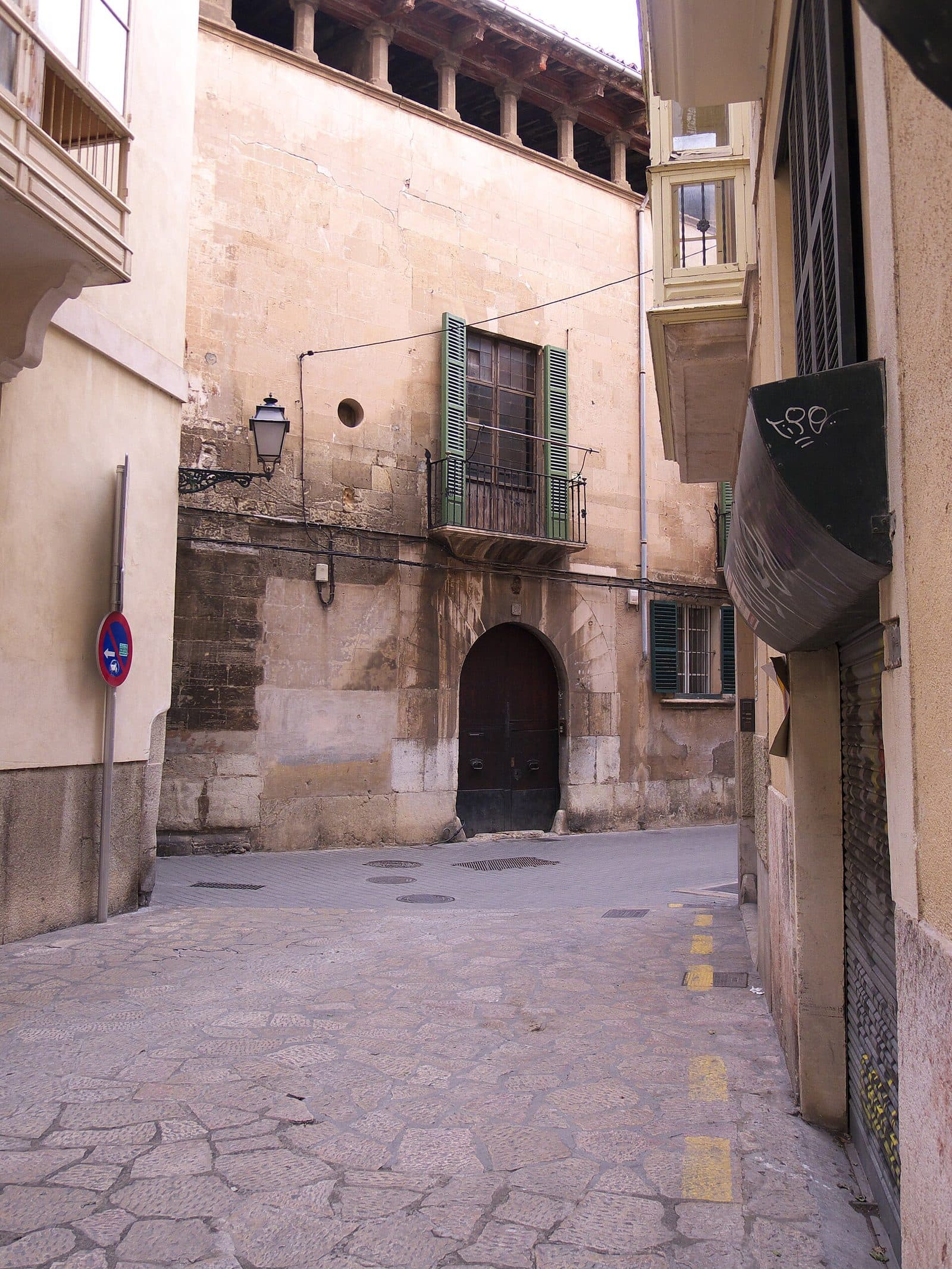
The first impression of Can Ribes is formed from the street. Unlike a church or fortress, this historic noble residence cannot be meaningfully appreciated from a great distance. Its architecture is designed to be viewed up close: the façade line, entrance and proportions only emerge when the eye stops sweeping across the city and focuses on the individual house.
The Façade
The exterior reveals the prestigious ambitions of an urban family residence. What matters is not ornamental richness alone, but the building’s order within the continuous development of the Old Town.
It is worth stepping back a little before approaching the building more closely. From a distance, its place within the row of façades becomes apparent, while the documented Gothic, Renaissance and Baroque influences point to several phases of development.
Gothic Traces
The Gothic elements refer to Palma’s older building tradition. At Can Ribes, they form a historical foundation beneath later alterations. The value of these traces therefore does not lie in the entire house appearing to be an unchanged Gothic building. What is more interesting is where older forms remain within an overall design that was subsequently remodeled.
This perspective requires some patience. Instead of searching for one spectacular feature, visitors should consider the relationship between the documented Gothic, Renaissance and Baroque influences.
Renaissance and Baroque
Renaissance and Baroque influences represent later phases in which ideas of prestige and display changed. Can Ribes combines them with Gothic influences.
These stylistic terms should not be understood as separate exhibition chapters. They appear within a house whose character emerged through change. This makes examining it more demanding, but also more rewarding: not every architectural element has to be assigned to a specific era to understand the essential message. The building shows that an important family residence in Palma was not a static monument, but responded over generations to new needs and aesthetic ideas.
The House as a Historical Whole
The strongest impression comes from the interaction between the layers. Gothic, Renaissance and Baroque influences do not stand side by side like objects in a display case; together, they form the building’s biography. Anyone who looks closely at Can Ribes will therefore see less of a “pure” style than a concentration of several chapters of the city’s history.
This interpretation also guards against false expectations. Can Ribes should not be confused with the former, similarly named industrial complex in another part of Palma, nor with a winery, finca or restaurant bearing the same name. The site in question is the historic noble residence Can Ribes de Pina. For finding the correct location, this precise name is more important than it is for many of the city’s better-known sights.
Visiting Can Ribes
Can Ribes is best suited to an exploration in which the walk through Palma is itself part of the experience. The house is not approached like an isolated excursion destination and then visited separately. It appears within the historic urban fabric, among streets, squares and other bourgeois and noble residences. Its significance is therefore particularly easy to understand when compared with its surroundings.
Arriving and Looking
When passing by for the first time, Can Ribes can easily be overshadowed by Palma’s better-known monuments. It is therefore worth making a deliberate stop in front of the building. First consider the entire street frontage: How does the house fit in with the neighboring buildings, which sections appear regular, and where can changes be recognized? Only then is it worth focusing on individual architectural details.
For viewing the exterior alone, Can Ribes is a compact stop. Those exploring Palma’s casals in greater depth and comparing the building with other historic residences can instead make it part of a longer Old Town walking tour. It is not useful to suggest a fixed visit duration because this depends largely on whether access to the building is possible and how closely its architecture is examined.
Check Access in Advance
No fixed opening hours are recorded for Can Ribes. There is likewise no generally applicable information about admission. Before making a dedicated journey, visitors should therefore check whether the building is currently accessible, whether only the exterior can be viewed, or whether visits are tied to special occasions or prior arrangements.
This is particularly important if Can Ribes is the main reason for the trip. Anyone incorporating the house into a wider walk through Palma can still view its historic façade as part of the cityscape without expecting a complete museum visit. Spontaneous visitors should assume neither that a ticket desk is continuously staffed nor that an exhibition is permanently accessible.
Time of Day and City Activity
There is no reliably documented “quietest hour” for Can Ribes.
Getting There and Parking
From Palma Airport, the drive initially follows the Ma-19 toward Palma. The city is 11 road kilometers away, and the journey takes around 20 minutes. These details explicitly apply only as far as Palma. Depending on traffic, the chosen parking facility and access to the Old Town, the final section to Can Ribes requires additional driving and walking time.
Driving to Palma
The Ma-19 is the direct connection from the airport toward the island’s capital. Navigation becomes more challenging within the city: Palma’s historic center has pedestrian areas, one-way streets and zones with restricted access. A navigation system that recognizes only the building’s name may also lead to a different place with the same name. The destination should therefore be checked as Can Ribes de Pina in Palma.
For visitors unfamiliar with the area, it is usually more pleasant to leave the car outside the narrow Old Town lanes or in a regular parking garage and complete the remaining journey on foot. Particular attention should be paid to access restrictions marked ACIRE. These zones do not operate like ordinary through roads and should not be entered without the appropriate authorization.
Parking and the Final Walk
The Old Town is not a district where visitors can reliably plan to find an available parking space directly outside a historic house. Public parking garages along the larger access routes eliminate the need to search through narrow streets. From there, the visit continues as a city walk, which suits the character of Can Ribes particularly well.
For roadside parking, markings and signs must be read carefully. Blue zones may require payment, while green-marked or otherwise designated areas may be reserved for residents. The rules posted at the specific parking space always apply. Anyone visiting Can Ribes together with other destinations in the center can also avoid repeated drives through the Old Town street network by parking once for a longer period.
By Bus
Several bus stops are located in the central area around the destination. These include stops at Plaça de Cort, Plaça d’en Coll, Plaça de sa Quartera and Plaça del Mercat. Which one is most practical depends on the route used and the access currently available to Can Ribes. The final section is completed on foot through the city center.
Traveling by public transport has a clear advantage here: it eliminates access restrictions and the search for parking. It also makes it easier to include the house in a walking tour that does not have to return to a parked car.
Bus lines to Can Ribes at a glance
| Line | Route | Departures/day | First | Last |
|---|---|---|---|---|
| 1 | Portopí - Sindicat | 6 | 07:15 | 09:15 |
| 3 | Pont d'Inca / Joan Carles I | 6 | 07:37 | 09:46 |
| 25 | s'Arenal - Pl. Reina | Catedral | 6 | 09:35 | 12:41 |
| 31 | Sant Jordi - Sindicat | 6 | 07:25 | 09:25 |
| 46 | la Bonanova - Gènova - Sindicat (dreta) | 6 | 07:20 | 09:15 |
| 47 | Gènova - la Bonanova - Sindicat (esquerra) | 6 | 07:30 | 08:53 |
| 20 | Portopí - Son Espases | 2 | 07:17 | 07:19 |
From the official GTFS feeds (TIB/SFM), no real-time data. The figures cover all stops in the town; weekend and holiday services differ — check with the operator before travelling.
Getting there by bus
662-pl. de Cort · 0.1 km as the crow flies
- CCCircular Centre Ciutat · 08:00–08:00 · Daily
663-pl. d'en Coll · 0.2 km as the crow flies
- CCCircular Centre Ciutat · 08:00–08:00 · Daily
664-pl. de sa Quartera · 0.2 km as the crow flies
- CCCircular Centre Ciutat · 08:00–08:00 · Daily
106-pl. del Mercat · 0.3 km as the crow flies
- 3Pont d'Inca / Joan Carles I · 08:00–08:00 · Daily
- 4Ses Illetes - Pl. Columnes · 08:00–08:00 · Daily
- 7Son Gotleu - Son Serra - Sa Vileta / Son Vida · 08:00–08:00 · Daily
- 20Portopí - Son Espases · 06:06–22:40 · Daily
52-pl. del Mercat · 0.3 km as the crow flies
- 4Ses Illetes - Pl. Columnes · 08:00–08:00 · Daily
- 7Son Gotleu - Son Serra - Sa Vileta / Son Vida · 08:00–08:00 · Daily
- 20Portopí - Son Espases · 06:06–22:40 · Daily
- 35Aquàrium - Pl. Reina | Catedral · 06:21–22:41 · Daily
983-Jutjats Nous · 0.3 km as the crow flies
- CCCircular Centre Ciutat · 08:00–08:00 · Daily
1-Sindicat - Àrea d'intercanvi Sindicat · 0.4 km as the crow flies
- 46la Bonanova - Gènova - Sindicat (dreta) · 08:00–08:00 · Daily
- 47Gènova - la Bonanova - Sindicat (esquerra) · 08:00–08:00 · Daily
6-Sindicat - Àrea d'intercanvi Sindicat · 0.4 km as the crow flies
- 1Portopí - Sindicat · 08:00–08:00 · Daily
453-pl. de la Reina - Catedral · 0.4 km as the crow flies
- 25s'Arenal - Pl. Reina | Catedral · 06:36–21:01 · Daily
105-pl. de Joan Carles I - Catedral · 0.4 km as the crow flies
- 3Pont d'Inca / Joan Carles I · 08:00–08:00 · Daily
- 4Ses Illetes - Pl. Columnes · 08:00–08:00 · Daily
- 7Son Gotleu - Son Serra - Sa Vileta / Son Vida · 08:00–08:00 · Daily
- 20Portopí - Son Espases · 06:06–22:40 · Daily
457-Escola Graduada · 0.4 km as the crow flies
- 31Sant Jordi - Sindicat · 08:00–08:00 · Daily
- N1Portopí - Porta des Camp · 08:00–08:00 · Daily
1377-Sindicat Àrea Sindicat · 0.5 km as the crow flies
- 31Sant Jordi - Sindicat · 08:00–08:00 · Daily
Timetable data: official GTFS feeds (TIB/EMT), no real-time — check with the operator before travelling.
Nearby Sights
Can Ribes gains from its setting in Palma. The noble residence is part of a city where medieval streets, early modern homes, churches and prestigious squares follow one another in close succession. Anyone who pauses only briefly in front of the façade before moving on does not necessarily miss the character of the place. The route through the surrounding area helps explain why a house of this type was built here.
Palma’s Historic Center
The nearby Plaça de Cort is a useful point of reference for exploring the center further. From there, the streets of the Old Town, the areas around Plaça d’en Coll and Plaça de sa Quartera, and the larger routes toward the cathedral can all be connected on foot. Can Ribes can serve as a stop that shifts attention from public monuments to the private lives of the historic elite.
In the narrower streets, it is worth noticing other old house façades and entrances as well. This reveals that Can Ribes belonged to an entire culture of urban residences. Not all these houses are open to the public, but together they shape the appearance of the Old Town just as strongly as individual famous sights.
From the Urban Palace to the Major Monuments
A worthwhile route leads from the historic residences to Palma’s La Seu Cathedral, Almudaina Palace and the old lanes surrounding them. This creates a vivid contrast between ecclesiastical, royal and private architecture. Within this sequence, Can Ribes represents the family residence: less monumental, but revealing for understanding the city’s former society.
Markets, squares and the livelier shopping streets can also be added to the route. They show another side of Palma, where historic buildings remain part of everyday life. This transition in particular prevents Can Ribes from appearing like a detached showpiece.
A Route for Architecture Enthusiasts
Anyone focusing on architectural history can combine Can Ribes with other casals in Palma. The search should not be limited to decoration. Differences in façade width, entrances, floor arrangements and later interventions reveal much about the varied ways in which these houses were used and developed.
A map with clearly marked buildings is recommended for such a walking tour. Similar house names are common on Mallorca, and Can Ribes can also be confused with places whose names are spelled only slightly differently. Adding “de Pina” and referring to Palma’s historic noble residence makes it easier to identify the correct building.
The place it belongs to
Palma in the place guidePractical Visitor Information
Realistic expectations are important at Can Ribes. This is a historic urban palace, not a large-scale experience museum. Its value lies in close observation and in placing it within Palma’s architectural and social history.
Footwear and Walking Routes
A visit usually involves not only time spent in front of a single building, but also several sections on foot.
Visiting with Children
For children, Can Ribes is most suitable as a short discovery stop within a varied city walk. The idea of a house made up of several historical layers can be explained vividly: Which parts look older, where does it appear to have been altered later, and why did an important family want to own a prestigious house in the city at all?
No dedicated children’s program or interactive activities are recorded. Families should therefore not expect an exhibition designed around play. The visit becomes more interesting when Can Ribes is combined with squares, larger monuments and breaks in the city center.
Access and Mobility
No reliable visitor information is available regarding accessibility at Can Ribes. Anyone requiring step-free access should clarify the building’s current accessibility directly in advance. Visitors arriving by car should also be aware of restricted vehicle access in the historic center.
Avoiding Confusion
The most important practical rule concerns the name. Several places and businesses on Mallorca use variations of Can Ribes or Can Ribas. These explicitly include other types of destinations that are not identical to the historic noble residence. When searching, navigating or asking for directions, always use “Can Ribes de Pina, Palma” and check that the result is located in the historic city.
Local insider tips
Search Using the Full Name
For maps and search services, enter “Can Ribes de Pina, Palma.” Several buildings and businesses on Mallorca have similar-sounding names; without the additional wording, searches can easily lead to a different destination.
Read the Street Frontage First
Begin by viewing the façade from a few steps back in relation to the neighboring houses. Then move closer: the transitions and irregularities in particular help explain the architecture that developed across several eras.
Plan It as an Old Town Stop
Can Ribes reveals its historical context best on a walking tour through central Palma. Plaça de Cort and other old residences provide useful points of reference before continuing to the cathedral and Almudaina.
Leave the Car Outside
The Old Town has one-way streets, pedestrian areas and restricted access. It is often more practical to travel to a central bus stop or park at the edge of the historic center and continue on foot.