
Sant Bartomeu in Valldemossa: Mallorca’s Quiet Village Church
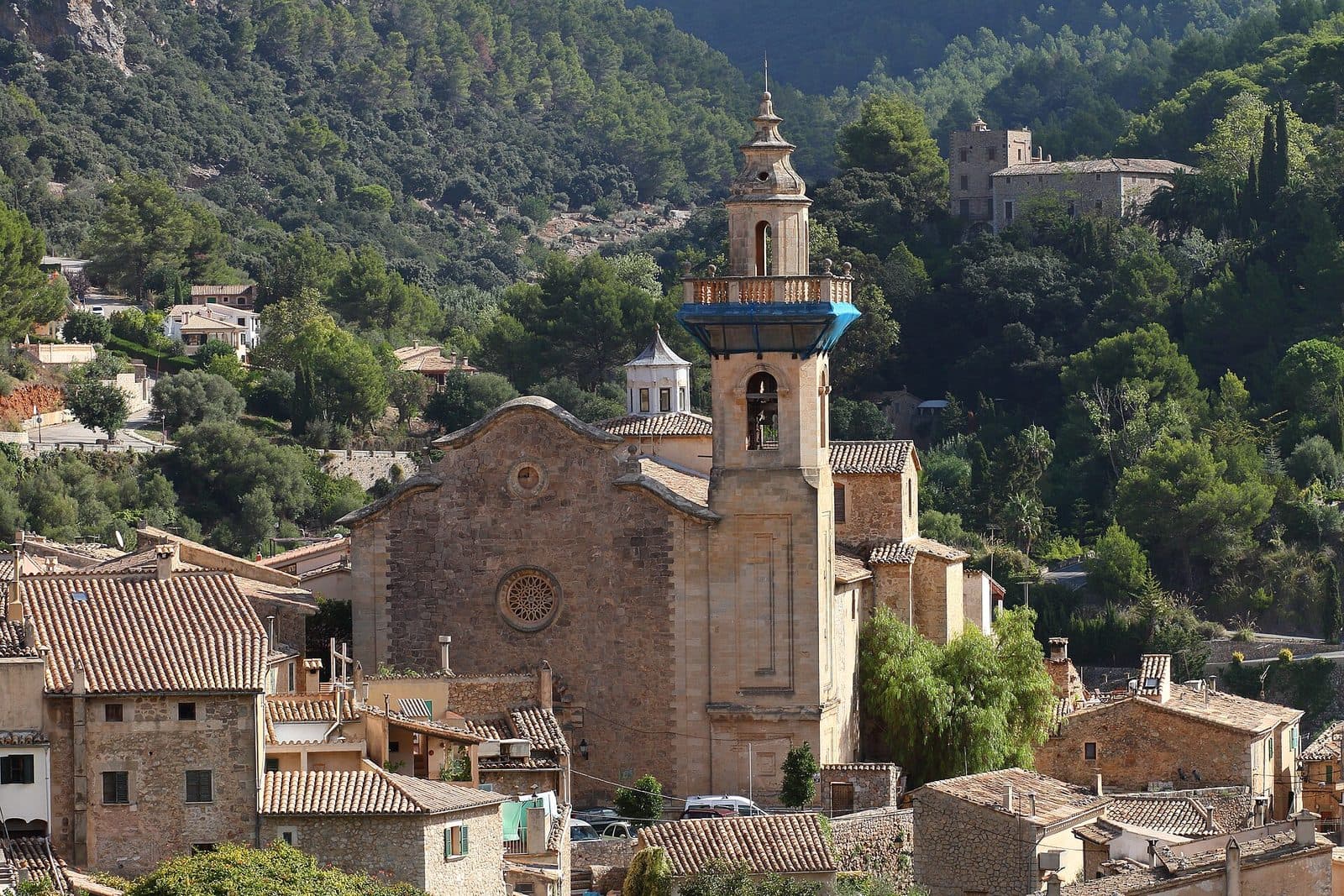

Sant Bartomeu stands somewhat apart from the grand narrative that first draws many visitors to Valldemossa. While everything around the Charterhouse revolves around kings, Carthusians, Frédéric Chopin, and George Sand, the parish church tells the story of everyday religious life in the village. It lies below the former monastery among the narrow lanes of the historic center and feels more like an integral part of Valldemossa than a monument set apart. That is precisely where its appeal lies: behind the restrained stone façade is a bright, richly furnished church interior with chapels, altars, paintings, sculptures, and woodwork. Anyone who enjoys taking time to explore historic sacred spaces will find many details here. At the same time, Sant Bartomeu is not a museum backdrop but the active parish church of Valldemossa.
A visit is particularly worthwhile as a peaceful counterpoint to the better-known Charterhouse. Architecture enthusiasts can trace a structure that evolved over centuries, visitors interested in cultural history will encounter figures from Valldemossa’s past, and even on a short village walk the church conveys something that is easily overlooked elsewhere: the history of the local community beyond its famous guests. A small park lies in front of the building. Busts of Chopin and George Sand recall the best-known chapter in the village’s history, but their story does not define Sant Bartomeu itself: the focus here is on the parish community, its patron saints, and the generations who enlarged, furnished, and preserved the building.
History and significance
The story does not begin with the Apostle Bartholomew. The first church documented on this site dates to 1245 and was initially dedicated to the Virgin Mary. Sant Bartomeu therefore reaches back to the early Christian history of Valldemossa. The small sacred building served the local community long before the Charterhouse and its guests later became famous and shaped the village’s image.
Medieval expansion
In the 14th century, the church was enlarged and dedicated to the Apostle Bartholomew. Its present name derives from this patronage. The expansion was not the last alteration: the building was modified and extended several times over the following centuries. Sant Bartomeu therefore cannot be reduced to a single construction phase. Instead, the church is a community building developed over a long period, reflecting the village’s changing needs and resources.
This also explains the difference between its considerable age and parts of its present appearance. Standing before the façade, visitors are not looking at the medieval church in an unchanged state. Earlier fabric, later chapels, the furnishings, and the relatively recent completion of the front and tower belong to different chapters of the same architectural history.
The Chapel of Saint John the Baptist
A particularly tangible trace of this development is the Chapel of Saint John the Baptist, added in 1570. It became the resting place of Joan Masroig and Adrià Ferrans, two men connected with the history of Valldemossa. Masroig was among the village’s early landowners and owned the historic building Es Molí. Ferrans played a major role in furnishing the royal Charterhouse.
The chapel thus connects the parish church with local history. It commemorates neither distant rulers nor abstract eras, but people whose property and work helped shape Valldemossa. On a tour, it is therefore more than a side chapel: it demonstrates how closely religious life, social standing, and local remembrance were once intertwined.
The organ as a symbol of perseverance
In the 16th and 17th centuries, Valldemossa came under economic pressure. Landowners left the village in search of better living conditions, and the parish community was also affected by these developments. Tradition holds that Jeroni Roig built the church organ during this period as a symbol of willpower and courage.
This gives the instrument a significance extending beyond its sound. It represents a community that continued to support its church even during difficult years. This background changes the way the interior can be viewed: the furnishings were not merely decorative but could serve as a public affirmation of solidarity and perseverance for the people of the village.
Façade and bell tower
The present main façade and bell tower were completed in 1930. In the same year, the patron saint Catalina Tomàs was canonized. The completion of these parts of the building therefore coincided with a moment of particular religious significance for the village.
Since then, the tower has been visible from various parts of Valldemossa. It does not stand out in the skyline as dramatically as the Charterhouse’s characteristic tower, but it fulfills a different role: it marks the parish church that remains in use today. Sant Bartomeu is not an abandoned monastery or an exclusively historical visitor attraction, but continues to be a place for worship and community life.
What to see
The first impression takes shape in the narrow streets of the historic center. Sant Bartomeu does not stand alone on a large, prestigious square but is integrated among Valldemossa’s closely packed houses. Natural stone and narrow lanes make the church appear restrained from the outside. Only the bell tower helps visitors identify it from farther away within the village.
The main façade
The front, completed in 1930, is the comparatively recent final stage of a much older building. This chronological gap is important: the façade does not represent an unchanged medieval state, but the last prominent step in a long sequence of alterations and expansions. Its stone construction blends with Valldemossa’s traditional houses and walls rather than seeking a sharp contrast with its surroundings.
From close by, it is worth first taking a few steps back to consider the relationship between the front, tower, and neighboring buildings. In the narrow streets, a perfectly symmetrical view from a distance is not the norm. The perspective changes as you walk, and individual parts of the building emerge only gradually. This makes the approach more engaging than a quick photo stop directly at the entrance.
The bell tower
The bell tower is the church’s clearest external landmark. Because it rises above the rooftops, it can be seen from several points in the village and helps with orientation while walking through the historic center. Its completion in 1930 belongs to the most recent major construction phase of Sant Bartomeu.
To understand Valldemossa, it is worth comparing it with the tower of the Charterhouse. Both belong to the village’s religious topography, but they represent different institutions and histories. One points to the former Carthusian monastery and its prominent visitors, the other to the parish church of the village community. Sant Bartomeu should therefore not be mistaken for part of the Charterhouse.
The nave
After the rather quiet exterior, the interior appears considerably richer. The church is bright and well preserved, with chapels and altars structuring the sightlines. Paintings, sculptures, and carved woodwork create numerous smaller focal points. The space is best appreciated not with a single glance from the entrance, but by walking slowly along the sides.
The brightness is one of the interior’s most striking qualities. It makes the furnishings stand out more clearly and prevents the relatively small building from feeling heavy. Nevertheless, the atmosphere remains that of a village parish church. Sant Bartomeu does not attempt to compete with the dimensions of large monastic churches; the proximity between nave, chapels, and altars is essential to its character.
The side chapels
The chapels reveal how the space was used and extended over generations. Each forms its own area of devotion within the church. Rather than perceiving them merely as decorative niches while passing, it is worth examining the different altars, figures, paintings, and wooden details. Precisely because the church interior remains manageable in size, these elements can be compared without walking long distances.
The Chapel of Saint John the Baptist from 1570 deserves particular historical attention. It is associated with the tombs of Joan Masroig and Adrià Ferrans. Its value therefore lies not only in its religious dedication but also in its commemoration of two figures from local history. Through his work on the Charterhouse’s furnishings, Ferrans even creates a direct historical bridge between Valldemossa’s two important sacred sites.
Altars, paintings, and sculptures
The altars form the most important visual focal points inside. Together with paintings and sculptures, they give the space its rich appearance. A visit becomes more rewarding when attention extends beyond the overall scene: the faces and gestures of the figures, framed pictorial panels, and transitions between colorful furnishings and natural stone speak both of religious devotion and of the craftsmanship expected by those who commissioned them.
Sant Bartomeu should not be confused with the more famous church of the same name in Sóller. The modernist show façade and the large square there do not belong in Valldemossa. The parish church here has its own, much more restrained exterior and derives its impact mainly from the contrast between its modest presence in the lane and its bright, richly furnished interior.
The woodwork
Carved wood is among the details that can easily be overshadowed by the larger altars and sculptures during a quick look around. It is therefore worth directing attention to frames, structures, and smaller ornamental sections as well. Such work conveys particularly clearly how much craftsmanship went into furnishing a village church that evolved over centuries. The wooden details should be viewed in relation to the interior as a whole. They connect the architecture, paintings, and sculptures rather than appearing as isolated exhibits. The space itself is the essential unity.
The organ
The organ created by Jeroni Roig is one of the features in which history and furnishings are closely intertwined. Its background refers to the economic difficulties experienced by Valldemossa in the 16th and 17th centuries. In local tradition, it appears as an expression of the courage and perseverance of those who remained in the village.
The instrument deserves a deliberate look. It tells the story of music in a context different from Valldemossa’s ever-present remembrance of Chopin. Here the focus is not on the stay of a famous composer, but on the musical voice of the parish community.
The small park
A small park in front of the church offers an opportunity to look back at the building and its surroundings after visiting the interior. Busts of Frédéric Chopin and George Sand commemorate the winter they spent in Valldemossa. Their presence connects the area outside the church with the village’s better-known cultural history without turning Sant Bartomeu into a Chopin site.
The park also serves as a transition between visiting the church and continuing a walk through the village. From here, lanes lead back into the historic center and uphill toward the Charterhouse. Anyone who pauses briefly can clearly see how closely religious, civic, and everyday places sit beside one another in Valldemossa.
Visiting Sant Bartomeu
The most fitting way to begin a visit is not at an information board, but with the approach through the lanes. Because Sant Bartomeu blends into the surrounding buildings, the church emerges only gradually. The bell tower serves as a landmark, while the façade itself becomes apparent only at close range. A short walk around the area in front helps explain its location below the Charterhouse.
From the exterior to the interior
First, it is worth looking at the front and tower completed in 1930. Perception changes noticeably upon entering: the restrained stone exterior gives way to a bright, richly furnished space. Visitors who walk directly to the main altar and then return slowly along the sides will first gain an overall impression before examining the individual chapels and woodwork.
Sant Bartomeu does not require a lengthy museum tour. The church works equally well as a short, focused stop or as a place for a more leisurely examination of its chapels, altars, and artworks. The amount of time worth spending therefore depends more on your interest in sacred architecture and local history than on the size of the building. The small park in front of the church can round off the visit.
Quiet periods and services
Sant Bartomeu is an active parish church. During a service, tourist sightseeing is not the priority; conversation, photography, and movement through the side areas should then be kept to a minimum. Even outside liturgical celebrations, a quiet and respectful visit suits this place better than a hurried tour in a large group.
Current opening hours and any access arrangements should be checked before visiting. Reliable fixed visiting hours and a current admission price are not recorded. An open church door should not automatically be taken to mean that every form of sightseeing is appropriate at that moment: notices at the entrance and the situation inside the church should determine how visitors behave.
Choose a quiet time of day
Valldemossa attracts many day visitors. Anyone wishing to experience Sant Bartomeu at its quietest should choose an early visit or the later afternoon. This recommendation also applies to the narrow streets and small area outside, which are often more pleasant at these times. The light on the natural stone and façade is also favorable for exterior photographs then.
The church interior itself is appealing as a retreat from a lively village tour. Brightness and silence shape the impression more strongly than spectacular staging. Particularly after the busy Charterhouse area, Sant Bartomeu reveals another side of Valldemossa: less famous biography, more everyday life shaped over generations.
Getting there and parking
From Palma, the direct route follows the Ma-1110 into the Serra de Tramuntana. From the center, Valldemossa is 19 road kilometers away, and the drive takes around 35 minutes. From Palma Airport, the route initially follows the Ma-20 and then the Ma-1110. Valldemossa is 25 road kilometers away, with a driving time of around 30 minutes.
These details apply to Valldemossa, not directly to the church entrance. Sant Bartomeu stands in the historic center below the Charterhouse. The final stretch passes through the compact village and is best covered on foot. The narrow, paved lanes are part of the experience; they also make clear why the church should not be approached like a destination on a broad through road.
Walking through Valldemossa
From the Charterhouse area, Sant Bartomeu is easily reached on foot through the lanes. The bell tower helps with orientation, although the church is not fully visible between the houses from every angle. Those arriving from above descend into the lower part of the historic center. The return journey accordingly involves another climb through the paved streets.
For navigation, the parish church should be clearly distinguished from the Charterhouse. Both have a church or church tower, but they are not part of the same complex. Sant Bartomeu stands independently on Carrer Rectoria and is the village’s parish church.
By bus
The Valldemossa 1 and Valldemossa 2 stops provide public bus access to the village. From there, the church is reached on foot through the historic center. Because timetables and routes may change, current connections should be checked before traveling. The same applies to the walk as when arriving by car: the final lanes are paved and not consistently level.
Route through the village
Sant Bartomeu is located in the historic center below the Charterhouse. Depending on the starting point, the route through the village includes slopes and paving stones. Comfortable shoes are therefore advisable even for a simple village tour.
Bus lines to Sant Bartomeu at a glance
| Line | Route | Departures/day | First | Last |
|---|---|---|---|---|
| 203 | Valldemossa / Deià | 152 | 06:47 | 22:34 |
From the official GTFS feeds (TIB/SFM), no real-time data. The figures cover all stops in the town; weekend and holiday services differ — check with the operator before travelling.
Getting there by bus
Valldemossa 1 (63002) · 0.4 km as the crow flies
- 203Valldemossa / Deià · Daily
Valldemossa 2 (63001) · 0.5 km as the crow flies
- 203Valldemossa / Deià · Daily
Ermita de la Trinitat 2 (63011) · 2.0 km as the crow flies
- 203Valldemossa / Deià · Daily
Ermita de la Trinitat 1 (63003) · 2.3 km as the crow flies
- 203Valldemossa / Deià · Daily
Timetable data: official GTFS feeds (TIB/EMT), no real-time — check with the operator before travelling.
Nearby sights
Above Sant Bartomeu lies the part of Valldemossa that most visitors head for first: the Charterhouse with its distinctive green-roofed tower. The walk between the two churches is short, but their stories differ significantly. The Charterhouse represents the former monastery, royal connections, and the stay of Chopin and George Sand; Sant Bartomeu tells the story of the parish community and everyday religious life in the village.
The Charterhouse of Valldemossa
Combining the two sites is particularly illuminating because it reveals two perspectives on Valldemossa’s past. In Sant Bartomeu, the Chapel of Saint John the Baptist commemorates Adrià Ferrans, who played a major role in furnishing the Charterhouse. This creates a tangible historical connection without reducing the parish church to an annex of the monastery.
For a walking tour, one option is to visit the busier Charterhouse first and then descend through the lanes to Sant Bartomeu. The combination also works in the opposite direction: the quieter village church then sets the mood for the more extensive visit to the monastery complex.
The lanes of Valldemossa
Between the two sights are narrow, paved streets lined with traditional stone houses, green shutters, and flower-covered façades. This route is more than a simple transfer. It shows how the churches are embedded in the dense village fabric of the Tramuntana and how strongly natural stone shapes Valldemossa’s appearance.
Sant Bartomeu is therefore best experienced as part of a walk. Anyone who stops only at the Charterhouse and then leaves will miss a quieter part of the historic center. The parish church shifts attention away from individual celebrities and toward the long history of the village itself.
The park in front of Sant Bartomeu
The busts of Chopin and George Sand in the small park provide a fitting transition to Valldemossa’s literary and musical heritage. The couple stayed in the village during the winter of 1838/39, but the principal site associated with their visit is the Charterhouse. The busts outside Sant Bartomeu are therefore more an indication of the village’s cultural identity than evidence of a special connection with the church.
After taking a break here, visitors can continue through the lower streets or return to the Charterhouse. The space is also suitable for reassessing the parish church’s dimensions from outside: it is smaller and less monumental than the famous monastery complex, but no less informative for understanding Valldemossa.
Serra de Tramuntana
Valldemossa lies in the northwest of Mallorca in the Serra de Tramuntana. Even the approach via the Ma-1110 leads from the Palma area into the mountain landscape. Anyone combining the church visit with a longer excursion can plan Valldemossa as a cultural stop between other villages and viewpoints in the region. Sant Bartomeu itself remains a destination for a peaceful village walk.
The place it belongs to
Valldemossa in the place guidePractical visitor information
Sant Bartomeu is not a large museum attraction with a fixed visitor route. Visitors enter an active parish church. This leads to the most important practical rule: services, prayer, and local events take priority. Quiet conversation and restraint when taking photographs suit the character of the building.
Paving stones and slopes
The route through Valldemossa’s historic center follows paved lanes and may include slopes, particularly between Sant Bartomeu and the higher Charterhouse. Shoes with a secure grip are more suitable than smooth soles. This also applies when only a short church visit is planned, as the journey is best completed with a walk through the village.
Visiting with children
The bell tower, figures, altars, and carved wooden details provide tangible focal points inside the church. Indoors, however, consideration must be shown for people praying and for services. The small park in front of the church offers space for a break afterward.
Considerate photography
For exterior photographs, the area in front and the different viewpoints from the adjoining lanes are more interesting than a single frontal image. Early in the day or later in the afternoon, the light falls favorably on the stone and houses. Inside, visitors should observe any photography notices. During liturgical activities or private devotion, it is better to keep the camera put away.
What Sant Bartomeu is not
Do not expect the modernist show façade of the church of the same name in Sóller or a Chopin exhibition. Nor is Sant Bartomeu part of the Charterhouse visitor route. The site’s strength lies in its own history: a parish church documented since the Middle Ages, expanded over several periods, with intimate chapels and rich furnishings behind restrained natural stone.
Those who understand these differences will not measure the church against the monumentality of other buildings on the island. Instead, Sant Bartomeu rewards close attention: to the Chapel of Saint John the Baptist, the woodwork, the organ, and the contrast between the simple exterior and bright interior.