
Mobile Home Mallorca: What's Really Allowed on Your Own Plot
The idea sounds tempting: a mobile home or a well-equipped motorhome on your own plot of land, far from building permit procedures and expensive architect fees. This exact hope drives many interested parties who ask about the legal situation on mallorca-forum.com. The sobering answer up front: mobile does not protect you from building law. Whether mobile home, container, yurt or permanently parked motorhome – as soon as a mobile form of housing is factually stationed on a plot of land on a permanent basis, the Spanish administration assesses it like any other building use. In this guide we explain where the difference between parking and living lies, why rural suelo rústico is a particular trap, what legal options actually exist, and what consequences you must expect in the event of a violation.

- Buying land on Mallorca — what you need to watch out for with suelo rústico
Mobile home, caravan, tiny house: what is legally what?
The Spanish legal framework does not distinguish according to marketing terms, but according to function and actual use. In the Spanish understanding, a "mobile home" is a transportable residential unit that is fundamentally intended for temporary or seasonal use and retains its mobility. To be distinguished from this are so-called "Habitaciones Ligeras de Ocio" (HLO, light leisure accommodation), for which stricter regulations apply – and motorhomes or caravans, which are treated under traffic law as vehicles, not as real estate.
| Form of housing | Legal status | Typical classification |
|---|---|---|
| Mobile home | Transportable residential unit, intended for seasonal use | Can be classified as a building implant if permanently installed |
| HLO (light leisure accommodation) | Its own, stricter regulation than a classic mobile home | Often subject to permit requirements, depending on the municipality |
| Motorhome / caravan | Vehicle under the General Transport Regulation (RD 2822/1998) | Considered substandard accommodation, not a regular dwelling |
| Tiny house on wheels | Treated similarly to a caravan if roadworthy | Once permanently installed: building assessment possible |
Note: Spanish law explicitly classifies motorhomes and caravans, similar to huts or caves, as substandard accommodation. They may be comfortable – but legally they do not count as regular living spaces in which one is permitted to "live" permanently as in a house.
Suelo rústico: why "mobile" does not protect against building law
The decisive factor is almost always the classification of the plot. On Mallorca – as throughout Spain – a distinction is made between developable land (suelo urbano) and rural land that is fundamentally not developable (suelo rústico or suelo rural). A suelo rústico is typically characterised by the absence of urban infrastructure such as sewage systems, paved roads, and water and electricity networks. It is precisely on such parcels that many foreigners – often unknowingly – buy plots of land on which illegal structures are later discovered.
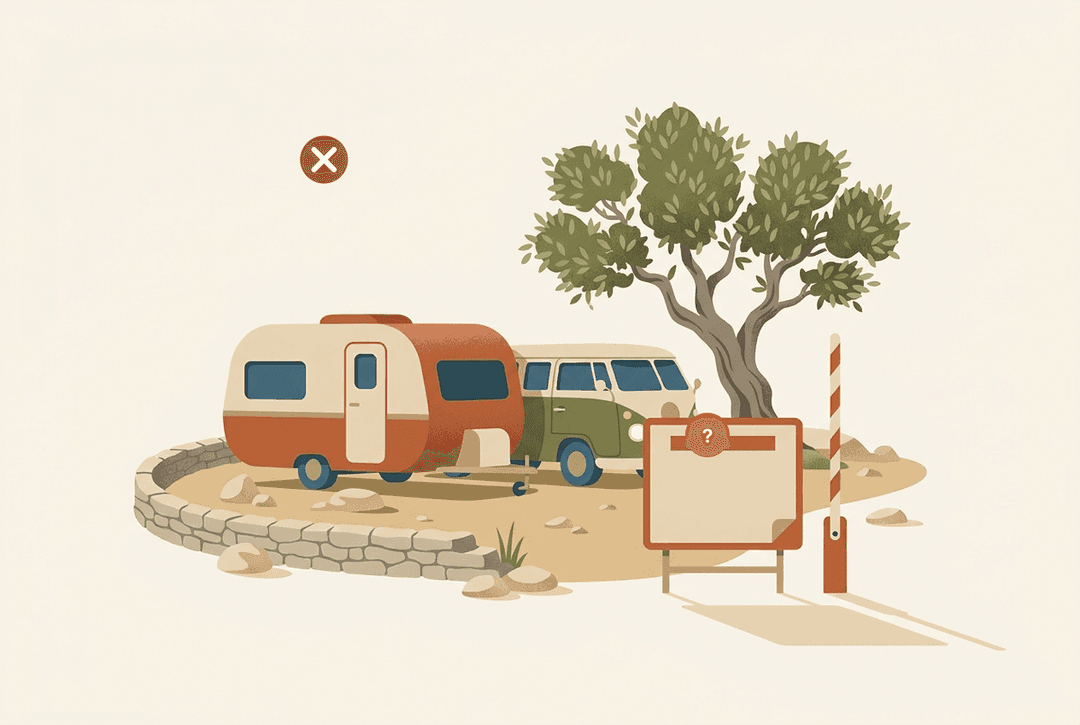
The installation of mobile homes on plots classified as suelo rústico is generally prohibited. Violations can result in sanctions. It's important to understand that authorities in practice usually don't assess the construction method ("mobile" vs. "fixed"), but rather the actual urban planning impact – in other words, whether permanent use as living space is created.
| Feature | Suelo urbano/urbanizable | Suelo rústico |
|---|---|---|
| Building use | Generally possible, with permission | Generally heavily restricted or prohibited |
| Infrastructure | Sewage system, roads, electricity available | Often lacking |
| Mobile home installation | Depends on the zoning plan, usually requires permission | Usually prohibited, risk of sanctions |
| Typical buyer mistake | – | Unwitting purchase of property with already existing illegal structures |
Note: Anyone who buys a plot with the intention of "simply" installing a mobile home there because it's "not a real house" does not thereby circumvent any permit requirement. Check the classification in the land use plan (PGOU of the respective municipality) before you invest. More on this in the guide Buying land in Mallorca.
Motorhome on your own plot: Parking vs. Living vs. Camping
With motorhomes, there's an additional distinction that is often overlooked in practice: the difference between mere Parking (aparcar) and Camping (acampar).
- Parking: The vehicle is parked without the awning, outdoor furniture or other elements being extended and taking up more space than absolutely necessary.
- Camping: Daily activities take place outside the vehicle – such as extending the awning or setting up furniture in the outdoor area.
Camping with a motorhome is only permitted at specifically designated sites; the specific regulations differ from region to region. Using a motorhome permanently as a residence on your own private plot is therefore a legal grey area with high risk: under traffic law, the vehicle remains a substandard form of accommodation and does not automatically become a legal form of housing just because it stands on your own land.
| Form of use | Legal classification | Risk |
|---|---|---|
| Short-term parking without unfolding/extending | Usually unproblematic under traffic law | Low, as long as no permanent use is apparent |
| Permanent standing with connections (water, electricity) | Can be classified as a structural/urban planning installation | Risk of sanctions and forced removal, depending on land classification |
| Camping outside designated sites | Generally not permitted | Risk of fines |
| Permanent residence in a motorhome on private land | Not legally recognised as regular living space | Possible issues with registration (padrón) and urban planning |
Requirement for planning permission: When does a mobile home need a building permit?
Even if a mobile home theoretically remains transportable, it may be subject to a requirement for planning permission – particularly if it is set up permanently or connected to utility networks (water, electricity, sewage). This is exactly the point currently being addressed by the highest courts: Spain's Supreme Court (Tribunal Supremo) has taken up a case in order to clarify nationwide and uniformly under what conditions the setting up of mobile homes without a conventional building permit is even permissible. Until such a landmark ruling is issued, practice remains inconsistent from region to region – an additional reason to obtain specific advice from the relevant municipality before undertaking any project.
- Check the classification of the plot (suelo urbano, urbanizable or rústico) with the responsible town hall or in the PGOU.
- Clarify whether a utility connection (electricity, water, sewage) is planned – this significantly increases the likelihood of a permit requirement.
- Actively ask whether the planned duration of use is classified as "seasonal" or as "permanent".
- Obtain written information (consulta previa) from the Ayuntamiento before buying or setting up.
- If in doubt, consult specialised legal advice – the line between legal mobile use and construction requiring a permit is often a matter of assessment.
For all cases where an unauthorised structural reality ultimately comes to light, it's worth taking a look at our guides on Building permit Mallorca, Legalising illegal construction and Fuera de Ordenación.
Taxes and fees: cheaper, but not free
Different fees and taxes may apply for setting up and using mobile homes depending on the region. In many cases these are lower than those for conventional buildings, but they vary significantly according to the respective municipal regulations. Anyone hoping to specifically save on purchase-related costs or ongoing charges with a mobile home should not generalise this assumption, but rather ask the municipality directly – blanket tax advantages cannot be reliably substantiated for Mallorca based on the current state of research.
The legal situation in the Balearic Islands: Tourism Law and registration requirement
Anyone wishing to rent out a mobile home or motorhome for tourism purposes also falls under Balearic tourism law. In the Balearic Islands, a Tourism Law was already passed in July 2017, which precisely defines what counts as the touristic marketing of living space – regardless of whether it is a conventional holiday home or an alternative form of housing. Since 1 July 2025, an expanded registration requirement has also applied: every landlord offering short-term or touristic rental must register it accordingly.
| Project | Relevant law | Important note |
|---|---|---|
| Touristic rental of a mobile home/property | Balearic Tourism Law (since July 2017) | Clearly defines what counts as a holiday residence |
| Short-term rental in general | Registration requirement since 01.07.2025 | Basically applies to all landlords of short-term accommodation |
| Permanent residence without renting | Building law/urban planning assessment | To be assessed independently of tourism law |
You can find out more about the legal framework for holiday rentals in our guides Renting out, Ley Vivienda Balearics and Property management Mallorca.
Legal routes: Campsites, permits and alternatives
If you genuinely want to live mobile or in an alternative way on Mallorca without stepping into a grey area, there are essentially three realistic options:
- Approved campsites: Motorhome camping with extended elements, awning and outdoor furniture is only permitted at specially designated sites.
- Vivienda permit on a suitable plot: Only with a regular building permit on appropriately classified land does a legally secure, permanent residence arise – regardless of whether the construction method is lightweight or solid.
- Combination of prefab house/tiny house with a regular permit: Even lightweight constructions can be approvable on suitable land, provided the project is registered from the outset as a building use and not designed as a "mobile workaround".
Note: Simply parking a motorhome – without extended elements and without everyday use outside the vehicle – is legally treated differently from camping or permanent residence. Anyone who doesn't know this boundary can quickly and unintentionally end up in a use that requires a permit.
Risks: Fines, demolition and official inspections
If a mobile form of housing is classified as an illegal building implantation on suelo rústico, sanctions can be imposed. The specific amount and nature of such sanctions depend on the municipality and the individual case – it is not possible to seriously state flat-rate fine amounts without knowing the specific case and the responsible municipality. More relevant is usually the question of demolition: if a use is classified as unauthorised, a demolition order can follow, regardless of how "mobile" the construction theoretically is.
For a deeper insight into how authorities on Mallorca deal with unauthorised buildings and what limitation periods play a role, it's worth taking a look at our guides Legalising an unauthorised build and Limitation period for unauthorised builds. The fundamental coastal protection issue is also relevant if your plot is located near the coast – see Ley de Costas Mallorca.
Most common mistakes
- "Mobile means legal": The most widespread misconception. Even transportable forms of housing are subject to building law as soon as they are used on a de facto permanent basis.
- Plot classification not checked: Anyone who buys a plot without checking the PGOU risks ending up with suelo rústico, where the placement of a mobile home is usually prohibited.
- Parking confused with camping: Anyone who sets up an awning, outdoor furniture and daily activities outside the vehicle is camping – with all the legal consequences that entails.
- Utility connection underestimated: A fixed connection to water, electricity or wastewater significantly increases the likelihood that the authority will assume a permit requirement applies.
- Tourism law ignored: Anyone wishing to rent out a mobile home must additionally observe the Balearic registration obligation in place since 1 July 2025.
Checklist before buying or setting up a mobile home
- Check plot classification (suelo urbano/urbanizable/rústico) with the town hall.
- Obtain written information (consulta previa) on the planned use.
- Clarify whether a utility connection is planned and how this is assessed.
- Realistically assess the intended duration of use: seasonal vs. permanent.
- If renting is planned: check Balearic tourism law and the registration obligation.
- If in doubt: seek local legal advice before investing.
- Check alternative options (approved campsites, regular building permit) in parallel.
What comes next?
If you decide to take the regular route – that is, a plot with an actual building or residential use option – the next step involves the regular building permit and, where applicable, questions of water supply or energy self-sufficiency in rural areas. Our guides on Mallorca building permit, Legalising a well and Water Restrictions in Mallorca help you realistically assess the next steps. Anyone who instead finds an existing unauthorised situation should look into legalisation options at an early stage.
Conclusion
A mobile home or motorhome on your own plot in Mallorca is not a loophole for getting around building law. What matters is not the type of construction, but the actual use: anyone who lives there permanently, connects to utility networks, or camps outside designated sites quickly moves into an area requiring permits or even facing sanctions – especially on plots classified as suelo rústico. The only truly safe routes are approved campsites for temporary use or a regular building permit for permanent residence. Careful checks here save you from costly surprises – and that's exactly why an individual assessment of the plot's situation is worthwhile before any purchase or installation.
Official sources
- Real Decreto 2822/1998, de 23 de diciembre (Reglamento General de Vehículos) – Boletín Oficial del Estado (BOE): https://www.boe.es
- Ley General de Turismo de las Illes Balears (Tourism Act, in force since July 2017, with later amendments) – Govern de les Illes Balears: https://www.caib.es
- Consell de Mallorca – Ordenación del territorio / suelo rústico: https://www.conselldemallorca.cat
- Tribunal Supremo (Poder Judicial) – Proceedings concerning mobile homes without a building permit: https://www.poderjudicial.es
Operating a campsite on a finca
A caravan for your own use and a campsite for guests are different undertakings. Even on your own finca in suelo rústico, providing pitches, sanitary facilities or accommodation for guests does not automatically make campsite operation permissible. What matters is whether the specific plot may be used for tourism and which facilities can be approved there.
Anyone planning a campsite should check with the local council before buying the land or setting up pitches whether the proposed use is permitted under planning rules, and discuss the authorisation required to operate it with the relevant Balearic tourism authority. The assessment should also cover access, drinking water, wastewater disposal and fire safety. Wooden cabins or other accommodation on the site must be assessed as part of the proposal; their construction does not automatically make them permissible.
General requirements for minimum site areas or the layout of a campsite cannot simply be applied to a finca on Mallorca. The rules and permits for the specific location are decisive. This overview is not legal or tax advice.