
Buying land in Mallorca: building land, classification, process
Buying a plot of land in Mallorca is something completely different from buying a finished villa: you're not buying a house, but legal potential – and that depends almost entirely on the classification of the land. Whether a parcel can eventually become a dream house, a finca, or nothing at all is not decided at the notary's office, but long before that, at the Land Registry (Catastro) and in the municipality's development plan (Bebauungsplan). In this guide you'll learn what the market for land in Mallorca looks like in 2026, what distinguishes building land from rustic land, how the process runs from reservation to handover of the keys, and what prices you realistically need to expect in which region. Concrete examples show you just how different the market really is – from the small building plot to the large country estate.

Calculate IVA and AJD
Explanation
The net price agreed with the developer, without the IVA (Spanish VAT). It is added on top and does not belong in this field.
- Total tax (IVA and AJD)
- €74,750.00
Legal status: 14 June 2026
This calculation is provided for guidance only and is not a substitute for tax or legal advice in specific cases.
The market for land in Mallorca in 2026
The overall Balearic property market remains tight in 2026: according to the quarterly report by API Baleares (published in May 2026), the average transaction price per square metre in the Balearics reached around 4.173 €/m² by the end of the first quarter of 2026 – an increase of 1,7 % compared to the previous quarter and 10,3 % year-on-year. The 12-month average of 4.079 €/m² was, at that point, the highest figure ever recorded in this series. Foreign buyers accounted for just under 30 % of all transactions in the first quarter of 2026.
The rental market also shows just how tight the overall situation is: in 2025 rents in the Balearics rose by more than 8 %, increasing the pressure on investors to consider their own building land as an alternative to buying an existing property. Market observations for 2026 suggest average prices per square metre of living space of between around 4.500 and 5.500 € per square metre, depending on the region – significantly higher in top locations. Around ten years ago, many regions were still below 3.000 € per square metre, which illustrates the momentum of the last decade.
Note: These market prices refer to built living space. Pure land prices vary far more widely, because location, classification and any building permit already in place dominate the value of an undeveloped plot – not the sheer square-metre figure of the land itself.
Building land, Urbanizable, Rústico: understanding the classification
Before you even start thinking about the price of a plot of land, you need to know which category it falls into. In Mallorca, municipalities and the Consell de Mallorca generally distinguish between three land classes:
| Classification | Meaning | Building potential |
|---|---|---|
| Suelo Urbano | Building land within the developed town area | Usually directly buildable, mostly with connection to water, electricity, sewage system |
| Suelo Urbanizable | Land designated for future development | Buildability depends on the progress of the municipality's development planning |
| Suelo Rústico | Rural, undeveloped land (finca land) | Usually not buildable or only under strict restrictions, often bound to minimum plot size and agricultural use |
Especially in rustic land at the foot of the Tramuntana or in the rural interior of the island, large, seemingly affordable plots are tempting – here special caution is advised, because a building permit is by no means automatically to be expected on Suelo Rústico. Additional restrictions can arise from nature protection areas (ANEI), the coastal protection law Ley de Costas, or special protection zones in the Tramuntana.
Attention: Always have the exact classification of a plot confirmed in writing by the responsible town hall (Ayuntamiento) or via a land registry extract before signing an option or reservation. A "buildable" plot in a listing is not a legal guarantee.
You can find more details on the respective categories in our in-depth guides on Finca & Suelo Rústico, on ANEI & nature protection plots, on building law in the Tramuntana and on the Ley de Costas.
What do plots of land on Mallorca really cost? Real examples
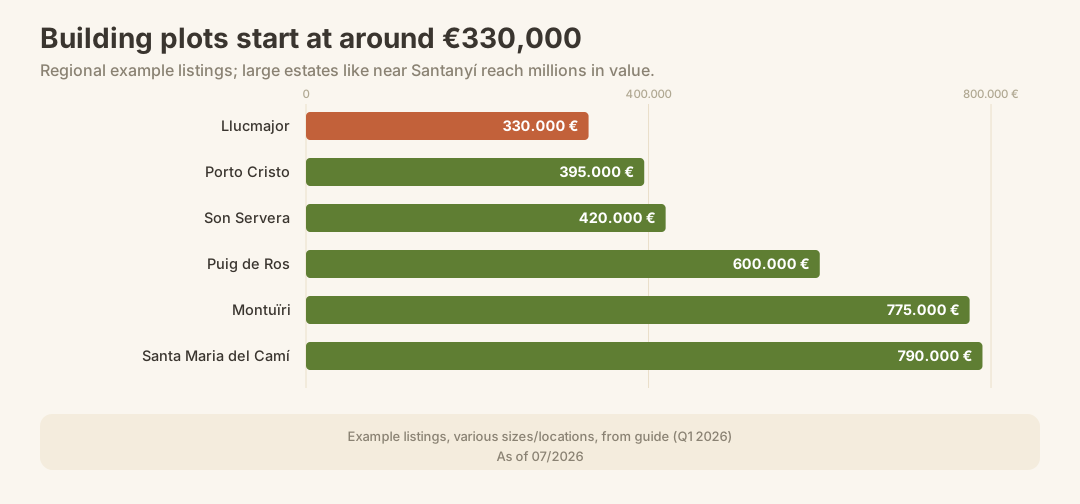
The price range for plots of land is enormous – from the small building plot in the village to the large estate near Santanyí. The following table shows real examples currently offered on the market, to get a feel for the range:
| Location / Region | Plot size | Building permit | Price |
|---|---|---|---|
| Llucmajor | Building plot | – | 330.000 € |
| Son Servera (Es Fetget) | Building plot | – | 420.000 € |
| Porto Cristo | 21,476 m² (45 m² already built) | with permit/licence | 395.000 € |
| Moscari (near Campanet) | Plot with panoramic views | – | 795.000 € |
| Santa Maria del Camí | Building plot | with permit | 790.000 € |
| Montuïri | Plot with finca project | with approved project | 775.000 € |
| Puig de Ros | Exclusive building plot, prime location | – | 600.000 € |
| Santanyí (surrounding area) | 280,000 m² | – | 3.800.000 € |
Note: Plots "with permit" (building permit/licence already granted) are noticeably more expensive than comparable plots without a permit – for example, offers in Magaluf that are explicitly marketed as "without permit". The price difference reflects the time, uncertainty and planning effort you would otherwise have to bear yourself.
Another beachfront plot in Puig de Ros also illustrates an important distinction: of the 1,080 m² plot area, only 540 m² was actually buildable – a classic example showing that the plot size alone says little about the actual building volume.
The process of buying a plot: from reservation to notary
The legal process for buying a plot is similar to a classic property purchase, with the difference that checking the classification and buildability carries even more weight.
- Reservation contract: In return for a usually small reservation fee, the plot is taken off the market for a few days. The fee is generally credited towards the purchase price upon completion of the sale.
- Option contract (Contrato de Opción de Compra): Common before the notarial purchase contract. All key conditions are fixed here – price, deadline, classification, any conditions. The option period usually runs for several weeks to months, during which you can complete financing and due diligence. An option fee of around 10% of the purchase price is customary, which is credited upon completion. If the buyer withdraws without good reason, the amount is forfeited to the seller.
- Notarial purchase contract (Escritura): Only the notarised purchase contract is legally binding in Spain. Ownership is only finally transferred upon signing before the notary and the subsequent registration.
You can find details on each individual step, including deadlines and typical clauses, in the guides on the Reservation contract, on the Notary appointment in Spain and on the entire legal process of buying a property.
| Phase | Typical duration | Typical payment |
|---|---|---|
| Reservation | A few days | Small reservation fee |
| Option contract | Several weeks to months | Approx. 10% of the purchase price |
| Notarial purchase contract | Appointment after the deadline expires | Final payment + notary/registry costs |
Due diligence: what to check before buying
For an undeveloped plot, checks before signing the contract are more important than for a finished property, because there's no existing building that has already "proven" the legal situation. Key points to check include:
- Land registry extract (Nota Simple) to confirm owner, encumbrances and mortgages
- Cadastral extract to confirm the actual classification (Urbano, Urbanizable, Rústico)
- The municipality's development plan (Plan General de Ordenación Urbana) for building height, setback distances, and permitted use
- Existing or missing infrastructure: water, electricity and sewage connections
- Possible restrictions due to nature conservation, coastal protection or heritage protection
Attention: A "cheap" large Rústico plot without reliable building information from the municipality can turn out to be practically unbuildable. Get this information in writing before making any down payment.
For legal support with this review, an independent lawyer specialising in real estate law is recommended – more on this in the guide on Lawyer for property purchases.
Buildability, water and electricity: the practical side
Besides the legal classification, the practical infrastructure determines how complex and costly construction will later be. Plots in Suelo Urbano generally already have water, electricity and sewage connections at the plot boundary. For fincas and plots in Suelo Rústico, this is often not the case – here, a private well or a private cistern is often needed, as well as, in some cases, an electricity connection over greater distances.
| Plot type | Water connection | Electricity connection | Building permit process |
|---|---|---|---|
| Suelo Urbano | Usually available | Usually available | Regular building permit procedure of the municipality |
| Suelo Urbanizable | Partially, depending on the state of development | Partially | Depending on the progress of the development planning |
| Suelo Rústico | Often requires its own well | Often more complex/expensive | Usually heavily restricted, may require a Declaración de Interés General |
You can read everything about wells, water rights and the legalisation of existing installations in the guide Water supply on the finca and Legalising a well. If, exceptionally, a construction project of public interest is to be permitted on Rústico land, a Declaración de Interés General is required. For the specific approval process itself, it is worth consulting the guide on Building permit Mallorca.
Regional price differences in Mallorca
The market in Mallorca has traditionally been shaped strongly by region. Palma, the southwest with its well-known golf and coastal locations, the quieter northeast, and the rural interior of the island differ considerably in price. While example listings in Llucmajor or Son Servera start as low as 330,000 to 420,000 €, exclusive plots in the southwest (such as Puig de Ros) quickly reach 600,000 € and more, and large country estates around Santanyí are in the millions. The average price per square metre for living space varies by region between roughly 4,500 and 5,500 €/m², and significantly higher in absolute top locations – plot prices cannot be directly derived from this, but generally follow the same trend.
Note: Those still looking for entry-level prices will find them more easily inland or in less touristy municipalities – at the expense of proximity to the beach or the sea.
Costs & additional expenses when buying a plot
In addition to the purchase price, buying a plot – as with property purchases in general – involves acquisition-related costs, including the property transfer tax (ITP) in the Balearic Islands, notary and land registry fees, and, where applicable, estate agent commission. The exact tax rates and current allowances for 2026 are summarised in the dedicated guide.
| Cost item | When due |
|---|---|
| Property transfer tax (ITP) | Upon notarial certification |
| Notary costs | At the notary appointment |
| Land registry entry | After notarisation |
| Estate agent commission (if applicable) | On conclusion of contract |
You'll find details on all items in the guides Balearic ITP 2026, Additional purchase costs in Mallorca and Estate Agent Commission in Mallorca. Anyone wanting to finance the plot should look beforehand into the special conditions for non-resident mortgages as well as the use of German equity, since pure land financing is often assessed more cautiously by banks than the purchase of a finished property.
Money transfer, power of attorney and reporting obligations
If you're transferring your capital from Germany, Switzerland or Scandinavia to Spain, you should plan this well in advance to avoid exchange-rate and timing risks at the notary appointment – more on this in the guide transferring money to Spain. If you can't or don't want to travel to Mallorca in person for the notary appointment, the whole process can be handled via a notarised power of attorney. As a German buyer, you should also not overlook the AWV reporting obligation to the Bundesbank.
Most common mistakes when buying land
- Relying on verbal assurances about buildability instead of written confirmation from the town hall
- Underestimating the costs of connecting utilities (water, electricity) for rústico plots
- No independent legal review before paying the option fee
- Confusing plot size with the actually buildable area
- Failing to clarify whether restrictions from nature conservation, coastal protection or Tramuntana building law apply
- Buying a plot burdened with an illegal ("Schwarzbau") structure without checking its legalisation status
If there is already an unauthorised building on the plot, find out in advance about the possibilities and limits of legalisation of illegal buildings.
What happens after the purchase?
After the notarial deed and land registry entry, the actual planning phase begins: architect, building permit process with the town hall and – depending on classification – possibly additional approval steps. Anyone wishing to realise a new-build project directly from a developer instead of on their own plot will find alternatives in the guide on new-build and off-plan purchases. Once the building is completed, the IBI tax becomes due annually.
Checklist: Buying land in Mallorca
- Have the classification (Urbano/Urbanizable/Rústico) confirmed in writing by the town hall
- Obtain and check the land registry and cadastral extracts
- Consult the municipality's development plan
- Clarify the infrastructure status (water, electricity, sewage)
- Engage an independent lawyer for due diligence
- Have the reservation and option contract legally reviewed
- Organise financing and money transfer early on
- Prepare the notary appointment and land registry entry
- Budget for additional costs (ITP, notary, register)
- After purchase: initiate the building permit process in good time
Conclusion
Buying a plot of land in Mallorca can be the direct route to your individual dream home – provided the classification, infrastructure and legal review are correct. The market remains tight in 2026: prices continue to rise, supply remains scarce, and international buyers account for a significant share of demand. Anyone who carefully checks before making a reservation what a plot of land is actually permitted for avoids the most costly mistakes – and benefits from a market that, despite high prices, still offers entry opportunities across various price segments.
Official sources
- Balearic Properties, Balearic property market Q1 2026 (based on: API Baleares quarterly report, May 2026): https://www.balearic-properties.com/de/immobilienmarkt-balearen-q1-2026
- Private Property Mallorca, Mallorca property market 2026: https://www.privatepropertymallorca.com/generally-de/der-immobilienmarkt-auf-mallorca-2026-zwischen-starker-nachfrage-und-begrenztem-angebot
- Rossitza Hantelmann, the process of buying property in Mallorca: https://rossitzahantelmann.com/ratgeber/ablauf-kauf-immobilie-mallorca
- Rudmann Guzek, Buying property in Mallorca – process 2026: https://rudmannguzek.com/immobilienkauf-auf-mallorca
Tool sheds, construction containers and agricultural use on rural land
Suelo rústico denotes a land classification; agrario describes agricultural use or a corresponding planning designation. An “agricultural” designation is therefore not automatically a separate land classification that can be built on freely. What matters is which uses the municipal plan permits for the specific plot and whether further protections apply.
A tool shed (caseta de aperos), agricultural storage building, stable or greenhouse may be permitted under certain conditions. The proposed structure must be compatible with the permitted use of the plot and meet the applicable requirements. Permission for a tool shed does not permit its use as a dwelling.
A prefabricated hut or construction container is not permitted simply because it can be moved. For a container used during building works, relevant factors include whether the works are authorised, what the container is for and how long it will remain in place. Before installing one, ask the relevant town hall in writing whether your specific proposal is permitted and which approval procedure applies. State its intended use, location, size, method of fixing and planned duration on site.
Note: This is not legal or tax advice.