
Reverse mortgage in Spain: eligibility, costs and heirs
A reverse mortgage in Spain can release money from your property without you having to sell it. Unlike with a conventional mortgage, you receive a lump sum or regular payments, with the property serving as security. You remain the owner while the debt grows over time. That is why it is not enough to look only at the potential monthly payment. The interest, contract costs, length of the payments and what your heirs will eventually inherit are also crucial.
This guide explains who can generally take out a reverse mortgage, why your main home needs to be considered differently from a holiday property, and which costs you should clarify before signing. You will also learn how repayment may work after your death and why it makes sense to speak to your future heirs before taking out a loan secured against the property. General information – not legal, tax, financial or credit advice.

Who can take out a reverse mortgage in Spain?
The Spanish reverse mortgage is a legally regulated loan for older property owners. The standard arrangement requires a minimum age of 65 years. You must own the property that will serve as security. Whether a lender offers the loan, and on what terms, depends in part on the property's valuation and the proposed payments.
| Consideration | Key point |
|---|---|
| Borrower's age | At least 65 years |
| Property | Owned by the borrower; serves as security |
| Payment | Can be made as a lump sum or in instalments |
| Legal framework | Reverse mortgages have been regulated by law in Spain since 2007 |
For owners of a holiday or second home, the distinction between eligibility in principle and reduced costs matters: a reverse mortgage can also be secured against such a property. However, the statutory cost reductions apply only to the main home. Some lenders also require you to be resident in Spain and to use your main residence as security. Do not assume, therefore, that the same requirements and additional costs apply to your holiday home.
How do payments and repayment work?
With a conventional mortgage, you receive money and then repay the loan. With a reverse mortgage, you also receive a loan, but generally do not have to make regular repayments of the principal. You may receive the money as a lump sum or in agreed instalments. At the same time, the debt secured against the property grows.
How much you can receive does not depend solely on the property's value. The maximum amount agreed in the contract and the borrower's age also play a part. Payments for a limited period are different from payments intended to be guaranteed for the rest of your life.
The debt generally becomes due after the death of the borrower or the last beneficiary covered by the contract. It can be repaid during their lifetime. Ask to see in the contract what amount would be payable at that point and what costs early repayment would incur.
Important: “No ongoing repayments” does not mean “free money”. Compare the projected total debt with the payments you would actually receive.
What do the example figures show – and what don’t they show?
The amount paid out depends heavily on your age and the value of the property. The following older set of examples illustrates this relationship; it is not a current offer or a calculation for your property.
| Property value | Age | Example: lump sum | Example: monthly payment |
|---|---|---|---|
| 200,000 € | 65 years old | 50,000 € | 200 € |
| 200,000 € | 80 years old | 78,000 € | 600 € |
| 500,000 € | 65 years old | 120,000 € | 500 € |
The figures come from a set of examples published by idealista in 2020. They show, for instance, that the payments offered for the same property may differ depending on your age when you take out the loan. They do not tell you what you would be offered today or how much you would eventually owe. For that, you need a personalised calculation covering the contractual interest and all costs.
What costs should you check before signing?
Setting up a reverse mortgage involves a property valuation and completing the contractual formalities. Other potential costs include independent advice, an arrangement fee, and notary and Land Registry fees. Under some contracts, costs are added to the loan rather than paid upfront. This can increase the eventual debt, even though less money initially leaves your account.
If the main residence is used as security, notary and land registry costs are reduced by law. You should not assume this applies to a second home or holiday property. Additional insurance can also change the figures; in particular, you need to establish whether it is intended to provide further payments once the agreed loan limit has been reached.
Before signing, ask for a breakdown that answers these questions:
- Which costs must you pay yourself before receiving any funds?
- Which amounts will be added to the loan?
- What interest rates apply to amounts paid out and costs that have accrued?
- When do payments stop – and under what conditions do they continue?
- How does the projected debt grow in the examples provided in the contract?
- What does it cost to repay the loan in full during your lifetime?
Note: Loan payments and any later payments from an additional insurance policy are not treated the same way for tax purposes. Check how the specific combination of contracts will be treated before signing.
What are the disadvantages of a reverse mortgage?
The immediate advantage is access to cash without having to give up ownership straight away. Less obvious is the growing debt. Depending on the agreed payments and the length of the contract, this could leave less of the property's value for your heirs. Even a high monthly payment is only meaningful if you know how long it will be paid.
Another risk is confusing different promises of payment: if loan payments stop when a maximum limit is reached, that does not automatically mean payments will continue for life. If an insurance policy is intended to bridge that gap, you need to examine its terms, costs and tax treatment separately.
A reverse mortgage is therefore not suitable simply because a property is worth a lot. What matters is whether the cash you need and the expected reduction in the value of your estate are acceptable to you and your family.
What happens to the property and the heirs after death?
When the owner dies, the question is how the debt that becomes due will be settled. The heirs can generally repay it, have the mortgage removed from the register and keep the property. Alternatively, they can sell the property and use part of the proceeds to repay the debt; the remaining proceeds then belong to the heirs who sell it.
Both options require a detailed calculation. Anyone who wants to keep the house needs to know how they can finance the repayment. Anyone who wants to sell needs to compare the expected sale proceeds with the debt outstanding at that point. Do not rely on a general statement about how much time the heirs would have: have the date the debt becomes due and the procedure after death set out in the specific contract checked.
Our guides to Spanish wills and Inheritance in the Balearic Islands. A reverse mortgage is no substitute for this planning.
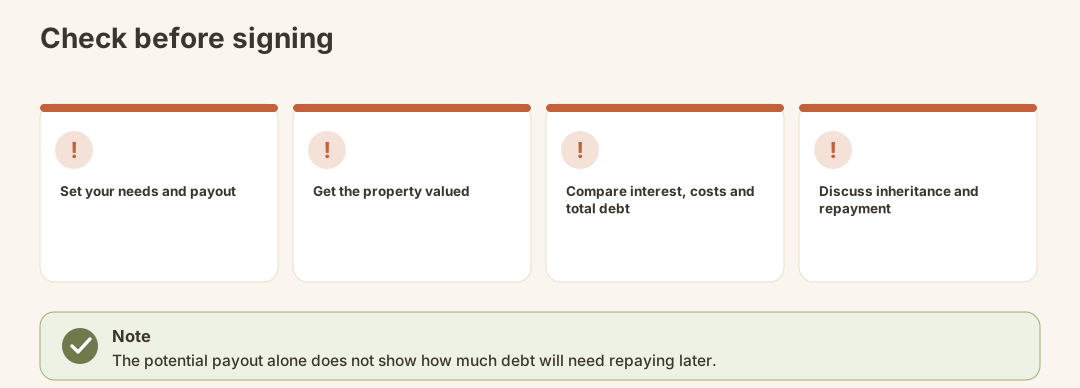
What checks should you make before signing?
- Define your needs: Decide whether you need a lump sum, regular payments or a combination – and what for.
- Have the property assessed: A valuation provides the basis for calculating the specific loan terms. Also check any existing charges in the Spanish Land Registry.
- Request a detailed loan calculation: Compare the amount paid out, interest, additional costs, maximum loan limit and the conditions under which payments end.
- Get independent advice: Discuss ownership, repayment and what happens on death before signing. Especially where there are multiple owners or beneficiaries, it must be clear whose death triggers repayment.
- Involve your heirs: Not as a substitute for making your own decision, but so that the later choice between repaying the loan and selling does not come as a surprise.
If you are also considering a sale while retaining rights of use, read how the sale of the nuda propiedad differs from retaining ownership with a reverse mortgage.
Most common mistakes
- Mistaking an illustrative payout for an offer. Age and property value alone are not enough for a reliable calculation of the loan terms.
- Comparing only the monthly payments you receive. Without interest, costs and the projected total debt, you are missing the crucial other half.
- Treating a holiday home like a main residence. In particular, cost concessions cannot simply be assumed to apply.
- Confusing fixed-term payments with lifelong payments. Check how any possible continuation would be funded.
- Overlooking what happens on death. The property remains yours, but the debt does not disappear.
- Overlooking additional costs because they are added to the loan. These amounts must also be taken into account later.
What happens next?
Once you have signed, keep the contract, property valuation and calculations somewhere the people handling your estate can find them. In particular, record whom your heirs can contact to find out the outstanding debt at that point and how to repay it.
If your needs change, look beyond the next payment and reassess the likely total debt. If you want to pay off the loan during your lifetime, early repayment is generally possible; the specific contract terms will determine how it works.
Checklist for your decision
- Am I the owner, and do I meet the age requirement?
- Is the property used as security my main home or another property?
- Will the proposed payment cover my actual needs?
- Do I understand when payments end and whether insurance is involved?
- Do I know the interest rate, fees and likely total debt?
- Do I know how to repay the loan during my lifetime?
- Will my heirs understand how they could keep or sell the property?
- Have the legal and tax implications of my specific contract been reviewed?
Conclusion
A reverse mortgage can let you access wealth tied up in your property while remaining its owner. Its cost, however, lies not just in the initial fees but, above all, in the debt that will eventually have to be repaid. Base your decision on a full calculation of the costs under the contract – and consider your heirs’ options from the outset.
Official sources
- Boletín Oficial del Estado (BOE) – official publication of Spanish legislation
- Banco de España – information on banking and financial products