
Buying bank-owned property or property at auction in Spain: what to check
Bank-owned properties and repossessions in Spain may sound like two routes to a cheap home. In reality, there can be substantial differences between a standard sale of a bank-owned property, an ongoing judicial auction and an offer involving an assignment of rights arising from auction proceedings. A low asking price tells you neither whether you can view the property nor whether it will be vacant when you acquire it. Wording such as sin posesión – without possession – deserves more attention than the word ‘bargain’.
This guide helps you distinguish between the terms used in Spanish property listings. You’ll learn where to find judicial auctions, which documents matter before you bid and why a listing is not, on its own, a reliable guide to the purchase process. Spanish procedural rules apply to judicial auctions in Mallorca; for other property purchases, you should also check the tax and planning issues that apply at the property’s location.

Bank-owned property or repossession: what are you actually buying?
A bank-owned property is a property that may have entered a lender’s portfolio following a repossession and is subsequently offered for sale. The listing then describes a sale from that portfolio – not necessarily an auction in which you bid yourself.
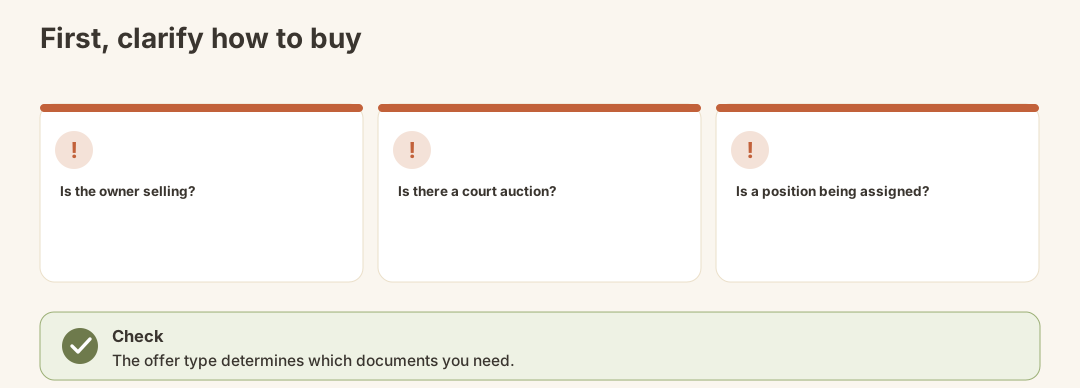

In a judicial auction, known in Spanish as a subasta judicial, you instead bid as part of ongoing enforcement proceedings. An ejecución hipotecaria is an enforcement action relating to a mortgage debt. You should scrutinise offers involving an assignment of rights arising from auction proceedings particularly carefully: they may not involve the usual sale of a property that is already vacant and available to occupy.
| Term used in the listing | What it initially describes | Question to ask before proceeding |
|---|---|---|
| Bank-owned property, vivienda de banco | Sale of a property from a bank’s portfolio | Who is the registered owner, and who is selling? |
| Subasta judicial | Ongoing judicial auction | Which official auction notice and conditions apply? |
| Ejecución hipotecaria | Enforcement proceedings relating to a mortgage | What stage have the proceedings reached? |
| Assignment arising from an auction | Offer to assign a position in the proceedings | What exactly is being assigned, and what court approval is required? |
| Without possession | Offer without guaranteed possession of the property | Who is using the property, and how could it be handed over? |
Caution: “From the bank”, “from an auction” and “without possession” are not interchangeable assurances about ownership, handover or condition. Ask for a written explanation of the exact type of sale or legal proceedings.
Where can you find bank-owned properties and foreclosure auctions in Spain?
You can research court auctions on the BOE’s official auction portal. Search for the property there and read the relevant auction notice and the information provided about the proceedings. A listing on a property portal may give you a lead, but it is no substitute for these checks.
Bank-owned properties are also marketed as ordinary properties for sale. If you find one on idealista or through an estate agent, the first thing to establish is who is actually selling and whether the property is still subject to court proceedings.
A note about our own services: mallorca.com, which runs this guide, also lists properties for sale. You should check the claims in any individual listing against the property documents there too.
What does a cheap listing tell you – and what doesn’t it?
An example from an idealista search for properties in Mallorca priced up to €100,000 shows why price alone is not enough to make a decision. The properties listed there differ considerably even in the basic details shown:
| Property shown | Listing price | Floor area | Bedrooms | Notable detail in the listing |
|---|---|---|---|---|
| Flat in Son Gotleu, Palma de Mallorca | €60,000 | 76 m² | 2 | Described as a property in the auction process and offered without possession |
| Country house in Santa Margalida | €93,000 | 45 m² | 1 | Listed in the same price search |
The listing in Son Gotleu gives the BOE identifier SUB-JA-2026-257815. It also describes an assignment arising from a judicial auction, the amount of which would need to be approved by the court. The displayed price therefore does not mean that you can buy a vacant, accessible flat on exactly those terms. The price and status of a listing can change; the current property and court documents are what matter.
| Details given in this example | Detail | What you cannot infer from it |
|---|---|---|
| Price of the flat in Son Gotleu | €60,000 | The final cost of acquisition |
| Floor area of the flat | 76 m² | The property's condition |
| BOE identifier | SUB-JA-2026-257815 | That the property has already been awarded to a bidder |
| Possession status | Without possession | That the property will be handed over vacant after payment |
| Court approval | Required for the assignment amount | That the assignment has already been approved |
How does buying through a judicial auction work?
For you, the process begins not with a bid, but with examining the specific case. Spain's Civil Procedure Act, the Ley de Enjuiciamiento Civil, governs court auctions. To take part, the currently published terms of the auction in question are decisive; you should not rely on older general guidance as instructions for an ongoing auction.
- Identify the property on the BOE portal. Compare the reference number, property description and documents with the listing that brought it to your attention.
- Check the auction notice and Land Registry records. Establish what ownership interest is being auctioned and which charges or rights matter to your decision.
- Clarify possession and use. Ask specifically about occupants, tenants and whether a viewing is possible. Do not assume that a successful bid will give you immediate access.
- Check the bidding terms and your financing. Read the eligibility requirements, deposits, payment terms and possible consequences of bidding for this auction before taking part.
- Only then decide whether to bid. Factor taxes, registration, the property's condition and any potential proceedings to obtain possession into your decision.
Your NIE and getting your documents ready are part of planning the purchase. Check the current terms of the specific auction to find out what evidence you need.
Why must you check the Land Registry and possession separately?
The Land Registry helps you establish which right in which property is involved and what entries are recorded. Possession answers a different question: Who can actually use and hand over the property? Acquiring ownership in the future does not automatically resolve that practical issue.
Particularly with sin posesión, you should establish who is using the property and what steps would be needed to obtain possession before making any financial commitment. If you cannot inspect the interior, you also cannot assess its condition as you could with an accessible property. For checking ownership and charges, our guide to the Spanish Land Registry is the appropriate next step; for visible defects and viewing questions, use the property viewing checklist.
On Mallorca, you should also check whether the property as built matches the paperwork. A low purchase price does not make an unauthorised extension any less of a problem.
What does ‘ejecución hipotecaria’ tell you about a listing?
Ejecución hipotecaria refers to enforcement proceedings relating to a mortgage. But the term alone does not answer the key question for your purchase: Are you bidding in an ongoing auction, being offered a position in the proceedings, or buying a property that the owner is already selling? A listing offering an assignment, for example, may still require court approval. Check the stage of the proceedings against the specific offer and, in the case of an auction, the official case record.
What costs should you consider besides the asking price?
In a standard purchase or a purchase at auction, taxes, registration costs and professional review fees may be payable on top of the price. You should establish which tax applies and how it is calculated in your particular case before making a binding decision – the asking price in a listing is not a complete purchase budget.
For Mallorca, you can find a breakdown of the costs in our guide to additional purchase costs. If possession is uncertain, there may be additional costs and delays that are not apparent from the advertised price. Have a lawyer familiar with Spanish property purchases review the specific case and the documents.
Note: This article does not constitute legal or tax advice. Particularly with auctions and assignments, rights, payment terms and consequences depend on the specific proceedings.
The most common mistakes when buying bank-owned property or at auction
- Confusing the asking price with the final price. The listing shown mentions not only the price but also ‘without possession’, a BOE identifier and a requirement for court approval.
- Mistaking a bank-owned property for an ongoing auction. Check whether you are negotiating with an owner, bidding yourself or being offered a position in proceedings.
- Reading only the listing. For a court auction, you need the official auction notice and the documents relating to the property.
- Assuming a land registry check settles the question of possession. A registry entry does not tell you when you will gain access to the property.
- Assuming you know the property's condition without viewing it. Where access is not possible, a significant risk remains unresolved.
- Accept general descriptions of the process without checking them. For a specific auction, follow the conditions currently published for that auction.
Checklist before making a binding decision
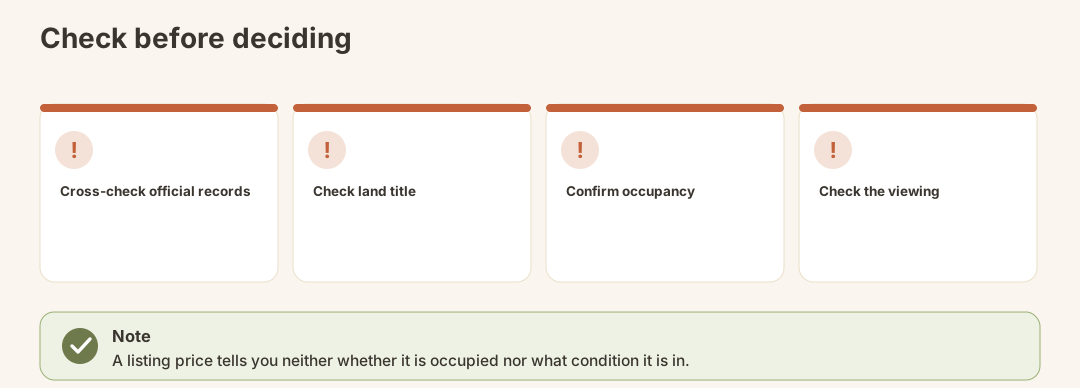
- I know whether this is a sale of a bank-owned property, a judicial auction or an assignment.
- For an auction, I have checked the property against the listing on the official BOE portal.
- Ownership, the property description and relevant land registry entries have been checked.
- The actual possession status has been clarified – not just the wording in the listing.
- I know whether I can view the property and, if so, to what extent.
- I have the terms governing bidding, payment or assignment.
- I have factored taxes, registration, building-related issues and possible next steps into my decision.
What happens next?
For an ordinary sale of a bank-owned property, the next steps are to review the contract documents and prepare for the purchase. For a judicial auction, the specific proceedings and the decisions made in them determine what happens next. Likewise, you should not treat an assignment arising from the proceedings as though it were a completed standard purchase.
For the rest of the buying process, see the guides to the notary’s role when buying property in Spain and buying a resale property in Mallorca. The key is to clarify legal status, possession and condition before planning when and how you can actually use the property.
Conclusion: Understand the process before assessing the price
A bank-owned property may be a house marketed through ordinary channels; a foreclosure auction is a judicial process. In between are offers to sell a position arising from those proceedings. The terms used in the listing are therefore a starting point, not a basis for your purchase decision. Compare the listing with the official case record, check the land registry and possession status separately, and do not base your calculations on the advertised price alone. If you cannot clearly establish how you would acquire the property, that is the most important thing to know before bidding.