
Lawyer for property purchase in Spain: Why the notary isn't enough
Anyone buying a property in Spain often has a pleasant surprise at the notary appointment: everything feels orderly, professional, efficient. What many people only realise afterwards is that the notary did not verify ownership, did not research any outstanding debts, and did not check any planning permissions. The Spanish notarial system simply works differently from the German or Austrian one. Anyone who skips a lawyer when buying property in Spain bears the full legal and financial risk themselves. This guide explains what an independent lawyer does, what pitfalls they prevent, how much they cost — and why the estate agent's tip to use a particular lawyer is often no coincidence.

Would you like to know whether your desired property is legally sound — before you sign the Arras contract?
- 📩 Submit a personal enquiry — we connect you with vetted, independent lawyers in Mallorca
- Understanding the complete purchase process
The crucial difference: what the notary in Spain does — and what they don't
In Germany, Austria, and Switzerland, the notary is the central protective authority in property purchases. They verify ownership, encumbrances, permissions, and draft the contract neutrally for both parties. This picture is fundamentally incorrect when it comes to Spain.
The Spanish notary authenticates the purchase contract (escritura pública) and confirms the identities of the parties involved. They ensure that the formal requirements for registration in the Land Registry are met. However, they carry outno legal or financial due diligence on the property, do not analyse outstanding debts or mortgages in detail, do not assess the planning permission situation, and do not represent either party on substantive matters.
| Task | German notarial system | Spanish notarial system |
|---|---|---|
| Authentication of the purchase contract | ✅ | ✅ |
| Review of Land Registry extract for encumbrances | ✅ | ❌ |
| Check of planning permissions / unauthorised construction | ✅ | ❌ |
| Neutral contract drafting on behalf of the buyer | ✅ | ❌ |
| Check for outstanding community charges | ✅ | ❌ |
| Tax advice on the purchase | ❌ | ❌ |
| Representation of the buyer | ❌ | ❌ |
This gap is structural — no criticism of the notary, but a question of the system. On Mallorca, it is filled by an independent lawyer.
Why "independent" is not a given when it comes to lawyers
It is common practice in Spain for estate agents to recommend a particular lawyer. This sounds helpful. But it frequently is not.
Estate agents in Spain are a largely unregulated profession — there is no mandatory training, no professional body registration, and no personal liability towards the buyer. Their interest lies in a quick sale, not in minimising risk for you. When the recommended lawyer works regularly with the agent, a conflict of interest is structurally built in: anyone who wants to be recommended again tomorrow will not put the brakes on today's deal.
Caution: A lawyer recommended by an estate agent is not automatically conflicted — but you should always instruct them separately, set out the mandate clearly, and obtain written confirmation that they represent solely your interests.
Self-styled "relocation consultants" or online flat-rate packages are equally no substitute for a qualified lawyer. They often possess neither a legal qualification nor a liable professional registration (colegiado).
What an independent lawyer does for you in practice
The work begins long before the notary appointment — ideally before the arras contract.
1. Due diligence on the property
This is the core of it. A good lawyer checks:
- Land registry extract (nota simple): owners, encumbrances, mortgages, easements, rights of pre-emption
- Cadastral situation: Does the registered floor area match the actual one?
- Planning permissions: Were extensions or conversions approved and correctly registered?
- Illegal construction: Is there any non-legalised built fabric? Is retrospective approval possible?
- Municipal debts: Outstanding IBI payments, refuse charges, development costs
- Community debts (comunidad de propietarios): Is there a resolution in place for a special assessment?
- Cédula de Habitabilidad: Is the habitation certificate in place, or does it need to be renewed?
- Energy certificate: A mandatory document without which no sale is possible
Note: In the worst case, unlegalised building work can result in a demolition order. Retrospective approval is possible in some cases, but it incurs considerable costs and uncertainty.
2. Review and negotiation of preliminary contracts
Before you sign the arras contract (contrato de arras penitenciales), your solicitor should have read it. Because:
- The deposit is generally 10 % of the purchase price
- It is non-refundable
- if the buyer withdraws — if the seller withdraws, you receive double the amount back — but only if the contract is correctly drafted
- Deadlines, conditions and withdrawal rights vary considerably depending on how the contract is structured
3. NIE application and tax preparation
Without a Número de Identificación de Extranjeros (NIE), no property purchase is possible. Your solicitor can arrange this by power of attorney and also discuss the tax structure of the purchase in advance — for example, whether buying through a Spanish SL makes sense from a tax perspective.
4. Attendance at the notary appointment and afterwards
At the notary appointment, the solicitor checks whether the final contract text corresponds to the agreed content. After the purchase, they handle:
- Registration with the tax authorities (ATIB in the Balearic Islands)
- Payment of property transfer tax ITP or, in the case of a new build, IVA + AJD
- Registration in the land registry
- Transfer of utility contracts (electricity, water)
The Balearic property transfer tax (ITP): What your lawyer needs to know
The Balearic Islands operate a progressive ITP system. Your lawyer must calculate the tax liability correctly, file it within the required deadlines and in the proper form, and remit it to the Agència Tributària de les Illes Balears (ATIB).
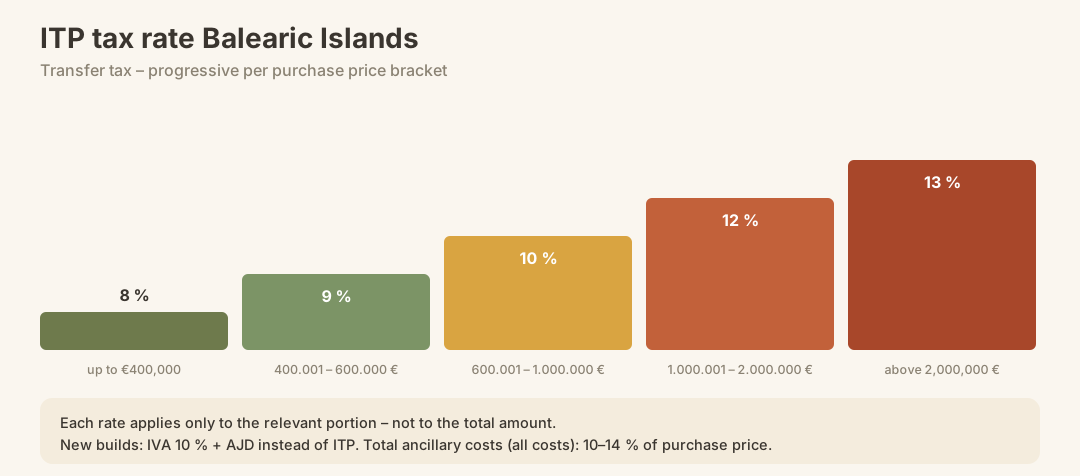
| Purchase price bracket | ITP rate (Balearic Islands) |
|---|---|
| Up to 400.000 € | 8 % |
| 400.001 € to 600.000 € | 9 % |
| 600.001 € to 1.000.000 € | 10 % |
| 1.000.001 € to 2.000.000 € | 12 % |
| Over 2.000.000 € | 13 % |
Important: The tax rate is progressive — each bracket applies only to the portion of the purchase price within that bracket, not to the total amount.
For new builds, ITP does not apply. Instead, IVA (10 %) and stamp duty AJD are payable. The total purchase costs remain similarly high — typically between 12 and 13 % of the purchase price.
As a rule of thumb, you should budget 10 to 14 % on top of the purchase price for all ancillary costs (taxes, notary, lawyer, land registry). Find out more in the detailed guide to purchase costs in Mallorca.
Typical pitfalls without a lawyer: real-life cases
These situations recur — not out of any bad faith on the part of sellers, but because the process is blind without legal guidance.
Case 1: The unauthorised terrace A buyer takes over a finca with a covered terrace. The roof structure was never approved. Only after the purchase does the local authority issue a demolition order. Retrospective approval: costly and uncertain.
Case 2: Community Debts Shortly before the sale, the owners' community passed a special levy for façade renovation. The seller failed to disclose this. The new owner is liable — debts to the comunidad transfer with the property.
Case 3: The Arras Without a Withdrawal Clause The buyer signs an arras contract on the estate agent's recommendation. Financing clauses are absent. The bank refuses the loan. The 10 % deposit is lost.
Case 4: The Missing Cédula The flat has no valid certificate of habitability. Without it, electricity and water contracts cannot be transferred to the new owner. Reissuing the certificate takes months and is not guaranteed, depending on the condition of the property.
Legal Fees for Property Purchases in Spain
An independent solicitor typically charges 1 to 2 % of the purchase price for full purchase support, plus VAT (IVA). For lower-value properties, minimum fees often apply.
| Service | Typical Billing |
|---|---|
| Due diligence (land registry, cadastre, planning law) | Usually included in the flat fee |
| Review of arras contract | Usually included in the flat fee |
| NIE application by power of attorney | Separate, depending on workload |
| ITP/AJD tax filing | Usually included in the flat fee |
| Land registry entry | Separate (official fee) |
| Power of attorney for purchase in absentia | Separate fee |
Compared with the risks — loss of deposit, illegal construction, debts, tax errors — the fee is a manageable insurance premium.
The Estate Agent: Useful for the Search, Not for Legal Review
Estate agents play an important role in buying property on Mallorca: they know the market, organise viewings, and assist with price negotiations. However, their legal responsibility towards the buyer is limited.
In Spain, an estate agent instructed by the seller is in principle liable for serious breaches of duty not directly towards the buyer. Misrepresentations or undiscovered defects are legally the buyer's problem — unless a dedicated solicitor has carried out the due diligence.
Furthermore, the profession of estate agent is unregulated in Spain. There is no mandatory membership of a professional body, no minimum training requirement, and no professional indemnity insurance as a legal prerequisite. This is not a value judgement about individual agents — but it is a practical reason to commission the legal review separately.
Most common mistakes when buying property without your own solicitor
- Signing the arras contract without due diligence — putting 10 % of the purchase price at risk before anything has been checked
- Instructing the agent's recommended solicitor — without written confirmation of exclusive representation of your interests
- Confusing the notary with a solicitor — the notary does not examine commercial risks
- Leaving the NIE application to the last minute — no NIE, no purchase contract
- Missing the ITP deadline — the transfer tax must be filed within 30 working days of signing the escritura
- Failing to check the cédula and energy certificate — both are mandatory documents; without them there are no utility contracts and no legally valid sale
- Ignoring community debts — they automatically pass to the buyer
- Issuing a power of attorney incorrectly — anyone who cannot appear in person before the notary needs a correctly apostilled power of attorney or one notarised in Spain
What comes next? Obligations as a new owner
Once the land registry entry is made, the role of owner begins — along with new deadlines.
- IBI (council tax): Annual payment to the local authority; due dates vary by municipality. More on this: IBI tax Spain
- Wealth tax (Impuesto sobre el Patrimonio):: Relevant above certain wealth thresholds, including for non-residents. Details: Wealth tax Spain
- Owners' community: If applicable, monthly/annual service charges; right to vote at residents' meetings. More: Owners' community Spain
- Insurance: Buildings insurance is not required by law, but is mandatory for a mortgage and generally advisable. Contents insurance Spain
- Intention to let: Anyone wishing to let their property needs various licences depending on the type of use (holiday rental, long-term rental) and must declare rental income for tax purposes. Rental income as a non-resident
Checklist: What your solicitor does before the notary appointment
- Land Registry extract (nota simple) requested and reviewed
- Cadastral situation checked, discrepancies in floor area documented
- Planning permissions for all structural elements requested from the Ayuntamiento
- Unauthorised structures identified and assessment of regularisation prospects initiated
- IBI arrears checked with the Ayuntamiento
- Community debts checked with the administrator of the comunidad
- Cédula de Habitabilidad checked (note validity period)
- Energy certificate present and registered in the Registro
- Arras contract reviewed for withdrawal clauses, deadlines and conditions
- NIE number in place or application initiated by power of attorney
- Tax structure of the purchase discussed (private individual vs. SL)
- Money transfer compliance ensured (AWV reporting obligation Spain)
- Power of attorney for notary appointment correctly drawn up (Power of attorney Spain notary)
Conclusion: An independent solicitor is not optional — it is standard practice
The Spanish system is not inferior to the German one — it is simply structured differently. The notary certifies; the solicitor protects. In Mallorca, buyers are operating in a market with high price levels, complex planning law (Suelo rústico, unauthorised builds, Tramuntana protected zone) and an unregulated estate agency market. In this environment, an independent, qualified solicitor — abogado colegiado — not a luxury option, but the sensible foundation of every purchase.
Instruct one before the Arras contract. Verify that they are mandated exclusively on your behalf. And leave deadlines and communication with authorities to them — that is their territory in Spain.
More on the complete purchase process · Purchase ancillary costs in detail · Checking the Spanish Land Registry
Official Sources
- Agència Tributària de les Illes Balears (ATIB) — Property Transfer Tax ITP, tax rates Balearic Islands: https://www.atib.es
- Consell de Mallorca, Departament de Territori — Building law, Suelo rústico, planning permissions: https://www.conselldemallorca.net
- Registro de la Propiedad (Spanish Land Registry offices) — Nota simple, land registry entry: https://www.registradores.org
- Consejo General del Notariado — Statistics Portal — Transaction data Balearic Islands: https://www.notariado.org
- Agencia Estatal de Administración Tributaria (AEAT) — NIE, tax obligations for non-residents: https://www.aeat.es
- Código Civil español, Art. 1445 ff. — Fundamentals of the purchase/sale contract (compraventa): https://www.boe.es