
Estate agent commission in Mallorca: Who pays how much – and how to find a reputable agent
The estate agent's commission in Mallorca is one of the most frequently misunderstood topics when buying property on the island — and one of the most important for your budget. Unlike in Germany, there is no law in Spain that uniformly regulates commission rates, payment obligations, or professional requirements for estate agents. Who pays, how much, when, and to whom — all of this is a matter of negotiation and must be clearly set out in the agency agreement. This guide explains which rates are standard in Mallorca, whether you as the buyer or seller will be the one footing the bill, when the commission becomes legally due, what types of agents exist on the island, and how to distinguish rogues from reputable professionals — with concrete figures, checklists, and an overview of the total additional purchase costs.

Are you planning a purchase or sale in Mallorca and want to know whether your agency agreement is fair?
- 📩 Submit a personal enquiry — We recommend vetted lawyers and estate agents from our network
- All purchase ancillary costs in Mallorca at a glance
What is the estate agent's commission — and why is it particularly noteworthy in Mallorca?
The estate agent's commission (Spanish: honorarios de agencia or comisión de agencia) is the performance-based fee that an estate agent receives for brokering a transaction. It only becomes due when a purchase contract is actually concluded — in other words, no completion, no commission.
That sounds straightforward, but in Mallorca there is one important particularity: The profession of estate agent is not a legally protected occupation in Spain. There is no uniform statutory licensing requirement, no minimum qualification prescribed by law, and no legally fixed commission rate. In principle, any person may act as a property intermediary — with one exception: lawyers are prohibited from simultaneously working as estate agents under their professional codes of conduct.
What this means for you: the entire question of commission — the rate, the obligation to pay, and when it falls due — depends on what is set out in the agency agreement. It is well worth reading this contract carefully before signing, or having it reviewed by a legal professional.
Note: Because the estate agency market in Mallorca is lightly regulated, the quality of providers varies considerably. A large number of agencies are active on the island. How to tell reputable providers from dubious ones is explained further down in this article.
How high is the estate agent's commission in Mallorca?
The commission is freely negotiable, but in practice it has settled into clear ranges. The following table shows the market-standard rates by property type:
| Property type | Typical commission rate | Basis |
|---|---|---|
| Standard residential properties | approx. 5 % | Purchase price |
| Upmarket residential properties | 5–6 % | Purchase price |
| Luxury properties (several million €) | 2–3 % | Purchase Price |
| All Categories | + 21 % IVA | on the commission amount |
Worked example: For a property priced at 800.000 €, a commission of 5 % amounts to exactly 40.000 €. On top of that, 21 % IVA is due, adding a further 8.400 €. Total cost for the estate agent's commission: 48.400 €.
Please note: For luxury properties in very high price brackets, a lower commission (2–3 %) is common and often negotiable. At the same time, a higher commission may be agreed in individual cases — for example when the pool of potential buyers is particularly limited or the property is exceptionally difficult to market.
The commission is therefore not a fixed figure. What you should avoid in any case, however, is finding out the commission-relevant figures only after the reservation agreement has been signed. More on this in the section on common mistakes.
Who pays the estate agent's commission: buyer or seller?
This is the most frequently asked question — and on Mallorca the answer is not straightforward.
The instruction principle
In Spain, the general rule is the instruction principle: whoever instructs the agent pays the commission. Since in practice it is often the seller who engages the agent's services to market their property, in many cases it is also the seller who owes the commission.
The situation in practice on Mallorca
In practice on Mallorca, however, the model whereby the buyer pays the commission also exists — or one in which it is split between buyer and seller. Which model applies depends on the individual agent, the property, and the contractual arrangement. The table below shows the three most common models:
| Model | Who pays | When typical |
|---|---|---|
| Seller pays alone | Seller | Common for standard properties; instruction principle |
| Buyer pays alone | Buyer | Occurs on Mallorca |
| Mixed model | Both parties | In some agreements or complex transactions |
What was agreed in the estate agent's or reservation contract is always the deciding factor. There is no legal obligation towards one solution or the other.
Note: Even when the seller formally pays the commission, this amount is in many cases priced into the asking price — meaning the buyer bears it indirectly. This is not a hidden trick, but simply market mechanics. As a buyer, factor this in regardless, and plan your total ancillary costs accordingly.
How payment works in practice
In practice, it is commonly handled as follows: the buyer retains the estate agent's commission payable by the seller from the agreed purchase price and hands the agent a cheque for the corresponding amount upon signing the notarised deed of sale (escritura). The commission thus becomes due at the very moment the buyer has paid the seller in full.
When does the commission become legally due?
The question of when an estate agent's commission falls due has long been a contentious issue in Spain. Several court rulings have brought clarity:
The traditional rule was: commission only becomes due upon signing the notarised purchase contract (escritura) — that is, once the transaction has been successfully completed. This remains the standard case.
However, in a landmark ruling by the Supreme Court dated 21 May 2014, it was established that an estate agent may, under certain circumstances, have a claim to their commission even if they were not involved through to the notarial completion — provided that their activity was instrumental in bringing about the connection between buyer and seller.
| Point in time | Entitlement to commission |
|---|---|
| Completion of escritura at the notary | Standard case — commission unambiguously due |
| Agent brought parties together, completion takes place without them | Possible entitlement (pursuant to landmark ruling 2014) |
| No purchase contract concluded | No entitlement (success-based model) |
Note: To avoid disputes, as a seller you should clearly define in the estate agent's contract under what conditions the commission has been earned. Your lawyer (abogado) can draft this.
Types of estate agent in Mallorca: who is who?
In Mallorca there is a bewildering variety of estate agent types. This rough categorisation will help you understand the landscape:
| Type of agent | Characteristics | Strengths | Weaknesses |
|---|---|---|---|
| Owner-managed agency | Personal service, regional specialist | In-depth local knowledge, direct contact | Smaller network |
| Franchise agent | Part of an international chain | Broad marketing channels, standardised processes | Less flexibility, sometimes high agent turnover |
| Supra-regional agency | Offices on several islands or in multiple countries | Easily accessible to international buyers | Coordination often more complex |
| "Mobile-phone agent" | Individual, often without an office, handling many parallel commissions | Low cost | Little accountability, barely any liability |
Please note: The "mobile-phone agent" category is particularly high-risk. Because the profession is unregulated, there are no minimum requirements. Paying attention to certifications and professional-body memberships is therefore important — more on this in the next section.
How do you recognise a reputable estate agent in Mallorca?
Since the estate-agent profession in Spain is not regulated by law, voluntary professional-body memberships are an important quality indicator. The following criteria will help you assess an agent:
Associations and certifications
| Association / characteristic | What it means |
|---|---|
| API (Agente de la Propiedad Inmobiliaria) | State-recognised title, professional indemnity insurance, continuing professional development obligation |
| ABINI (Asociación Balear de Inmobiliarias) | Balearic estate-agents' association; members commit to a code of professional conduct |
| FIABCI | International real-estate association; membership demonstrates international networking |
| Written estate agent contract | A requirement of every reputable agent – commission, scope of services, and duration clearly defined |
| Proof of professional indemnity insurance | Protects you in the event of errors or damage caused by the agent |
Minimum requirements you should check
- Tax registration: The agent must be registered as a business for tax purposes (autónomo or SL) and must be able to provide a Spanish tax number (CIF/NIF).
- Written contract: No reputable agent works without a written agreement covering commission and scope of services.
- References and reviews: Verifiable client reviews and traceable reference transactions.
- Transparency regarding commission: The commission and its tax treatment (IVA 21 %) must be clearly communicated before the instruction is placed.
- No dual instruction without transparency: If an agent acts for both buyer and seller (agente dual), they must disclose this.
What does an estate agent on Mallorca do – and what don't they do?
Before you decide whether the commission is worth the price, it is worth taking a closer look at the range of services a professional agent on the island provides:
What a good agent takes care of:
- Market price analysis and valuation of the property
- Professional property photography and preparation of the exposé
- Marketing via national and international portals as well as the agent's own network
- Pre-qualification of prospective buyers
- Organisation and accompaniment of viewings
- Negotiation between the parties
- Coordination with the notary, solicitor, and bank where applicable
- Accompaniment through to the signing of the escritura
What an agent does not replace:
- The legal due diligence on the property (that is the responsibility of your solicitor)
- Tax advice (tax consultancy)
- The land registry check (Registro de la Propiedad)
Please note: On Mallorca it is absolutely standard practice and strongly recommended to engage an independent lawyer in addition to the estate agent. They will check encumbrances in the land registry, planning and building law status, outstanding debts, and the contract — matters that fall outside the scope of the estate agent's services.
Estate agent commission and total purchase costs: what you really need to budget for
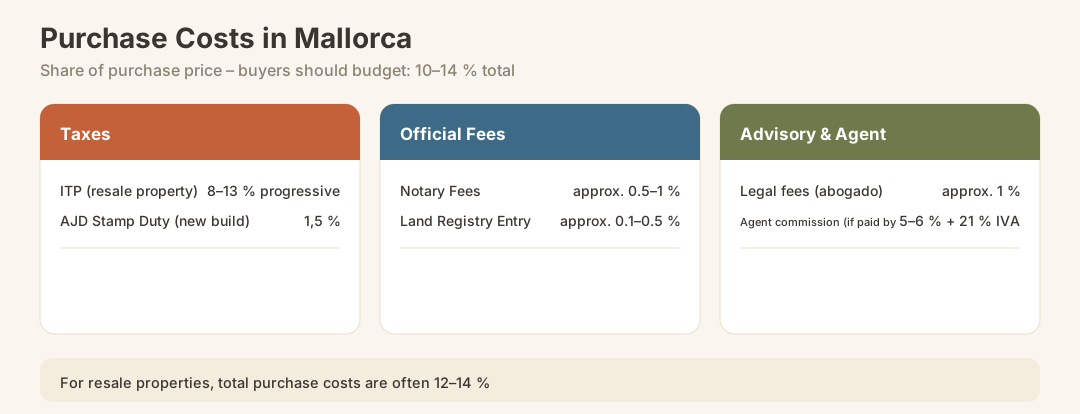
The estate agent's commission is one part of a larger block of ancillary costs. As a buyer on Mallorca you should budget for 10 to 14 % on top of the purchase price as total additional costs. For resale properties the figure is closer to 12–14 % due to the progressive property transfer tax (ITP).
| Cost item | Typical amount | Who pays |
|---|---|---|
| ITP (property transfer tax, resale property) | 8–13 % progressive | Buyer |
| Notary fees | approx. 0.5–1 % | Buyer |
| Land registry entry | approx. 0.1–0.5 % | Buyer |
| Legal fees (abogado) | approx. 1 % | Buyer |
| Estate agent commission (if paid by buyer) | 5–6 % + 21 % IVA | Buyer or seller |
| Stamp duty AJD (new builds only) | typically 1.5 % | Buyer |
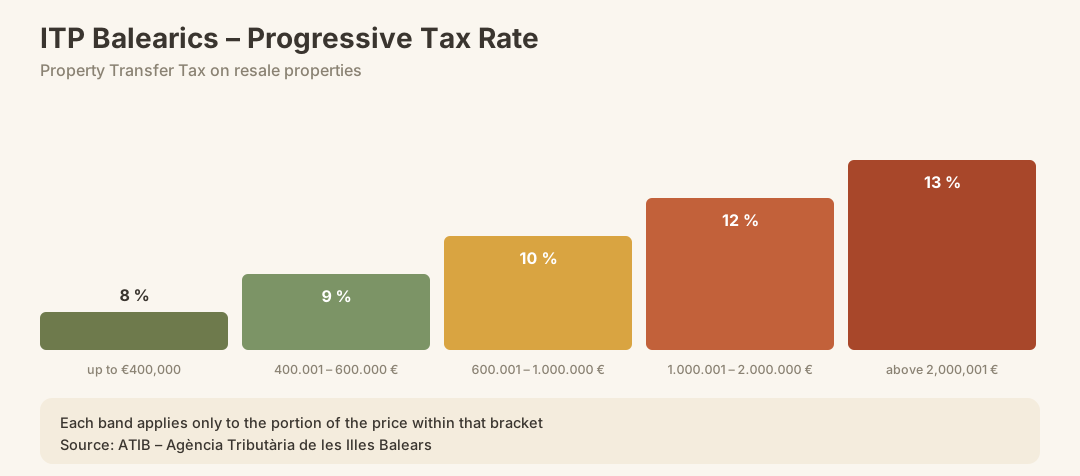
The ITP on the Balearic Islands is calculated on a progressive basis: 8 % on the first 400.000 €, 9 % on the portion between 400.001 and 600.000 €, 10 % on 600.001 to 1.000.000 €, 12 % on 1.000.001 to 2.000.000 €, and 13 % above 2.000.001 €.
You can find more details in our comprehensive guide to purchase costs on Mallorca and specifically on the ITP Balearen 2026.
Sole agency or open mandate: which is better?
Many property owners on Mallorca instruct several estate agents simultaneously — hoping to achieve greater reach. That is understandable, but it comes with drawbacks:
| Model | Advantages | Disadvantages |
|---|---|---|
| Sole agency (exclusiva) | Agent invests more (photography, marketing, network); clearly defined responsibility | You are tied to one agent for the duration of the contract |
| Open mandate (multiple agents) | Theoretically greater reach | Agents invest less, as the commission is uncertain; the property can come across as "stale" on the market; multiple listings with different prices confuse buyers |
Tip: A well-negotiated sole agency agreement with a clear duration and defined marketing obligations is more efficient in most cases than an open mandate. Make sure an exit clause is included in case the agreed services are not delivered.
Most common mistakes when dealing with estate agent commission on Mallorca
These mistakes regularly cost buyers and sellers money or time:
- No written commission agreement — Verbal arrangements are difficult to enforce. Always confirm everything in writing.
- Only discovering the commission in the reservation contract — Some buyers only find out at the reservation contract stage that they are expected to pay the commission. Clarify this at the very first meeting.
- Forgetting IVA — 21 % VAT is added on top of the commission. On a commission of 40.000 €, that is an additional 8.400 €.
- Instructing an agent without professional indemnity insurance — If something goes wrong, there may be nobody liable.
- Not engaging an independent solicitor – The estate agent represents their own interests – not necessarily yours. A solicitor is not optional; it is essential.
- Instructing multiple agents without a clear arrangement – This leads to disputes over who has earned the commission.
- Confusing the commission with part of the purchase price – The commission is a separate fee paid to the agent and does not appear in the notarised purchase price. This has tax implications.
What happens next? The process after choosing an agent
Once you have selected and instructed an agent (whether as buyer or seller), a clearly structured process follows:
- Property search / marketing – The agent prepares a listing or sources suitable properties
- Viewings – The agent coordinates and accompanies
- Offer and price negotiation – The agent mediates between the parties
- Reservation agreement (contrato de reserva or arras) – First binding stage; have the Reservierungsvertrag Spanien reviewed carefully
- Due diligence – Your solicitor checks the Grundbuch, encumbrances, and planning permissions
- Private purchase contract (contrato privado de compraventa)
- Notarised purchase deed (Escritura) – This is when the commission becomes due; the process at the notary
- Land registry entry and tax payment
You can find the complete legal process in our guide to the legal process when buying property on Mallorca.
Checklist: Finding and instructing a reputable estate agent on Mallorca
Before you sign an agent's contract, go through this list:
- Agent is registered for tax purposes (CIF/NIF present and verifiable)
- Written agent contract in place (commission, duration, scope of services, termination conditions)
- Commission including IVA clearly stated
- Who pays the commission (buyer, seller, split) is contractually agreed
- Agent is a member of a recognised association (API, ABINI or similar) or has evidence of comparable qualification
- Professional indemnity insurance in place
- References checked / verifiable reviews examined
- Sole agency clause (duration, exit for non-performance) negotiated
- Independent lawyer (abogado) already instructed or to be instructed shortly
- Commission arrangement discussed with lawyer before reservation contract is signed
Conclusion
The estate agent's commission on Mallorca is in practice 5–6 % of the purchase price plus 21 % IVA – with no statutory regulation, based purely on market convention and freedom of contract. Who pays is not regulated by law: in practice it is often the seller, sometimes the buyer – depending on the agreement. The commission is generally due as soon as the notarial purchase contract has been signed.
What makes matters equally difficult for both buyers and sellers is that the estate agency profession is unregulated in Spain. For this reason, association memberships, written contracts, professional indemnity insurance and comparing several providers are not optional extras but essentials. And: the agent is no substitute for a lawyer. Anyone buying or selling on Mallorca needs both.
As a buyer, budget for total additional costs of 10–14 % on top of the purchase price – depending on the agreement, the estate agent's commission may also be included in this. As a seller, you should regard the commission as a marketing investment rather than money lost: in a tight market, a good agent will often achieve a higher price than the cost of their commission.
Official sources
- Tribunal Supremo (Supreme Court of Spain): Landmark ruling on when the estate agent's commission falls due, dated 21 May 2014 – www.poderjudicial.es
- Agencia Tributaria (AEAT) – IVA (value added tax): Currently applicable IVA rate of 21 % on services – www.agenciatributaria.es
- Agència Tributària de les Illes Balears (ATIB) – ITP: Balearic property transfer tax scale – www.atib.es
- Registradores de España – Registro de la Propiedad: Land Registry entry and encumbrance search – www.registradores.org
- Consell de Mallorca – Urbanisme: Planning and building regulations Mallorca – www.conselldemallorca.net
- Colegio Oficial de Agentes de la Propiedad Inmobiliaria (COAPI): Professional association of licensed API estate agents – www.coapi.org