
Additional purchase costs when buying property in Mallorca: complete overview
When you buy a property in Mallorca, the purchase price is only part of the equation. The additional purchase costs when buying property in Mallorca typically amount to between around 10 and 13 per cent on top — for resale properties this is driven by the progressive Balearic property transfer tax (ITP), and for new builds by VAT (IVA) plus stamp duty (AJD). On top of that come notary fees, land registry fees, gestoría fees, and usually a solicitor. This overview breaks down every line item with current figures for 2026, two fully worked examples (€500,000 and €1.5 million), and the ongoing costs thereafter — so your budget holds no surprises.

Are you planning a purchase and want the additional costs calculated accurately in advance?
- 📩 Submit a personal enquiry — we will estimate your purchase costs specifically for your target property and your circumstances
- To the property guide
What actually counts as additional purchase costs?
The additional costs fall into two categories: taxes (by far the largest item) and professional and administrative fees (notary, land registry, gestoría, solicitor). Which tax applies depends solely on whether you are buying a resale property or a new build — the two are mutually exclusive:
| Category | Resale property (second transmission) | New build (first sale from developer) |
|---|---|---|
| Main tax | ITP (progressive, 8-13 %) | IVA 10 % + AJD 1.5 % (2 % from €1 million) |
| Notary (escritura) | yes | yes |
| Land registry (Registro) | yes | yes |
| Gestoría | optional, customary | optional, customary |
| Solicitor | recommended (~1 %) | recommended (~1 %) |
| Estate agent commission | typically the seller | typically the seller/developer |
ITP and IVA are never levied simultaneously on the same purchase. Resale properties between private individuals are subject to ITP; a new build purchased directly from the developer is subject to IVA plus AJD. This is precisely where the most costly miscalculations occur — more on that below.
The full breakdown: 10–13 % in detail
The following table is the centrepiece. It shows every line item, the applicable rate, and what it is based on. Percentages refer to the purchase price or the tax assessment value (more on that shortly).
| Item | Resale | New build | Assessment base / Note |
|---|---|---|---|
| ITP (Property Transfer Tax) | 8–13 % on a sliding scale | — | Balearic tiered rate, see below |
| IVA (VAT) | — | 10 % | on the purchase price, payable to the developer |
| AJD (Stamp Duty) | — | 1.5 % (2 % from 1 Mio. EUR) | on the notarised value |
| Notary (escritura compraventa) | ~0.1–0.4 % | ~0.1–0.4 % | statutory Arancel, decreasing with price |
| Land Registry (Registro de la Propiedad) | ~0.05–0.25 % | ~0.05–0.25 % | statutory Arancel, decreasing with price |
| Gestoría | ~300–600 EUR | ~300–600 EUR | Tax filing and registration processing |
| Solicitor (optional, recommended) | ~1 % | ~1 % | Due diligence, representation |
| Estate agent commission | usually the seller | usually the developer | generally not applicable to the buyer |
Important regarding the tax base: For ITP, the higher value of the purchase price and the official valor de referencia of the land registry applies. If the notarised price is lower, the ATIB will still tax the reference value. So do not plan based solely on the negotiated price.
The Balearic ITP progressive rate schedule (resale properties)
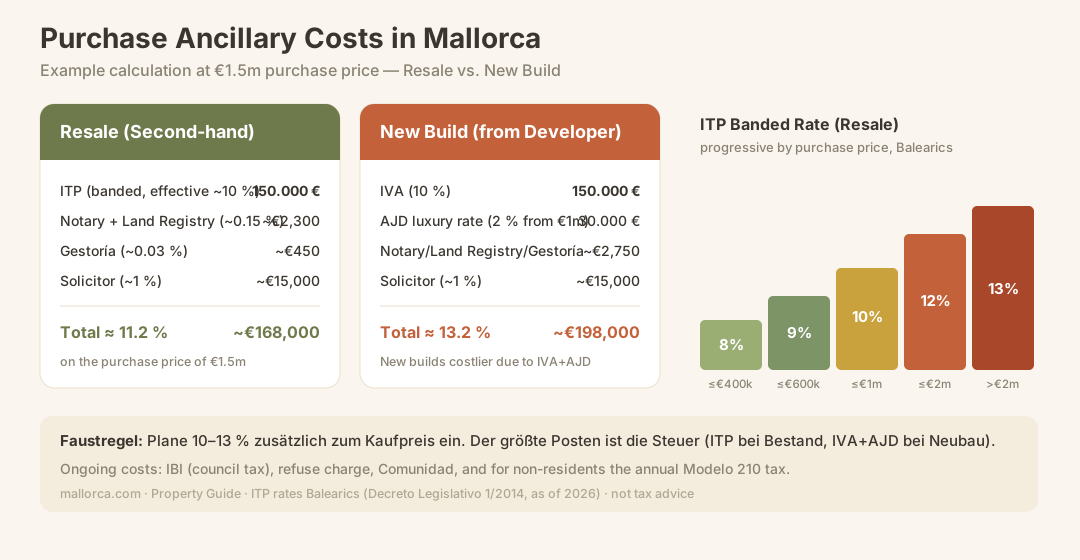
The Balearic Islands levy ITP not as a single percentage on the total price, but progressively in bands — similar to income tax. Each band is applied only to the portion of value within that band. This scale continues to apply under Decreto-ley 4/2023:
| Value band (tax base) | Marginal tax rate |
|---|---|
| up to 400,000 EUR | 8 % |
| 400,000.01 - 600,000 EUR | 9 % |
| 600,000.01 - 1,000,000 EUR | 10 % |
| 1,000,000.01 - 2,000,000 EUR | 12 % |
| over 2,000,000 EUR | 13 % |
The most common mistake: applying the top rate to the entire purchase price. This is incorrect and significantly overestimates the tax. The correct approach is to calculate band by band (see worked examples).
New build: IVA 10 % + AJD 1.5 % — and the luxury surcharge
For new builds purchased from a developer, 10 % IVA applies to the purchase price (payable to the developer, not to the ATIB), plus AJD on the notarised value. The standard AJD rate in the Balearic Islands is 1,5 %. With effect from 1.1.2023, however, an increased rate of 2 % applies as soon as the actual or declared property value is equal to or above 1,000,000 EUR. This luxury rate is enshrined in Article 17 bis of Decreto Legislativo 1/2014 (introduced by the Balearic budget law Ley 11/2022, in force since 1.1.2023) — not in the later Decreto-ley 4/2023, which governs the ITP bands. In the premium segment, the 2 % rate is the rule rather than the exception.
Worked example 1: Resale property at 500,000 EUR
Assumptions: resale property, purchase between private individuals, tax base = purchase price 500,000 EUR, no reduced rate.
ITP by band:
| Band | Amount in the band | Rate | Tax |
|---|---|---|---|
| up to €400,000 | €400,000 | 8 % | €32,000 |
| €400,000–€500,000 | €100,000 | 9 % | €9,000 |
| ITP total | €41,000 |
This equates to an effective average rate of 8,2 % — not 9%.
Other ancillary costs (estimate):
| Item | Amount (approx.) |
|---|---|
| ITP | €41,000 |
| Notary | ~€700–€1,000 |
| Land registry | ~€500–€700 |
| Gestoría | ~€350–€500 |
| Solicitor (~1%) | ~€5,000 |
| Total ancillary costs | ~€47,600–€48,200 |
Overall, approximately 9.5–9.7% on top. Without a solicitor, approximately 8.5%.
Worked example 2: Villa at €1,500,000
This is where the progressive rate becomes noticeable — and in the case of a new build, the AJD luxury surcharge applies.
Option A — Resale (ITP):
| Band | Amount in the band | Rate | Tax |
|---|---|---|---|
| up to €400,000 | €400,000 | 8 % | €32,000 |
| 400,000–600,000 EUR | 200,000 EUR | 9 % | 18,000 EUR |
| 600,000–1,000,000 EUR | 400,000 EUR | 10 % | 40,000 EUR |
| 1,000,000–1,500,000 EUR | 500,000 EUR | 12 % | 60,000 EUR |
| Total ITP | 150,000 EUR |
Effective average rate: 10 %.
Option B — New build (IVA + AJD):
| Item | Calculation | Amount |
|---|---|---|
| IVA | 10 % of 1,500,000 EUR | 150,000 EUR |
| AJD (luxury rate 2 %) | 2 % of 1,500,000 EUR | 30,000 EUR |
| Total tax | 180,000 EUR |
Other ancillary costs (both options, approx.):
| Item | Amount (approx.) |
|---|---|
| Notary | ~1,200–1,800 EUR |
| Land registry | ~800–1,100 EUR |
| Gestoría | ~400–600 EUR |
| Solicitor (~1 %) | ~15,000 EUR |
This puts the resale option at around 11,2 % in total ancillary costs, and the new-build option at around 13,2 % — the 2 % luxury AJD makes the difference clearly visible.
Who pays what?
Not every item falls to the buyer. The allocation below reflects the statutory default rule — deviating agreements are sometimes possible, but cannot be enforced against the tax authorities.
| Position | Buyer | Seller | Negotiable? |
|---|---|---|---|
| ITP / IVA + AJD | ✅ | — | no (statutory) |
| Plusvalía municipal (IIVTNU) | — | ✅ | privately yes, vis-à-vis the authority no |
| Notary (protocol copy) | — | ✅ (general rule) | yes |
| Notary (first copy) | ✅ | — | yes |
| Land Registry entry | ✅ | — | yes |
| Gestoría (purchase) | ✅ | — | yes |
| Estate agent commission | usually — | usually ✅ | yes |
| Energy performance certificate | — | ✅ | no |
Two points are particularly relevant for buyers on Mallorca: The estate agent commission is usually borne by the seller (unlike in many other EU countries) — the standard rate is around 5-6 % of the sale price (sometimes above that when IVA is included). And the Plusvalía municipal (land value increment tax) is legally payable by the seller; a contractual transfer of this liability to a consumer-buyer may be challengeable as an unfair contract term.
Ongoing costs after purchase
Signing the deed is just the beginning. As an owner, you face annually recurring costs — and as a non-resident owner in Spain, your own tax-filing obligations.
| Cost type | Amount / Basis | Frequency |
|---|---|---|
| IBI (property tax) | Multiplier × cadastral value; Palma ballpark ~0.5–0.8 % of cadastral value | annually |
| Refuse charge (tasa de residuos) | municipal charge + incineration tariff of the Consell de Mallorca | annually/half-yearly |
| Comunidad de propietarios | service charge for owners' communities, varies by property | monthly/quarterly |
| Modelo 210 (IRNR) | Tax return for non-residents | annually |
IBI: Property tax is calculated on the cadastral value (not the market value) multiplied by the municipal rate. The cadastral value is often considerably lower than the purchase price, which is why IBI tends to be more modest than the market value might suggest. The reference date is 1 January: whoever is the owner on that date owes IBI for the entire year — when purchasing, the current year is often apportioned between the parties.
Refuse: In Mallorca, the incineration tariff of the Consell de Mallorca is added on top of the municipal refuse charge. For 2026, the Consell has reduced waste tariffs by 10 % — a rare piece of relief in an otherwise rising refuse-charge environment.
Modelo 210 — the most costly item to forget: If you are a non-resident who owns a self-used (not let) property, you must file an annual notional income tax return on an imputed rent — even if the property stands empty:
| Case | Assessment basis | Tax rate |
|---|---|---|
| Cadastral value reviewed in the last 10 years | 1.1 % of cadastral value | 19 % (EU/EEA) / 24 % (third country) |
| Cadastral value older | 2.0% of the cadastral value | 19 % / 24 % |
| Rental income (EU/EEA) | Rental income less deductible expenses | 19 % |
| Rental income (third country) | Rental income without deduction | 24 % |
The reduced rate of 19% applies to residents of the EU and the EEA (Iceland, Norway, Liechtenstein); for third countries — including the United Kingdom since Brexit — the rate is 24%, and only EU/EEA residents may deduct expenses on rental income. The deemed rental income imputation (referred to in the AEAT guidance as renta inmobiliaria imputada, Tipo de renta 02) is declared once a year — for the 2025 tax year, by the end of 2026. Anyone who ignores this risks back-payments, late surcharges, and penalties.
The most common mistakes
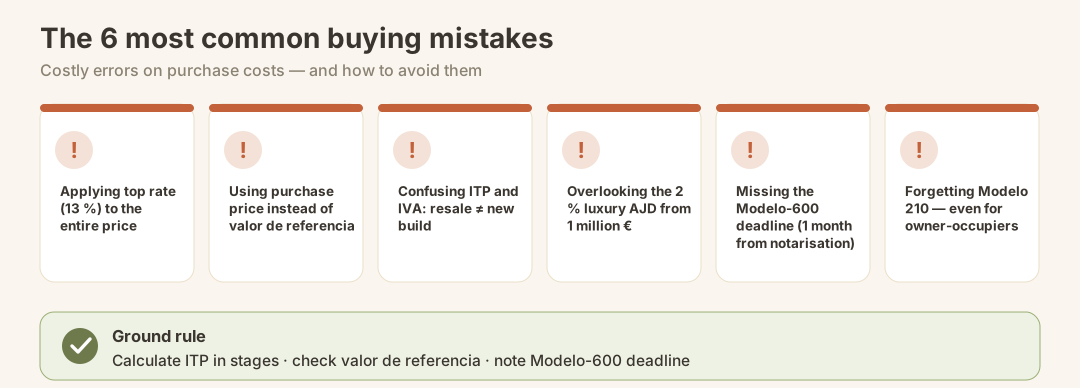
- Applying the top rate to the entire purchase price. ITP is progressive. The 13% rate applies only to the portion of the value above €2,000,000, not to the total purchase price.
- Calculating based on the purchase price alone. The taxable base for ITP is the higher of the purchase price and the valor de referencia as determined by the cadastre. If the reference value is higher, you will pay more.
- Confusing ITP and IVA. Resale property = ITP. New build from a developer = IVA + AJD. The two never apply simultaneously — misclassifying this can throw your budget seriously off.
- Overlooking the 2% luxury AJD. For new builds valued at €1,000,000 or more, stamp duty is 2% rather than 1.5%.
- Missing the deadline. ITP/AJD is self-assessed via Modelo 600 with the ATIB — the binding deadline for the Balearic Islands is one month from the date of notarisation (ATIB). Late submission incurs surcharges and default interest.
- Forgetting Modelo 210. As a non-resident, you have an annual filing obligation — paying the local IBI does not substitute for it.
Checklist before signing at the notary
- Resale or new build confirmed → correct tax (ITP vs. IVA+AJD) budgeted for
- Valor de referencia checked with the cadastre (higher than the purchase price?)
- ITP calculated on a stepped basis — not a flat rate using the top rate
- For new builds ≥ €1,000,000: 2% AJD rather than 1.5% accounted for
- Provision set aside for notary + land registry + gestoría fees
- Solicitor/due diligence instructed (~1%)
- Who bears the estate agent's commission — agreed in writing
- Modelo 600 deadline noted in the calendar (1 month from notary appointment, ATIB)
- Ongoing costs (IBI, refuse collection, Comunidad, Modelo 210) included in the budget
What comes next?
After the purchase come the operational matters: the annual Modelo 210 obligation as a non-resident, where applicable the NIE number for all tax and administrative processes, and — if you are not using the property yourself — letting it out. Entry points for these topics:
- Relocation Guide — authorities, taxes, registration
- Applying for a NIE number on Mallorca — a prerequisite for every purchase
- Long-term rental on Mallorca — if you want to let rather than use the property yourself
- Current market report — understanding price levels and locations
Conclusion
Budget for buying property on Mallorca with 10–13 % in additional purchase costs on top of the purchase price. For resale properties, the progressive ITP dominates (8 % up to 400.000 EUR, rising to 13 % above 2 Mio. EUR); for new builds, the combination of 10 % IVA + 1,5 % AJD applies — with the 2 % luxury surcharge from 1 Mio. EUR upwards. Notary, land registry and gestoría fees are comparatively modest, while a lawyer typically accounts for around 1 %. Anyone who calculates in stages from early on, checks the catastral reference value and factors in the ongoing costs (IBI, rubbish collection, Comunidad, Modelo 210) from the outset will buy without any unpleasant surprises. It is always best to verify the exact rates and deadlines against the official ATIB figures.
Official sources
- ATIB — Agència Tributària de les Illes Balears — ITP/AJD, Modelo 600, deadline (1 month)
- BOE — Decreto Legislativo 1/2014 (Art. 17 bis: AJD luxury rate 2 % from 1 Mio. EUR)
- BOE — Decreto-ley 4/2023 (Balearic ITP tiered scale / ISD reform)
- AEAT — Modelo 210 IRNR, instructions
- BOE — Real Decreto 1426/1989 (notary fee schedule)
- Real Decreto 1427/1989 (land registry fee schedule)
- Consell de Mallorca — waste disposal tariff 2026
Disclaimer: This article is a general guide only and does not constitute tax or legal advice. Tax rates, thresholds, reduced rates and deadlines are subject to change and depend on your individual circumstances (residency status, marital status, primary residence, property value). The only binding references are the official sources (ATIB, AEAT) and advice from a gestoría, tax adviser (asesor fiscal) or lawyer. In particular, verify the exact Modelo 600 deadline and any applicable reduced rates before signing the escritura.