
Fixed or variable mortgage in Spain: which model suits you?
You've found the property, the numbers add up – and now the question hanging in the air is: how do you actually finance it? The decision between a fixed variable mortgage Spain is no purely academic exercise, but has very real consequences for your monthly repayment, your risk profile and your liquidity over the next 20 or 30 years. This guide explains exactly how fixed-rate, variable-rate and mixed mortgages work in Spain, where the Euribor comes into play, what distinguishes non-residents from residents – and whether you're better off going directly to a bank or engaging a specialist mortgage broker. By the end, you'll know which questions you need to ask before you sign.

Would you like to know which mortgage model suits your buyer profile in Mallorca?
- 📩 Submit a personal enquiry — individual assessment for your situation
- All the information on property financing in Mallorca
The Spanish mortgage system: what's immediately different
Anyone coming from Germany, Austria or Switzerland often encounters surprises at first contact with a Spanish bank. Some differences are structural in nature and affect every buyer regardless of nationality or place of residence.
No standard interest rates. Spanish banks do not publish binding list prices for overseas buyers. Every bank has its own interest-rate policy, and your specific offer will depend on your individual buyer profile – income, debt ratio, equity, country of origin. A rate comparison without a personal assessment is therefore always only a rough guide.
Mandatory products as a rate discount. In Spain it is common practice for banks to offer lower interest rates if you simultaneously take out other products: life insurance, home contents insurance, a salary account. This is virtually unheard of in Germany. In Mallorca you should always compare the annual percentage rate (TAE/APR), not just the nominal rate.
Valuation report (Tasación) as the basis. The bank does not simply lend you a percentage of the purchase price, but a percentage of the lower of the purchase price and the official bank valuation (Tasación). If the Tasación comes in below the purchase price, your loan amount decreases – and your equity requirement increases.
| Feature | Spanish bank | German/Austrian bank |
|---|---|---|
| Standard rate for overseas buyers | No fixed rate, assessed individually | Often an annuity loan with a fixed rate |
| Mandatory products | Common (insurance, account) | Rare |
| Lending basis | Lower of purchase price/Tasación | Often the purchase price |
| Language requirement | Spanish language skills recommended | German/English |
| Variable rate culture | Widely used (Euribor) | More of a fixed-rate culture |
Resident or non-resident: the most important distinction
Before you start looking at interest rates, you need to clarify one fundamental question: are you tax-resident in Spain (resident) or not? This distinction makes a considerable difference to your financing options.
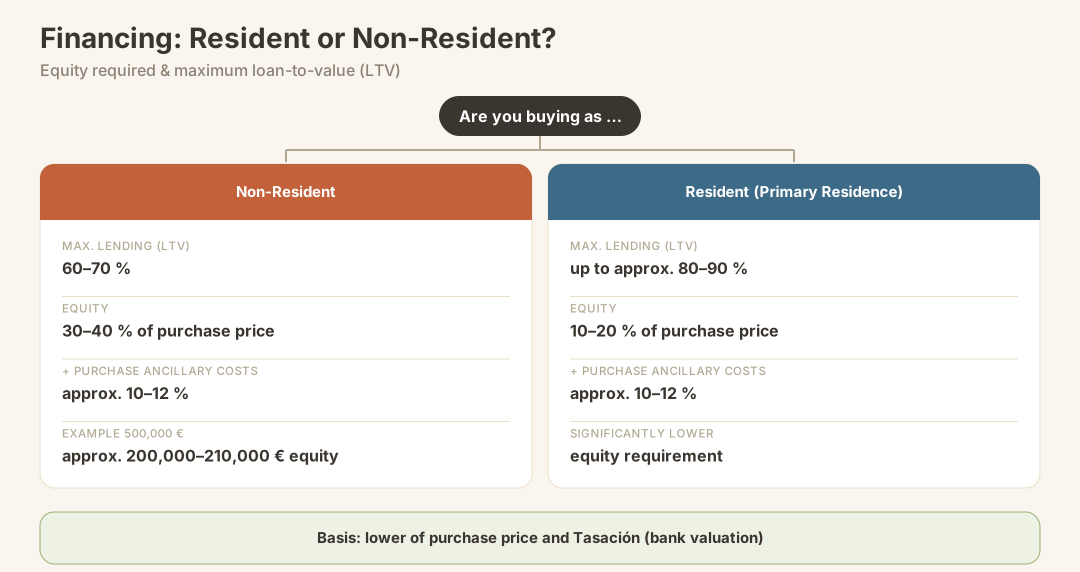
Non-residents are generally offered a maximum of 60 to 70 % of the lending value (Loan to Value, LTV) by Spanish banks. This means: for a property priced at 500.000 €, a non-resident can borrow at most 350.000 €. The remainder – i.e. 150.000 € plus purchase costs of around 10 to 12 % – must come from your own funds. On a purchase price of 500.000 €, that equates to roughly 50.000–60.000 € in ancillary costs, meaning a total equity requirement of around 200.000–210.000 €.
Residents can, by contrast, obtain financing of up to 80–90 % of the lending value, which significantly reduces the equity required.
Please note: The 70 % cap applies to the lower of the purchase price and the tasación. If the tasación comes in below the purchase price, the cap is calculated on the basis of the lower figure.
| Status | Max. lending (LTV) | Equity required (approx.) |
|---|---|---|
| Non-resident | 60–70 % | 30–40 % + ancillary costs |
| Resident (primary residence) | up to approx. 80–90 % | 10–20 % + ancillary costs |
| Purchase ancillary costs in Mallorca | — | approx. 10–12 % of the purchase price |
You can find detailed figures on transfer tax, notary fees, and other ancillary costs in our guide to purchase costs in Mallorca.
A comparison of the three mortgage models
Fixed rate (Hipoteca a tipo fijo)
With a fixed-rate mortgage, you pay the same interest rate throughout the entire term. Your monthly repayment is identical from start to finish – regardless of what the Euribor does.
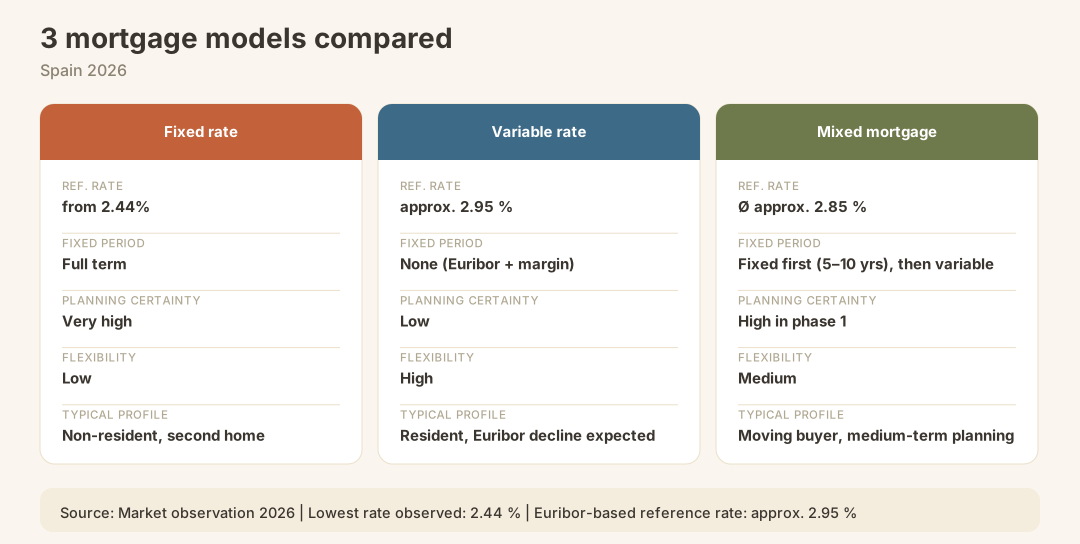
Advantages: Full financial planning certainty, no interest rate risk, ideal for people who do not live permanently in Spain and cannot afford large fluctuations in their cash flow planning.
Disadvantages: The initial interest rate is generally slightly higher than with a variable model. If the Euribor falls sharply, you do not automatically benefit from this.
According to current market observations (as of 2026), the lowest observed interest rate is around 2,44 %, whilst the average across all mortgage models is quoted at approximately 2,85 %. These figures are indicative and may vary depending on the buyer's profile and the bank.
Variable rate (Hipoteca a tipo variable)
Variable mortgages in Spain are typically linked to the 12-month Euribor. Your interest rate is the Euribor plus a bank margin (diferencial). If the Euribor rises, your monthly repayment rises – if it falls, it decreases.
As a reference, research indicates a Euribor-based variable reference interest rate of approximately 2,95 %. For 2026, market observers expect stabilisation rather than a further sharp decline or rise in the Euribor – a return to zero-interest levels remains a distant prospect.
Advantages: Often a more favourable initial rate; you benefit directly from falls in the Euribor.
Disadvantages: Repayment volatility, difficult long-term planning, particularly with second homes or purchasing projects that span across borders.
Mixed mortgage (Hipoteca mixta)
An increasingly popular model: during the first few years (commonly 5 to 10 years) a fixed interest rate applies, after which the loan switches to a variable rate based on the Euribor. You are essentially buying yourself planning certainty during the most critical phase of the financing – the move-in and settling-in period – before transitioning to the variable model thereafter.
Market observations show that many buyers in Mallorca and across Spain as a whole are opting for this variant, not least because the combination of Euribor uncertainty and the comparatively long loan terms strengthens the desire for a transitional guarantee.
| Mortgage type | Interest rate lock-in period | Planning certainty | Flexibility | Typical profile |
|---|---|---|---|---|
| Fixed rate | Entire term | Very high | Low | Non-resident, second home, budgeting is important |
| Variable rate | None (Euribor + margin) | Low | High | Resident, expects Euribor to fall |
| Mixed mortgage | Fixed at first, then variable | High in phase 1 | Medium | Relocating buyer, medium-term planning |
The Euribor: What You Really Need to Know
The 12-month Euribor is the benchmark rate for variable and mixed mortgages in Spain. It is influenced by the European Central Bank (ECB) and is reset on a monthly basis. As a borrower, it affects you in two ways:
- Direct impact on repayments: If the Euribor rises by 1 percentage point, your monthly repayment on a variable mortgage rises accordingly – on a loan of €200,000 over 25 years, that would be a noticeable additional burden running into three figures each month.
- Recalculation: In Spain, variable mortgages are typically recalculated once a year or every six months based on the current Euribor rate (Revisión). You will then be notified of your new monthly repayment.
For 2026, available forecasts point to a period of stabilisation – neither the sharp rises of previous years nor a return to near zero appears likely. This makes variable mortgages more attractive again for buyers with a higher risk appetite, without replacing the planning certainty of a fixed rate.
Note: Euribor forecasts are not guarantees. When taking out a variable or mixed mortgage, always ask for scenarios to be calculated for Euribor at +1% and +2% – the so-called stress test.
What the Bank Requires from You: The Document Package
Spanish banks are particularly thorough when it comes to overseas buyers. This has less to do with mistrust than with the fact that they have to verify your income and repayment capacity themselves, without access to German or Austrian government databases.
Standard documents for non-residents:
- Valid passport or national identity card
- NIE number (Número de Identificación de Extranjero) – absolutely essential; no contract can be signed without it
- Proof of income for the last 6 to 12 months (payslips or tax assessments)
- Overview of all existing debts and financial obligations
- Proof of available equity capital (bank statements, custody account statements)
- Current land registry extract or draft purchase contract for the target property
- Official tasación (bank valuation) – usually commissioned by the bank itself
Please note: Not all Spanish banks have German-speaking advisers. It is advisable to either bring an interpreter or engage a mortgage broker who can handle communication.
A power of attorney can help in cases of absence – more on this in the guide to Power of Attorney at the Notary in Spain.
Financing via a German vs. Spanish bank
You essentially have two financing options: a Spanish bank or a German (or Austrian) bank that specialises in overseas financing.
German/Austrian banks typically finance Mallorca properties as annuity loans with a fixed interest rate. The product is familiar to you, negotiations are conducted in German, and creditworthiness is assessed according to domestic standards. The property on Mallorca is registered as collateral. Disadvantage: not every bank offers this type of financing, and the maximum loan-to-value limits can be more restrictive than those of Spanish lenders.
Spanish banks know the local market, work with a broader range of products (fixed, variable, mixed) and have direct experience with the land registry process on Mallorca. Disadvantage: language barrier, mandatory ancillary products, and an individualised interest rate policy without transparent list prices.
| Criterion | Spanish bank | German/Austrian bank |
|---|---|---|
| Language | Spanish (partly English) | German |
| Interest rate models | Fixed, variable, mixed | Predominantly fixed rate |
| Mandatory products | Frequently | Rarely |
| Max. LTV non-resident | 60–70 % | Depending on provider |
| Familiarity with Mallorca process | High | Intermediate |
| Bureaucracy | Involved, paper-heavy | Fairly standardised |
Broker or direct to the bank? The crucial difference
A mortgage broker (Corredor de hipotecas) is no luxury in Spain – for many overseas buyers, it is the most pragmatic route to a competitive offer.
What a mortgage broker does:
- They know the lending rates of several banks simultaneously and can compare real offers – without you having to approach five banks individually and face repeated rejections yourself.
- They handle communication in Spanish and assist with the document package.
- They know which bank has the highest likelihood of approval for your specific profile (income from abroad, self-employment, property type).
- Through consolidated volumes, they can often negotiate better terms than an individual buyer.
Going direct to the bank makes sense if you already have an existing relationship with a Spanish bank, speak fluent Spanish, or it is a very standardised financing situation (resident, fixed salary, low external capital).
What does a mortgage broker cost? Terms vary: some brokers are paid by the referring bank, others charge a fee to the buyer. Clarify this transparently in advance.
Please note: Every Spanish bank presents its own product as the best. Without a comparison, you have no way of judging that. An independent broker with access to several banks is therefore particularly valuable for first-time financing in Spain.
Costs associated with a mortgage: what is often overlooked
In addition to interest rates, a mortgage in Spain incurs further costs that you must factor into your calculations.
| Cost type | Who pays (under current regulations) | Order of magnitude |
|---|---|---|
| Tasación (bank valuation) | Borrower | depending on property value, several hundred euros |
| Notary fee for mortgage deed | Since 2019: bank | — |
| Land registry entry for mortgage | Since 2019: bank | — |
| Stamp duty (AJD) on mortgage | Since 2019: Bank | — |
| Compulsory insurance (life, home) | Borrower | Ongoing, depending on the contract |
| Early repayment charge | Borrower (in the event of early repayment) | Subject to contract |
Note: Since the reform introduced by the Spanish Mortgage Law of 2019, banks bear most of the one-off mortgage arrangement costs. The tasación remains the buyer's responsibility. Compulsory products such as insurance remain ongoing costs and should be factored into the annual percentage rate (TAE).
The purchase ancillary costs (property transfer tax ITP, notary fees, land registry entry for the purchase itself) are separate from the mortgage costs — they are levied on the purchase price and are not covered by the bank. Full details can be found in the guide to purchase ancillary costs on Mallorca.
The most common mistakes when taking out a mortgage in Spain
1. Underestimating the equity required. Many buyers factor in the 30–40 % equity but forget the additional 10–12 % in ancillary purchase costs. This often leaves insufficient liquidity for renovation or initial furnishing.
2. Comparing only the nominal interest rate. Compulsory products such as life and home insurance can significantly increase the annual percentage rate (TAE). Always use the TAE as the benchmark for comparison.
3. Not obtaining the tasación in advance. Buyers who only commission the tasación after signing the contract sometimes find that the bank lends less than expected — and the purchase falls through or requires additional financing.
4. Failing to carry out a stress test. Anyone taking out a variable or mixed-rate mortgage should know what the monthly repayment would be at Euribor +1 % or +2 %.
5. Underestimating the language barrier. Mortgage contracts in Spanish are complex. A misunderstood clause relating to early repayment or compulsory products can prove costly for years.
6. Applying for the NIE number too late. Without a NIE, no contract can be signed. The application process can take weeks. Start early — ideally during the property search.
7. Approaching only one bank. As there are no standard list rates and each bank assesses applications individually, comparing several offers is almost always worthwhile.
What comes next? The following steps
Once you have a mortgage offer in hand, the formal purchase process begins. The key stages are:
- Reservation agreement (Contrato de Reserva or Arras): You secure the property by paying a deposit. Further details can be found in the guide to the Reservation contract in Spain.
- Land Registry check (Nota Simple): Before purchasing, make sure to check whether any charges, mortgages or restrictions are registered at the Land Registry. Details in the guide onchecking the Land Registry in Spain.
- Notary appointment: The purchase contract and mortgage deed are executed simultaneously. Both parties and the bank must be present or represented by power of attorney.
- Land Registry registration of the purchase and the mortgage.
- Tax payments: ITP, AJD (where applicable to the buyer) within the statutory deadlines.
- Transfer of funds: The equity must be transferred before the notary appointment – bear in mind the AWV reporting obligation from €12,500. More on this in the guide on theAWV reporting obligation when buying property in Spain.
Our guide on thelegal process of buying property in Spain.
Checklist: applying for a mortgage in Spain
- NIE number applied for (as early as possible)
- Equity calculated: purchase price × 30–40 % (non-resident) + 10–12 % ancillary costs
- Proof of income for the last 6–12 months prepared
- Overview of debts and liabilities compiled
- Bank statements and proof of equity gathered
- Tasación commissioned in good time
- At least 2–3 bank offers obtained (directly or via a broker)
- Nominal interest rate AND TAE (effective annual interest rate) compared
- Mandatory products and their costs noted
- Stress calculation carried out for Euribor +1 % / +2 % (for variable/mixed rates)
- Mortgage type (fixed / variable / mixed) consciously chosen
- Decision made on mortgage broker or direct bank route
- Notary appointment coordinated, power of attorney arranged if necessary
Conclusion
The decision between a fixed rate, variable rate, and mixed mortgage in Spain depends less on the interest rate level alone than on your personal circumstances: residency status, loan-to-value ratio, risk appetite, and time horizon. As a non-resident on Mallorca, you will generally have to work within a maximum loan-to-value of 60–70 % of the tasación value and bring correspondingly solid equity to the table. The fixed rate offers the financial predictability that makes particular sense for second homes purchased from abroad. Variable mortgages have a lower entry rate, but require an honest stress analysis.
Engaging a mortgage broker is almost always worthwhile – not for the convenience, but because the Spanish market has no transparent, standardised rates, and a broker can provide genuine comparisons across multiple banks. Going directly to a bank is a valid option if you speak the language and already have a sound knowledge of the market.
Ultimately, the rule is: take your time, compare your options, and do not sign any mortgage deed without having understood every single point – in Spanish.
Official sources
- Banco de España – Regulation of the mortgage market, Euribor publications: https://www.bde.es
- Euribor official – European Money Markets Institute (EMMI): https://www.emmi-benchmarks.eu
- Ley 5/2019 reguladora de los contratos de crédito inmobiliario (Spanish Mortgage Act 2019) – BOE: https://www.boe.es/eli/es/l/2019/03/15/5
- ATIB – Agència Tributària de les Illes Balears (Balearic tax authority, ITP/AJD): https://www.atib.es
- Agencia Tributaria (AEAT) – Tax residency, NIE: https://www.agenciatributaria.es
- Colegio de Registradores de España – Land Registry: https://www.registradores.org