
Tasación Spain: Property Valuation When Buying a House in Mallorca
Anyone buying a property in Mallorca with bank financing will inevitably encounter the Tasación — the official property valuation under Spanish law. This may sound like a technical formality, but in practice it is one of the most consequential stages in the entire buying process: if the so-called bank value comes in below the negotiated purchase price, the buyer must make up the difference from their own funds — sometimes tens of thousands of euros that were nowhere visible on paper. In this guide you will learn exactly what a Tasación is, how the process works, which factors influence the value, how to handle a value gap, and what market prices in Mallorca in 2026 mean for your financing options.

Do you already have a specific property in mind and want to know how realistic your financing is?
- 📩 Submit a personal enquiry — we will assess your case and connect you with vetted Tasadores and financing advisers in Mallorca
- Complete buying process in Mallorca — every step from reservation to the notary
What is a Tasación — and why is it not the same as a valuation back home?
The Tasación (Spanish: tasación hipotecaria or tasación oficial) is a formalised property valuation carried out by a state-approved valuer — the Tasador homologado — The result is not a non-binding opinion of value but an officially recognised document that the bank uses as the basis for granting a mortgage.
The crucial difference from a German market-value assessment: in Spain a bank is permitted to use exclusively the official Tasación for a mortgage — no estate agent's estimate, no comparative valuation report, no in-house calculation. This is governed by the Ley Hipotecaria and the associated valuation regulations. The approved valuation companies are supervised by the Spanish central bank (Banco de España) and the financial markets authority (CNMV).
What the Tasación is not:
- Not a market-value report in the German sense for inheritance or divorce purposes
- Not an official determination of the purchase price
- Not a guarantee that the bank will actually lend against exactly that value (the loan-to-value limit is set separately)
Please note: A Tasación is generally valid for six months from the date of issue. If a process drags on and the document expires, a new valuation must be commissioned — at fresh cost.
Who needs a Tasación — and who does not?
The short answer: every buyer taking out a Spanish mortgage absolutely needs a Tasación. Anyone buying entirely with their own funds is not legally obliged to obtain one — but may commission it as a voluntary sanity check.
| Buyer type | Tasación required? | Justification |
|---|---|---|
| Purchase with a Spanish mortgage | Yes, always | Statutory requirement (Ley Hipotecaria) |
| Purchase with a German/Austrian bank loan secured against a Mallorca property | Usually yes | Foreign banks generally require a Spanish Tasación |
| Pure cash purchase | No (voluntary option) | No statutory requirement |
| New build / Off-plan (handover) | Yes | Bank requires a valuation before releasing funds |
| Gift / Inheritance (tax valuation) | Not this form | Separate procedure via ATIB / Balearic tax office |
Please note: Even if your home bank in Germany is providing the financing and the Mallorca property serves as security, in almost all cases it will require a Tasación prepared in accordance with Spanish law — not an internal estimate.
Who is authorised to carry out a Tasación?
Only valuation firms (Sociedades de Tasación) that are registered and authorised with the Banco de España may issue bank-grade Tasaciones. The most prominent firms operating in the Spanish market include Tinsa (one of Spain's leading independent valuation institutes, whose IMIE index forms the basis for official price indices), Tecnitasa, Gesvalt and CBRE Valuations. The actual on-site inspection is carried out by an architect or structural engineer accredited with the respective firm.
What you can do:
- You can in principle commission the valuation firm yourself — you are not obliged to use the firm suggested by the bank (this has been explicitly clarified since the mortgage reform of 2019)
- The bank must accept a Tasación commissioned by you from an approved firm, provided it meets technical standards
- In practice, many buyers nonetheless use the bank's list — it is faster and avoids unnecessary queries
The valuation process step by step
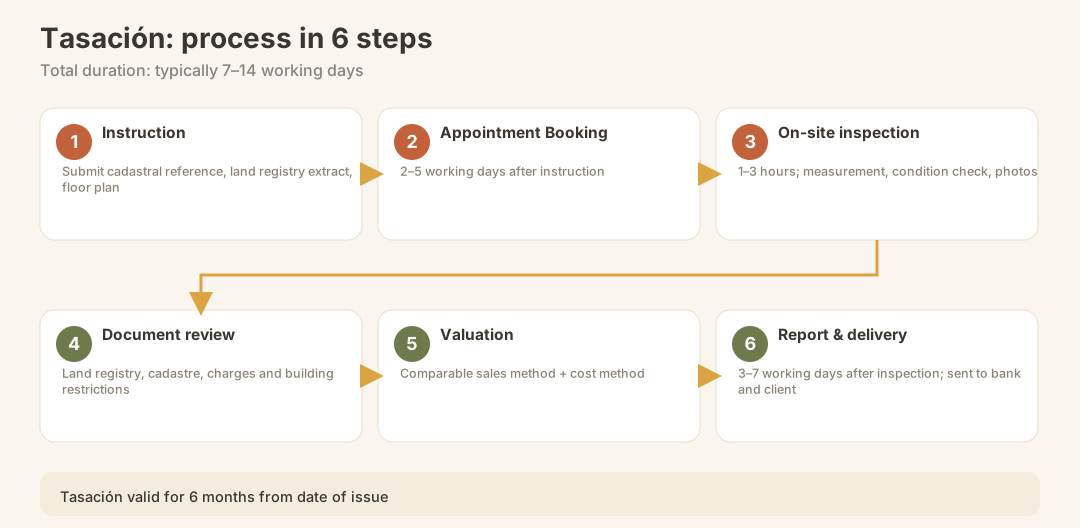
- Commissioning: You or your bank contact an approved Tasadora. You provide the cadastral reference, land registry extract and floor plan — where available.
- Appointment: The Tasador arranges an on-site appointment with you or the seller. They inspect the property, take measurements, assess its condition and document everything photographically.
- Document review: In parallel, the firm checks the land registry (Registro de la Propiedad), cadastral extract (Catastro) and any encumbrances or building restrictions.
- Valuation: The Tasador applies the legally prescribed method — for residential properties this is typically the comparative method (método de comparación), supplemented by the depreciated replacement cost method (coste de reposición).
- Report preparation: The report is issued digitally and contains a site plan, photographs, comparable properties, value calculations and the final assessed value.
- Delivery: The document is sent to the bank and is accessible to you as the commissioning party.
| Step | Typical duration |
|---|---|
| Appointment scheduling after instruction | 2–5 working days |
| On-site inspection | 1–3 hours |
| Report preparation after inspection | 3–7 working days |
| Total duration (from instruction to report) | Typically 7–14 working days |
What does the Tasador assess — and how is the value determined?
During the on-site appointment, the Tasador analyses a range of factors that feed directly into the valuation:
- Location and micro-location: Municipality, urbanisation, sea views, noise environment, infrastructure
- Floor area: The actually measured usable floor area (superficie útil) — not the built area stated in the listing (superficie construida), which is frequently larger
- Year of construction and condition: Age of the building, extent of renovation, quality of fittings and finishes
- Legal situation: Have all extensions been granted planning permission? Are there any entries in the land registry that reduce the value?
- Energy status: Energy certificate available or not
- Comparable properties: The Tasador draws on actual transactions and current asking prices of comparable properties in the immediate vicinity
Please note: Unauthorised structures (obras ilegales) or non-legalised extensions must by law be noted by the Tasador and are generally not into the assessed value — or may even result in the financing being declined. It is therefore worth carrying out a thorough check at the Land Registry.
Bank value vs. purchase price: the gap and its consequences
This is where the most practically important question arises: what happens when the valuation figure comes in lower than the agreed purchase price?
Example calculation:
| Item | Amount |
|---|---|
| Negotiated purchase price | 600.000 € |
| Valuation value (Tasación) | 540.000 € |
| Maximum bank financing (80 % of the Tasación value, primary-residence residents) | 432.000 € |
| Maximum bank financing (60–70 % of the Tasación value, non-residents/holiday property) | 324.000–378.000 € |
| Equity requirement for residents (purchase price − bank loan) | 168.000 € |
| Equity requirement without gap (80 % of 600.000 €, resident) | 120.000 € |
| Additional cost due to gap (resident) | 48.000 € |
The bank always uses the lower of the two values — purchase price or Tasación value. In Spain the loan-to-value limit is typically based on up to 80 % of the Tasación value for first-home buyers with primary residence, and generally on 60–70 % of the Tasación value for non-residents or holiday properties (the exact limits depend on the individual bank and your profile).
Your options when there is a gap:
- Cover the difference from your own funds — the most common route if you have sufficient liquidity
- Renegotiate with the seller — use the Tasación as leverage to argue for a price reduction
- Commission a second Tasación — if you consider the value too low, you can obtain a second opinion; whether the bank will accept it is not guaranteed
- Alternative financing structure — e.g. partial financing via a German loan secured against other assets
Please note: If you have signed a reservation contract or Contrato de Arras before obtaining the Tasación, and the gap emerges, you are still legally bound to the agreed price. Always ensure that the financing clause (condición suspensiva de financiación) is included in the preliminary contract. Find out more in the guide on the reservation contract.
Mallorca 2026: Why the gap problem is more common today
Current market data makes the gap problem structurally more significant than in previous years. The independent market study by the Steinbeis Transfer Institute (Center for Real Estate Studies / CRES), carried out in collaboration with Porta Mallorquina for the twelfth time, shows: the average price per square metre on Mallorca has risen island-wide by 9,8 % in 2026 to 7.370 €/m², with existing properties becoming around 12 % more expensive, while new builds increased by only around 4 %.
At the same time, asking prices — the basis for purchase negotiations — in certain locations are significantly above the average:
| Location | Indicative asking prices 2026 |
|---|---|
| Son Vida (Palma) | > 8.580 €/m² |
| Portals Nous / Bendinat | > 8.350 €/m² |
| Cas Català / Illetes | approx. 7.990 €/m² |
| South-west overall (Calvià area) | approx. 10.000 €/m² (mean asking price) |
| Island-wide (existing properties) | Ø 7.370 €/m² |
Sources: Tinsa IMIE Index, Idealista data, Porta Mallorquina/STI CRES Market Study 2026
The problem: Tasadores base their valuations on completed transactions — that is, prices that were actually notarised. In a rapidly rising market, comparable values lag behind current asking price levels. This systematically creates a wedge between what buyers and sellers perceive as 'fair' and the verifiable market value the Tasador applies.
Costs and who bears them
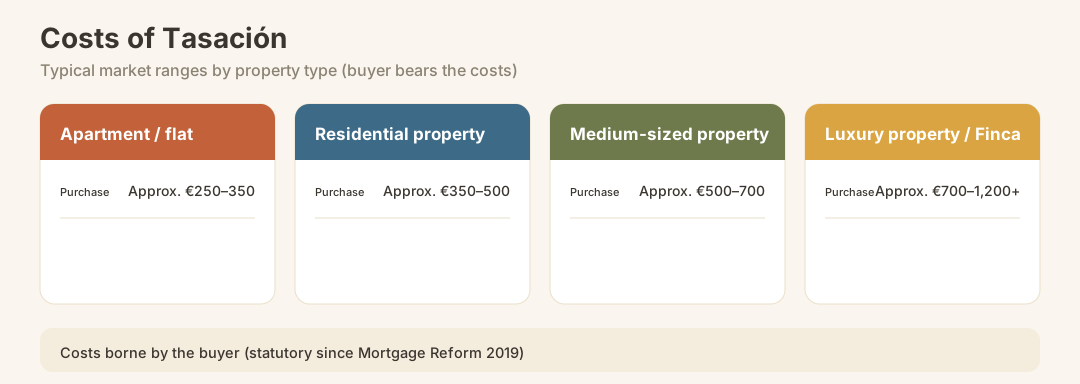
In Spain, since the 2019 mortgage reform, the cost of a Tasación is clearly borne bythe buyer — not the bank. This is governed by law.
| Property type | Typical costs for the Tasación |
|---|---|
| Apartment / flat up to 200.000 € | Approx. 250–350 € |
| Residential property 200.000–500.000 € | Approx. 350–500 € |
| Property 500.000–1.000.000 € | Approx. 500–700 € |
| Luxury property > 1 Mio. € / Finca | Approx. 700–1.200 € and above |
Note: These ranges are based on typical market experience; exact prices vary depending on the valuation company and the property.
The Tasación is one part of thepurchase ancillary costs on Mallorca, which you should calculate in full before buying. In addition to the Tasación, transfer tax (ITP), notary fees, land registry fees, and gestoría charges will apply.
Most common mistakes with the Tasación
1. Commissioning the Tasación too late Anyone who only commissions the valuation after signing the Arras contract risks a nasty surprise. Ideally: commission the Tasación as soon as there is a serious intention to buy and a price is known.
2. Concealing non-legalised extensions The Tasador sees everything — and officially records any unauthorised structures in the report. This can jeopardise the financing. More on the subject oflegalising unauthorised construction.
3. Relying solely on the estate agent's asking price Asking prices on Mallorca are structurally high in 2026. It cannot be taken for granted that the bank will confirm this price as the lending value — particularly in locations where comparable transactions are still scarce.
4. No financing clause in the preliminary contract Without acondición suspensiva, the buyer remains legally bound even when there is a significant gap. The Arras payment (often 10 % of the purchase price) is then forfeited.
5. Ignoring the validity period The Tasación is generally valid for six months. If completion is delayed — which can happen on Mallorca with complex properties — it must be renewed.
6. Failing to check the Land Registry in advance If the registered floor area and the actual floor area do not match, the Tasador may restrict the property's financeability. Always check the Land Registry in advance.
Tasación and tax implications: what else you should know
The value recorded in the Tasación carries tax significance beyond the mortgage itself:
- ITP (Impuesto sobre Transmisiones Patrimoniales): The Balearic tax authority ATIB may compare the purchase price against the valuation value or the cadastral value. If the purchase price is significantly lower, an additional tax demand may follow. Anyone buying a property well below the valuation value should ensure they are covered from a tax perspective.
- Wealth tax (Impuesto sobre el Patrimonio):): The valuation value may become relevant as a reference figure. More on this in the guide to wealth tax in Spain.
- Sale: When you later sell, the original purchase price (not the valuation value) forms the tax basis for the gain — which generally works in your favour. Details on the IRPF exemption on sale.
What comes next? The Tasación within the overall process
The Tasación is not an isolated step — it is embedded in the entire mortgage process and runs in parallel with other checks:
Offer → Reservation contract (Arras) → Commission the Tasación
→ Bank assessment of buyer profile → FEIN (European Standardised Information Sheet)
→ 10-day reflection period → Notary appointment (Escritura) → Land Registry entry
The Tasación typically falls between signing the Arras and the bank's final credit approval. Timing is critical: if the valuation is delayed, the entire financing approval is delayed.
For the complete legal process — from the first viewing through to handover of the keys — our comprehensive guide to the legal process for buying a property.
Checklist: preparing for your Tasación
- Request a Land Registry extract (nota simple) from the Registro de la Propiedad or query it online
- Check the cadastral extract (ficha catastral) — floor areas and registered buildings
- Be able to present the Cédula de Habitabilidad — what it is and how to apply for it
- Energy performance certificate (Certificado de Eficiencia Energética) to hand — obligations on Mallorca
- Check all structural alterations for planning compliance (Dekra, architect or solicitor)
- Condición suspensiva de financiación included in the arras contract
- Select a tasadora from the list of firms approved by the Banco de España
- Coordinate an appointment for an on-site inspection (ensure access to the property)
- Factor the validity period (generally 6 months) into your purchase timeline
Conclusion
The tasación is no mere bureaucratic footnote on Mallorca — it is the cornerstone of your financing decision. In a market where average prices across the island stand at 7.370 €/m² in 2026, rising considerably above that in prime locations such as the south-west, the gap between the asking price and a demonstrable transaction value becomes a structural risk factor. Anyone who commissions the tasación early, clarifies the legal status of the property in advance, and includes a financing clause in the preliminary contract goes into negotiations far better prepared — and avoids nasty surprises just before the notary appointment. Do you need support selecting a tasador or structuring your financing?
📩 Submit a personal enquiry — we will help you find the right expert for your specific situation on Mallorca.
Official sources
- Banco de España — list of approved tasadoras: https://www.bde.es
- Tinsa by Accumin — IMIE property price index Spain: https://www.tinsa.es
- Registro de la Propiedad / Colegio de Registradores — land registry search and transaction data: https://www.registradores.org
- Catastro — cadastral extracts online: https://www.sedecatastro.gob.es
- ATIB (Agència Tributària de les Illes Balears) — Balearic tax authority, ITP reference values: https://www.atib.es
- BOE: Ley Hipotecaria (Real Decreto de 8 de febrero de 1946 and amendments) — https://www.boe.es
- Orden ECO/805/2003 — Valuation regulations for real estate for mortgage purposes: https://www.boe.es/buscar/act.php?id=BOE-A-2003-7253