
Property Viewing Checklist Mallorca: What You Need to Look Out for When Viewing
Viewing a property in Mallorca often feels different from viewing one back home – the light is more beautiful, the views more captivating, the sales pressure more subtle. That is precisely the problem. Anyone who walks through a finca or a city apartment without a structured property viewing checklist for Mallorca will systematically overlook the issues that later prove costly: illegal extensions, a missing Cédula de Habitabilidad, unresolved water supply arrangements, or a land registry entry that does not match reality. This guide provides a comprehensive inspection framework – from preparation and the on-site viewing through to the documents you must have in hand before signing a reservation contract. Every point is tailored to the Mallorca market in 2026.

Do you already have a specific property in mind and want to know what risks are genuinely involved?
- 📩 Submit a personal enquiry — experienced Mallorca experts will review your chosen property with you
- Understand the complete buying process step by step
Before the viewing: preparation is half the battle
You will save yourself considerable effort on the ground if you request certain documents in advance – or at least know which ones you are entitled to ask for. The aim is not to walk into a property blind, but to arrive with enough background knowledge to rule out obvious deal-breakers before you even board the plane.
What you should request before the viewing
| Document | Where to obtain it | Purpose |
|---|---|---|
| Nota simple (land registry extract) | Registro de la Propiedad (online or in person) | Owner details, encumbrances, mortgages, registered floor area |
| Listing with floor plan | Agent / seller | Initial floor area check, room layout |
| Site plan (Catastro extract) | Sede del Catastro (catastro.meh.es) | Compare cadastral area with land registry area |
| Most recent IBI notices | Seller | Rateable value, outstanding payment arrears |
| Energy certificate (Certificado Energético) | Seller (mandatory prior to sale) | Energy efficiency rating A–G |
| Community meeting minutes (last 2–3 years) | Seller / property management company | Planned special levies, disputes |
Note: The land registry extract (Nota simple) costs a few euros and can be ordered via the online portal of the Registro de la Propiedad. It shows you immediately whether the property still has a mortgage registered against it that must be discharged before completion.
No more than 3–4 viewings per day should be planned. Viewing more properties on the same day means details blur together and first impressions cloud your judgement.
Location and surroundings: what to check in the area
Location on Mallorca is not a uniform factor. A property in Palma is assessed by entirely different standards than a finca in the centre of the island or a house near the coast. The following points should be worked through systematically:
Location checklist for the neighbourhood walk-around
- How good is the road access – passable year-round or subject to seasonal bottlenecks?
- Is there nearby infrastructure (supermarket, doctor, school, pharmacy)?
- How close is the nearest beach, the nearest village?
- Is the plot in a coastal zone – are there restrictions under the Ley de Costas?
- Is the plot designated as Suelo Rústico (rural land) or Suelo Urbano (building land)?
- Is there mobile reception and/or a fibre-optic connection?
- Orientation of the house: where does the terrace/pool face – south, west?
- Sightlines: what changes seasonally (vegetation, neighbouring development)?
Coastal properties fall within the protected zone of the Ley de Costas – typically a 100-metre protection zone from the coastline, within which new builds and extensions are severely restricted. You can find full details in the guide to the Ley de Costas Mallorca.
Special building regulations apply to plots outside the urban area – i.e. classic fincas. What may be built on Suelo Rústico is heavily regulated and varies depending on the municipality and its conservation status. More on this in our guide to Finca auf Suelo Rústico.
Building fabric and fixtures: what you can see with your own eyes
Mallorca has its own distinct building character. Older houses – town palaces, village houses, fincas – are frequently built from Mares stone, a local sandstone that is porous and prone to moisture problems in winter when heating and ventilation are inadequate. Humidity on the island regularly exceeds 80 % during the winter months. What looks dry and perfect in summer can reveal mould growth on walls, inside wardrobes, and under floors in winter.
Building fabric checklist on site
| Inspection point | What to look for |
|---|---|
| Walls (interior/exterior) | Damp stains, salt efflorescence, traces of mould – particularly in north-facing rooms, cellars, and storage areas |
| Roof and terraces | Cracks in the waterproofing, water marks at ceiling edges, condition of the downpipes |
| Floors | Uneven surfaces, hollow spots beneath tiles (tap them!), damage caused by rising damp |
| Windows and doors | Do they close snugly? Single or double glazing? Are the shutters in working order? |
| Electrical installation | Age of the system, fuse box, earthing, number of sockets |
| Plumbing | Test water pressure at all outlets, drainage, hot water supply |
| Pool | Condition of the lining, filtration system, heating system present? |
| Air conditioning/heating | Type, age, maintenance record |
| Cellar/underground garage | Damp, cracks, pumping system present? |
Watch out: Traces of mould are sometimes freshly painted over before viewings. Test wall surfaces with a hygrometer, or look out for suspiciously fresh paint directly along wall-floor junctions, behind furniture, and in corners.
If you are planning an extensive renovation, an architect's survey is advisable before the reservation contract is signed. The cost range for complete refurbishments on Mallorca is considerable – find out more in the guide on complete refurbishment costs on Mallorca.
Water supply and utility connections for fincas
With urban properties, water and electricity are almost always connected to the public network. With fincas and country houses – and this applies to a large proportion of the sought-after properties in the island's interior and along the north coast – the situation is quite different.
Utility questions for fincas and country houses
| Point | What to check |
|---|---|
| Water source | Connection to the public network, private well (Pozo), or cisterns? |
| Well licence | Is the well registered and approved with the Consell de Mallorca / water authority? |
| Water quality | Is a drinking water analysis available? Salinity, nitrates? |
| Power supply | Mains connection or diesel generator? Is there a photovoltaic system? |
| Internet/telephone | Clarify availability of fibre broadband or satellite |
| Waste water | Septic tank (Fosa Séptica) or mains sewage connection – condition, date of last service |
Unregistered wells are considered illegal and can result in fines or enforced closure. What is required for legalisation is explained in our guide to legalising a well on Mallorca.
Legal status of the property: the most important documents
This is the point at which buyers on Mallorca most frequently encounter nasty surprises. Not because sellers are fundamentally dishonest, but because the building history of many properties – particularly older country houses and fincas – was poorly documented for decades.
Mandatory documents before completion
| Document | Content | Risk if missing |
|---|---|---|
| Nota simple (land registry extract) | Owner, encumbrances, charges, registered area | Hidden mortgages, incorrect ownership |
| Escritura de Compraventa (purchase deed from previous owner) | Previous transactions, stated floor areas | Discrepancies between Catastro and land registry |
| Cédula de Habitabilidad | Habitation certificate issued by the local authority | Without a Cédula there is no legal residency status and no electricity contract |
| Licencia de Primera Ocupación | First occupation licence (new build) | Missing for some new-build properties on Mallorca |
| IBI receipts for the last 3–5 years | Council tax paid? | Arrears pass to the buyer |
| Comunidad accounts | Community costs, debts of the previous owner | Community debts can pass to the buyer |
| Energy certificate (Certificado Energético) | Class A–G, mandatory before sale | Without submission the seller risks a fine |
Note: Outstanding IBI debts and Comunidad arrears of the previous owner attach to the property in Spain – and therefore to the new owner. Always ask to see proof of payment for the past few years.
Our guide explains the land registry check in detail:Checking the land registry in Spain.
Illegal extensions and unauthorised construction: a Mallorca-specific risk
Mallorca has a long history of informal building activity. Terraces were roofed over, bedrooms added, guest houses built – often without planning permission. The problem: these extensions are frequently not registered in the land registry or the Catastro. Technically you buy them along with the property, but they are not legalised.
How to identify illegal extensions
- Compare the floor area stated in the listing with the area shown in the land registry extract (Nota simple) and the Catastro extract – if all three do not match, caution is warranted.
- Ask the agent or seller directly: "Are there any parts of the building that do not have planning permission?" and have the answer recorded in writing.
- Check whether planning permission exists for all visible structures (guest house, carport, pool house, pergola).
- Insist on an architect's report or a technical due-diligence inspection.
Warning: Legalising unauthorised buildings on Mallorca is possible, but time-consuming and costly. It is also not always successful – particularly in protected zones such as ANEI or within the protected areas of the Ley-de-Costas. More on this in our guides Legalising unauthorised construction on Mallorca and identifying illegal extensions.
Holiday letting: is an ETV licence in place or obtainable?
If you plan to let the property as holiday accommodation – even only seasonally – the question of the ETV licence (Licencia de Arrendamiento Turístico de Vivienda) is central.
ETV licence: what you must ask during the viewing
| Question | Background |
|---|---|
| Is there an active ETV licence? | The licence is tied to the individual, but transferable under certain conditions |
| Is the property a flat in a multi-family building? | Since Decreto 4/2025, a moratorium is in effect for flats in multi-family buildings on Mallorca – new ETV licences are de facto no longer being granted |
| Is the property located in a zone subject to quota restrictions? | Certain municipalities and zones have closed quotas |
| Is the building registered as a Unifamiliar (detached house)? | Different rules apply to detached houses than to apartment complexes |
Please note: The Decreto 4/2025 of the Balearen has further cemented the freeze on new ETV licences in multi-family buildings. Anyone speculating on holiday rentals and purchasing a flat risks never obtaining a licence. Always have the licensing eligibility checked by a solicitor in advance.
Details on the current legal position: ETV-Lizenz Mallorca and ETV-Lizenz übertragen.
Owners' Community (Comunidad de Propietarios): What to check
If you are buying a flat, a terraced house, or an apartment within a development, you automatically become a member of the Comunidad de Propietarios. What many people underestimate: the community can pass special levies that affect you as the new owner immediately.
Comunidad checklist
- Monthly community charges (Cuota de Comunidad) – the amount and what is included
- Are there any outstanding debts owed by the previous owner to the community?
- Read the minutes of the last 2–3 owners' meetings – any major works planned?
- Are there any ongoing legal proceedings involving the community?
- Is the property manager a professional or a volunteer owner?
- Condition of communal areas: pool, lifts, roof terraces, gardens, underground car park
- Are pets permitted?
- Are there provisions in the community statutes regarding short-term lettings?
Everything about the legal structure is explained in the guide to the Eigentümergemeinschaft in Spanien.
Taxes and ongoing costs: what you pay after the purchase
Many buyers calculate the purchase price carefully – and systematically underestimate the ongoing financial burden. More relevant for the viewing, however, is whether any outstanding taxes and charges transfer to the property.
Overview of ongoing costs (approximate figures)
| Type of cost | Responsible party | Notes |
|---|---|---|
| IBI (property tax) | Owner | Annual; amount depends on the rateable value (Valor Catastral) and the municipality |
| Rubbish collection fee (Basura) | Owner | Varies by municipality; typically in the low to mid two-digit to three-digit euro range per year |
| Comunidad fee | Owner | Varies considerably – from under 100 € to several hundred euros per month in luxury developments |
| Home contents insurance | Owner | Recommended; compulsory with a mortgage |
| Non-resident income tax (IRNR) | Owners without Spanish residency | Calculated on the Catastro value |
| Wealth tax (Impuesto sobre el Patrimonio) | Above certain thresholds | Balearic rate – details in the guide |
Please note: Arrears on IBI in Spain attach to the property as a charge in rem. This means that even if you are the new owner, you are liable for outstanding amounts from previous years. Request the IBI receipts for at least the last three years.
For all tax questions after the purchase: IBI Steuer Spanien and Steuern & Recht Mallorca.
Most Common Mistakes When Viewing a Property on Mallorca
In practice, the same mistakes come up time and again. Here are the most common ones – and how to avoid them:
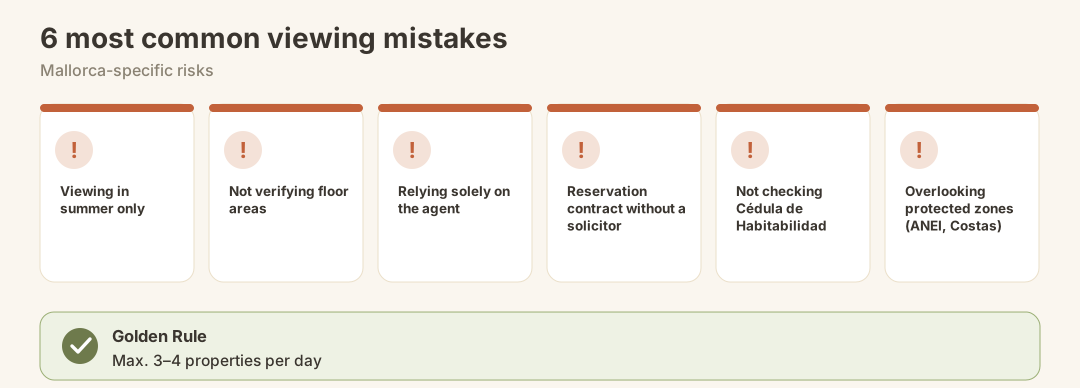
Only viewing in summer. The light is lovely, but damp and mould only reveal themselves in winter. Where possible, visit at least once in autumn or winter – or explicitly ask for photos taken during the winter season.
Not verifying floor areas. The exposé, Nota simple and Catastro often show different figures for square metres. Discrepancies of more than 10 % are a warning sign.
Relying solely on the estate agent. The estate agent almost always represents the seller. Your own solicitor for the property purchase is not an expense – it is protection.
Signing a reservation contract without legal review. The reservation contract often commits you to a deposit. Have it checked before you sign. Details on the reservation contract in Spain.
Not checking the Cédula de Habitabilidad. Without a valid Cédula, the property is not legally habitable. It may be missing, expired, or not updated following alterations. More on this: Cédula de Habitabilidad Mallorca.
Overlooking protected zones. ANEI (Áreas Naturales de Especial Interés), the Tramuntana World Heritage area and Ley-de-Costas zones impose severe restrictions on construction and use. Checking the municipality's Urbanismosplan is essential. More on ANEI and nature conservation and on Tramuntana building regulations.
Too many viewings in a single day. More than 3–4 properties per day reliably leads to memory errors.
What comes next? The steps after the viewing
If you are seriously considering a property, the following steps should be taken after the viewing, in this order:
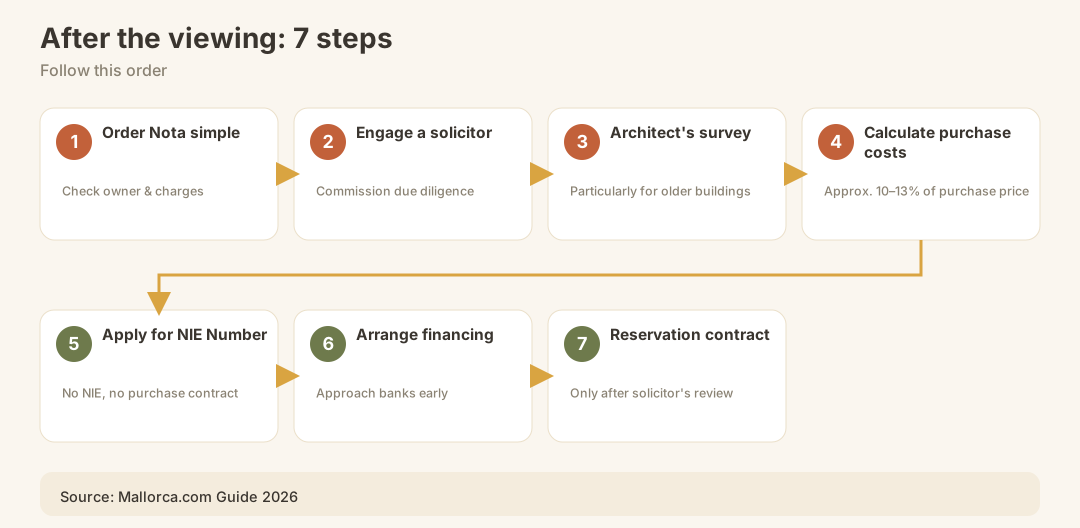
- Order a Nota simple (Registro de la Propiedad) – check ownership and encumbrances
- Instruct a solicitor – commission due diligence and have all documents reviewed
- Technical inspection / architect's survey – particularly with older buildings and fincas
- Calculate purchase ancillary costs – property transfer tax (ITP), notary, land registry entry, and solicitor fees add up to approx. 10–13 % of the purchase price. Details: Purchase ancillary costs Mallorca
- Apply for NIE number – no Spanish tax identification number, no purchase contract
- Clarify financing – if a mortgage is required: contact Spanish banks at an early stage. Property financing Mallorca
- Review and sign the reservation contract – only after solicitor review
Complete property viewing checklist Mallorca (summary)
Before the viewing
- Nota simple (land registry extract) requested
- Catastro extract obtained and compared with nota simple
- IBI receipts for the last 3 years requested
- Energy certificate available and up to date
- Comunidad minutes for the last 2–3 years read
- Planning permissions for all visible structures requested
- Cédula de Habitabilidad – valid and current?
- ETV licence: available, active, transferable?
- Maximum 3–4 properties planned per day
Location and surroundings
- Year-round accessibility checked
- Coastal area (Ley de Costas)? ANEI protected zone?
- Designated Suelo Rústico or Suelo Urbano?
- Infrastructure (doctor, school, shopping) checked
- Mobile reception and internet availability tested
Building fabric on site
- Walls checked for damp stains, mould, and salt efflorescence
- Roof and terraces inspected for cracks and water stains
- Floors tapped for hollow spots
- Electrical installation and fuse box inspected
- Water pressure and hot water tested in all rooms
- Pool: condition, heating system, filter
- Air conditioning/heating: type, age, maintenance record
Finca-specific
- Water supply clarified (mains / well / cistern)
- Well licence registered and approved?
- Water quality analysis available?
- Septic tank: condition and date of last service
- Power supply: mains connection or generator/PV?
Legal status
- All visible structures entered in the land registry?
- Catastro area ≈ land registry area ≈ listing area?
- Title deed from previous owner available?
- IBI arrears ruled out?
- Comunidad debts of the previous owner ruled out?
After the viewing
- Solicitor instructed to carry out due diligence
- Architect's survey commissioned (for older properties)
- NIE number applied for or already in hand
- Purchase ancillary costs calculated in detail
- Reservation contract signed only after solicitor's review
Summary
Viewing a property on Mallorca is not a holiday — even if the scenery suggests otherwise. Anyone working through this checklist protects themselves against the typical pitfalls: hidden structural defects caused by the porous Mares stone, unresolved unauthorised construction, missing permits, and discrepancies between the land registry and reality. The three most important principles: request documents before your flight, never view more than 3–4 properties per day, and engage an independent solicitor — not just at the notary's office, but at the latest before signing the reservation contract.
Understanding the market as a whole also helps with a realistic price check: current price data and price trends can be found in our overview of property prices on Mallorca.
Official sources
- Registro de la Propiedad (Land Registry) – Online order Nota simple: registradores.org
- Sede Electrónica del Catastro – Cadastre enquiry Spain: catastro.meh.es
- Agència Tributària de les Illes Balears (ATIB) – Taxes Balearic Islands: atib.es
- Consell de Mallorca – Urbanisme – Planning and building regulations Mallorca: conselldemallorca.net
- Govern de les Illes Balears – Turisme – ETV licences and Decreto 4/2025: caib.es
- Boletín Oficial del Estado (BOE) – National legislation, Ley de Costas: boe.es
- Boletín Oficial de las Illes Balears (BOIB) – Balearic regulations: boib.caib.es