
Transferring money to Spain for a property purchase – avoiding the sterling trap
Anyone buying a property on Mallorca who holds their purchase funds in British pounds or another foreign currency faces a race against two deadlines: the reservation contract, at which point a five- or six-figure sum changes hands, and the notary appointment, by which the remaining balance must be sitting in full in euros in a Spanish bank account. Weeks or even months can pass between these two milestones — and the GBP/EUR exchange rate can move considerably in that time. This guide takes you through every step of how to plan transferring money to Spain for your property purchase, what transfer routes are available, when it makes sense to lock in a rate, what Spanish banks and authorities will expect of you — and where the most common and costly mistakes lie in wait.

Would you like to know how much your budget is actually worth in euros after the transfer — and when the best time to exchange is?
- 📩 Submit a personal enquiry — We'll connect you with vetted FX and property specialists on Mallorca
- The Mallorca buying process: step by step
Why the exchange rate matters so much when buying on Mallorca
Mallorca properties are priced exclusively in euros. Anyone holding their wealth in pounds sterling, Swiss francs, or any other non-euro currency carries a currency risk from the very first offer through to the handover of keys — whether they like it or not.
A concrete example brings this to life: suppose you are buying a finca for €800,000. If the GBP/EUR rate stands at 1.20 (i.e. £1 = €1.20), you need around £667,000. If the rate drops to 1.10, you suddenly need around £727,000 — roughly £60,000 more for exactly the same property. Over the course of a buying process that stretches across several months, a move of that magnitude is far from unusual.
GBP/EUR: historical range of fluctuation
| Period | Approximate GBP/EUR rate level | Notable feature |
|---|---|---|
| Before the Brexit referendum in 2016 | ~1.30–1.42 | Historically strong pound |
| Immediately after the Brexit vote | ~1.15–1.20 | Sharp depreciation |
| Post-Brexit normalisation | ~1.10–1.18 | Elevated volatility |
| Current (June 2026) | ~1.157 | Source: umrechner-euro.de, as of 05.06.2026 |
Even in a year without political shocks, the GBP/EUR rate can fluctuate noticeably. On a purchase price of €500,000, that can translate into a significant additional sum — more than most buyers manage to save through price negotiation.
Please note: The rates quoted here are indicative figures. For current rates, refer to the European Central Bank (ECB) or your transfer provider.
The payment structure when buying on Mallorca — who pays what, and when?
To plan your transfer requirements, you need to understand the timeline of the Spanish buying process. It typically breaks down into three payment stages:
| Stage | Contract | Typical amount | Timing |
|---|---|---|---|
| 1. Reservation payment | Reservation contract (contrato de reserva) | Often €5,000–€10,000 or negotiable | Immediately after agreement, within days |
| 2. Deposit | Private purchase contract (contrato de arras) | Typically 10% of the purchase price | Weeks after reservation |
| 3. Remaining purchase price + additional costs | Notarial deed (escritura pública) | Remaining balance + approx. 10–13% additional costs | Notary appointment, possibly weeks to months later |
This means: you will need euros in your Spanish bank account at three different points in time – and each time the exchange rate of that particular day applies, unless you have secured it in advance.
Please note: The contrato de arras stipulates: if the buyer withdraws, the deposit is forfeited. If the seller withdraws, they must repay double the amount. The funds must therefore be unconditionally available by the agreed date – which is a strong argument for not leaving the transfer to the last minute.
You can find more about the contractual process in the guide Reservierungsvertrag Spanien as well as in the overview Kaufnebenkosten Mallorca.
Step by step: transferring money to Spain for a property purchase
Step 1 – Apply for your NIE number (before any transfer)
Without the Spanish foreigner identification number (Número de Identidad de Extranjero, NIE) you can neither sign a purchase contract in Spain nor open a Spanish bank account to receive the transfer. The NIE is also a mandatory requirement for Spanish banks when receiving funds.
Apply using form EX-15 at the National Police or a Spanish consulate; processing time can be several weeks depending on the season.
Step 2 – Open a Spanish bank account
Spanish notaries work with bank cheques (cheques bancarios) or value-dated transfers to a Spanish account. While it is technically possible to transfer directly from abroad, in practice notaries and sellers often require proof that the funds originate from a Spanish account. Open the account well in advance so that there is no time pressure between account opening and the first payment deadline.
Step 3 – Choose your transfer method (high-street bank vs. FX specialist)
This is where some of the greatest savings potential lies – and where the most common mistake is made.
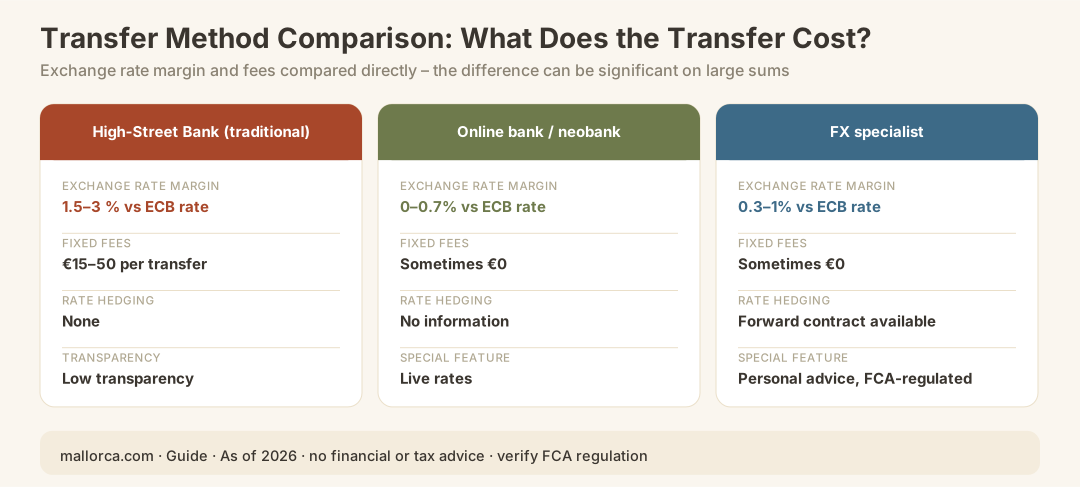
| Transfer method | Typical exchange rate mark-up over ECB rate | Fixed fees | Notable feature |
|---|---|---|---|
| High-street bank (traditional) | 1,5–3 % | 15–50 EUR per transfer | No exchange rate hedging, limited transparency |
| Online bank / neobank | 0–0,7 % | Sometimes 0 | Up-to-date daily rates |
| Specialist FX provider | 0,3–1 % | Sometimes 0 | Forward contracts available, personal advisory service |
When transferring 500.000 EUR, the difference between a high-street bank and an FX specialist can be considerable – and even more so for larger sums.
Note: FX service providers operating in the UK are regulated by the FCA (Financial Conduct Authority). Always verify a valid FCA authorisation before entrusting any provider with your funds.
Step 4 – Consider Rate Hedging
A Forward Contract allows you to lock in today's exchange rate for a future transfer – typically up to 12 months in advance. A deposit on the secured amount is usually required; the exact terms vary by provider.
| Instrument | Function | Advantage | Disadvantage |
|---|---|---|---|
| Spot Transfer | Exchange at the current day's rate | Fast and straightforward | Full exchange rate risk |
| Forward Contract | Rate is fixed today for a future transfer | Planning certainty | You don't benefit from a favourable rate movement |
| Limit Order | Automatic purchase when your desired rate is reached | Optimal entry rate possible | No timing guaranteed |
| Stop-Loss Order | Automatic purchase when the rate threatens to fall | Protection against a sharp rate decline | May trigger below the desired level |
Step 5 – Execute and Document the Transfer
Spanish banks and the tax authority AEAT expect proof-of-origin documentation for larger deposits into property accounts. Keep the following documents to hand:
- Bank statements for the last 3–6 months (source of funds)
- NIE number
- Purchase contract or Arras contract as proof of intended use
- Proof of income / tax assessments where applicable
Reporting Obligations and Capital Controls: What Spain Requires of You
Spain has no general capital movement restrictions for EU/EEA citizens, but reporting obligations do apply:
| Threshold | Regulation | Form / Authority |
|---|---|---|
| Cash transport from €10,000 equivalent | Declaration requirement when crossing the border | Customs / Agencia Tributaria (AEAT) |
| Account holders abroad with balances from €50,000 | Declaration as part of the tax return | Modelo 720 (AEAT) |
| Transfers from certain amounts from non-EU countries | Review by the receiving bank (anti-money laundering) | Ley 10/2010 |
Please note: The Modelo 720 is the declaration of assets held abroad. As a British citizen following Brexit, or as a non-EU resident, seeking tax advice from a local gestor or tax adviser before making the transfer may be advisable. Link the property purchase to your tax planning at an early stage – further information can be found in the Taxes & Legal.
The Sterling Trap: Three Real-Life Scenarios
Scenario A – The purchase goes smoothly, but the bank charges extra
The Müller-Harrison family books a finca for €650,000. They transfer three partial payments via their high-street bank. The exchange rate mark-up is approximately 2% on each occasion. Had they used an FX specialist with a significantly lower mark-up, they would have saved a considerable sum.
Scenario B – Exchange rate movement between the arras and the notary appointment
Mr Williams reserves in March at GBP/EUR 1.18. By the notary appointment in June, the rate stands at 1.10. For the outstanding €450,000 he now needs approximately 409,000 GBP instead of approximately 381,000 GBP – an unplanned additional requirement of approximately 28,000 GBP. A Forward Contract, taken out in March, would have avoided this entirely.
Scenario C – The transfer arrives too late
The notary appointment is set for Tuesday at 10 a.m. The transfer was sent on Friday afternoon. Due to the SWIFT correspondent banking route and the weekend, the funds do not clear until Tuesday lunchtime. The notary cannot execute the escritura. The vendor sets a deadline extension at the buyer's cost. Solution: arrange the transfer at least 3–5 working days before the notary appointment; faster transfers may be possible with certain FX specialists.
A Summary of Costs: What Comes on Top of the Purchase Price?
Transferring money to Spain does not simply mean transferring the agreed purchase price. You also need to factor in the ancillary purchase costs, which are particularly high in the Balearic Islands.
| Cost item | Balearic Islands guideline figure 2026 | Note |
|---|---|---|
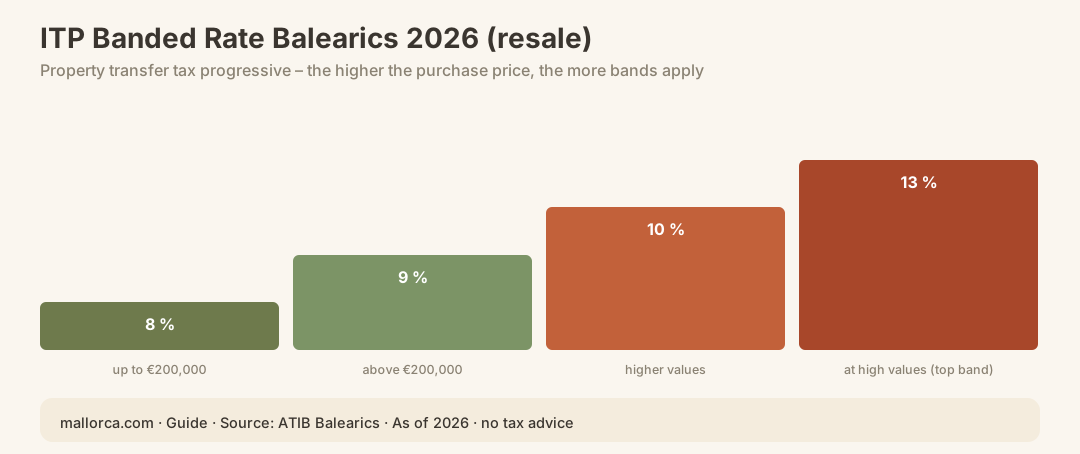
| ITP (property transfer tax, resale) | 8% up to €200,000, then 9%, 10%, up to 13% for high values | Progressive tiered rate |
| IVA + AJD (new build) | 10% IVA + 1.5% AJD | Only on first sale by a developer |
| Notary fees | approx. 0.1–0.5% of the purchase price | Capped by Spanish fee regulations |
| Land registry entry | approx. 0.1–0.3% | Following notarial certification |
| Lawyer / gestor | approx. 1% or a fixed fee | Recommended, not a legal requirement |
| Transfer costs (FX) | 0.3–3% of the transfer amount | Depends on provider, see table above |
Total ancillary purchase costs: typically 10–13% of the purchase price, which must also be available in euros. Currency conversion costs arise here too if you are transferring from pounds. These amounts are sometimes overlooked by buyers when planning their transfer.
You can find more details on Balearic tax rates in the guide Purchase ancillary costs Mallorca.
Most common mistakes when transferring money
Transferring too late. Only initiating the bank transfer the day before the notary appointment. Allow a buffer of at least 3–5 working days — for international transfers from the UK, a full week is advisable.
Forgetting the ancillary costs in the transfer planning. The 10–13% purchase ancillary costs must also be available in euros — as a separate amount, not just the agreed purchase price.
Using your high-street bank without comparing. The exchange rate markup charged by traditional high-street banks is often considerably above the interbank rate. On larger purchase prices, this can amount to a significant sum. Compare the rate markup and fees before every transfer.
No rate protection despite a lengthy purchase process. If several months pass between the arras contract and the notary appointment, the currency risk is considerable. A forward contract provides planning certainty.
Only applying for the NIE number at the notary. No NIE means no Spanish bank account, and no bank account means no smooth transfer. Apply for your NIE at the same time as your first viewing.
Forgetting the payment reference in the transfer. Spanish banks ask about the purpose of larger incoming payments. Always include the reference from the purchase contract.
Not having proof of the source of funds to hand. Anti-money-laundering regulations (Ley 10/2010) require Spanish banks to verify large deposits. If bank statements or proof of income are missing, delays can occur.
Please note: Anyone who appoints a notarial power of attorney holder to handle the transaction must ensure that the power of attorney expressly covers the receipt and instruction of bank payments. More on this in the guide Vollmacht Spanien Notar.
For British buyers after Brexit: key considerations
Since Brexit, the United Kingdom is a third country with respect to the EU. This has the following implications for money transfers:
| Aspect | Situation before Brexit | Situation post-Brexit (2026) |
|---|---|---|
| SEPA transfers | Yes, GBP possible (UK was a SEPA member) | No, the UK is no longer part of the SEPA zone |
| Transfer method | SEPA transfer | SWIFT/IBAN transfer, potentially via a correspondent bank |
| Processing time | 1–2 working days | 2–5 working days, depending on bank and route |
| Cost | Low due to SEPA regulation | Higher fees possible; FX specialists compete actively |
| Residency status | EU freedom of movement | 90/180-day rule as a tourist; visa required for permanent residency |
Note: As a British citizen wishing to live permanently in Mallorca after purchase, you will need more than just the property acquisition itself — namely, a residence permit. This also affects your tax obligations. Seek advice from a specialist solicitor before transferring funds. Information on Immobilienfinanzierung Mallorca can be found in the relevant guide.
What comes after the transfer? – Next steps after the notary appointment
After notarisation and receipt of full payment:
- Land registry entry (Registro de la Propiedad) – you or your solicitor submit the Escritura for registration. Registration takes several weeks depending on the land registry office.
- Tax payments – transfer tax (ITP) must be paid within 30 working days of signing; the funds must also be in the Spanish account by this point.
- Utility contracts and community charges – ongoing euro payments for which a permanent Spanish account is advisable.
- Tax registration – depending on residency status and use of the property, annual tax obligations arise (IBI, non-resident tax, etc.); more on this under IBI Steuer Spanien.
Checklist: transferring money to Spain for a property purchase
- NIE number applied for in good time (form EX-15)
- Spanish bank account opened (before first payment date)
- FX providers compared (exchange rate margin, fees, FCA regulation checked)
- Rate hedging considered (forward contract worth considering for a lengthy purchase process)
- Total amount including purchase costs (10–13 %) budgeted for
- Transfer initiated at least 5 working days before notary appointment
- Payment reference (purchase contract reference) included in transfer
- Proof of funds (bank statements 3–6 months) prepared
- Modelo 720 / post-Brexit tax obligations reviewed
- Notary appointment and tax payment deadlines (ITP) in the calendar
Conclusion
Transferring money to Spain for a property purchase may sound like a technical afterthought — but it is anything but. Exchange rate fluctuations, unnecessary bank charges, and timing errors can add up to significant sums. The good news is that these costs are largely controllable if you plan early, choose the right transfer route, and consider rate hedging. British buyers face additional hurdles since Brexit due to the loss of the SEPA framework and tax complexities that require early advice. Anyone who integrates the transfer into the overall planning of the purchase process — rather than treating it as a final step — will arrive at completion cost-effectively and on time.
Official sources
- European Central Bank (ECB) – daily reference rates: https://www.ecb.europa.eu/stats/policy_and_exchange_rates/euro_reference_exchange_rates/
- Agencia Tributaria (AEAT) – Modelo 720 foreign assets: https://sede.agenciatributaria.gob.es
- AEAT – Anti-Money Laundering and Modelo S-1 (Capital Movements): https://www.agenciatributaria.es
- Spanish Civil Code (Código Civil) Art. 1445 et seq. – Contract of Sale: https://www.boe.es/buscar/act.php?id=BOE-A-1889-4763
- Ley 10/2010 de prevención del blanqueo de capitales: https://www.boe.es/buscar/act.php?id=BOE-A-2010-6737
- Agència Tributària de les Illes Balears (ATIB) – ITP Rates Balearic Islands: https://www.atib.es
- Financial Conduct Authority (FCA) – Register of Authorised Payment Service Providers UK: https://register.fca.org.uk
- Notariado.org – Statistics Portal of Spanish Notaries: https://www.notariado.org/liferay/web/cien/sala-de-prensa/noticias/detalle