
Non-Resident Mortgage Spain: How the 60–70 % Financing Works
Getting a mortgage in Spain as a non-resident is not wishful thinking – but it is not a foregone conclusion either. Spanish banks generally classify buyers without tax residency in Spain as a higher risk, which has a direct bearing on the loan-to-value ratio, interest rate, and documentation requirements. This guide explains what mortgage non-resident Spain means in practice: what loan-to-value limit you can realistically expect, which banks actively serve this segment, what documents you will need, how the process works, and what costs you need to budget for beyond the monthly repayment – in concrete terms, with figures, and without rose-tinted glasses.

Do you need support financing your Mallorca property?
- 📩 Submit a personal enquiry — we will connect you with experienced mortgage advisers and lawyers on the ground
- An overview of all purchase costs when buying property on Mallorca
Resident or non-resident – the crucial distinction
Before you look at any terms and conditions, you need to know your status. In Spain, you are considered a tax non-resident if you spend fewer than 183 days per year in the country and your primary economic interests are not based in Spain. This status has immediate consequences for your mortgage.
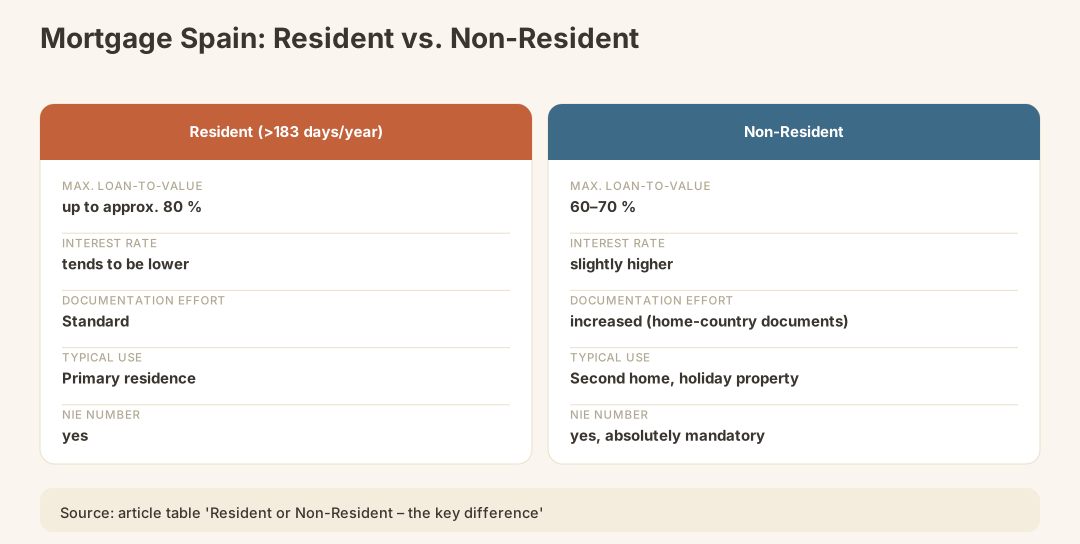
| Criterion | Resident (>183 days/year) | Non-resident |
|---|---|---|
| Max. loan-to-value | up to approx. 80 % | 60–70 % |
| Interest rate level | generally lower | slightly higher |
| Documentation burden | Standard | Higher (home-country documents required) |
| Typical use | Primary residence | Second home, holiday property |
| NIE number required | yes | yes, absolutely mandatory |
The reasoning is understandable: if a Spanish bank had to enforce a mortgage against a borrower resident in Germany, Austria, or Switzerland, the process is considerably more complex than it would be with someone living locally. This risk is reflected in the terms and conditions – not a disaster, but something you must factor in.
Loan-to-value ratio: why 60–70 % is the decisive lever
The most important figure in your financing plan is the loan-to-value ratio (LTV): the proportion of the purchase price or the bank valuation (Tasación) that the bank will finance as a maximum. For non-residents, this limit is 60 to 70 per cent – calculated on the lower of the two values: purchase price or Tasación.
Please note: If the Tasación value is below the purchase price – which is not uncommon in desirable locations on Mallorca – the bank calculates its 60–70 % on the lower valuation figure. This can noticeably reduce the loan available to you.
Example calculation:
| Item | Amount |
|---|---|
| Purchase price of the property | 400.000 € |
| Tasación (bank valuation) | 370.000 € |
| Basis for calculation | 370.000 € (the lower value) |
| Maximum loan (70 %) | 259.000 € |
| Required equity (purchase price minus loan) | 141.000 € |
| Purchase ancillary costs (approx. 11 %) | approx. 44.000 € |
| Total liquidity from own funds | approx. 185.000 € |
The example illustrates: for a 400.000-euro property you are bringing roughly 185.000 euros in cash to the table – almost half the purchase price. Anyone who has not planned for this will face a nasty surprise at this point.
See also our guide to the purchase ancillary costs on Mallorca, where ITP, notary fees, and land registry charges are explained in detail.
Which banks finance non-residents?
The major Spanish financial institutions have by now developed their own products for foreign buyers.
| Bank | Product / Special feature |
|---|---|
| BBVA | Up to 70 % LTV; terms of up to 30 years in certain cases |
| Banco Santander | "Mundo Mortgage"; typically 60 % on a Tasación basis; service available in English, French, Italian, Polish, and Portuguese |
| CaixaBank / HolaBank | Innovative online service model; multilingual |
Note: Banks' offers are not publicly standardised. Terms are calculated individually based on your buyer profile, income, property location, and equity. Obtain at least three quotes – ideally through two different channels (direct bank contacts and an independent mortgage broker).
Interest rates in 2026: what you can realistically expect
Unlike some northern European markets, Spain does not offer uniform fixed interest rates for all profiles. Every bank calculates individually based on your buyer profile.
| Interest rate type | Indicative value 2026 |
|---|---|
| Average mortgage interest rate | approx. 2.85 % |
| Lowest observed fixed rate | approx. 2.44 % |
| Variable rate (Euribor-based) | approx. 2.95 % |
Fixed vs. variable: A fixed rate protects you against Euribor fluctuations and ensures predictable monthly payments – particularly relevant if you are not primarily using the property as a source of income. Variable rates can be cheaper in the short term, but carry the risk of Euribor volatility. Non-residents are often offered the variable model first; however, a fixed rate is negotiable.
Note: The interest rate offered is always tailored to your individual profile. The figures quoted above are indicative values, not guarantees.
The Tasación: the bank valuation as a key document
Before the bank makes any credit commitment, it commissions an official property valuation – known as the Tasación. This figure forms the basis for calculating the maximum loan amount.
Key points regarding the Tasación:
- The bank commissions an approved valuation company (Sociedad de Tasación).
- You can also commission a valuer yourself, but you should check in advance whether the bank will accept them.
- The Tasación typically costs several hundred euros – this amount is generally charged to you regardless of the outcome of the loan application.
- The assessed value may differ from the purchase price – either upwards or downwards.
You can find out more about property valuation in our guide to the Tasación in Spain.
Documents: what you need to submit as a non-resident
This is the part most people underestimate. Spanish banks require significantly more documentation from non-residents than from resident customers – because they cannot directly verify your financial situation abroad.
Documents from your home country:
| Document | Details |
|---|---|
| Passport (valid) | Copy of both pages |
| NIE number | Absolutely mandatory; no mortgage without a NIE |
| Proof of income | Last 2–3 pay slips or tax assessments (self-employed: management accounts, profit and loss statement) |
| Tax return | Usually the last year, possibly two years |
| Bank statements | Typically: last 3–6 months |
| Credit report / proof of creditworthiness | e.g. SCHUFA (Germany), KSV (Austria) |
| Employment contract or proof of business | Permanent employment preferred; self-employed individuals require more documents |
| Proof of equity | Bank statements confirming that the 30–40 % is available |
Property-related documents:
| Document | Details |
|---|---|
| Reservation contract or Arras | Shows the bank what you are purchasing |
| Nota Simple (land registry extract) | Confirms ownership and encumbrances |
| Tasación | Commissioned by the bank itself |
Please note:All documents from your home country must generally be translated into Spanish (by a sworn translator). Some banks accept English as an interim solution; do not rely on this.
For the land registry check, we recommend our guide on Checking the Spanish Land Registry.
The NIE Number: Why It Holds Everything Up
The Número de Identificación de Extranjero (NIE) is your tax identification number in Spain. Without it, nothing moves forward: no bank account, no notary appointment, no mortgage, no transfer of ownership.
You can apply for your NIE at:
- the Spanish consulate in your home country (book an appointment in advance)
- the relevant immigration office (Oficina de Extranjería) in Spain
- a local notary or solicitor with an appropriate power of attorney
Processing times vary depending on the authority and the time of year – allow several weeks. Having a solicitor apply for the NIE on your behalf using a power of attorney often saves time.
Find out more in our guide on Power of Attorney at a Spanish Notary.
Step by Step: The Mortgage Application Process
The process in Spain is structured somewhat differently from that in Germany or Austria. Here is the typical sequence:
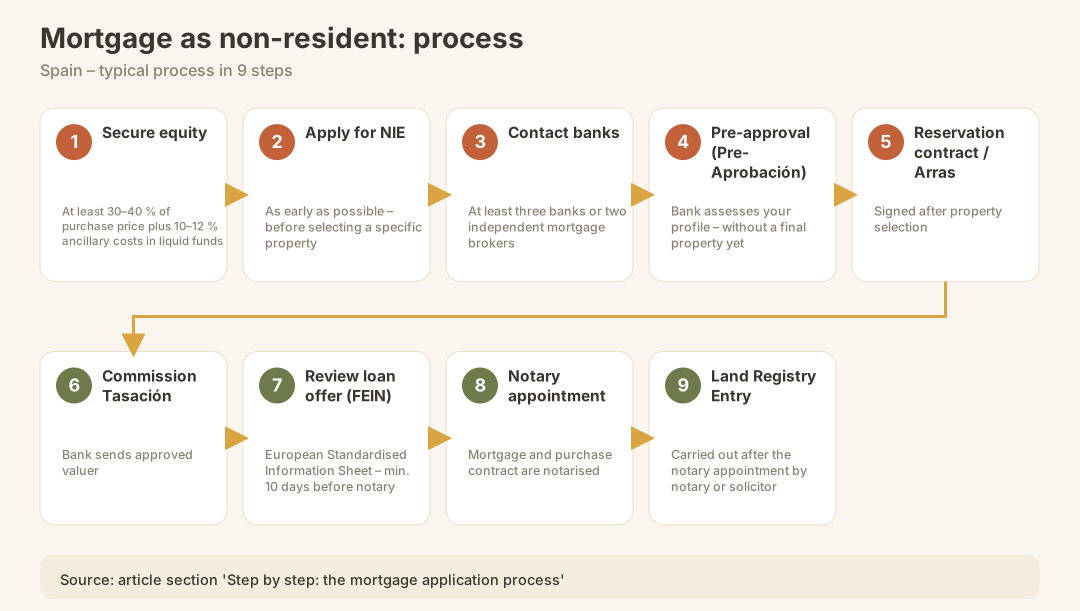
- Secure your equity – Make sure you have at least 30–40 % of the purchase price plus 10–12 % in ancillary costs available in liquid funds.
- Apply for your NIE – As early as possible, ideally before you have selected a specific property.
- Contact banks – Approach at least three banks or two independent mortgage brokers. For the initial enquiry, it helps to have a concrete 'example property' from a property portal so the bank can enter figures into their system.
- Obtain pre-approval (Pre-Aprobación) – The bank reviews your profile and issues an indicative approval, without yet requiring the final property details.
- Sign the reservation contract / Arras – Once you have found the property; the customary deposit amount should be agreed with your solicitor, as it varies.
- Commission a Tasación – The bank will send an approved valuer.
- Review the loan offer (FEIN) – The bank is legally required to provide you with the European Standardised Information Sheet (FEIN) at least ten days before signing.
- Notary appointment – The mortgage deed and purchase contract are executed simultaneously or in quick succession.
- Land Registry entry – Carried out after the notary appointment by the notary or your solicitor.
You can read more about the full legal process of buying a property in our guide Legal process of buying property in Spain.
Costs associated with the mortgage
In addition to the purchase transaction costs, the mortgage itself gives rise to specific expenses. Make sure you budget for these.
| Cost item | Who bears it? | Note |
|---|---|---|
| Tasación (bank valuation) | Buyer | Several hundred euros; payable regardless of the outcome of the loan application |
| Notary fees for the mortgage deed | since 2019: bank | Regulated by law |
| Stamp duty on the mortgage (AJD) | since 2019: bank | Regulated by law |
| Land Registry entry for the mortgage | since 2019: bank | Regulated by law |
| Arrangement fee (Comisión de apertura) | Buyer | Not all banks charge this; negotiable |
| Mortgage broker advisory fee | Buyer | Where a broker is engaged; amount varies |
| Certified translator (documents) | Buyer | For home-country documents |
Note: Since the reform of the Mortgage Act (Ley 5/2019), Spanish banks bear the notary, tax and land registry costs of the mortgage deed. For the purchase deed itself, the buyer continues to bear the costs.
Mortgage vs. self-financing: When does a mortgage make sense?
Many wealthy buyers in Mallorca ask themselves whether they should take out a mortgage at all. This is not purely a financial decision, but also a tax consideration.
Arguments in favour of a mortgage as a non-resident:
- Capital remains invested (leverage effect)
- Rental income can, under certain conditions, be offset against mortgage interest (clarify the tax details with your tax adviser)
- Liquidity for renovations, ancillary costs or further investments is preserved
Arguments against a mortgage:
- Interest burden with moderate rental yields or purely owner-occupied use
- Increased administrative effort
- Exchange-rate and interest-rate risk with a variable rate
If you are looking to let the property, also read our guide on taxing rental income as a non-resident – there you will find out how IRNR tax on rental income is calculated.
The most common mistakes when taking out a mortgage as a non-resident
In practice, the same stumbling blocks come up time and again:
- Tasación not estimated in advance – Anyone who only calculates on the basis of the purchase price will be caught off guard if the bank valuation comes in lower. Obtain an informal assessment beforehand.
- NIE applied for too late – The NIE takes time. Anyone who only starts the process after signing the reservation contract will end up under time pressure.
- Only one bank contacted – Terms and conditions vary considerably. Getting at least three offers is standard practice.
- Own funds underestimated – 30–40 % equity plus 10–12 % purchase ancillary costs often adds up to 45–55 % of the purchase price from your own pocket. Many buyers only plan for 20 %.
- Documents not translated – Certified translations take time and cost money. Do not leave it until the last minute.
- FEIN deadline ignored – The ten days between receipt of the FEIN and the notary appointment are legally mandatory. An earlier notary appointment is not possible.
- Spanish bank account opened too late – Most banks require a Spanish account for mortgage payments. This also requires lead time.
What comes next? Taxes and obligations as a mortgage holder
The formalities do not end with the mortgage. As a non-resident with a property in Spain, you have ongoing tax obligations.
- IRNR (Impuesto sobre la Renta de No Residentes): Even if you do not rent out the property, a notional personal use is taxed. In the case of actual rental, the rental income is taxed.
- IBI (Impuesto sobre Bienes Inmuebles): Annual property tax levied by the local authority – due regardless of use and mortgage. Details in our guide to IBI tax Spain.
- Mortgage term: Up to 30 years is possible with certain banks; typical terms are often shorter.
- Early repayment: Governed by mortgage law; early repayment charges have been capped since 2019.
For a comprehensive overview of taxes on a later sale, we recommend the guide Taxes on property sales Spain.
Checklist: mortgage non-resident Spain
- NIE number applied for (well in advance!)
- Equity of at least 30–40 % of the purchase price available
- Purchase ancillary costs (approx. 10–12 %) planned as separate liquidity
- At least three bank offers obtained (or two mortgage brokers)
- All home-country documents compiled and certified translation arranged
- Tasación risk (value potentially below purchase price) taken into account
- Spanish bank account opened or in progress
- Solicitor engaged for the purchase process and mortgage review
- FEIN received and ten-day period before notary appointment factored in
- Ongoing tax obligations (IRNR, IBI) known and planned for
Conclusion
A mortgage as a non-resident in Spain is achievable – but requires significantly more equity, more documentation, and more lead time than in many other countries. The 60–70% loan-to-value limit is not a matter for negotiation; it is a structural feature of the Spanish banking system for this buyer segment. Those who plan ahead, apply for their NIE in good time, compare several banks, and take a realistic view of the tasación can put a solid financing package in place. The major Spanish banks – BBVA, Santander, CaixaBank – have developed their own products for international buyers and in some cases offer multilingual service. An independent mortgage broker and a locally experienced solicitor are not a luxury in this process – they are a sound investment.
Official Sources
- Banco de España – regulatory framework for mortgage lending and consumer protection: https://www.bde.es
- Ley 5/2019, reguladora de los contratos de crédito inmobiliario – Spanish Mortgage Act (BOE No. 65, 16.03.2019): https://www.boe.es/eli/es/l/2019/03/15/5
- AEAT – Agencia Estatal de Administración Tributaria – IRNR for non-residents: https://www.agenciatributaria.es
- Notariado.org – statistics portal of the Spanish notaries – Balearic market data: https://www.notariado.org/liferay/web/cien/sala-de-prensa
- Ministerio de Asuntos Exteriores – NIE application (consular route): https://www.exteriores.gob.es