
Pre-emption Rights on Property in Spain: Who Can Really Step In?
Anyone buying a property in Spain rarely thinks about pre-emption rights first — and that can prove costly. The pre-emption right property Spain (derecho de adquisición preferente) grants certain individuals or authorities the right to step into an already-negotiated purchase contract on the same terms and displace the original buyer. Unlike German law, many of these rights are enshrined in Spanish legislation and therefore do not necessarily appear in the land registry — a classic pitfall that catches even experienced buyers off guard. This guide explains which pre-emption rights exist, who may exercise them, what deadlines apply, and how to protect yourself legally as a buyer or seller. In Mallorca and the Balearic Islands in particular, regional tenancy legislation and public-law requirements add additional layers you need to be aware of.

Are you currently buying a property and want to know whether a pre-emption right could jeopardise your deal?
- 📩 Submit a personal enquiry — get the legal position clarified for your specific property
- Complete purchase process step by step
Contractual vs. statutory pre-emption rights: the crucial difference
Spanish law recognises two fundamentally different categories of pre-emption rights, and they are treated very differently in legal terms.
Contractual pre-emption rights arise from an agreement between the owner and another party — for example, a neighbour who has secured the right to purchase the finca first. For these rights to be enforceable against a bona fide third party, they must be registered in the land registry. If no entry exists, the protection of good faith applies: as a buyer you acquire ownership validly, provided you were unaware of the right at the time of purchase. At the latest, an up-to-date land registry extract will be available at the notary appointment — if the contractual pre-emption right is not noted there, you are on the safe side.
Statutory pre-emption rights (retracto legal) are an entirely different matter. They arise by operation of law — without anyone having agreed to them contractually or registered them in the land registry. An up-to-date land registry extract will therefore not reveal them. They can nonetheless be validly exercised if the statutory conditions are met and the deadlines are observed.
| Feature | Contractual pre-emption right | Statutory pre-emption right |
|---|---|---|
| Origin | Agreement between the parties | By operation of law |
| Land registry entry required? | Yes, for third-party effect | No |
| Visible in the land registry extract? | Yes (if registered) | Generally no |
| Protection for bona fide purchasers possible? | Yes (if entry is absent) | No |
| Typical examples | Neighbour agreement, tenant option | Co-owner, tenant (LAU), state |
Please note: Statutory rights of pre-emption are the real risk for buyers. Anyone who only checks the land registry when purchasing has not yet done all their homework.
Right of pre-emption of a co-owner (retracto de comuneros)
If a property belongs to several people — for example following an inheritance or as jointly owned property — each co-owner has a statutory right of pre-emption if another co-owner wishes to sell their share to a third party. This right is enshrined in the Spanish Civil Code.
What this means for you as a buyer: if you purchase from someone who owns only a fractional share of a property (cuota indivisa), the other co-owners may step into the purchase on the same terms. This is particularly relevant for inherited properties where several siblings are co-owners and only one wishes to sell.
Practical consequence: Before you sign a purchase contract for a co-ownership share, your solicitor should check whether the other co-owners have waived their right of pre-emption — ideally in writing and notarially certified.
Tenant's right of pre-emption (retracto arrendaticio)
The tenant's right of pre-emption is the most commonly encountered statutory right of pre-emption in everyday practice and is governed by the Spanish Tenancy Act (Ley de Arrendamientos Urbanos, LAU). If you purchase a property that is tenanted, the tenant must be notified in writing of the intended sale — including all material terms and conditions.
Procedure for tenanted properties:
- The seller notifies the tenant in writing of the intention to sell, the purchase price, and all conditions (notificación fehaciente)
- The tenant has the right to purchase in preference at the stated price (derecho de tanteo)
- If the tenant does not respond or waives their right, the property may be sold to a third party
- If the tenant is not properly informed, or the sale is completed on different terms, the tenant may subsequently exercise the right of pre-emption (retracto) – generally within 30 days of becoming aware of the sale
Please note: In the Balearic Islands, the rental situation is additionally governed by regional legislation. Anyone wishing to sell or purchase a tenanted property should clarify the current legal position with a local solicitor. You can find more on the subject of long-term rentals at Long-term Rentals Mallorca.
| Tenancy Law – Right of Pre-emption | Detail |
|---|---|
| Legal basis | Ley de Arrendamientos Urbanos (LAU) |
| Properties affected | Rented flats and houses |
| Duty to inform | In writing, stating the price and all terms and conditions |
| Tanteo period | Generally 30 days after notification |
| Retracto period | Generally 30 days after becoming aware of the sale |
| Exception | The tenant may waive the right in writing |
Right of pre-emption for rural plots and neighbours
Under Spanish law, neighbouring landowners hold a right of pre-emption in respect of rural plots (fincas rústicas). However, Spain's Supreme Court (Tribunal Supremo) clarified in a ruling of April 2016 that the mere fact of being a neighbour is not sufficient. A further requirement is that the property in question cannot be subdivided and is registered in the Land Registry as a single parcel of land (finca) must be registered.
The neighbour's right of pre-emption (retracto de colindantes) is therefore not automatically applicable in every case – it depends on the specific characteristics of the plot.
Tenants and usufructuary tenants also have statutory rights of pre-emption when leased land is sold. Anyone purchasing a finca with an existing lease agreement should therefore examine this aspect with their solicitor.
Right of pre-emption of co-heirs (retracto de coherederos)
Where a property forms part of an estate and several heirs are involved, each co-heir has a right of pre-emption if one of the other co-heirs wishes to sell their inherited share to an outside party. This right is similar to the co-owner's right of pre-emption and is likewise enshrined in the Civil Code.
Particularly in the case of properties originating from inheritances or estates, a careful examination of the ownership situation and the co-heir arrangements is therefore advisable. You can find more on Balearic inheritance rules under Inheritance & Gifts Balearic Islands.
Right of pre-emption of the state and local authorities
Public bodies – the Spanish state, autonomous communities, and local authorities – may also exercise statutory rights of pre-emption in certain cases. This is particularly relevant in respect of:
- Listed buildings (bienes de interés cultural, BIC): When selling cultural assets or properties in specially protected areas, the competent authorities hold a right of pre-emption.
- Social housing and subsidised residential properties (VPO/VPL): For properties within the social housing sector, there are generally statutory rights of pre-emption held by the authorities, the exercise of which is subject to strict conditions. More on this under VPO/VPL Mallorca.
- Spatial planning and urban development: In certain urban planning situations, local authorities may assert rights of pre-emption – for example, where land is required for public purposes.
| Public right of pre-emption | Trigger |
|---|---|
| State / Autonomous Community | Listed building protection, BIC properties |
| Local authority | Urban development, social housing |
| Balearic Islands (VPO/VPL) | Subsidised housing |
Deadlines: When must the right of pre-emption be exercised?
The exercise of the right of pre-emption is subject to strict deadlines. The right lapses if the deadline passes without being exercised.
As a general rule under Spanish law: The retracto legal can generally be exercised within 9 calendar days of notification to the person entitled to pre-emption or after registration in the Spanish Land Registry. This deadline may vary depending on the legal basis — under tenancy law (LAU), the tanteo and the retracto each have their own deadlines (generally 30 days).
Please note: The specific deadlines always depend on the applicable legal basis and the individual case. Have your solicitor determine the relevant deadline for your specific property.
| Right of pre-emption | Typical deadline |
|---|---|
| Retracto legal (general) | Generally 9 calendar days after notification/Land Registry entry |
| Tenant tanteo (LAU) | Generally 30 days after written notification |
| Tenant retracto (LAU) | Generally 30 days after becoming aware of the sale |
| Public authorities | Variable depending on the applicable regulation |
The particular risk of an understated purchase price
A problem historically widespread in Spain — illegal today but not entirely extinct — is the understatement of the purchase price (precio negro): A lower price than actually paid is recorded in the notarial purchase contract. This is fiscally illegal — and has a particularly dangerous dimension when it comes to rights of pre-emption.
The person entitled to pre-emption can exercise the right at the notarially recorded purchase price. As the displaced buyer, you would in this case not only lose the property — you would also lose the undeclared premium you actually paid, as it cannot be proven legally.
Warning: Never sign a notarial deed of purchase stating a purchase price that does not correspond to the actual amount paid. This is a criminal tax offence and exposes you to considerable financial risk in the event of a right of pre-emption being exercised.
Step by step: How to check for rights of pre-emption before purchasing
- Obtain a land registry extract (nota simple) – this shows registered encumbrances, rights and contractual pre-emption rights; however, it does not replace a check of statutory pre-emption rights
- Clarify the tenancy status – is the property let? If so, what type of tenancy agreement exists, since when, and under which law?
- Check the ownership structure – are there co-owners or a community of heirs? Are all parties able and entitled to give their consent?
- Check lease and usage arrangements – particularly for rural plots and fincas
- Check listed-building status and public protection categories – BIC status, location within protected zones, VPO status
- Notify tenants or entitled parties in writing – proper notification including all terms and conditions
- Obtain written waivers – in writing, ideally notarised, from all parties holding pre-emption rights
- Document the deadlines – record the start and end of pre-emption periods in writing
The most common mistakes when dealing with pre-emption rights
Anyone who underestimates these points risks losing the property again after purchase or becoming embroiled in costly legal disputes.
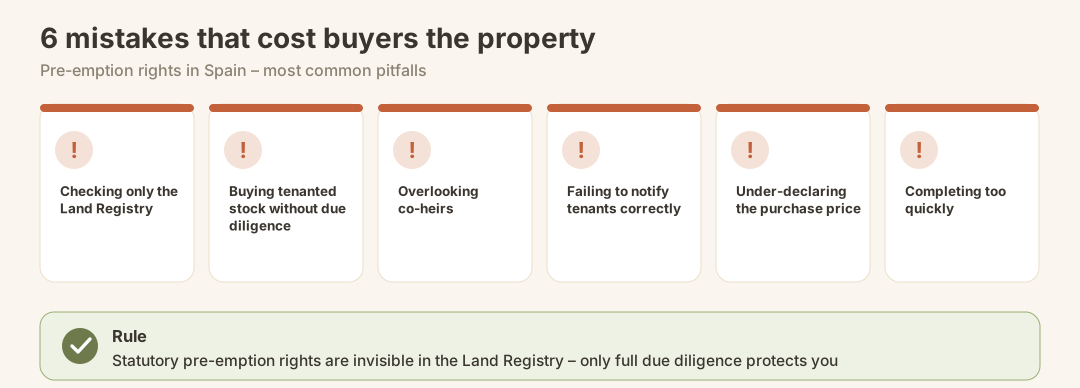
Mistake 1: Checking only the land registry Statutory pre-emption rights are not registered there. The land registry only protects against contractual rights that have not been registered.
Mistake 2: Purchasing a tenanted property without due diligence Sellers do not always volunteer the existence of a tenancy agreement. Have the seller confirm in the purchase contract that the property is free of tenancies — and verify this yourself.
Mistake 3: Overlooking co-heirs Particularly with inherited properties, the chain of ownership is often unclear. An incomplete line of succession can jeopardise the entire transaction.
Mistake 4: Failing to notify the tenant correctly Formalities errors in the notification — missing price, missing terms, incorrect form of delivery — can revive the tenant's retracto right.
Mistake 5: Under-declaring the purchase price As explained above: in the event that a pre-emption right is exercised, you will lose the unofficial premium entirely.
Mistake 6: Completing too quickly Pre-emption deadlines run from the moment of notification. Anyone who completes a purchase before the deadline expires risks the entitled party still being able to step in with legal effect.
What comes next? Next steps after the pre-emption rights review
Once all pre-emption rights have been clarified or removed by way of waiver declarations, you can proceed with the purchase process with considerably greater certainty. Typical next steps:
- Reservation agreement (contrato de arras or reservation agreement): Read first Reservation agreement Spain
- Calculate purchase ancillary costs: The Balearic Islands apply a progressive ITP scale (8 % to 13 % depending on the purchase price bracket). Details at Purchase ancillary costs Mallorca
- Instruct a solicitor to fully coordinate the due diligence: Solicitor property purchase Spain
- Review the Land Registry in detail: Check Land Registry Spain
- Prepare notary appointment and transfer of ownership: Notary Spain
Checklist: Pre-emption rights before purchasing property in Spain
- Current nota simple (Land Registry extract) obtained and reviewed
- Tenancy status of the property clarified (let/not let)
- Tenant correctly notified in writing of all purchase terms and conditions (if let)
- Waiting period for tenant pre-emption right observed
- Lease or usage agreements at land level reviewed
- Co-owner structure fully recorded
- Co-heirs identified and their pre-emption rights addressed
- Listed building status and public protection categories reviewed
- VPO/VPL status of the property checked (if relevant)
- Waivers obtained from all relevant holders of pre-emption rights
- Purchase price declared in full and correctly in the contract
- Lawyer instructed with expertise in Spanish property law
Conclusion
The right of pre-emption on property in Spain is no theoretical edge case – it is a real risk in a considerable number of transactions, particularly with tenanted properties, inherited properties, fincas subject to leasehold arrangements, and subsidised housing. The crucial difference from German law: many of these rights are enshrined in statute and invisible in the land register. Anyone who relies solely on the nota simple has only done part of their homework.
The good news: with thorough due diligence carried out by an experienced local lawyer, clear written waivers, and correctly observed deadlines, the risk can be reduced to virtually zero. Buying a property on Mallorca or elsewhere in Spain is then a safe and rewarding decision – but not without this groundwork.
Official Sources
- Código Civil Español (Spanish Civil Code), Art. 1445 ff. (contract of sale), Art. 1521 ff. (retracto legal): https://www.boe.es/eli/es/rd/1889/07/24/(1)/con
- Ley de Arrendamientos Urbanos (LAU), Law 29/1994: https://www.boe.es/eli/es/l/1994/11/24/29/con
- Registro de la Propiedad (Land Registry): https://www.registradores.org
- Agència Tributària de les Illes Balears (ATIB) – ITP and other taxes: https://www.atib.es
- Govern de les Illes Balears – housing policy and VPO: https://www.caib.es
- Consell de Mallorca – spatial planning and listed heritage assets: https://www.conselldemallorca.net