
IBI Tax Spain: Property Tax, Waste Charges & Vado in Mallorca
You own a finca, an apartment or a villa on Mallorca — and at some point either a letter lands in the post box or none arrives at all, even though the tax has long been due. That is precisely what makes the IBI tax Spain so tricky: most municipalities no longer send paper bills and rely on property owners to take responsibility themselves. This guide explains how the Impuesto sobre Bienes Inmuebles (IBI) is calculated, what the cadastral value has to do with it, which additional municipal charges such as refuse collection fees (basura) and dropped-kerb permits (vado) are added on top, when you need to pay — and why a direct debit is by far the most hassle-free solution. You will also learn how IBI and non-resident income tax differ and what to expect when purchasing a property.

Would you like to know exactly how much IBI you owe or whether your cadastral value is correct?
- 📩 Submit a personal enquiry — Individual assessment by experts on Mallorca
- All taxes & legal matters at a glance
What is IBI — and who pays it?
The Impuesto sobre Bienes Inmuebles, or IBI for short, is Spain's equivalent of council tax or property tax. The legal basis is the Ley de Haciendas Locales (LHL), specifically Article 60 et seq. Under the law, the liable party is the owner, the holder of a building lease, or the usufructuary — not automatically the tenant, even though rental agreements sometimes stipulate otherwise.
IBI is a municipal tax: every municipality (Ayuntamiento) on Mallorca levies it independently, sets its own rate within the legally prescribed limits, and is also responsible for collection. This explains why two neighbouring fincas in different municipalities can receive noticeably different annual bills.
Please note: IBI and non-resident income tax (Modelo 210) are two entirely separate taxes. IBI goes to the town hall; income tax goes to the national Agencia Tributaria. Paying only one of them does not settle the other.
How is IBI calculated? Cadastral value and tax rate
The formula is straightforward: IBI = cadastral value × tax rate. The complexity lies in both factors.
The cadastral value (Valor Catastral)
The cadastral value reflects the value of the land and any buildings on it, and is determined using an official valuation table for each cadastral unit. It is generally well below the market value. Technically it is reassessed every ten years (revisión catastral); in between, it can change due to inflation, renovation, or alterations to the property.
The tax rate
Spanish law prescribes ranges within which municipalities may freely set their own rate:
| Property type | Statutory minimum | Statutory maximum |
|---|---|---|
| Urban properties (urban) | 0,4 % | 1,1 % |
| Rural properties (rústico) | 0,3 % | 0,9 % |
During the financial crisis after 2008, many municipalities raised their rates significantly; since then, figures on Mallorca have varied considerably. You can find out the rate currently applicable in your municipality by enquiring directly with the relevant Ayuntamiento or through the ATIB.
Example calculation
| Parameter | Value |
|---|---|
| Cadastral value | 180.000 € |
| Municipal rate | 0,65 % |
| Annual IBI | 1.170 € |
In the Balearic Islands, the calculation also incorporates a municipality-specific factor applied to the cadastral value that takes into account the type of development. The precise figures are available from the municipal authority on request.
When and how do you need to pay IBI?
Payment deadlines
In most municipalities on Mallorca, the so-called periodo voluntario de pago (voluntary payment period) begins on 1 October and ends on 2 December. Slightly different deadlines apply to around a dozen town halls — it is worth checking the specifics.
Please note: Most municipalities on Mallorca no longer send out paper payment notices. You are personally responsible for keeping track of the deadline. Anyone who pays late risks substantial surcharges.
Payment methods
| Municipality | Payment method |
|---|---|
| Most Mallorca municipalities | Balearic tax authority ATIB: sede.atib.es |
| Calvià | Directly with the Ayuntamiento Calvià |
| Inca | Directly with the Ayuntamiento Inca |
| Municipalities on neighbouring islands | Directly with the relevant Ayuntamiento |
Online, you can log in via the ATIB platform, view the amount due and pay directly. A code on the tax notice — if one is still being sent — provides access to the current status.
Tip: Set up a direct debit
The most hassle-free solution is a direct debit mandate with your Spanish bank. The ATIB or the responsible town hall will then automatically debit the amount on the due date. For non-residents with a Spanish bank account, this is the standard approach — and reliably prevents late-payment surcharges.
Refuse charges (Basura / Tasa de Residuos)
The refuse charges — in Spanish tasa de basura or tasa de residuos sólidos urbanos — are a separate municipal levy and do not appear on the IBI bill, even though they are sometimes collected together.
| Feature | Detail |
|---|---|
| Legal basis | Municipal bye-law (ordenanza municipal) |
| Assessment basis | Depending on the municipality: property size, type of use, number of residential units |
| Payment frequency | Usually annual, sometimes half-yearly |
| Responsible authority | Ayuntamiento or appointed body |
| Due date | Depending on the municipality, often aligned with the IBI period |
The amount varies considerably: a small apartment pays significantly less than a large detached house. Whether the property is used as a primary or secondary residence may also be a factor. If in doubt, enquire directly with the Ayuntamiento.
Vado: the access permit
The vado (also known as a vado permanente) is the charge for an approved exit or entrance on private land — that is, for crossing the pavement to reach your garage or driveway. The fees go directly into the municipal coffers.
| Feature | Detail |
|---|---|
| What it covers | Authorisation to cross the pavement on a permanent basis |
| Identification | Blue sign showing the number of hours or "24h" at the entrance |
| Responsible authority | Ayuntamiento |
| Payment frequency | Annual |
| Consequence without authorisation | No legal basis to report vehicles blocking the access |
Please note: A vado sign without a valid permit has no legal effect. Anyone wishing to have unauthorised vehicles removed from their driveway needs an active, paid permit from the town hall.
The Catastro: the basis of all municipal taxes
The Catastro (land registry) is the state register in which all plots and buildings in Spain are recorded along with their essential characteristics. It is not the same as the property register (Registro de la Propiedad), even though both are relevant for property owners.
| Catastro | Registro de la Propiedad | |
|---|---|---|
| Content | Physical characteristics, cadastral value, type of use | Ownership rights, encumbrances, mortgages |
| Responsible body | Dirección General del Catastro (national) | Local land registry office |
| Relevance for IBI | Direct (basis of calculation) | Indirect |
| Online access | sede.catastro.gob.es | registradores.org |
If the data held in the Catastro does not match the actual property — for example following a conversion or an extension — this can result in incorrect cadastral values and consequently an incorrect IBI. An update (declaración de alteración catastral) is then mandatory.
Please note: Undeclared building works may be missing from the Catastro and can cause problems during a later inspection — including tax-related issues. For more information, see the guide on legalising unauthorised buildings on Mallorca.
IBI and non-resident income tax: the difference
Many owners who are not registered in Spain confuse the IBI with non-resident income tax (IRNR). Both taxes relate to the same property — but are entirely independent of one another.
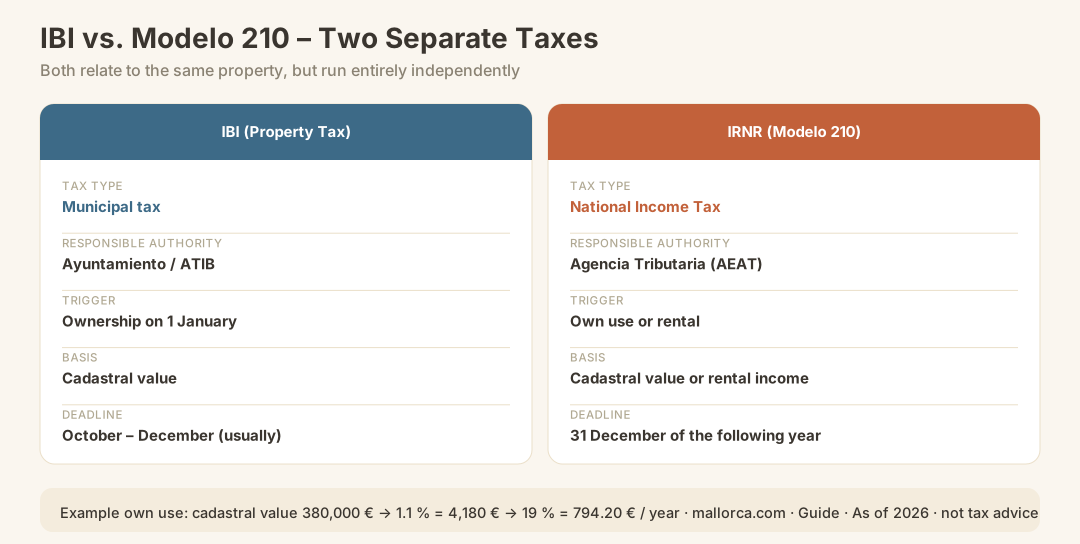
| IBI | IRNR (Modelo 210) | |
|---|---|---|
| Type of tax | Municipal tax | National income tax |
| Responsible body | Ayuntamiento / ATIB | Agencia Tributaria (AEAT) |
| Trigger | Ownership on 1 January | Owner-occupation or letting |
| Basis | Cadastral value | Cadastral value or rental income |
| Deadline | October–December (as a rule) | 31 December of the following year |
Example: Owner-occupation by non-residents
Those who do not let their property still owe the Spanish tax authorities a notional rental income (imputación de rentas). This is calculated at 1.1% of the cadastral value, on which EU/EEA citizens pay a tax rate of 19 %.
Example: Cadastral value €380,000
→ 1.1% = €4,180
→ 19% thereon = €794.20 annual income tax
This tax is in addition to IBI — it does not replace it.
IBI when buying a property: who pays what?
IBI is levied on whoever is registered as owner in the Catastro on 1 January of the tax year. When a purchase takes place mid-year, this raises an important question: who bears the IBI for the current year?
In practice, this is settled in the purchase contract. The usual approach is a pro-rata apportionment (prorrateo) between seller and buyer based on the date of transfer of ownership. Buyers should ensure this point is explicitly recorded in the notarial contract.
Note: If there is an outstanding IBI liability at the time of purchase, the new owner may be held liable in certain circumstances. It is therefore advisable to check with ATIB before completing the purchase. You can find more about the process in the guide to buying property in Mallorca.
Overview: all municipal charges in Mallorca
| Charge | Spanish | Who pays | Due date | Responsible authority |
|---|---|---|---|---|
| Property tax | IBI | Owner / Usufructuary | Oct.–Dec. (generally) | ATIB / Ayuntamiento |
| Waste collection charge | Tasa de basura | Owner | Depending on municipality | Ayuntamiento |
| Driveway permit | Vado permanente | Owner | Annually | Ayuntamiento |
| Vehicle tax | IVTM | Vehicle owner | Depending on municipality | Ayuntamiento |
| Business tax | IAE | Business owner | Annually | ATIB / Ayuntamiento |
| Capital gains tax on land value (sale) | Plusvalía municipal | Seller | Upon sale | Ayuntamiento |
Most common mistakes with IBI on Mallorca
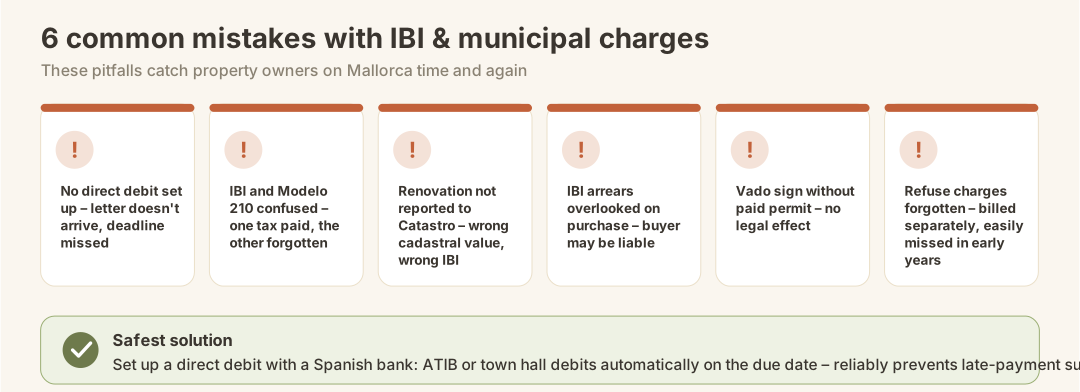
- No direct debit set up: You wait for a letter that never arrives — and end up paying late.
- Confusing IBI and IRNR: Only the IBI has been paid, but the Modelo 210 has been forgotten (or vice versa).
- Incorrect cadastral value: A renovation or extension has not been reported to the Catastro — meaning the basis for calculation is wrong.
- Overlooking IBI arrears when purchasing: Buyers fail to check whether any outstanding amounts exist before the notary appointment.
- Vado without a valid permit: The sign is in place, but the annual fee has not been paid — rendering the permit void.
- Forgetting waste collection charges: Because they are sometimes billed separately, they get lost in the chaos of the first years of ownership.
- Unclear responsibility: In Calvià and Inca, payment does not go through the ATIB but directly through the town hall.
What comes after the IBI? Further annual tax obligations
The IBI is the best-known, but not the only annual tax obligation for property owners on Mallorca.
- Modelo 210 (IRNR): Non-residents are generally required to declare income tax on owner-occupied or rented properties annually by 31 December of the following year.
- Wealth tax: Payable for non-residents with property assets in Spain above certain thresholds — details in the Guide to Wealth Tax in Spain.
- Taxes on sale: When you later sell, capital gains tax and the municipal Plusvalía municipal apply — more on this in the Guide to Taxes on Property Sales.
- Inheritance and gift tax: The Balearic Islands have had significant tax relief for close relatives for a number of years — everything you need to know in the Guide to Inheritance & Gift Tax Balearic Islands.
Checklist: IBI & municipal charges under control
- Cadastral value of the property checked (sede.catastro.gob.es)
- Municipal multiplier enquired about at the Ayuntamiento
- Direct debit mandate set up with a Spanish bank
- Payment deadline of your own municipality noted (generally 1 Oct. – 2 Dec.)
- Waste collection charges recorded separately and entered in the payment calendar
- Vado permit applied for and annual fee paid (if driveway present)
- On purchase: IBI arrears checked with the ATIB
- On purchase: IBI apportionment agreed in the purchase contract
- Modelo 210 for the current tax year noted in the calendar
- Catastro data updated after renovation or extension
Conclusion
The IBI Steuer Spanien is fundamentally straightforward — as long as you know how it is calculated, when it is due, and who collects it. The cadastral value is the basis, the municipal multiplier determines the amount, and the ATIB handles payment for most Mallorca municipalities. On top of this come standalone charges such as waste collection fees and Vado, which are easily overlooked. The most important step for non-residents: set up a direct debit mandate and do not confuse the IBI with the Modelo 210 — both taxes run in parallel and neither replaces the other. Once you understand this, there will be no nasty surprises.
Official sources
- Ley de Haciendas Locales (RDLeg 2/2004): Legal basis for the IBI, Art. 60 ff. — noticias.juridicas.com
- ATIB – Agència Tributària de les Illes Balears: Payment portal for municipal charges in most Mallorca municipalities — sede.atib.es
- Dirección General del Catastro: Cadastral information and Valor Catastral online — sede.catastro.gob.es
- AEAT – Agencia Estatal de Administración Tributaria: Responsible for Modelo 210 (non-resident income tax) — aeat.es
- Consell de Mallorca: Island institution with further information on local regulations — conselldemallorca.net