
Valor de Referencia Spain: The New Tax Value and Its Implications for Property Buyers
Anyone who buys, inherits, or receives a property as a gift in Mallorca or elsewhere in Spain will inevitably encounter it: the Valor de Referencia Spain, the new cadastral reference value. Since 1 January 2022, it has replaced the previously customary contract price as the assessment basis for property transfer tax (ITP/AJD) and inheritance and gift tax in most cases. This may sound technical – but it has very real consequences: if the reference value exceeds the purchase price, you pay tax on a figure you never agreed to. In this guide, you will learn how the value is calculated, where to look it up, when it applies, how it differs from the old cadastral values – and what you can do if you believe it is incorrect.

Not sure whether your purchase price falls below the reference value – and what that means for your tax liability?
- 📩 Submit a personal enquiry — We will review the specific figures for your desired property together with you
- A complete overview of all purchase ancillary costs in Mallorca
What is the Valor de Referencia – and why does it exist?
For decades in Spain, the individually agreed purchase price was the basis for calculating property transfer tax. The result: buyers and sellers had a tax incentive to enter the lowest possible price in the notarial deed – and pay the remainder in cash. The tax authorities could subsequently review the transaction and apply a higher "value", but were required to justify and prove this in each individual case. The burden of proof lay with the tax office.
With Law 11/2021 of 9 July (Ley de medidas de prevención y lucha contra el fraude fiscal), the Spanish legislature reversed this logic. Since then, the cadastral authority (Dirección General del Catastro) sets an annually updated reference value for virtually every property. This value is based on actual notarial sales in the respective location and is calculated statistically using market data. It is publicly accessible before anyone buys or inherits a property.
Please note: If the reference value is higher than the purchase price, tax is calculated on the reference value – not on the price you paid. If the purchase price is higher than the reference value, the purchase price applies. The higher of the two values always takes precedence.
The reversal of the burden of proof is the decisive systemic change: anyone who believes the reference value is too high must now disprove this themselves – it is no longer the tax office's responsibility.
Valor de Referencia vs. Valor Catastral: the difference
Many buyers confuse the two terms. This is understandable, as both originate from the cadastral authority. However, they serve different purposes.
| Characteristic | Valor Catastral (cadastral value) | Valor de Referencia (reference value) |
|---|---|---|
| Purpose | Assessment basis for IBI (property tax), IRPF imputation | Assessment basis for ITP/AJD and inheritance/gift tax |
| Determination | Land Registry, rarely updated, often outdated | Land Registry, annually reassessed |
| Calculation basis | Location, year of construction, floor area, historical tables | Actual notarial sales in the surrounding area |
| Relationship to market price | Often significantly below market value | Must not exceed market value (statutory requirement) |
| Publicly accessible | Yes, via Catastro | Yes, via sedecatastro.gob.es |
| Valid since | For decades | 1 January 2022 |
For your ongoing property tax (IBI), the Valor Catastral therefore continues to play the decisive role. For the purchase, inheritance, or gift of a property, the Valor de Referencia is the determining factor from 2022 onwards.
Please note: Not every property already has a certified reference value. New builds, undeveloped plots in outlying areas, or highly atypical properties may be missing. In such cases, the old method applies: the tax office or ATIB calculates a guide value using its own tables — and you continue to have the option of challenging this.
Which taxes are affected?
The reference value is not relevant for all property taxes — but it does apply to the two most expensive one-off events when ownership changes hands.
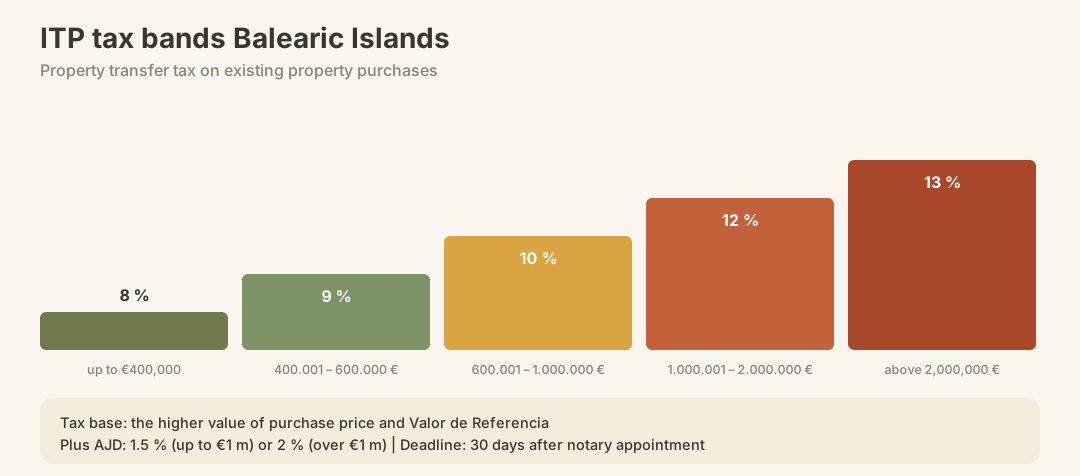
Property transfer tax (ITP/AJD) on the purchase of existing properties
When you buy a second-hand property in Mallorca, you pay property transfer tax (Impuesto sobre Transmisiones Patrimoniales, ITP). Since 2022, the tax base has been the higher of the purchase price and the Valor de Referencia. The Balearic Islands apply the following progressive tax rates:
| Purchase price bracket | ITP rate (Balearic Islands) |
|---|---|
| Up to 400.000 € | 8 % |
| 400.001 € – 600.000 € | 9 % |
| 600.001 € – 1.000.000 € | 10 % |
| 1.000.001 € – 2.000.000 € | 12 % |
| Over 2.000.000 € | 13 % |
In addition, the Balearic Islands levy a stamp duty (AJD) of 1,5 % on properties up to 1.000.000 € and 2 % on properties over 1.000.000 €. The ITP must be paid within 30 days of the notarial transfer of ownership.
Example calculation: You purchase a finca for 800.000 €. The reference value is 850.000 €. The tax is calculated on 850.000 €:
| Bracket | Amount | Rate | Tax |
|---|---|---|---|
| Up to 400.000 € | 400.000 € | 8 % | 32.000 € |
| 400.001 – 600.000 € | 200.000 € | 9 % | 18.000 € |
| 600.001 – 850.000 € | 250.000 € | 10 % | 25.000 € |
| Total ITP | 75.000 € |
Had the tax been calculated on the basis of the purchase price (800.000 €), the ITP would have been only 70.000 € — the reference value costs you 5.000 € more here.
Inheritance and gift tax (ISD)
In the case of inheritances and gifts of property, the reference value also applies as the minimum tax base — provided it is higher than the declared value. This is particularly relevant when parents transfer a property to their children at a nominal price, or when a property in an estate is valued below market value.
Where and how to look up the reference value
The official port of call is the online portal of the Spanish Cadastre authority. You can access it at:
To retrieve the value, you will need the Referencia Catastral of the property — a 20-digit alphanumeric reference number. You can find this:
- In the purchase offer or agent's listing
- On the seller's current IBI notice
- On the land registry extract (Nota Simple)
- On property portals such as Idealista (often shown directly)
On the ATIB website (Agència Tributària de les Illes Balears, atib.es) you can also check whether a certified reference value exists for your specific Balearic property, or whether the authority uses its own indicative value.
Note: The reference value is set by the Catastro annually. It is therefore worth checking the current value shortly before the notary appointment – particularly if several months pass between reservation and completion.
Properties without a certified reference value
Not every property on Mallorca already has an officially certified reference value. This typically affects:
- Newly constructed buildings that have not yet been fully recorded in the Catastro
- Undeveloped plots in rural or very remote locations
- Properties with an unclear cadastral record (e.g. following renovation or extension without an updated notification)
In these cases, the purchase price does not automatically apply. The ATIB or the responsible tax office then sets its own estimated value – based on tables and valuation formulas. This value can still be challenged, but the burden of proof likewise rests with the buyer or heir.
Always check before purchasing whether a reference value has been certified for the property. This will save you unwelcome surprises after the notary appointment.
What to do if the reference value is too high?
The law expressly provides that the reference value must not exceed market prices. In practice, however, this does occur – particularly in areas where the underlying data (notarial sales) is sparse or where prices have fluctuated significantly. The reference value then lags behind the market.
You have two options for challenging an excessively high reference value:
Option 1: Challenge within the tax proceedings (indirect)
You first pay the tax on the basis of the reference value and then lodge an appeal (recurso de reposición or reclamación económico-administrativa) against the tax assessment. In these proceedings you can demonstrate – for example by means of an independent valuation report (Tasación) – that the actual value of the property is lower. The tax authority must then carry out a review.
Option 2: Direct challenge to the reference value itself
Since the reform it is also possible to challenge the reference value directly with the cadastral office. However, the procedure is more involved and requires a detailed statement of reasons.
Important: You cannotsimply challenge a tax assessment by paying less than the amount due. Pay the full amount first and then appeal — otherwise penalty surcharges may be imposed.
For a professional counter-valuation, it is advisable to engage a certified property valuer (Tasador homologado). Find out more in our guide to Tasación – Property Valuation in Spain.
The reference value for new builds: the special case of IVA instead of ITP
When purchasing a newly built property directly from the developer, ITP does not apply — instead, VAT (IVA) is charged, typically at 10% of the purchase price. In this case, the Valor de Referencia is not the taxable base, as IVA is calculated on the contractually agreed price.
However, AJD (stamp duty) may apply to new builds, and for subsequent resales the reference value does become relevant. Anyone considering new builds and off-plan projects in Mallorca should factor this into their exit strategy.
Impact on inheritances and gifts in the Balearic Islands
The reference value can have significant consequences — both positive and negative — particularly in the case of inheritances and gifts.
On the positive side: The Balearic Islands have substantially reduced inheritance and gift tax for direct relatives (parents, children, spouses) in recent years. Nevertheless, correct valuation remains important, as the reference value serves as the minimum taxable base.
On the negative side: Anyone wishing to transfer a property by way of a gift at a nominal price cannot simply reduce the tax burden by stating a low price. Tax will be calculated on at least the reference value.
Full details of allowances and rates in the Balearic Islands can be found in the guide to Inheritance & Gifts in the Balearic Islands.
Impact on property sales
When selling a property, the Valor de Referencia is relevant to the seller in two respects:
Plusvalía Municipal (IIVTNU): This municipal tax on the increase in land value since the last change of ownership continues to be calculated on the basis of the Valor Catastral (not the reference value). It should be noted, however, that the state coefficients for the Plusvalía were adjusted from 2026 onwards.
Income tax on the capital gain (IRPF/IRNR): The taxable gain is calculated as the sale price minus the acquisition costs. If the reference value was used as the assessment basis for the original purchase (i.e. higher than the purchase price), it can be argued that this higher value should also be applied as the acquisition value — which reduces the subsequent capital gain. This question has not yet been conclusively resolved under tax law; you should definitely seek individual advice. More on this in the guide Taxes on Property Sales in Spain.
Most Common Mistakes When Dealing with the Valor de Referencia
Anyone who underestimates or ignores the reference value often ends up paying more — sometimes significantly more. These are the mistakes we see most frequently:
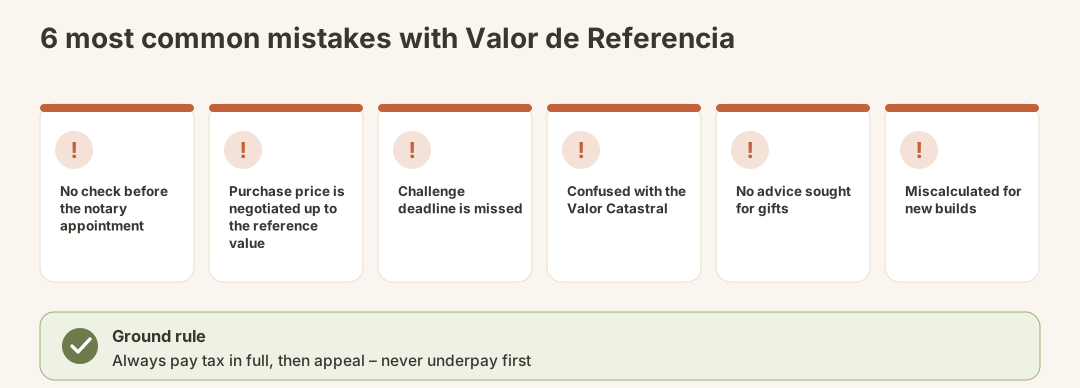
No check before the notary appointment: Many buyers only find out when they receive the tax assessment that the reference value exceeds the purchase price. A preliminary check takes less than ten minutes on sedecatastro.gob.es.
Purchase price is negotiated up to the reference value: Sellers sometimes attempt to artificially raise the purchase price to the level of the reference value in order to save the buyer tax. This only helps, however, if the purchase price is above the reference value — not the other way around.
Appeal deadline is missed: There are deadlines for lodging an objection against a tax assessment. Anyone who waits too long loses the right to do so.
Confusion with the Valor Catastral: The cadastral value shown on the IBI assessment is not the reference value. The two are different figures, and for ITP purposes only the reference value counts.
No advice sought for gifts: Many family transfers are carried out without any tax review. This can prove costly if the reference value is significantly higher than the declared gift value.
Miscalculation on new builds: On a first purchase from a developer, IVA applies, not ITP. The reference value plays no role here — but it very much does on any subsequent resale.
What comes next? Ongoing taxes after the purchase
The Valor de Referencia is a one-off matter at the point of acquisition. After that, other taxes come into play that are incurred on an annual basis:
| Tax | Assessment basis | Who pays | Frequency |
|---|---|---|---|
| IBI (property tax) | Valor Catastral | Owner | Annual |
| IRPF Imputación (deemed income tax) | Valor Catastral | Non-residents without rental income | Annual, Modelo 210 |
| Patrimonio (wealth tax) | Market value / purchase price | Non-residents with assets exceeding the allowance | Annual |
| Plusvalía Municipal | Valor Catastral | Seller upon resale | Upon sale |
For full details on IBI property tax and possible reductions in Mallorca, see the guide IBI Steuer Spanien and for specific discounts, see IBI-Ermäßigung Mallorca.
Checklist: Valor de Referencia before purchase
Before you sign, make sure you have ticked off the following points:
- Referencia Catastral of the property obtained (from the listing, Nota Simple, or IBI notice)
- Valor de Referencia retrieved from sedecatastro.gob.es and compared with the purchase price
- Checked whether a certified reference value exists or only an indicative value
- ITP calculation carried out on the basis of the higher value (purchase price or reference value)
- If reference value > purchase price: check whether a Challenge worth considering (obtain a Tasación)
- 30-day deadline for ITP payment after the notary appointment noted in the calendar
- tax adviser or solicitor engaged for total additional purchase costs
A complete overview of the entire purchase process is provided in our guide to the Legal process for buying property in Spain.
Summary
The Valor de Referencia has been the new reality for property purchases in Spain since 2022 – and anyone who ignores it risks an unpleasant surprise when the tax assessment arrives. The logic is straightforward: the purchase price and the reference value are compared; whichever is higher determines the ITP assessment base. In Mallorca in particular, where market prices can be considerably above the cadastral values, this can cut both ways – sometimes the reference value is lower and therefore irrelevant, sometimes it is higher and ends up costing five figures more.
The good news: a quick online query at sedecatastro.gob.es will tell you exactly where you stand before the notary appointment. And if the reference value has genuinely been set too high, there are legal avenues to challenge it. The important thing is to act early – not only once the assessment letter lands on your doormat.
Official sources
- Ley 11/2021, de 9 de julio, de medidas de prevención y lucha contra el fraude fiscal: https://www.boe.es/eli/es/l/2021/07/09/11
- Sede Electrónica del Catastro – Consulta del Valor de Referencia: https://www1.sedecatastro.gob.es/Accesos/SECAccvr.aspx
- Agència Tributària de les Illes Balears (ATIB) – Valoraciones de bienes inmuebles: https://www.atib.es/ta/valoraciones/default.aspx
- ATIB – General information ITP/AJD Balearic: https://www.atib.es
- Dirección General del Catastro: https://www.catastro.hacienda.gob.es
- AEAT – Impuesto sobre Transmisiones Patrimoniales: https://www.agenciatributaria.es