
Setting up an SL in Spain: When does a limited company make sense for expats?
You're considering setting up your own company in Spain and wondering whether forming an SL in Spain is the right route — or whether simple autónomo status will do. This is a question almost every expat who wants to run a serious business ends up asking. The Sociedad Limitada (S.L.) is the direct Spanish equivalent of a German GmbH: limited liability, a manageable minimum share capital, and a single shareholder is sufficient. At the same time, it brings ongoing bookkeeping obligations, costs, and bureaucracy that only make financial sense above a certain profit level. This guide walks you through the entire formation process step by step, gives you an honest comparison of the SL versus autónomo status, sets out the real tax rates, and highlights the most common mistakes — so you can make an informed decision before you visit the notary.

Which business structure suits your situation in Spain?
- 📩 Submit a personal enquiry — We'll connect you with experienced tax advisers and gestorias on Mallorca
- Tax adviser Spain expat – how to find the right adviser
What exactly is a Sociedad Limitada?
The Sociedad Limitada is by far the most widespread legal structure for small and medium-sized businesses in Spain. Structurally it mirrors a German GmbH: a legal entity with its own legal personality, in which the shareholders' liability is limited to the capital contributed. Your personal assets remain — unlike with autónomo status — essentially untouched, provided you do not give personal guarantees to banks or business partners.
A few key parameters to keep in mind:
| Feature | Sociedad Limitada (SL) | German GmbH | Austrian GmbH |
|---|---|---|---|
| Minimum capital | 3.000 € (or 1 € under certain conditions) | 25.000 € | 35.000 € (founding privilege: 10.000 €) |
| Liability | Limited to company assets | Limited | Limited |
| Minimum shareholders | 1 | 1 | 1 |
| Residency requirement for director | No | No | No |
| Standard corporation tax rate | 25 % | up to approx. 33 % (incl. trade tax) | 25 % |
Please note: The "Crea y Crece" Act (Ley 18/2022) allows formation with as little as 1 € in share capital under certain conditions. In practice, however, most gestorias and solicitors still recommend the standard 3.000 €, as low capitalisation can be viewed critically by banks and business partners.
The SL is managed by one or more directors (administradores) — not necessarily a shareholder. There is no residency requirement for the director, which makes the structure attractive for international founders. At the same time, the SL is required to maintain proper accounting records and must file annual accounts with the commercial registry (Registro Mercantil) once a year.
SL vs. autónomo: An honest comparison
Before you book the notary appointment, you should answer this question honestly: is setting up an SL actually worthwhile for you? The most important rule of thumb from practice is: from an annual profit of approximately 40.000 € the SL begins to become tax-efficient — provided you do not withdraw the entire profit immediately as a salary or dividend.
The reason is straightforward: the SL pays a flat corporate tax rate (25 % standard, 23 % for SMEs with turnover below 1 Mio. €), whereas the autónomo is subject to progressive income tax (IRPF), which is significantly higher beyond a certain level.
| Criterion | Autónomo | Sociedad Limitada |
|---|---|---|
| Liability | Unlimited — personal assets at risk | Limited to company assets |
| Tax basis | Progressive IRPF | Flat corporate tax rate 25 % (23 % SME) |
| Tax break-even | — | From approx. 40.000 € annual profit |
| Set-up effort | Low (registration with RETA + Hacienda) | High (notary, registry, approx. 6 weeks) |
| Ongoing bookkeeping | Simplified | Full accounting + annual accounts |
| Social security for founders | RETA (monthly, income-dependent since 2023) | Director typically subject to RETA |
| Flat Rate / Zero Quota | Yes (€80/month in the first 12 months, offset on the Balearic Islands) | No |
| Credibility with banks | More limited | Better (annual accounts available) |
Caution: Even if the SL appears more tax-efficient – if you withdraw all the profit to cover your personal living costs (as salary or dividend), the tax advantage diminishes considerably, as the withdrawals are subject to tax again at your personal level.
If you are just starting out, expect a low income, or want to take advantage of the Tarifa Plana (€80/month in the first 12 months as a new Autónomo), autónomo status is often the more pragmatic way to get started. The Balearic Islands also offer the "Cuota Cero", which offsets these €80 entirely – a genuine head start that is not available to an SL.
You can find more information on the ongoing tax obligations as an Autónomo, in particular the quarterly Modelo 303 and 130, in our separate guide: 👉 Modelo 303 & 130 for Autónomos in Spain
The SL tax rates in detail
The tax argument for the SL stands or falls on the specific rates. Here are the most important ones:
| Type of tax | Rate | Condition |
|---|---|---|
| Corporation tax (Impuesto sobre Sociedades) | 25 % | Standard rate |
| Corporation tax for SMEs | 23 % | Turnover below €1 million |
| Corporation tax for new SLs (start-up years) | 15 % | First and second profit-making year |
| IVA (VAT) | 21 % | Standard rate |
| Corporation tax Germany (incl. trade tax) | up to approx. 33 % | For comparison |
| Corporation tax Austria | 25 % | For comparison |
The 15 % rate in the first two profit-making years is a genuine head start: a newly formed SL pays only 15 % corporation tax on its first profits. Compared with the German overall rate of up to 33 %, this is competitive even after taking deductions and regional incentives into account.
Please note: Anyone relocating to Spain as a shareholder-director who meets the requirements of the so-called Beckham Regime (Art. 93 LIRPF) can pay a flat 24 % income tax rate on Spanish earned income up to €600,000 for six tax years. The regime was extended by the Start-up Law 2023 to remote workers, innovative entrepreneurs and directors. More on this in our guide: 👉 Beckham Law Spain – Requirements and Application
Step by step: Setting up the SL
Forming a Sociedad Limitada in Spain follows a clearly defined sequence of steps. With all documents in order and professional support, the entire process typically takes around six weeks – the actual notarisation itself takes approximately one week once all documents have been submitted.
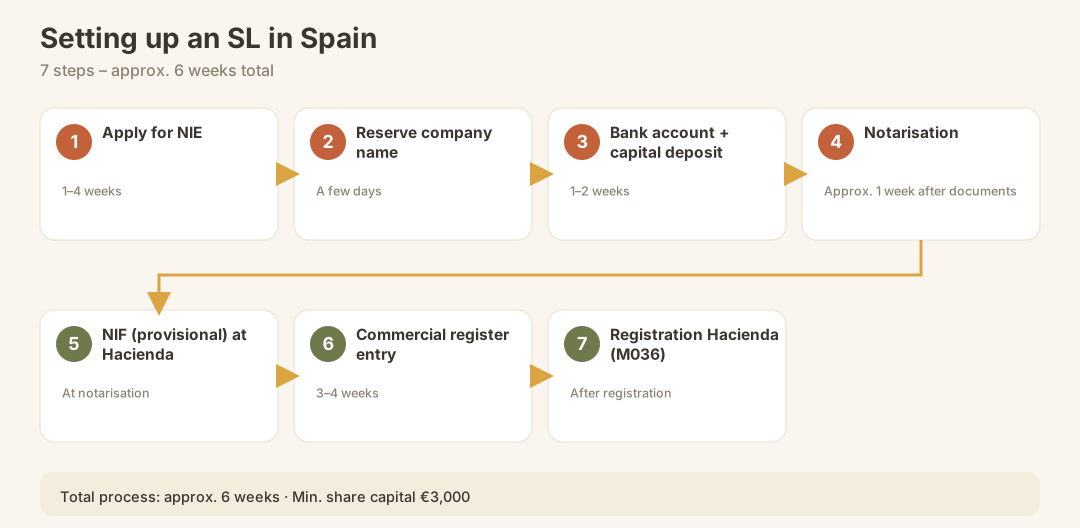
Apply for a NIE number for all shareholders and directors All parties involved need a Spanish identification number for foreign nationals (NIE). Without a NIE, nothing can proceed – neither with the notary nor with the bank. → Details on the NIE: Applying for Residencia & NIE in Spain
Apply for the company name at the Central Commercial Registry (Registro Mercantil Central) in Madrid This is where availability of your chosen name is verified. You will receive a certificate (certificación negativa de denominación), which must be presented to the notary. The certificate has a limited validity, so move forward promptly.
Open a bank account for the company in formation and pay in the share capital The share capital (minimum €3,000) must be deposited into an account in the name of the "SL en constitución". The bank will issue a certificate of deposit, which the notary requires. → Tips on Spanish bank accounts: Opening a Bank Account in Spain
Have the deed of incorporation and articles of association notarised The notary and lawyer/gestoría will draft the articles of association. All shareholders must appear in person or issue a notarised power of attorney – which is particularly useful if you are incorporating from abroad.
Apply for a tax number (NIF) from the Hacienda Following notarisation, a provisional NIF is issued. The company can begin operating domestically from this point onwards.
Registration in the Commercial Register (Registro Mercantil) Registration typically takes three to four weeks from the date of notarisation. Only once this is complete does the SL acquire full legal capacity.
Registration with the Hacienda (Modelo 036) and, where applicable, enrolment in the IAE The company must register its economic activity with the tax authorities. In addition, the shareholder-director who is actively working within the company will typically register with the RETA (the social security scheme for self-employed persons).
| Step | Responsible body | Typical duration |
|---|---|---|
| Apply for NIE | Consulate / police in Spain | 1–4 weeks |
| Reserve company name | Registro Mercantil Central, Madrid | A few days |
| Bank account + capital deposit | Spanish bank | 1–2 weeks |
| Notarisation | Notary in Spain | Approx. 1 week after documents submitted |
| NIF (provisional) | Agencia Tributaria (AEAT) | Upon notarisation |
| Commercial register entry | Registro Mercantil | 3–4 weeks |
| Registration with Hacienda (M036) | AEAT | After registration |
Costs: what setting up an SL actually costs
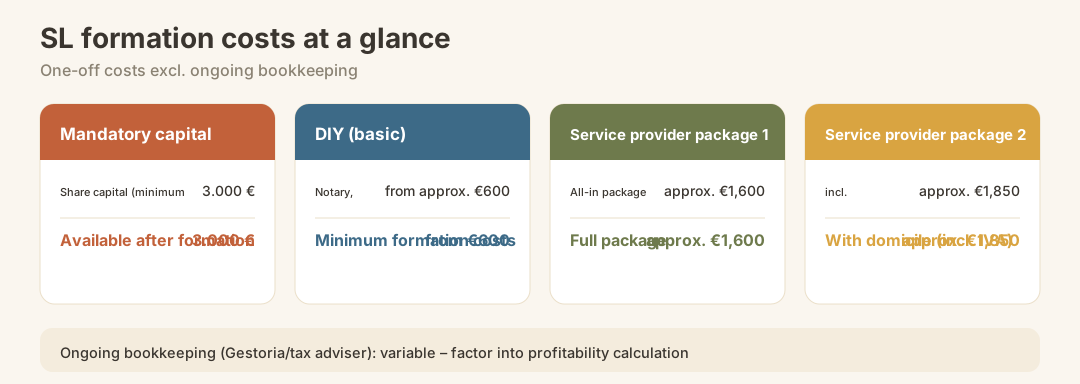
No nasty surprises, please. Here are the key cost items:
| Type of cost | Amount (approx.) |
|---|---|
| Share capital (mandatory deposit) | 3.000 € (available for use after incorporation) |
| Total incorporation costs (notary, register, taxes) | from approx. 600 € |
| Package price with service providers (all-in, Package 1) | approx. 1.600 € incl. IVA |
| Package price with registered address/office service (Package 2) | approx. 1.850 € incl. IVA |
| Ongoing bookkeeping (gestoría/tax adviser) | variable depending on scope |
The share capital of 3.000 € is not a sunk cost: after incorporation it can be used for investments or as working capital.
Please note: In addition to the one-off costs mentioned above, ongoing costs for bookkeeping, annual accounts and tax advice will apply. These should be factored into your profitability calculations.
Ongoing obligations of the SL: what to expect
An SL is not a 'set and forget' model. You will have ongoing obligations from day one:
- Full double-entry bookkeeping in accordance with Spanish law
- Quarterly tax filings (IVA, advance corporation tax payments)
- Annual financial statements (cuentas anuales), which must be filed with the Registro Mercantil – failure to do so can result in substantial fines
- Corporation tax return (Impuesto sobre Sociedades) once a year
- Registration of the actively working shareholder-director with the Seguridad Social (generally via RETA)
- General meeting to be held and documented at least once a year
For most founders this means in practice: you will need a reliable gestoría or tax adviser. This is not a luxury — it is a legal requirement.
If you want to understand your tax situation as a resident in Spain, read our guide: 👉 Taxes as a resident in Spain (IRPF)
The property SL: once a tax-saving model, now to be viewed with caution
A special case that was once very common on Mallorca and other holiday islands: the so-called property S.L. — an SL set up solely to hold a property. Until around 2006 this was a popular tax-saving model, as the asset-managing SL could, under certain conditions, benefit from more favourable corporation tax rates when selling a property.
The tax landscape has fundamentally changed in the meantime. Anyone evaluating a property SL today should work through the following points with a specialist tax adviser:
- The former special tax advantages no longer exist in this form
- Ongoing accounting costs and tax obligations of the SL can outweigh the benefits when the property is used purely passively
- When the property is used as a holiday home, additional licensing questions come into play
Please note: For holiday landlords in the Balearic Islands, the area of tourist rental licences (ETV) is heavily regulated. Make sure you are up to date with the current legal position before deciding on a structure.
The Beckham regime and the SL: the combination for founders
Anyone who moves to Spain personally as a founder or managing director can apply for the so-called Beckham regime under Artículo 93 LIRPF — provided they were not tax-resident in Spain during the five years prior to the move and the relocation is professionally motivated.
The Startup Law 2023 extended the circle of eligible individuals: remote workers, innovative entrepreneurs and managing directors can also use the regime. The key points:
- 24 % flat income tax on Spanish earned income up to 600.000 €
- Valid for six tax years
- Foreign income largely remains outside Spanish taxation
The combination of a newly founded SL (15 % corporation tax in the first two profitable years) with the Beckham regime at shareholder level can be very tax-efficient for certain profiles — but it is not suitable for everyone. Individual advice is essential here.
The most common mistakes when setting up an SL in Spain
For those who have done their research and still fall into typical traps — here are the most common pitfalls:
Founding too early, without a profitability check: An SL only makes sense above a certain level of profit. Anyone with an annual profit below 40.000 € who withdraws everything often pays more than as an autónomo.
Failing to obtain NIE numbers for all parties in advance: Missing NIE numbers are the most common cause of delays. Allow sufficient lead time.
Choosing the wrong company name: The preferred name is already taken in the central register, but the chaos only becomes apparent at the notary appointment. Check early and have alternative names ready.
Taking on a shelf company without due diligence: Purchasing a shelf company that has already been used operationally is risky if you do not have a complete picture of its history. Hidden debts or outstanding tax liabilities can be very difficult to trace.
Failing to file annual accounts: This may sound trivial, but many small SLs miss the deadline for filing with the Registro Mercantil. The consequences are substantial fines.
Running an SL without an accounting structure: Without a gestoría or tax adviser from the outset, an SL can quickly run into compliance problems.
Misconception: an SL always protects against personal liability: When banks require personal guarantees (which is common with small SLs that have no equity buffer), you are personally liable — despite the SL wrapper.
What comes next? Running the SL on an ongoing basis
Once the company is set up, the real business life begins. A few points that many people only think about in hindsight:
- Managing director's salary: As an active shareholder-director, you can set yourself a salary and deduct it as a business expense — this is a genuine tax advantage over the autónomo, who pays tax directly on all their income.
- Bank loans: Compared with autónomos, companies generally have easier access to external financing, as annual accounts increase transparency.
- Dividend distributions: Distributed profits are subject to IRPF at the recipient level (or the Beckham regime). The double taxation agreement with Germany is relevant here if shareholders remain resident in Germany.
- Modelo 720: If, as a Spanish resident, you hold shares in foreign companies or foreign accounts above certain thresholds, a reporting obligation applies. More on this: 👉 Modelo 720 – Reporting obligation for assets held abroad
Checklist: Am I ready to set up an SL?
Before you take the first step, work through this list honestly:
- My expected annual profit is sustainably at or above 40.000 €
- I do not want to withdraw all the profit privately straight away
- I need limited liability (high-liability activity or external-facing business)
- I have or am applying for a NIE for all shareholders and directors
- I have thought of a company name and alternatives
- I have a tax adviser or a gestoría to handle the ongoing bookkeeping
- I have budgeted for 3.000 € share capital plus formation costs (from approx. 600 €)
- I am aware that incorporation takes approx. 6 weeks
- I have checked whether the Beckham regime is an option for me
- I have calculated the profitability compared with autónomo status
Conclusion: When the SL is genuinely worthwhile for people relocating abroad
The Sociedad Limitada is a serious tool — but not a cure-all. It is worthwhile for you if you sustainably expect profits above the threshold of approximately 40.000 € per year, operate in a high-liability field, want to retain part of the profit within the company, wish to build credibility with business partners or banks, or can combine the Beckham regime as a qualifying founder.
It is not (yet) worthwhile if you are just starting out, expect low income, can make use of the Tarifa Plana or Cuota Cero in the Balearen, or if you intend to withdraw every euro of profit privately in any case.
For both paths, the decision has tax, legal, and social security implications that vary from person to person. An experienced tax adviser with expertise in Spain is not optional — they are the key to success.
👉 An overview of all tax topics for residents 👉 Remote work on Mallorca: legal and tax considerations
Official sources
- Registro Mercantil Central (name reservation for SL): https://www.rmc.es
- Agencia Tributaria (AEAT) – corporation tax, NIF, Modelo 036: https://www.aeat.es
- Seguridad Social – Alta en RETA (registration as self-employed): https://portal.seg-social.gob.es
- Ley de Creación y Crecimiento de Empresas ("Crea y Crece") – Ley 18/2022: https://www.boe.es/eli/es/l/2022/09/28/18
- Ley del Impuesto sobre Sociedades – Real Decreto Legislativo 4/2004 (consolidated text via BOE): https://www.boe.es
- Artículo 93 LIRPF (Beckham regime / Régimen especial para trabajadores desplazados): Ley 35/2006, BOE: https://www.boe.es/eli/es/l/2006/11/28/35