
Environmental Sticker Spain: The Distintivo Ambiental from the DGT
Anyone driving through Palma, Madrid or Barcelona will come across it: the Spanish environmental sticker, officially called the Distintivo Ambiental. It classifies vehicles according to their emissions and determines in many places whether you're allowed to drive into the city centre or not. For vehicles registered in Spain, the classification is already stored with the traffic authority DGT – actually displaying the sticker itself is voluntary, but sensible. In this guide you'll learn which four categories exist, how to check your category free of charge, where to order the sticker, what it costs, and which special rules have applied in Palma's environmental zone since 2025.

- Find a car workshop near you — for ITV checks and technical questions about classification
What is the Distintivo Ambiental?
The Distintivo Ambiental is the classification introduced by the Spanish traffic authority DGT (Dirección General de Tráfico) that categorises vehicles according to their energy efficiency and environmental impact. The aim is to give preferential treatment to more environmentally friendly vehicles and to provide municipalities with a tool for traffic restrictions during high air pollution as well as for tax or mobility-related benefits. In several cities, the sticker is already being used to deny entry to vehicles without the appropriate classification.
The classification itself is automatically stored with the DGT for every vehicle registered in Spain – no separate registration is required. Displaying the physical sticker on the windscreen is voluntary according to the DGT, but is recommended, as checks in environmental zones are increasingly carried out via camera systems and number plate recognition.
| Feature | Details |
|---|---|
| Responsible authority | DGT (Dirección General de Tráfico) |
| Legal basis for the zone requirement | Climate Change and Energy Transition Act (obliges municipalities to establish environmental zones) |
| Cost of the classification check | free |
| Cost of the physical sticker | from €6 |
| Display | voluntary, but recommended |
| Position on the vehicle | bottom right of the windscreen; on motorbikes in a clearly visible spot |
The four environmental stickers at a glance
The DGT distinguishes four categories, which together cover roughly the more efficient half of the Spanish vehicle fleet. The remaining approximately 50% of vehicles do not receive a sticker because they do not meet the criteria.
| Sticker | Colour | Vehicle type |
|---|---|---|
| 0 Emisiones | Blue | Battery electric (BEV), electric with range extender (REEV), plug-in hybrid (PHEV) with ≥ 40 km electric range, fuel-cell vehicles |
| ECO | Green-Blue | Plug-in hybrid with < 40 km electric range, hybrid without plug (HEV), natural gas (CNG/LNG), autogas (LPG) |
| C | Green | Petrol vehicles from build year January 2006 (Euro 4/5/6); diesel cars from September 2015; vehicles with more than 8 seats as well as commercial vehicles (petrol/diesel) from 2014 |
| B | Yellow | Petrol vehicles from 1 January 2001 (Euro 3); diesel from 2006 (Euro 4/5); vehicles with more than 8 seats as well as commercial vehicles (petrol/diesel) from 2006 |
Vehicles that do not meet any of these four categories are considered the "other" – unclassified – segment and are not allowed to enter many low-emission zones. Incidentally, whether your vehicle still meets the current Euro standard is also documented during the regular ITV (technical inspection).
Note: When a vehicle is newly registered or re-registered in Spain, the classification is automatically assigned based on the vehicle data (fuel type, build year, Euro standard). More on this in the guide Registering a car in Spain.
Who needs the sticker – and who doesn't?
As a general rule: anyone registered in Spain who regularly drives into a low-emission zone (Zona de Bajas Emisiones, ZBE) should know their classification and display the sticker visibly. The Distintivo is not formally mandatory everywhere, but in practice it is a prerequisite for entering many city centres.
Gradually, all cities across Spain with more than 50,000 inhabitants have had to set up a low-emission zone; according to press reports, around 149 cities were already affected at the start of 2024. Reports suggest that this requirement is expected to be extended in the medium term to smaller municipalities with more than 20,000 inhabitants as well.
| Vehicle origin | Needs Spanish sticker? | What applies instead |
|---|---|---|
| Vehicle registered in Spain | Yes (recommended, classification is already on file) | Purchase the sticker at Correos and display it |
| Vehicle registered abroad (e.g. German number plate) | No – no Spanish sticker available | Compliance with the respective city's entry criteria and, where applicable, prior registration; foreign environmental stickers (e.g. the German particulate matter sticker) may be recognised if they correspond to the matching class |
| Hire car with Spanish number plate | Generally yes, the classification is on file just as for any Spanish vehicle | Use the landlord or check with the DGT |
If you're still driving your vehicle with an foreign number plate in Mallorca, you should find out in advance about the specific entry rules of the respective city before driving into environmental zones, as no Spanish sticker can be issued for your vehicle.
Palma Environmental Zone (ZBE): What applies since 2025
Palma de Mallorca has also set up a Zona de Bajas Emisiones. It covers the entire old town area and is bordered by the inner-city ring road (the Avenidas) as well as the Paseo Marítimo. Since January 2025, stricter rules for motorised traffic have applied there.
| Feature | Details |
|---|---|
| Scope | Palma old town, bordered by Avinguda Gabriel Roca (Paseo Marítimo), Passeig Mallorca, Avinguda Portugal, Avinguda d'Alemanya, Avinguda Comte de Sallent, Avinguda Gran i General Consell, Plaça d'Espanya, Avinguda Alexandre Rosselló, Gabriel Alomar |
| In force since | 1 January 2025 |
| Approved stickers | 0 Emisiones, ECO, C (green, green-blue and blue sticker) |
| Enforcement | Cameras at entry points, including Berenguer de Tornamira, Jaume III, Via Roma, Plaça d'Espanya |
| Exception | Car parks within the zone remain accessible |
Please note: For foreign-registered vehicles there is no Spanish sticker – what counts here is whether the city's entry criteria are met. Google Maps now warns of upcoming environmental zones, but this does not replace your own checks.
You'll find detailed information on driving bans, resident exemptions and the exact signage in the specialist guide ZBE Palma Environmental Zone.
Step by step: check classification and apply for a sticker
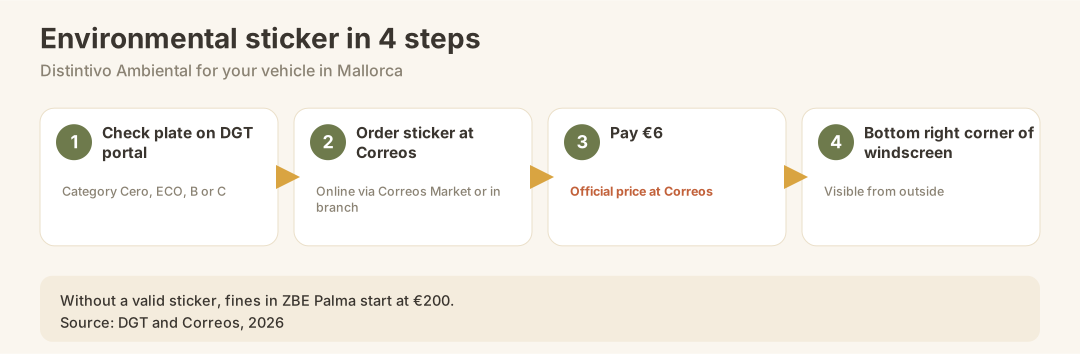
- Check the classification online. Via the DGT portal (sede.dgt.gob.es), the miDGT app, or by phone or in person, you can find out free of charge which category your vehicle falls into – even if it's not registered to you. The number plate is all that's needed.
- Order the sticker, if desired: either online via Correos Market or directly at a Correos branch.
- Have your documents ready: the vehicle registration document (Permiso de Circulación) and ID/NIE of the vehicle owner or the authorised person; for companies, the company's tax document is sufficient.
- Make the payment: from €6 per sticker, regardless of vehicle class.
- Waiting for delivery or collecting in person: When ordering via the Correos business customer page, delivery is stated to take around 48 hours.
- Affixing: Attach the sticker to the lower right area of the windscreen; for motorcycles, to a clearly visible part of the vehicle.
Costs, sizes and points of sale
Correos is the DGT-authorised distribution partner for the Distintivo Ambiental and offers the stickers both online and in branches.
| Detail | Detail |
|---|---|
| Price | from €6 per sticker, regardless of category |
| Diameter car/van | 97 mm |
| Diameter motorcycle | 87 mm |
| Material | Sticker (adhesive film) |
| Points of sale | Correos branches nationwide; Correos Market online shop |
| Documents required | Vehicle registration document + ID card of the owner or authorised representative |
Note: Checking the classification itself is always free of charge – you only pay if you order the physical sticker.
Foreign vehicles, hire cars and tourists
For vehicles registered outside Spain, the DGT does not issue a Distintivo Ambiental. Anyone driving with a German or other EU number plate must instead check whether the vehicle meets the entry criteria of the respective low-emission zone – in some cases, foreign environmental stickers (such as the German Feinstaubplakette) are recognised, provided they correspond to the appropriate environmental class. In practice, this means for hire cars with a Spanish number plate: the classification is registered with the DGT just like for any other Spanish vehicle and can be checked via the number plate lookup.
Anyone moving to Mallorca permanently and wanting to re-register their vehicle will find the necessary steps in the guide Registering a car in Spain. To search for a suitable vehicle locally, it's worth taking a look at the Directory of car dealers.
Fines for breaching the low-emission zone
Anyone entering an environmental zone without a valid classification or in breach of the access rules risks a fine which, according to press reports, is often quoted as starting at around €200, depending on the municipality. Checks are increasingly automated via cameras at the entry points, which capture number plates and match them against the classification held on file with the DGT.
| Offence | Consequence |
|---|---|
| Entering without the appropriate classification | Fine, often starting at around €200 (varies by municipality) |
| Missing sticker despite having the required entitlement | generally no fine, as the classification is stored automatically – but checks may be more difficult without a visible sticker |
General information on fine procedures, appeal deadlines and payment arrangements in Spain can be found in the guide Fines in Spain.
Most common mistakes
- Confusing registration: Many people believe they need to separately "register" their vehicle with the DGT for the sticker. For Spanish vehicles, however, the classification is already stored automatically.
- Confusing foreign number plates with the Spanish sticker: There is no Spanish sticker for vehicles registered abroad – here, the local entry criteria apply.
- Underestimating the Palma zone: Anyone who doesn't know the boundaries of the old-town zone may inadvertently enter with the wrong class and risk a fine that, depending on the municipality, can quickly be in the region of €200 or more.
- Sticker not displayed visibly: The position at the bottom right of the windscreen is mandatory so that it can be recognised during checks.
- Missing documents when ordering: Without the vehicle registration document and an identity document, Correos cannot correctly assign and issue the sticker.
What comes next? Outlook on further environmental zones
The number of environmental zones in Spain is expected to continue growing in the coming years: while the requirement has so far applied to towns with 50,000 or more inhabitants, reports suggest the threshold could drop to municipalities with 20,000 or more inhabitants by 2026. For Mallorca, this means that, besides Palma, further municipalities could set up their own low-emission zones in the medium term. Anyone buying or leasing a vehicle should therefore factor in the environmental class from the outset – for example when buying a used car in Mallorca or at the next upcoming ITV appointment.
Checklist: environmental sticker Spain
- Vehicle classification checked free of charge via sede.dgt.gob.es or the miDGT app
- Checked whether the vehicle is registered in Spain or abroad
- For Spanish-registered vehicles: sticker ordered via Correos (online or in branch)
- Vehicle registration document and identity document kept ready for the order
- Sticker fixed to the bottom right of the windscreen
- Boundaries and rules of the ZBE Palma (or the destination city) checked in advance
- For foreign number plates: local entry criteria checked instead of the Spanish sticker
- Vehicle insurance and registration status of the vehicle kept up to date (see Car Insurance in Spain)
Conclusion
The environmental sticker in Spain is no bureaucratic add-on, but rather – in an increasing number of cities, including Palma's old town – a prerequisite for smooth entry with your own vehicle. For cars registered in Spain, the classification is already stored automatically with the DGT and can be checked online free of charge; the physical sticker costs from 6 € and can be ordered via Correos in just a few steps. Anyone travelling with a foreign number plate should find out specifically about the local entry rules before driving into an environmental zone, as no Spanish sticker is issued for these vehicles. Given the growing number of low-emission zones, it's worth knowing your own vehicle class early on – at the latest by the time of your next move or vehicle purchase on Mallorca.
Official sources
- DGT – Distintivo ambiental (overview, classes, lookup): https://www.dgt.es/nuestros-servicios/tu-vehiculo/tus-vehiculos/distintivo-ambiental/
- DGT Sede Electrónica – lookup of the vehicle classification: https://sede.dgt.gob.es/es/vehiculos/informacion-de-vehiculos/distintivo-ambiental/
- Correos – Distintivo Ambiental DGT for private individuals: https://www.correos.es/es/es/particulares/para-el-ciudadano/servicios-de-la-dgt/distintivo-medioambiental
- Correos – Distintivo Ambiental DGT for businesses: https://www.correos.es/es/es/empresas/para-tu-negocio/servicios-de-la-dgt/distintivo-ambiental-dgt
- Correos Market – order form for the Distintivo Ambiental: https://www.market.correos.es/product/distintivo-ambiental-dgt