
Car accident in Spain: parte amistoso, police and insurance deadlines
A traffic accident in Spain plays out differently in key respects than in Germany – and it's precisely these differences that regularly cost German residents on Mallorca money or nerves. Anyone who relies purely on the reflexes they're used to from Germany can easily miss the Spanish notification deadline to their own insurer or underestimate just how short the limitation period for their own claims actually is. This guide covers the first minutes at the scene of the accident, how to handle the parte amistoso, the question of whether to call the police or not, and the concrete deadlines under Ley 50/1980 and the motor liability law RDLeg 8/2004 – with a focus on a Spanish-registered vehicle and a Spanish policy, i.e. everyday life as a resident, not a rental-car holiday.
- Find a workshop near you — for assessments and repairs after the accident
The first minutes at the scene of the accident
Safety comes before paperwork. Secure the vehicle, move it out of moving traffic if possible, switch on the hazard lights, put on a hi-vis vest if needed and set up a warning signal. Only after that comes the documentation: photos of both vehicles, the final resting position, visible damage, number plates and the whole accident scene, as well as an exchange of personal details and insurance information with the other party.
In the event of personal injury, caring for the injured takes priority over any documentation. In this case, the emergency number 112 comes first – it works everywhere in Spain and connects you to the ambulance service, fire brigade or police.
Note: For the basic equipment required in the vehicle and the current requirements regarding the warning triangle or warning beacon, you'll find details in the guide on the V-16 warning beacon.
When to call the police, and when the parte amistoso is enough
Not every accident requires police involvement. In cases of pure vehicle damage, a clear-cut situation and agreement between both parties on how it happened, filling out the joint parte amistoso is sufficient in practice – a police report is then not essential. In other situations, however, calling the police is the right decision, as it prevents later disputes about how the accident happened and creates an official record.
| Situation | Recommendation |
|---|---|
| Only material damage, clear-cut course of events, both parties in agreement | Fill out the parte amistoso, police not strictly necessary |
| Personal injury, however minor | Call the police (112) |
| Disagreement about how the accident happened | Call the police |
| The other party has no valid papers or no identifiable insurance | Call the police |
| The other party fleeing the scene | Call the police, file a report (denuncia) |
| Suspicion of alcohol or drug influence | Call the police |
| Damage to public property (traffic light, crash barrier, road sign) | Call the police |
Please note: This table is a practical guide, not an exhaustive list of legal requirements. When in doubt, it's better to call 112 once too often than to be left without official documentation later on.
How to file a report afterwards, if necessary, is explained in the guide Filing a Denuncia.
The parte amistoso: what it is – and what it isn't
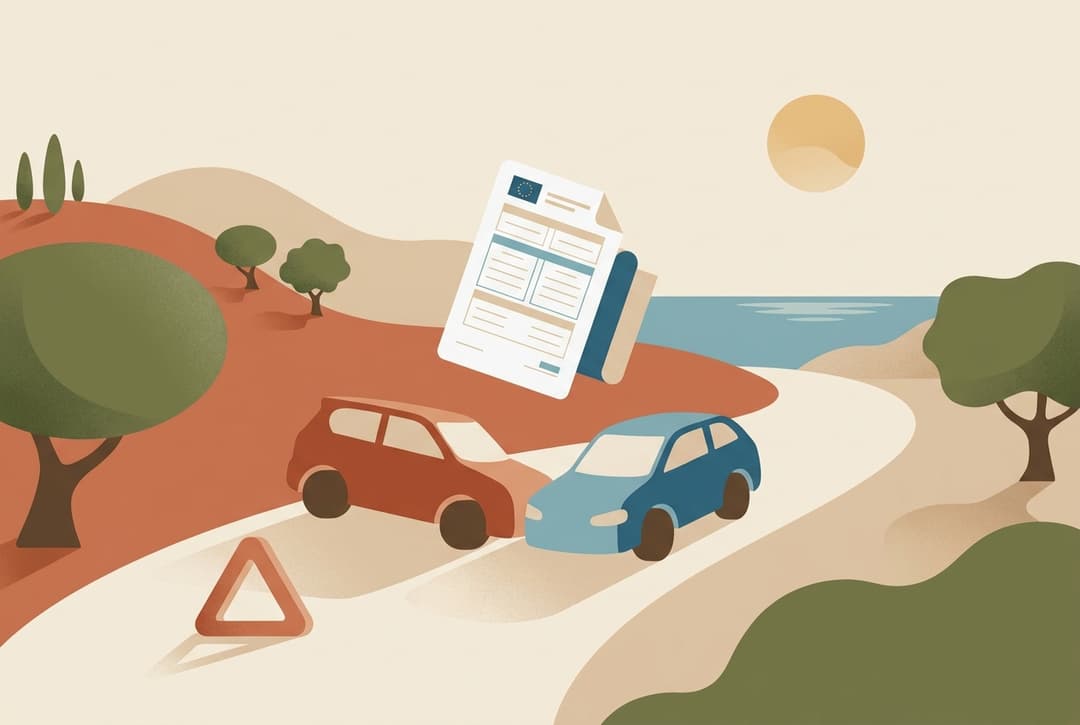
The parte amistoso de accidente (also known as the declaración amistosa de accidente) is the standardised European accident form that both drivers fill out and sign together. It is not a legally required form, but a piece of evidence and, in practice, the usual basis for the subsequent settlement of the claim by the insurance companies.
Important regarding the signature: it is not an admission of fault. By signing it, you're merely confirming that the events described in the form took place as stated – not that you're at fault. Each party keeps their own identical copy. A form that's filled out incompletely or inconsistently makes the subsequent settlement considerably more difficult, because both insurers then have to work without a matching basis.
Alongside the paper form, there are now also digital versions offered through insurance associations – the Spanish umbrella association of insurance companies, Unespa, provides such an app-based solution. This doesn't change the function in any way: joint documentation, no determination of fault.
What belongs in the parte amistoso
| Detail | Why it matters |
|---|---|
| Date, time, exact location of the accident | Basis for matching records between both insurers |
| Registration number, make and model of both vehicles | Clear identification |
| Insurance company and policy number for both parties | Requirement for filing the claim |
| Sketch of the accident | Avoids later contradictions |
| Signature of both drivers | Confirms the described course of events (not an admission of fault) |
| Names and contact details of any witnesses | Helpful in the event of a later dispute about what happened |
Deadlines at a glance: what expires when
This is the core point where German and Spanish practice differ most clearly. Four deadlines affect you directly as a party involved in the accident, and a fifth affects your insurer.
| Deadline | Duration | Legal basis |
|---|---|---|
| Notification to your own insurer | 7 days from becoming aware of the claim | Ley 50/1980, Art. 16 |
| Response from the other party's insurer (oferta/respuesta motivada) | 3 months from the claim being made | RDLeg 8/2004, Art. 7 |
| Default interest charged to the insurer for unjustified delay | 20% per year after 3 months without payment/settlement | Ley 50/1980, Art. 20 |
| Insurer's right of recourse against the party at fault | 1 year from payment to the injured party | RDLeg 8/2004, Art. 10 |
| Limitation period for your own compensation claim | 1 year | Código Civil, Art. 1968 |
Note: RDLeg 8/2004 was amended, among other things, by Ley 5/2025. Whether and how individual deadlines have specifically shifted as a result is not examined in detail here – if you have an ongoing case, rely on current information from your insurer or a legal adviser, not solely on this article.
What you owe your own insurer
The central obligation is set out in Article 16 of Ley 50/1980: you must report the claim to your insurer within seven days of becoming aware report it – not necessarily from the day of the accident itself, if you only find out about relevant circumstances later. The policy may provide for a longer period, but never a shorter one. It's therefore worth checking your own contract terms right after the accident.
Watch out, a widespread misconception: A late report does not automatically result in the loss of insurance cover. The insurer can only claim compensation for the damage that was caused by the late report itself. And even this claim lapses if the insurer has found out about the accident by other means anyway – for example via the police or the other party. Report it as quickly as possible regardless, because in the event of a dispute you'll first have to prove these exceptions.
You can find an overview of the obligations and coverage under the Spanish motor insurance policy in the guide Car Insurance in Spain.
What the other party's insurer owes you
This is where the most practically important lever for injured parties lies. Article 7 of the RDLeg 8/2004 obliges the other party's insurer to respond within three months of your claim notification – with one of two clearly distinguished responses:
- Oferta motivada (reasoned offer): when liability is established and the damage has been quantified.
- Respuesta motivada (reasoned response): in all other cases, for example when liability is disputed or the claim has been rejected.
If this response fails to materialise, default interest accrues to the insurer's detriment – Article 7 explicitly states this. Silence is therefore not a cost-free option for the insurer.
It's important here to keep two clocks apart, both of which run for three months but start at different points in time:
| Deadline | Runs from | Legal consequence |
|---|---|---|
| Response with oferta or respuesta motivada | Receipt of your claim by the insurer | Default interest, Art. 7 RDLeg 8/2004 |
| Repair or monetary compensation | Occurrence of the damage event itself | Increase of the compensation by 20 % per year, Art. 20 Ley 50/1980 – provided the delay is not justified and is attributable to the insurer |
So remember both dates: the day of the accident and the day your claim was received by the other party's insurer.
Limitation period: the one difference that can cost you money
If, as a German, you think of a "usual" limitation period for compensation claims, you probably have three years in mind. In Spain, claims arising from non-contractual liability (responsabilidad extracontractual) – and a road traffic accident falls exactly under this – are subject, under Article 1968 of the Código Civil, to a period of just one year.
The most important practical tip in this article: Anyone who, after a no-fault accident, waits because they want to sort out the settlement "at some point" risks losing their entire claim within twelve months in Spain. The period can be interrupted by an out-of-court claim – but don't rely on this without professional support; act early instead.
Hit-and-run is a criminal offence, not a minor administrative violation
Anyone who leaves the scene of an accident involving personal injury in Spain commits, since the Ley Orgánica 2/2019, a separate criminal offence under the Código Penal (Article 382 bis) – not merely a traffic violation that ends with a fine. This distinguishes the Spanish legal situation from certain everyday German assumptions, in which fleeing the scene after minor bodywork damage is sometimes downplayed. Details on fines for other traffic violations can be found in the guide Fines in Spain – hit-and-run itself, however, belongs to a different, criminal-law category.
When the other party involved is uninsured or unknown
For cases where the party at fault cannot be identified or no valid insurance cover exists, Spain has a state safety-net institution, the Consorcio de Compensación de Seguros. The details of this institution's jurisdiction and procedures go beyond the scope of this guide – what matters here is simply that such a case does not automatically mean being left without any compensation.
What happens next?
After initial treatment and completing the parte amistoso, the usual next steps are: notifying your own insurer within the seven-day period, obtaining a repair cost estimate or expert report if necessary, and – if the other party is liable – waiting out the three-month period for the oferta motivada from the other party's insurer. Personal injury claims are assessed according to a specific compensation scale (the so-called baremo); the exact amount depends on the individual case and cannot be stated here in general terms.
For the repair itself, it helps to contact a garage early on – in the car repair workshop directory you'll find businesses in Mallorca.
Most common mistakes
- Reporting to your own insurer too late, even though the seven-day period runs from the moment you become aware of the incident – while a delay doesn't automatically forfeit insurance cover, acting promptly avoids unnecessary disputes.
- Parte amistoso filled in incompletely or inconsistently, which makes later settlement considerably more difficult.
- Underestimating the one-year limitation period, because people are used to a longer period from Germany.
- Only using the parte amistoso even in the case of personal injury, instead of calling the police – official documentation is especially important where there are injuries.
- Not paying attention to the three-month deadline for the other party's insurer and therefore not claiming default interest owed.
- Not filing a police report after the other party fled the scene, even though this is precisely a case that clearly warrants involving the police.
Checklist: Traffic accident in Spain
- Secure the vehicle, switch on hazard lights, use a hi-vis vest and warning lamp/triangle if needed.
- In the event of personal injury, disputes over how the accident happened, missing documents, hit-and-run, or suspected alcohol/drug use: call 112.
- Take photos of the vehicles, damage, number plates and the accident scene.
- Fill in the parte amistoso together and completely, each party keeps a copy.
- Note down the contact details of any witnesses.
- Inform your own insurer within seven days of becoming aware of the accident.
- For claims against the other party: keep the three-month deadline for the oferta motivada in mind.
- Don't lose sight of the one-year limitation period for your own claims.
Conclusion
A traffic accident in Spain follows its own logic, which can be summed up in three numbers: seven days for your own notification, three months for the other party's insurer to respond – and one year for your claim to become time-barred. Anyone who knows these deadlines, fills in the parte amistoso properly, and calls the police when in doubt, is in a considerably better position when it comes to settling the claim than someone who relies on German habits. The biggest pitfall remains the short limitation period – acting early pays off here more than at any other point in this guide.
Official sources
- Ley 50/1980, de 8 de octubre, de Contrato de Seguro (Art. 16, 20) – https://www.boe.es/buscar/act.php?id=BOE-A-1980-22501
- Real Decreto Legislativo 8/2004, texto refundido de la Ley sobre responsabilidad civil y seguro en la circulación de vehículos a motor (Art. 7, 10) – https://www.boe.es/buscar/act.php?id=BOE-A-2004-18911
- Código Civil, Art. 1968 (limitation period for non-contractual claims) – https://www.boe.es
- Código Penal, Art. 382 bis, introduced by Ley Orgánica 2/2019 – https://www.boe.es
- Dirección General de Tráfico (DGT) – https://www.dgt.es