
Deregistering a car in Spain: Baja definitiva, scrapping and Desguace
If you want to permanently get rid of your car in Spain, you don't need to deregister it with the traffic authority yourself – the process goes through the scrapyard. The baja definitiva is the official procedure by which a vehicle is irrevocably taken off the road and destroyed, and this is exactly what distinguishes it from the baja temporal, which only temporarily takes a car off the road without losing its registration. In this guide you'll learn what documents the Centro Autorizado de Tratamiento de Vehículos (CATV) requires, what scrapping costs, how to deregister a car without vehicle documents or after the owner's death, and from when you no longer have to pay Kfz-Steuer.

Baja definitiva, temporal or export – what fits your situation?
Before you do anything, you should clarify which type of deregistration you actually need. The DGT clearly distinguishes between permanent deregistration with scrapping, a reversible pause, and export abroad. Each option has its own deadlines, costs and responsible authorities.
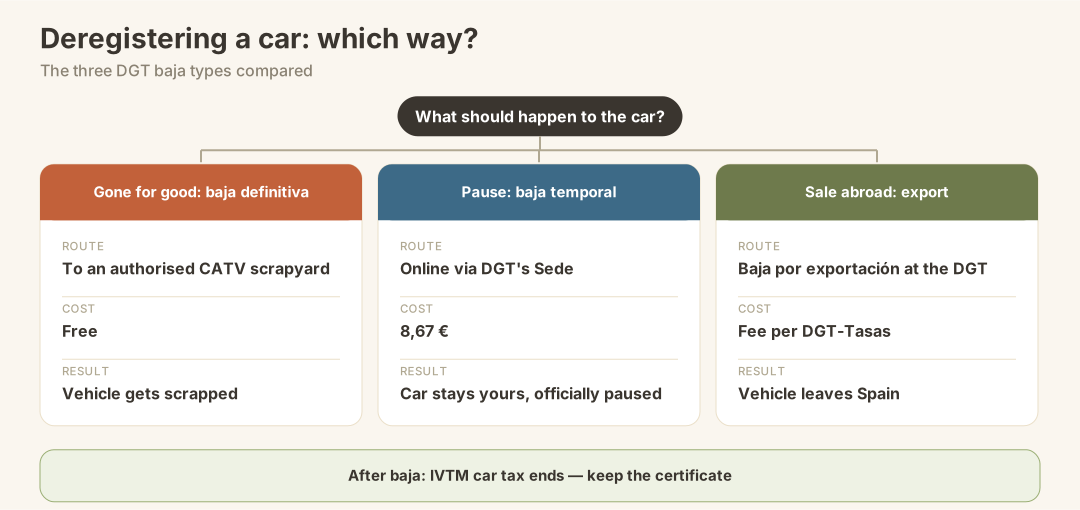
| Type of deregistration | Purpose | Where to apply | Costs | Reversible? |
|---|---|---|---|---|
| Baja definitiva | Vehicle permanently taken off the road, is destroyed | Desguace / CATV | Free of charge | No |
| Baja temporal | Temporary deregistration, e.g. for a long stay abroad | DGT (online, app miDGT, Cl@ve) | €8.67 (Tasa 4.1) | Yes, re-registration possible at any time |
| Baja definitiva – vehicle no longer exists | Car is still registered in your name but has physically disappeared | DGT (online/app/appointment) | Free of charge after 15 years of registration in Spain, otherwise €8.67 | No |
| Baja definitiva – historic vehicle | Collector's vehicle, to be preserved | Jefatura de Tráfico or electronic register | Depending on effort | No, but without scrapping |
Note: If your vehicle has a judicial or administrative lien (precinto), you cannot apply for either a baja definitiva or a baja temporal. The lien must first be lifted.
If you'd rather sell your car instead of deregistering it, it's worth taking a look at our guide Buying & selling used cars in Mallorca – there you'll find out how the change of ownership (traspaso) works instead of deregistration.
Baja definitiva: step by step to the desguace
The baja definitiva is the standard procedure when a car has reached the end of its service life. You don't need to go to the traffic authority for this – the authorised scrapyard handles all communication with the DGT.
- Take the vehicle to a Centro Autorizado de Tratamiento de Vehículos (CATV). Only there is the baja definitiva legally valid – a regular scrap dealer is not sufficient.
- Prove your identity. As a private individual, you need an official document proving identity and residence: DNI, Spanish driving licence, Tarjeta de Residencia or passport together with your NIE number.
- Hand over vehicle documents and keys. The desguace checks the registration certificate and vehicle log book.
- Receive the Certificado de destrucción and Justificante de baja definitiva. These two documents serve as your proof to any authority that the vehicle has been officially taken off the road.
- Keep the documents safe. There is an online verification service from the DGT that lets you check the authenticity of the Justificante.
Attention: The baja definitiva is irreversible. Once the vehicle has been handed over to the desguace, it is destroyed – unlike the baja temporal, there is no way back onto the road.
The process itself is free of charge at the CATV. In individual cases, however, additional costs may arise, for example if you arrange collection of a vehicle that is not roadworthy. You don't need to make a separate report to your town hall (Ayuntamiento) – the DGT takes care of this automatically.
Baja temporal: taking your car off the road without giving it up
If you just want to stop using your car for a longer period, for example because you're temporarily abroad, the baja temporal is worthwhile. It saves you ongoing costs without permanently losing the registration.
| Feature | Regulation |
|---|---|
| Maximum duration per application | 1 year |
| Renewal (prórroga) | As often as you like, each for 1 year, application up to 2 months before expiry |
| Automatic reversion | After the deadline expires, the vehicle automatically counts as "alta" (registered) again |
| Cost | €8.67 (Tasa 4.1) |
| Use during the baja | No driving permitted |
| Parked on a public road | Insurance and ITV must remain valid |
| Parked on private property | No obligation for insurance or ITV |
Important: The justificante de baja temporal must be submitted to your insurer so that the policy is paused – this does not happen automatically. If you want to use the vehicle again later, you must actively re-register it before driving it. You'll find details on re-registration and the technical inspection in our guide to ITV Mallorca (MOT).
An exception applies to agricultural vehicles: here the one-year limit does not apply, and the vehicle can remain in baja temporal indefinitely, although it must first be deregistered from the Registro Oficial de Maquinaria Agrícola (ROMA) of the relevant Autonomous Community.
Deregistering a vehicle without papers
If the vehicle registration document or registration certificate has been lost or stolen, this is no obstacle to deregistration. For this, you fill out a so-called declaración responsable, stating your details, the vehicle details and the reason for the missing documents. This form is sufficient for both the baja temporal and the baja definitiva.
Historic vehicle: deregistration without scrapping
If you own a vehicle of historic or collector's value that is intended for a museum or is to be preserved, a special route applies: you do not take the car to the desguace (scrapyard). Instead, you apply for the baja definitiva especial de vehículo histórico directly at a Jefatura de Tráfico or via the DGT's electronic register. This way, the vehicle remains physically preserved while still being officially taken off the road.
Vehicle no longer exists but is still registered
A common case in practice: a car was taken to a scrapyard years ago, but the scrapyard never reported the baja to the DGT – so the vehicle is still formally registered in your name, even though it no longer exists. For this, there is the baja definitiva de vehículos que ya no existen materialmente.
| Requirement | What applies |
|---|---|
| No ITV and no third-party liability insurance in the last 10 years | Baja can be requested without further proof |
| ITV or insurance activity exists within the last 10 years | Certificado de destrucción from the Desguace (national or foreign) must be submitted |
| Precinto (lien/seizure) on the vehicle | Must be lifted beforehand |
| Agricultural vehicle | Must first be deregistered from the ROMA register |
The costs depend on how long the vehicle has already been registered in Spain: if the first registration in Spain took place more than 15 years ago, the process is free of charge, otherwise the Tasa 4.1 of 8,67 € applies. The registered owner or a person authorised by them is entitled to submit the application.
Power of attorney: authorising someone else to handle the deregistration
If you don't want to handle the deregistration in person, you can authorise a third party. For this, you use the DGT form "Modelo 24 – Otorgamiento de representación", specifying the procedure "Baja definitiva voluntaria" under the category "Vehículos". For the baja at the Desguace, the form signed by both parties together with the DNI of the owner and the authorised person is sufficient. If the vehicle is registered to a company, you will also need the CIF of the company, the DNI of the managing director, and the corresponding representation documents.
Deceased owner: deregistering a car after a death
If the registered owner has passed away, the vehicle can still be brought to baja definitiva. In addition to the vehicle registration document, a declaración responsable for deregistration due to the death of the owner must be submitted at the Desguace or Centro Autorizado de Tratamiento de Vehículos. Our guide Death in Mallorca explains how to generally handle inheritance matters and official procedures after a death in Mallorca. For cross-border inheritance cases involving Germany, our article on Inheritance from Germany is also relevant.
Vehicle tax (IVTM): from when do you stop paying?
The vehicle tax is levied by the municipality where the vehicle has its tax domicile (domicilio fiscal) – regardless of whether the car is actually used. As long as a vehicle is registered as "alta" (active), the tax liability arises anew each year.
Note: The tax liability arises on 1 January each year. If your vehicle is still registered on this date, the municipality will collect the tax for the entire year. If you no longer want to pay tax for the coming year, you should complete the deregistration before the end of the year.
You don't need to make a separate notification to the town hall – the DGT takes care of this automatically once the baja has been carried out.
Most common mistakes when deregistering a car in Spain
- Went to the wrong place: For the baja definitiva, a regular scrap dealer is not sufficient – only a CATV authorised by the DGT will do.
- Overlooked precinto: An existing court or administrative lien blocks any type of deregistration until it has been lifted.
- Baja temporal without insurance notification: Anyone who fails to submit the justificante de baja temporal to the insurer keeps paying unnecessarily for the policy.
- Deregistered too late in the year: Anyone who only completes the deregistration in January still has to pay the Kfz-Steuer (vehicle tax) for the entire current year.
- No documents kept: Without the certificado de destrucción and the justificante de baja definitiva, it cannot be proven to the authorities that the vehicle has been officially deregistered.
- Residents driving with a foreign number plate: Anyone who is resident in Spain is generally not allowed to drive a vehicle with a foreign number plate. More on this in our guide Foreign number plate Mallorca.
What comes next? Next steps after deregistration
After the baja definitiva, the obligation to have ITV and insurance for this vehicle automatically ends as well, since the DGT informs the relevant authorities accordingly. If you're planning to register a new or used vehicle instead, our guide Registering a car in Spain will help you. For the right policy for your next vehicle, it's worth taking a look at Car insurance Spain. If you need to get your Spanish driving licence or have your German one transferred, you'll find the details under Transferring a driving licence. And if you happen to have an outstanding fine in the meantime, sort it out before the deregistration – details on this in Fines in Spain.
Checklist: Deregistering a car in Spain
| Step | Done? |
|---|---|
| Clarify: baja definitiva, temporal or export required | ☐ |
| Check the precinto (lien) and have it lifted if necessary | ☐ |
| Have identity document (DNI/NIE/Residencia) ready | ☐ |
| Have vehicle documents and keys ready (or a declaración responsable in case of loss) | ☐ |
| Find a CATV / scrapyard nearby | ☐ |
| Keep the Certificado de destrucción and Justificante de baja | ☐ |
| For baja temporal: forward the Justificante to the insurance company | ☐ |
| Complete the deregistration before 1 January to save on vehicle tax | ☐ |
You can find a suitable business for collection, scrapping or technical preparation in the business directory of car workshops in Mallorca. If you'd rather sell your old vehicle instead of deregistering it, take a look at the business directory of car dealers.
Conclusion
Deregistering a car in Spain is less complicated than it might seem at first glance – as long as you know which route you need. For a vehicle that's permanently out of service, the way leads directly to an authorised scrapyard, free of charge and without an appointment at any authority. For a temporary pause, the baja temporal at the DGT is sufficient. Special cases such as historic vehicles, deceased owners or physically missing cars are clearly regulated, but require the right supporting documents. Anyone who acts in good time before 1 January and keeps all their documents saves themselves unnecessary tax payments and hassle with the authorities.
Official sources
- DGT – Baja definitiva: https://www.dgt.es/nuestros-servicios/tu-vehiculo/no-vas-a-usar-tu-vehiculo/baja-definitiva/
- DGT Sede Electrónica – Baja definitiva ordinaria and historic vehicles: https://sede.dgt.gob.es/es/vehiculos/altas-bajas-y-rehabilitacion/baja-definitiva-ordinaria/
- DGT Sede Electrónica – Baja definitiva de vehículos que ya no existen materialmente: https://sede.dgt.gob.es/es/vehiculos/altas-bajas-y-rehabilitacion/baja-definitiva-de-vehiculos-que-ya-no-existen-materialmente/
- DGT – Baja temporal: https://www.dgt.es/nuestros-servicios/tu-vehiculo/no-vas-a-usar-tu-vehiculo/baja-temporal/
- DGT – Centros Autorizados de Tratamiento de Vehículos (Desguaces): https://www.dgt.es/conoce-la-dgt/con-quien-trabajamos/Centros-Autorizados-de-Tratamiento-de-Vehiculos
- Federal Foreign Office – Registering a vehicle in Spain: https://spanien.diplo.de/es-de/service/2551510-2551510