
Parking in Palma: free white-line spaces and ORA rules
Anyone moving to Palma quickly realises: Parking in Palma is the daily skirmish that everyone without their own parking space talks about. Blue and green lines, ACIRE signs, parking meters with app connectivity and a limited supply of underground car parks – if you don't know the rules, you can quickly end up paying twice or finding your car with the tow truck service. In this guide you'll learn how the ORA system works, what a fine really costs, where free parking spaces can still be found in Palma, and what you need to watch out for if your vehicle isn't yet registered in your name. You'll find specific addresses, prices per hour and the most important contact points in the tables further below.
Understanding the colour codes: blue, green, yellow, white
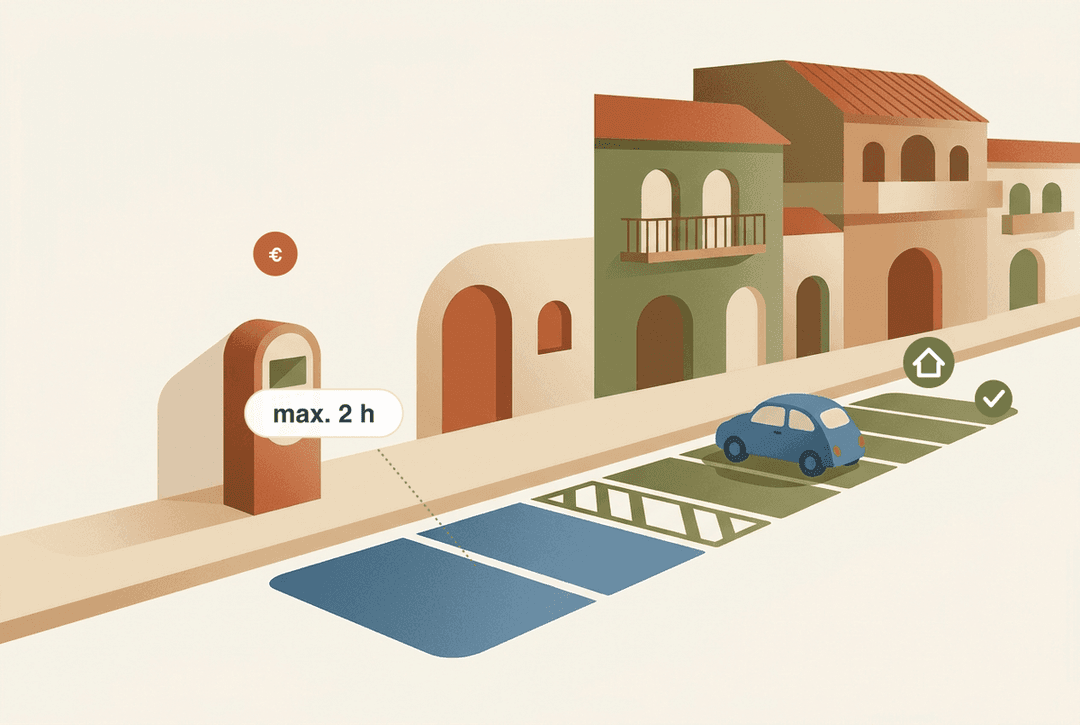
On Mallorca's streets – and especially in Palma – the lines at the roadside immediately show you whether and how you're allowed to park. Anyone who knows these four colours avoids most mistakes from the outset.
| Colour | Meaning | Rule |
|---|---|---|
| Blue (ORA zone) | Chargeable zone | Buy a parking ticket at the machine or via app, maximum duration usually 2 hours |
| Green | Resident priority | Usually more expensive and more strictly time-limited for visitors than blue |
| Yellow | Absolute no-stopping zone | Parking or even just stopping is prohibited – risk of a fine or towing |
| White | Free | Rare in the city centre, more common in residential areas and smaller streets |
Note:The maximum parking duration in blue zones is generally around two hours – the exact time is always shown on the sign directly at the parking section. A parking ticket covering the entire desired parking time is mandatory.
Resident parking (ORA-Resident): What applies to you?
According to Palma City Council, the ORA is the responsible "parking ordinance and regulation" for the blue-marked street sections in the city. Green lines are generally reserved primarily for residents. Whether and how your neighbourhood offers its own resident accreditation, and what costs and quotas are involved, tends to differ depending on the district – reliable, up-to-date details are only available directly from Palma City Council or the responsible body, SMAP.
In practice, the following is often required for such resident accreditation:
- Proof of the Registered address (Empadronamiento) within the relevant zone.
- A vehicle that is verifiably registered to you.
- A personal application at the relevant municipal office.
You should definitely have these points confirmed on-site, as details and required documents may change.
Note: If your car is not yet registered in your name – for example, because you have only just bought it or your NIE hasn't been issued yet – resident accreditation is generally not possible during this transitional period. Until the vehicle documents and NIE are fully in order, you are usually left with normal (paid) parking or an underground car park. You can find more on vehicle registration in the guide Registering a car in Spain and on registered addresses in the guide Empadronamiento.
If – like many newcomers in neighbourhoods such as Santa Catalina – you don't yet have your own parking space, it's worth taking a look at the underground car parks and free outdoor parking spaces further down while you wait for your NIE and the vehicle re-registration.
Underground car parks and multi-storey car parks in Palma: prices and addresses
Palma currently has 16 public, underground car parks with a total of around 4,500 parking spaces. They are operated by the municipal car park company SMAP, Carrer Enrique Alzamora 1, 1A, 07012 Palma, Tel. 971 214 646, Email atencioclient@smap.palma.es, Web www.smap.es.
| Underground car park | Capacity | Telephone |
|---|---|---|
| Plaça d'Espanya | 844 spaces | 971 496 245 |
| Bisbe Berenguer de Palou | 515 spaces | 971 721 470 |
| Plaça Major | 508 spaces | 971 722 225 |
| Comtat del Rosselló | 484 spaces | 971 724 115 |
| Passeig Mallorca | 435 spaces | 971 452 413 |
| Avingudes | 414 spaces | 971 712 613 |
| Plaça de l'Olivar | 380 spaces | 971 720 315 |
| S'Escorxador | 334 spaces | 971 202 506 |
| Marquès de la Sènia | 264 spaces | 971 457 736 |
| Parc de la Mar | – | 971 727 703 (bicycles free of charge) |
| Comte de Sallent | – | 971 495 174 |
In terms of price, classic above-ground car parks range between €1.25 and €2.00 per hour, while multi-storey car parks and underground car parks usually cost €1.30 to €3.15 per hour. Billing is almost everywhere calculated to the exact minute.
| Example | Price per hour |
|---|---|
| Parc de ses Estacions (car park) | 1,25 € |
| Parking Manacor (underground car park) | 1,30 € |
| Parc de sa Riera (underground car park) | 1,30 € |
| Santa Pagesa (underground car park) | 1,30 € |
Note: Anyone who parks in Palma regularly should check the entrance heights of underground car parks beforehand – SUVs or vans in particular don't fit into every entrance.
Free car parks and Park & Ride
Parking completely free of charge in Palma's centre is rare, but not impossible. Good chances exist in somewhat quieter residential areas outside the pedestrian zone.
| Neighbourhood/Area | Special feature |
|---|---|
| Son Armadams | Near Castell de Bellver, often white lines |
| Around Son Moix (stadium) | Larger open areas, a bit further out |
| Ciudad Jardín | Free, but a walk along the promenade into the centre is required |
The city also runs free outdoor car parks on the outskirts, which are suitable as park & ride:
| Outdoor car park | Cost |
|---|---|
| Gabriel Alomar i Villalonga | Free |
| Son Gotleu | Free |
| Son Roca | Free |
| Can Valero | Free |
| Son Real | Free |
From there, it's usually worth switching to the bus or walking a short distance into the centre, rather than driving a car into the narrow old town alleys.
ACIRE zones: The invisible trap in the old town
Large parts of Palma's historic old town are designated as ACIRE zones (restricted access areas). Only residents and authorised vehicles are allowed in — cameras automatically read the number plates, and unauthorised entries result in a fine, all without an official needing to be present.
Warning: A round sign with a red border and the wording "ACIRE" means: do not enter unless you are expressly authorised. In narrow old town alleys, it's worth either heading for an underground car park or leaving the car altogether and continuing on foot.
Fines and towing: What does a mistake cost?
Illegal parking or overstaying your time in the blue zone can quickly become expensive in Palma – but the amount depends on how quickly you react.
| Situation | Cost |
|---|---|
| Parking ticket overstay, paid directly at the machine within 1 hour | 6 € |
| Fine, payment within 15 days | 30 € |
| Fine, payment after the 15 days have expired | 60 € |
You can pay a fine at any branch of Bankia, Caixabank, Banca March, BBVA, Colonya, Caja de Ahorros de Pollença or Banco de Santander. It's more convenient to do it online via the website of Palma City Council (pagaments.palma.es).
Note: If your vehicle has been towed, contact the responsible department of Palma City Council as quickly as possible – the longer the car stays in the depot, the higher the additional storage fees usually turn out to be. You can also find general details on fine procedures in the guide Fines in Spain.
Payment apps and parking ticket machines
For the blue ORA zones, you can either pay in the classic way at the parking ticket machine or use a parking app such as mobiAPParc, which lets you book parking time directly from your smartphone and extend it if needed. For general navigation in Palma and on the island, Waze (current reports on closures and speed cameras) and Google Maps (opening hours, addresses) are widely used and helpful, but they don't replace the signage on site.
Low Emission Zone (ZBE) Palma: What you should know
As in many major Spanish cities, Palma has regulations regarding a low emission zone (Zona de Bajas Emisiones, ZBE), which can affect access and, indirectly, parking for older or particularly high-emission vehicles. Since such regulations tend to change over time, it's worth checking the current environmental sticker status of your vehicle before driving into the city centre. You can find all the details in the separate guide ZBE Palma low emission zone.
Renting a parking space: alternatives to street parking
Anyone living as a resident in Palma long-term without their own parking space faces a choice: risk street parking every day or rent a fixed space. Options range from a fixed subscription space in one of the municipal underground car parks (see table above, usually organised via SMAP) to privately rented garage spaces in residential complexes, which can vary greatly depending on the neighbourhood and location. Centrally located spaces near the old town or in sought-after neighbourhoods like Santa Catalina are naturally more coveted and scarcer than spaces a bit further out.
- First check whether your neighbourhood offers an ORA resident scheme – that's often the cheapest solution.
- Compare the monthly prices of fixed spaces in the SMAP underground car parks with private offers near you.
- Ask your building management whether there are any fixed parking spaces available in the building or in the immediate vicinity.
- Use the free outdoor car parks or underground car parks with hourly rates during the transition period (e.g. while you're waiting for your NIE or vehicle re-registration).
Most common mistakes when parking in Palma
- Overlooking ACIRE signs: Anyone driving into a Restricted Access zone without authorisation is automatically captured by camera – a fine is practically guaranteed to follow.
- Not buying a parking ticket for the full parking duration: Even a short overrun is enough for a penalty ticket.
- Confusing green and blue lines: Green is usually more expensive and has stricter time limits for non-residents than blue.
- Applying for resident accreditation without your own vehicle: As long as the car isn't registered in your name, the ORA-Resident scheme generally doesn't work.
- Leaving a penalty ticket unpaid for too long: €30 becomes €60 after 15 days – acting quickly pays off financially.
What comes next?
Once your vehicle is officially registered in your name and your empadronamiento address lies within an ORA zone, you can apply for resident accreditation directly at Palma Town Hall. In parallel, it's worth looking into fixed parking space offers if you're planning long-term not to have to search for a space every day. Anyone who has just imported or re-registered their vehicle will find further steps in the guide Importing & re-registering a car.
Checklist: Stress-free parking in Palma
- Checked the colour code of the parking line at your destination (blue/green/yellow/white)
- For blue zones: bought a parking ticket for the full planned time or used the app
- Paid attention to ACIRE signage in the old town
- Prepared empadronamiento and vehicle registration for the ORA-Resident application
- Noted an alternative underground car park or free outdoor car park as a backup
- Saved SMAP contact details for fixed parking spaces
- Know the payment method for any penalty tickets (bank or online)
Conclusion
Parking in Palma is manageable once you understand the system of colour codes, ORA zones and ACIRE restrictions. For residents without their own parking space, it's worth first checking resident accreditation once empadronamiento and vehicle registration are complete – until then, underground car parks with clear hourly rates and the few free outdoor car parks on the outskirts can help. Anyone who knows the fine escalation scale can react quickly and cheaply to a penalty ticket, instead of accidentally letting €30 become €60.
Official sources
- Ayuntamiento de Palma – car parks and ORA information: https://palmavirtual.palma.es/de/parkhauser-
- Payment portal of Palma City Council (fines/charges): https://pagaments.palma.es/pagaments/tributs/Inicio.htm?idioma=1&lang=de
- SMAP – Sociedad Municipal de Aparcamientos de Palma: https://www.smap.es/