
Selling a car in Spain: Notificación de venta and Transferencia
Anyone wanting to sell their car in Spain should be familiar with two administrative procedures: the Notificación de venta, which you as the seller submit to the DGT, and the Transferencia, which your buyer must complete within 30 days. Both steps are connected, but run separately and carry different responsibilities. Anyone who delays the Notificación de venta may remain liable for fines, insurance and taxes on the vehicle – even though it has long since had a new owner. In this guide you'll learn which documents the purchase contract must necessarily include, how to check whether your car can even be transferred, what to watch out for with vehicles subject to Reserva de Dominio or with foreign number plates, and which deadlines and costs apply in 2026.

Why the Notificación de venta is essential
The Notificación de venta is the notification to the Spanish traffic authority DGT that you have sold your vehicle. It doesn't replace the actual change of ownership, but from the moment it's submitted it protects you from remaining responsible for the car. As long as the buyer hasn't completed the Transferencia, fines from fixed speed cameras, insurance obligations and ITV requirements otherwise continue to run under your name.
The DGT explicitly advises not to wait for the buyer, but to submit the Notificación de venta yourself promptly. In practice, some buyers delay the re-registration by weeks or months – a risk you eliminate as the seller with the Notificación de venta.
Please note: The Notificación de venta isn't possible for so-called VMP (Vehículos de Movilidad Personal, e.g. e-scooters subject to registration requirements). In this case, the Transferencia of the VMP must be carried out directly.
Before selling: Can your car actually be transferred?
Before looking for a buyer, it's worth checking whether your vehicle is free of "cargas" (encumbrances). If it isn't, the DGT will block any transfer – both the Notificación de venta and the Transferencia.
| Possible encumbrance (Carga) | Significance for the sale |
|---|---|
| Impuesto de Circulación / IVTM outstanding | A vehicle without the previous year's vehicle tax paid cannot be transferred |
| Outstanding fines (sanciones) | Unpaid fines completely block the transfer |
| Reserva de Dominio registered | Transfer only possible after approval from the financing bank or assumption of debt by the buyer |
| Embargo or Precinto (seizure/confiscation) | Sale only possible with a signed acknowledgement from the buyer |
| Vehicle in "baja temporal" | Must first be re-registered before the Notificación/Transferencia |
A free "informe reducido" from the DGT shows you whether the vehicle is correctly identified, registered and free of encumbrances. For more in-depth details – such as workshop history via the digital maintenance log – there's the "informe detallado" for 8.67 €. Both reports can be requested via the DGT's Sede Electrónica.
Note: The buyer should also request an Informe before payment – this helps avoid nasty surprises regarding Reserva de Dominio or seizures. You can also find details on the technical inspection in the guide to ITV (MOT) in Mallorca.
The purchase contract: these details are mandatory
You should never hand over your vehicle without a signed Contrato de Compraventa. The DGT even provides a free contract template on its website for this purpose.
| Mandatory information in the purchase contract | Why it's important |
|---|---|
| Name/company + DNI, NIE or NIF of buyer and seller | Clear identification of both parties |
| Vehicle data: make, model, registration number | Assignment to the specific vehicle |
| Purchase price | Basis for the buyer's later ITP calculation |
| Exact date and time of signing | Decisive for liability questions until the Notificación de venta |
| Signature on every single page | Prevents subsequent manipulation |
It is also advisable to keep a copy of the DNI, NIE or Tarjeta de Residencia of the other party. Enter the exact handover time in the contract – because until the Notificación de venta, speed camera fines and ITV sanctions otherwise formally remain your responsibility.
Step by step: submitting the Notificación de venta to the DGT
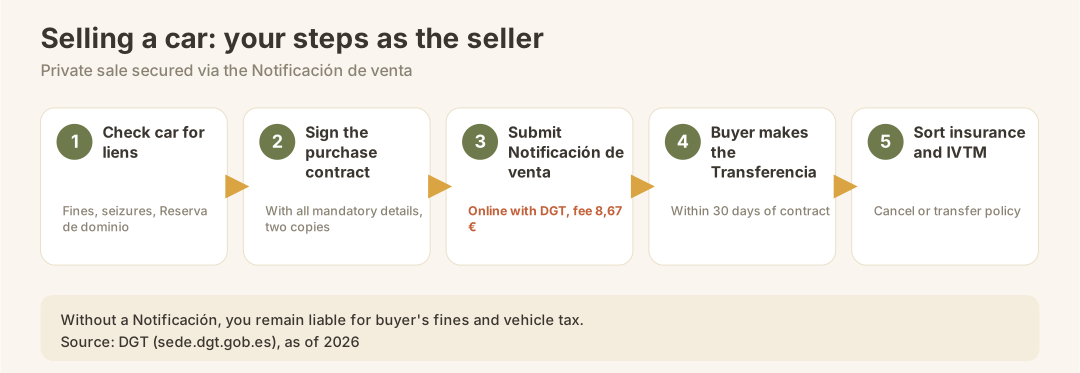
- Sign the contract with the buyer (on every page, with the time noted).
- Obtain a copy of the buyer's identification document.
- Submit the Notificación de venta via the Sede Electrónica of the DGT, the miDGT app, by phone, or with an appointment in person.
- Pay the fee of 8.67 € (Tasa 4.1).
- Keep the confirmation – it documents from when you are no longer liable.
| Channel | Who can use it | Cost |
|---|---|---|
| Registro electrónico (Sede DGT) | Seller or authorised person | 8,67 € |
| miDGT app | Seller | 8,67 € |
| By phone | Seller | 8,67 € |
| In-person appointment (Cita previa) | Private individuals only, not companies | 8,67 € |
The Notificación de venta may only be submitted by the seller themselves or by an authorised representative. A power of attorney can be lodged via the DGT's Registro de apoderamientos, or alternatively via the "Otorgamiento de representación" form (Modelo 24) for the in-person appointment.
Note: Some advisers recommend submitting the Notificación de venta within a few days of the handover – officially, the DGT only requires this to be done "as soon as possible". The sooner, the better for your liability release.
What happens next: Transferencia and ITP for the buyer
The buyer is legally required to apply for the Transferencia (change of registered owner) within a maximum of 30 days after signing the purchase contract. Only after this step is a new Permiso de Circulación issued – and it is only valid if a current ITV is in place.
Before the Transferencia, the buyer must settle the Impuesto de Transmisiones Patrimoniales (ITP) or prove an exemption, depending on the Comunidad Autónoma, via Modelo 620 or Modelo 621. This tax is borne by the buyer, not the seller. You can read more about the administrative process of re-registration in the guide Registering a car in Spain.
| Step | Responsible party | Deadline |
|---|---|---|
| Notificación de venta | Seller | As early as possible, do not wait for the buyer |
| Pay/be exempted from ITP (Modelo 620/621) | Buyer | Before completion of the Transferencia |
| Transferencia / change of registered owner | Buyer | Max. 30 days after signing the contract |
| New Permiso de Circulación | Issued by the DGT | After successful Transferencia, only with a valid ITV |
Special case: Reserva de Dominio, seizure and outstanding fines
If the vehicle was financed through a bank or finance company, the latter will often have registered a Reserva de Dominio in the Registro de Bienes Muebles. In this case, a change of registered owner is only possible once the purchase price has been paid in full. You will then need to request a "carta de cancelación de reserva de dominio" from the finance company and arrange for its cancellation in the Registro de Bienes Muebles – processing there typically takes around 15 days.
In the case of an Embargo or Precinto (official seizure/impoundment), a sale is generally possible if the buyer confirms in writing that they are aware of the situation and accept it.
Attention: A vehicle with outstanding fines or unpaid vehicle tax cannot be transferred under any circumstances – neither via Notificación de venta nor via Transferencia. Clear any outstanding items beforehand, for example with reference to the guide Fines in Spain.
Selling a car with a German or foreign number plate
A vehicle with German registration is difficult to sell to Spanish buyers in Spain, since legal use in Spain would first require re-registration with a Spanish number plate – an effort that most buyers shy away from. Realistic buyers are therefore often other Germans who want to continue driving with the German number plate.
Anyone who, as a resident, permanently drives with a foreign number plate takes a risk: checks can lead to fines and, in extreme cases, to the confiscation of the vehicle. For many residents in this situation, selling is the more pragmatic solution than an often lengthy re-registration process. You can find everything about the legal background in the guide Foreign Number Plates in Mallorca.
If the ITV or the German TÜV has expired, you can still sell the vehicle – but you should explicitly note the missing inspection certificate in the purchase contract. Often the buyer takes care of the subsequent technical inspection themselves.
Selling to a dealer instead of a private individual
As an alternative to a private sale, you can hand over your car to a professional Compraventa company or a car dealer. The DGT refers to a separate procedure for this, the "Entrega de un vehículo a un compraventa", which differs from selling to private individuals. One advantage: a specialist business generally takes care of the re-registration, registration certificate, and inspection card themselves when buying and reselling. You can find a dealer or purchasing partner near you in the directory of car dealers.
After the sale: insurance, tax and documents
Your practical responsibility does not automatically end with the handover – only the Notificación de venta formally cancels it.
| Task after the sale | Purpose |
|---|---|
| Submit the Notificación de venta | Liability for fines, insurance, ITV ends |
| Cancel or transfer vehicle insurance | Avoid double payments |
| Check/stop direct debit for the Impuesto de Circulación (IVTM) | No debit for a vehicle you no longer own |
| Keep a copy of the signed purchase contract | Evidence for later queries from the DGT |
If you are unsure which insurance policy to cancel or whether a refund is possible, it helps to take a look at the guide Car Insurance in Spain. For more complex cases – such as multiple vehicles, company cars or tax questions regarding the sale proceeds – it is worth consulting a Gestoría; you can find suitable contacts in the directory of tax advisors.
Most common mistakes when selling a car in Spain
- Handing over the vehicle without a signed purchase contract or without a copy of the buyer's ID.
- Waiting too long to submit the Notificación de venta in the hope that the buyer will complete the Transferencia promptly.
- Selling despite outstanding fines, unpaid vehicle tax, or a registered Reserva de Dominio – in which case the transfer is simply blocked.
- Missing exact time in the purchase contract, even though this is precisely what determines liability in the event of a dispute.
- Selling a foreign-registered vehicle to a Spanish buyer without prior re-registration, even though practical use is then hardly possible.
What happens next?
After a successful Notificación de venta and completed Transferencia, the buyer receives a new Permiso de Circulación – provided the ITV is valid. For you as the seller, the main task remaining is the administrative follow-up: cancelling the insurance, checking direct debits, and keeping a copy of the contract for any future queries. If you're planning to buy a new or used vehicle yourself afterwards, you'll find further practical tips for everyday life in Mallorca in the guide Buying & selling used cars.
Checklist: Selling a car in Spain
- Informe reducido (free) or informe detallado (8.67 €) requested from the DGT
- Vehicle tax (IVTM) and all fines settled
- Reserva de Dominio checked and, if applicable, Cancelación applied for
- Purchase contract drawn up with all mandatory details and signed on every page
- Copy of the buyer's ID obtained
- Notificación de venta submitted via Sede Electrónica, the miDGT app, phone, or an appointment
- Fee of 8.67 € paid
- Vehicle insurance cancelled or transferred
- Confirmation of the Notificación de venta safely archived
Conclusion
Selling a car in Spain is not a complicated procedure if you know the correct order: first check that the vehicle is free of encumbrances, then sign a complete purchase contract, and after that submit the Notificación de venta to the DGT as soon as possible. The actual Transferencia is then the buyer's responsibility, who has 30 days to complete it. Anyone who follows this order avoids the biggest risk when selling a car in Spain: continuing to be liable for fines, insurance, or the ITV of a vehicle that already belongs to someone else.
Official sources
- DGT Sede Electrónica – Notificación de venta: https://sede.dgt.gob.es/es/vehiculos/notificacion-de-venta/
- DGT Sede Electrónica – Transferencia o cambio de titularidad de un vehículo: https://sede.dgt.gob.es/es/vehiculos/transferencias-de-vehiculos/
- DGT – Vender un vehículo de segunda mano: https://www.dgt.es/nuestros-servicios/tu-vehiculo/vas-a-comprar-o-vender-un-vehiculo-de-segunda-mano/vender-un-vehiculo-de-segunda-mano/
- DGT – Comprar un vehículo de segunda mano: https://www.dgt.es/nuestros-servicios/tu-vehiculo/vas-a-comprar-o-vender-un-vehiculo-de-segunda-mano/comprar-un-vehiculo-de-segunda-mano/
- DGT – Register of powers of attorney (apoderamientos): https://sede.dgt.gob.es/es/otros-tramites/autorizaciones-de-representaciones-rea/