
Moving belongings duty-free to Spain: cambio de residencia and tax exemption 2026
Anyone relocating permanently to Mallorca or Spain is entitled to import furniture, household goods, electrical appliances and even their own car completely free of customs duty and import VAT under certain conditions – this is known as the exemption for removal goods upon a cambio de residencia (change of residence). The catch: the tax exemption only applies if you present the correct documents at the correct time. Miss the deadline or leave out a single piece of paperwork, and what should have been a duty-free move can quickly turn into a costly tax demand. In this guide you will find out what qualifies as removal goods, which deadlines are irreversible, how a car is treated separately, which documents you need, and how to handle the entire process step by step.

Planning your move to Mallorca and don't want to miss a single deadline?
- 📩 Submit a personal enquiry — individual assessment of your situation before you make any mistakes
- Relocation Service Mallorca – professional support from A to Z
What actually counts as removal goods?
Removal goods is not an exclusive term in Spanish tax and customs law reserved for furniture lorries – it covers all personal belongings that you bring with you when transferring your habitual residence from your previous country to Spain. Two criteria are decisive: the items must belong to you, and they must be intended for your personal use – not for resale.
Typical removal-goods categories:
| Category | Examples | Tax exemption possible? |
|---|---|---|
| Household goods / furniture | Sofas, wardrobes, beds, tables | ✅ Yes |
| Clothing & linen | All personal textiles | ✅ Yes |
| Electrical appliances | Fridge, washing machine, TV | ✅ Yes |
| Professional work equipment | Portable tools, laptops (personal use) | ✅ Yes, provided they are not used for commercial purposes |
| Vehicles | Cars, motorcycles, scooters | ✅ Yes, under special conditions (see below) |
| Pets | Dogs, cats, horses | ✅ Yes |
| Alcohol & tobacco | Spirits, cigarettes | ❌ No |
| Commercial vehicles | Vans for commercial purposes | ❌ No |
| New goods | Unused items, in original packaging | ❌ No |
Important: Only used goods qualify for the exemption. Anyone bringing a brand-new flat-screen television in its box has no entitlement to tax relief – the item must have genuinely been used at the previous place of residence prior to the move.
The basic requirements for the tax exemption
The exemption is tied to several conditions that must all be met simultaneously. If even one of them is missing, the entitlement lapses entirely.
The four core conditions
- Transfer of residence: You are permanently relocating your habitual residence to Spain – not as a tourist, not as a second-home owner.
- Previous period of residence abroad: You must have had your habitual residence for at least 12 consecutive months outside Spain.
- Minimum ownership period of the items: The removal goods must have been in your possession for at least 6 months to your previous place of residence prior to giving it up, and must have been in your personal use.
- Personal use at the new place of residence: You continue to use the items in Spain for the same private purposes.
Please note: The 12-month period for residence abroad refers to uninterrupted months. Short stays in Spain during this time may interrupt the period – if in doubt, a tax adviser or a gestoría should check whether your pattern of stays meets the requirement.
Deadlines: When must the removal goods be imported?
One of the most common mistakes when moving to Spain is underestimating the deadlines. The exemption does not apply indefinitely.
| Item | Deadline from the date of establishing residence in Spain |
|---|---|
| General removal goods (furniture, household effects, etc.) | Generally up to 12 months after taking up residence |
| Vehicles (car, motorcycle) | 60 days from the date of issue of the Residencia |
The 12-month deadline for general removal goods does give you some flexibility – for example if a second shipment of stored items follows – but the same principle applies: the earlier you declare the import, the lower the risk of queries. For vehicles, however, the 60-day deadline is uncompromising: it starts on the day of official registration of residence (Residencia) and cannot be extended.
The vehicle as a removal item: the most important special rule
For many people moving abroad, the car is the single most expensive item – and at the same time the most bureaucratically complex. Spain treats vehicles as removal goods when three conditions are met:
- The vehicle has been in your ownership for at least 6 months
- It was intended for your personal use
- It comes to Spain from your previous country of residence together with the move or within the applicable deadline
The tax exemption means in concrete terms: you pay neither import VAT (IVA) nor registration tax (Impuesto de Matriculación / IEDMT) – which can quickly amount to several thousand euros for a mid-range car. The remaining fees for ITV (the Spanish equivalent of the MOT), DGT registration and number plates are reported to be approximately 200 to 500 euros.
Important:From the day you register your Residencia, you are required to re-register your vehicle. The widespread assumption that you may still drive on German plates for 6 months only applies to tourists – as a resident, you are obliged to do so from day 1. The Spanish police and the DGT actively enforce this.
You can find more details about the entire re-registration process in the guide Importing & re-registering your car.
Documents for the duty-free import of removal goods
For general removal goods (excluding vehicles), you will typically need the following documents. The exact list may vary slightly depending on the customs office – always have it confirmed in advance.
| Document | Purpose | Special note |
|---|---|---|
| Deregistration certificate from Germany (Abmeldebestätigung Einwohnermeldeamt) | Proof of previous place of residence | Apostille recommended |
| Proof of at least 12 months of residence abroad | Fulfilment of the time requirement | Certificate of registration or equivalent |
| NIE number (Número de Identificación de Extranjero) | Required for all customs/tax procedures | Apply in advance |
| Residencia certificate (Certificado de Registro) | Proof of Spanish residence | Issued by the Policía Nacional |
| Empadronamiento | Proof of residential address in Spain | Issued by the Ayuntamiento |
| Inventory list of all goods | Customs declaration | Detailed, in Spanish |
| Proof of personal use of items (at least 6 months) | Fulfilment of the ownership duration requirement | Proof of purchase, photos, invoices |
For the NIE number and the Empadronamiento you'll find dedicated guides on mallorca.com – ideally, you should have completed these steps before importing your removal goods.
Required documents specific to the vehicle
The vehicle requires its own set of documents, going beyond the standard proof of removal goods:
| Document | Details |
|---|---|
| Deregistration certificate from the country of origin | Apostilled, translated into Spanish and certified; proof of at least 12 months of registration at the last place of residence |
| Vehicle registration certificate Part I (Fahrzeugschein) | Original |
| Vehicle registration certificate Part II (Fahrzeugbrief) | Original |
| COC document (Certificate of Conformity / EU Declaration of Conformity) | Proof of EU type approval |
| Proof of import (ferry ticket, vehicle transport invoice) | When and how the vehicle was imported into Spain |
| Empadronamiento at current place of residence | Current and valid |
| Residencia certificate | With date of issue for deadline calculation |
Please note: Without the COC document, the DGT will block registration entirely. If you no longer have the COC, you can request a replacement from the manufacturer or importer – however, this can sometimes take several weeks.
Step by step: how to handle the duty-free import
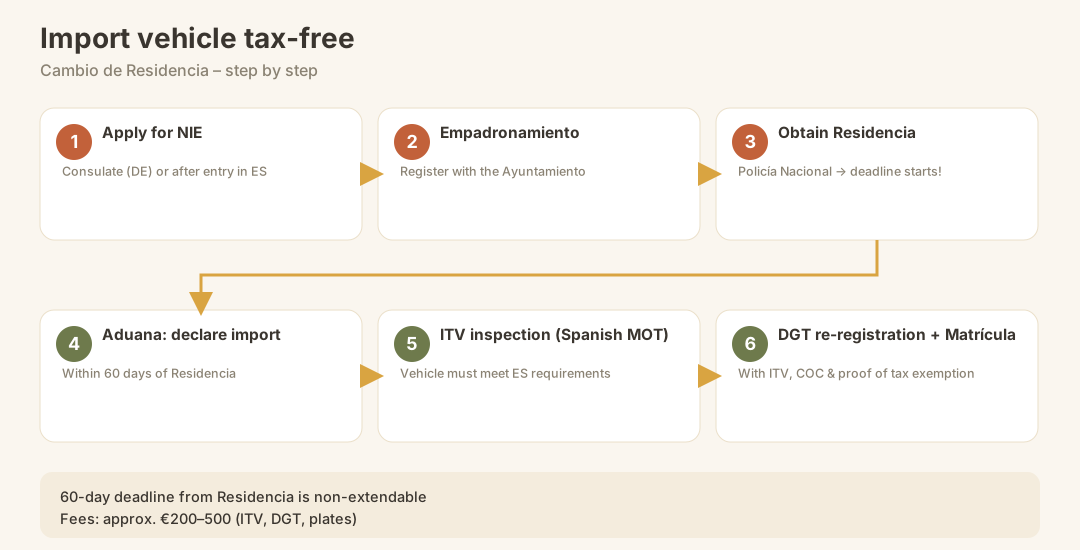
General removal goods
- Apply for your NIE – either in Germany at a Spanish consulate or after entering Spain. Without an NIE, nothing can proceed.
- Empadronamiento – register with your Ayuntamiento (local council); you will need a registered address in Spain.
- Apply for residencia at the Oficina de Extranjería / Policía Nacional. The issue date of this certificate is the starting point for all deadlines.
- Draw up an inventory list – in Spanish, with a detailed description and estimated value of each item.
- Customs declaration – submit to the relevant customs office (Aduana) before the goods are imported or immediately afterwards, depending on the customs office. For Mallorca, the Aduana Palma de Mallorca is the competent authority.
- Exemption application – submit together with all supporting documents.
- Retain customs documentation – for at least the blocking period (see below).
Vehicle
- Steps 1–3 as above
- Gather all vehicle documents (see table above), have the deregistration certificate apostilled and translated
- Tax-free importation – register with the Aduana within 60 days of the residencia being issued
- ITV inspection (Spanish MOT) – the vehicle must meet Spanish requirements
- Re-registration with the DGT with registration certificates, ITV report, COC and proof of tax exemption
- Fit Spanish number plates (Matrícula)
- Motor insurance – switch to Spanish number plates – find out more in the guide KFZ-Versicherung Spanien
The blocking period: what applies after importation
The tax exemption is tied to a commitment to personal use. After tax-free importation, you may not immediately sell, lend or otherwise transfer the imported items – and in particular the vehicle.
| Subject | Lock-up period before disposal |
|---|---|
| General removal goods (furniture, household effects) | Typically 12 months |
| Vehicles | Typically 12 months |
If you sell or transfer the vehicle within the lock-up period, the tax exemption is revoked retrospectively and you will be required to pay the originally waived duties — plus any applicable interest.
What happens without the tax exemption? The cost perspective
So you know what is at stake, here is a realistic comparison:
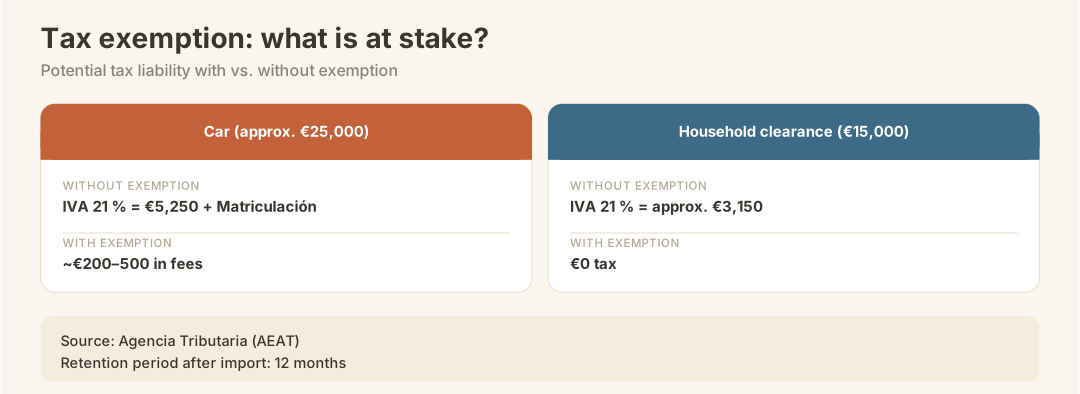
| Scenario | Potential tax liability |
|---|---|
| Private car (mid-range, value approx. 25.000 €), without exemption | IVA 21 % (5.250 €) + registration tax depending on CO₂ |
| Private car (mid-range, value approx. 25.000 €), with exemption as removal goods | ~200–500 € in fees (ITV, DGT, number plates) |
| Household contents value 15.000 €, without exemption | IVA 21 % on the import value (approx. 3.150 €) |
| Household contents with exemption | 0 € tax, transport costs only |
The figures make it clear: anyone who misses or forfeits the exemption can end up paying a five-figure sum in a single case. The investment in proper preparation — or a good gestoría — pays for itself quickly.
Most common mistakes when importing removal goods
These are the pitfalls we see time and again:
- Missing the deadline: The 60-day window for the vehicle starts from the date the Residencia is issued — not from the moving date. Anyone who applies for their Residencia early must also import the car early.
- Missing apostille: The German deregistration certificate must be apostilled and translated into Spanish. Without this, the Aduana will not accept the document.
- COC not available: The COC document is overlooked or misplaced by many people relocating – requesting a replacement from the manufacturer takes time.
- Inventory list incomplete or in German: A handwritten list in German without quantities and estimated values is not sufficient.
- New goods mixed in: Anyone who imports brand-new, originally packaged items under the guise of 'removal goods' risks additional charges for the entire contents of the shipment.
- Selling the vehicle too early: Anyone who transfers the car within the embargo period loses the exemption retrospectively.
- Residencia confused with Empadronamiento: Both documents are required, but the Residencia (Certificado de Registro) is the definitive document for the start of the deadline – not the Empadronamiento.
What comes next? Tax-related follow-up matters
With the cambio de residencia, you also shift your tax centre of gravity. This has consequences:
- IRPF: As a resident, you are subject to unlimited income tax liability in Spain. What you can deduct is explained in the guide IRPF-Abzüge Balearen.
- Modelo 720: Foreign assets above certain thresholds must be declared – details in the guide Modelo 720.
- Driving licence: As a resident, you must convert your German driving licence within the required timeframe. EU citizens generally have 2 Jahre from the date of issue of the Residencia to do so (Swiss nationals after just 6 months) – more on this in the guide Führerschein Spanien umschreiben.
- ITV: The imported vehicle requires regular ITV inspections following re-registration – everything you need to know in the guide ITV Mallorca.
- Health insurance: With Residencia you are in principle entitled to access the Spanish public health system – or you can opt for a private solution: Health Insurance Spain.
Checklist: Moving Goods to Spain Duty-Free
Print this list out or save it for reference:
Check the Requirements
- Registered at your previous address for at least 12 months
- Moving goods owned and in use for at least 6 months
- No new goods in the shipment
- Vehicle: owned for at least 6 months and used for personal use
Obtain Documents
- NIE number in hand
- Deregistration certificate from Germany (apostilled + translated into Spanish + certified)
- Residencia applied for and issued (note the date!)
- Empadronamiento completed at the Ayuntamiento
- Inventory list prepared (in Spanish, with quantities and estimated values)
- Proof of purchase or proof of use for key items
Vehicle Extras
- Vehicle registration certificate Part I + II in hand
- COC document in hand (request it if necessary)
- Obtain ferry ticket or proof of transport
- 60-day deadline from the Residencia date entered in the calendar
Import Procedure
- Aduana contacted and documents discussed in advance
- Customs declaration submitted
- Exemption certificate received and kept safe
- Restriction period (12 months) noted in the calendar
- For vehicle: ITV appointment booked, DGT re-registration initiated
Conclusion
The tax exemption for household goods on a cambio de residencia is a genuine financial advantage — but it does not happen automatically. It requires careful preparation, complete documentation, and strict adherence to deadlines. Particularly for vehicles, the 60-day deadline from the date of Residencia issue is a hard cut-off that many people relocating tend to underestimate.
Anyone who meets all the requirements and acts in good time can save thousands of euros in tax — and will arrive in their new life on Mallorca with Spanish number plates, manageable fees, and a clean administrative start. If you are unsure about any individual points, it is worth having a conversation with an experienced gestoría or a tax adviser specialising in Spain — before you book the ferry.
Official Sources
- Agencia Tributaria (AEAT) – Competent authority for customs and tax exemptions upon change of residence: https://www.agenciatributaria.es
- Aduana Palma de Mallorca – The relevant customs office for imports to the Balearic Islands: accessible via the AEAT website
- Dirección General de Tráfico (DGT) – Vehicle registration and re-registration: https://www.dgt.es
- Policía Nacional – Oficina de Extranjería – Issuance of the Residencia (Certificado de Registro): https://sede.policia.gob.es
- Gobierno de España – Sede Electrónica – Empadronamiento and administrative procedures: https://sede.administracion.gob.es