
Cost of Living in Mallorca 2026: What Life on the Island Really Costs
The cost of living on Mallorca is a concern for anyone seriously considering a move to the island. And rightly so: whilst Mallorca is noticeably more affordable than major German cities — significantly so when it comes to electricity, groceries and certain services — the Balearic Islands are, according to a consumer expenditure report from 2026, the fourth most expensive region in Spain, with costs that can exceed the Spanish average by more than 12,000 € per year. What this means for your day-to-day life depends greatly on where you live, how you live, and where your income comes from. This guide breaks down all the key cost categories — rent, groceries, utilities, healthcare, transport, education — with concrete figures, comparative values and a healthy dose of realism.

Want to know whether your budget is sufficient for everyday life on Mallorca?
- 📩 Submit a personal enquiry — we'll help you assess your budget realistically
- Everything about living and daily life on Mallorca
Mallorca in a cost comparison: what the figures really show
Mallorca is expensive — but compared to what? That makes all the difference. Within Spain, the Balearic Islands rank among the most expensive regions in the country: a consumer expenditure report from February 2026 places the archipelago as the fourth most expensive region in Spain, with additional costs of over 12,000 € per year compared to the Spanish average.
Measured against major German cities, the picture looks rather different. Someone who has been living in Berlin and spending around 4,590 € per month can achieve a comparable standard of living on Mallorca for approximately 3,400 € — a saving of around 26 percent. The biggest differences are seen in basic utilities (around 42 percent cheaper), groceries (18–23 percent cheaper) and rent (up to 24 percent cheaper than in major German cities).
At the same time, it should be noted that the local average wage on Mallorca is around 1,646 € net per month. The island works financially above all for people who bring a location-independent income with them — whether as retirees, remote workers, self-employed individuals or investors.
| Cost comparison | Mallorca (approx.) | Berlin (approx.) | Difference |
|---|---|---|---|
| Total monthly costs (1 person) | 3.400 € | 4.590 € | −26 % |
| Basic utilities (85 m²) | 193 € | 332 € | −42 % |
| Groceries | 18–23 % cheaper | Reference | − |
| Local average salary (net) | approx. 1,646 € | considerably higher | − |
Housing: renting and buying on Mallorca
Housing is by far the largest cost item — and the one that has risen most sharply in recent years. The rental market on Mallorca is tight, particularly in Palma and the sought-after coastal locations.
Rental prices 2026
| Property type | Palma city centre (approx.) | Outside the centre (approx.) |
|---|---|---|
| 1-bedroom flat | 828–975 €/month | approx. 700–900 €/month |
| 3-bedroom flat | 1,342–1,663 €/month | approx. 1,150–1,400 €/month |
For comparison: a 50-m² flat in Munich or Hamburg typically costs between 1,200 and 1,500 € — on Mallorca you can still come in below that depending on location, though the gap has narrowed considerably in recent years.
Please note: In heavily touristed municipalities such as Calvià, Deià or Pollença, long-term rental prices can be significantly higher than those in Palma. Seasonal fluctuations also play a role.
Additional Costs When Buying a Property
Those who buy rather than rent should expect purchase transaction costs of typically 10–15 percent of the purchase price (taxes, notary, land registry). These costs must be factored into budget planning without exception.
Food and Supermarket Prices in Everyday Life
According to the Consumer Expenditure Report 2026, food is the second largest household expense after housing. On Mallorca, costs run 18–23 percent below the level of major German cities — provided you shop strategically and do not rely exclusively on imported goods from Germany.
The following prices are drawn from aggregated user data (Numbeo, as of 2026) for Palma de Mallorca:
| Product | Price (approx.) |
|---|---|
| Milk, 1 litre | 1,19 € |
| White bread, 500 g | 1,04 € |
| Eggs (12, medium) | 3,08 € |
| Chicken breast fillets, 1 kg | 7,86 € |
| Beef, 1 kg | 14,25 € |
| Tomatoes, 1 kg | 2,50 € |
| Oranges, 1 kg | 1,59 € |
| Bottled water, 1.5 litres | 0,60 € |
| Wine (mid-range, 0.75 l) | 5,00 € |
Those who regularly insist on German branded products will, in experience, pay considerably more, as many imported items carry substantial markups.
Eating Out: Restaurants and Cafés
Mallorca offers an enormous range — from an inexpensive bar serving a menú del día to a Michelin-starred restaurant on the harbour. For everyday purposes, the following benchmark figures from Palma de Mallorca are realistic:
| Category | Price (approx.) |
|---|---|
| Basic restaurant, 1 course | 16,50 € |
| Three-course meal for 2 people (mid-range) | 60,00 € |
| Fast food (combo meal) | 12,00 € |
| Cappuccino | 2,79 € |
| Local draught beer (0.5 l) | 4,00 € |
| Water (0.33 l, bottle) | 2,40 € |
The menú del día — a two- or three-course lunch with a drink — is available in more modest establishments for 10–14 Euro and represents for many residents the most affordable way to enjoy a decent midday meal.
Utility Costs: Electricity, Water, Internet
When it comes to basic utility costs, Mallorca is significantly below German levels. For a flat of approximately 85 m², the following monthly costs are realistic:
| Item | Mallorca (approx.) | Berlin (approx.) |
|---|---|---|
| Electricity, water, heating, refuse (85 m²) | 193 €/month | 332 €/month |
| Internet (60+ Mbit/s) | depending on provider | − |
Please note:Electricity in Spain is linked to the spot market and can fluctuate considerably depending on your tariff and the season. Air conditioning in summer drives electricity costs up significantly – a factor many newcomers underestimate. Those living in a finca or a house with a pool also need to budget for water consumption and pool maintenance.
For everything related to registering for water supply on Mallorca, you'll find all the details in the guide Registering for Water on Mallorca.
Getting Around: Car, Bus, Train
Mallorca is barely comfortable to live in without your own vehicle outside of Palma. The road network is well developed, and petrol is generally cheaper than in Germany.
What has changed in 2026: The public intermodal card makes buses and trains on Mallorca free of charge – a genuine relief for everyone living in Palma or well-connected municipalities who don't need a car.
| Mobility Costs | Mallorca (approx.) |
|---|---|
| Public transport with intermodal card (2026) | free |
| Car insurance | depending on vehicle and provider |
Anyone bringing their German car over or needing to transfer their driving licence will find all the steps in the guides Cars & Transport on Mallorca and ITV on Mallorca.
Health Insurance and Healthcare
Healthcare costs are often one of the biggest surprises for people emigrating from Germany – both positively and negatively. Residents who contribute to the Spanish social security system (as employees or autónomo) are entitled to public healthcare (Seguridad Social).
Those who are not employed or who prefer private cover can get by with private health insurance from around 55.90 Euro per month – a fraction of German statutory contributions, which frequently amount to 180 Euro or more.
Please note: Private Spanish health insurance policies often provide good basic cover, but do not always include all the benefits you may be used to from the German system. For comprehensive cover, a careful comparison is worthwhile.
You'll find full details on insurance obligations, Seguridad Social and private tariffs in the guide Health Insurance in Spain.
Taxes: What Residents Pay
Anyone who lives on Mallorca for more than 183 days a year is considered a tax resident in Spain and must declare their worldwide income in Spain (IRPF). Spanish income tax law uses a progressive rate; the Balearen have their own tax rates.
Self-employed individuals additionally pay the monthly Cuota Autónomo (social security contribution), the amount of which depends on their income.
| Tax obligation | Details |
|---|---|
| Income tax (IRPF) | progressive, Balearic rates apply |
| Foreign assets ≥ 50.000 € | Reporting obligation Modelo 720 |
| Non-residents (< 183 days) | separate non-resident tax |
| Self-employed | monthly Cuota Autónomo |
For a comprehensive overview, the guides Taxes as a Resident (IRPF), Modelo 720 and Non-resident tax.
Sample budgets: What do I actually need per month?
To make the abstract figures more tangible, three realistic scenarios help – all based on the researched values:
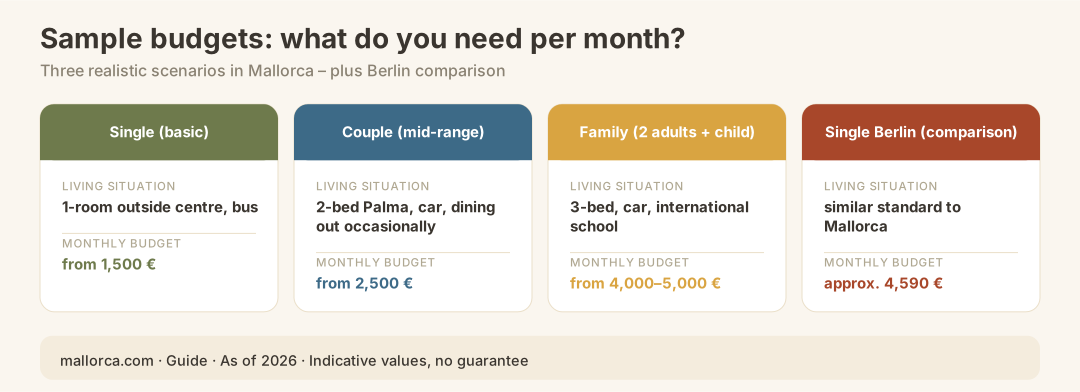
| Scenario | Key details | Monthly budget (approx.) |
|---|---|---|
| Single, simple lifestyle | 1-bed flat outside the centre, cooking at home, bus | from 1,500 € |
| Couple, mid-range standard | 2-bed flat in Palma, car, occasional meals out | from 2,500 € |
| Family (2 adults, 1 child) | 3-bed flat, car, international school | from 4,000–5,000 € |
| Comparison: single person in Berlin | similar standard | approx. 4,590 € |
Please note: These budgets are guideline figures. Location, lifestyle and individual habits can shift actual costs considerably up or down.
The most common budgeting mistakes
People moving to Mallorca often fall into the same cost traps. The following points are systematically underestimated:
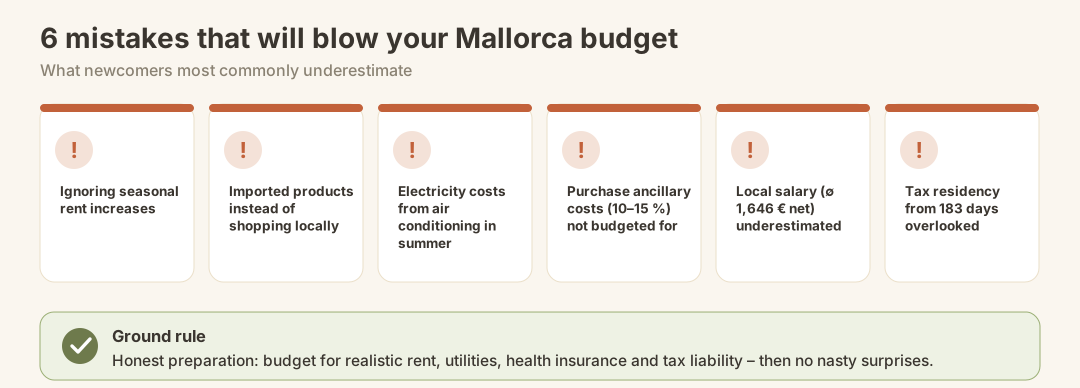
- Seasonal rent increases: Short-term rental contracts in tourist areas can be significantly more expensive in summer than in winter.
- Imported products from Germany: Anyone wanting to replicate their usual shopping basket 1:1 on Mallorca will often pay considerably more.
- Electricity costs in summer: Air conditioning drives utility bills noticeably higher during the warmer months.
- Ignoring purchase ancillary costs: Typically 10–15 percent of the purchase price for taxes, notary and land registry fees is frequently not budgeted for.
- Underestimating local salary levels: Anyone wishing to work locally should be aware that the average net wage is around 1,646 Euro – significantly below German levels.
- Not considering tax residency: Spanish tax liability kicks in after 183 days of residence – ignoring this risks back payments and penalties.
- Taking out private insurance too late: Anyone who arrives without seamless insurance cover may encounter problems due to waiting periods or pre-existing conditions.
What comes next? Authorities, registration and day-to-day organisation
Once the budget is in place, the practical organisation begins. EU citizens need a NIE number after three months at the latest; for permanent residence, the Residencia (registration with the Policía Nacional) is also required. Anyone living on Mallorca for more than six months should deregister in Germany and register on Mallorca in the residents' register (Empadronamiento).
All steps in the correct order:
- Apply for a NIE number
- Empadronamiento (municipal registration)
- Register your residence
- Sort out health insurance
- Check your tax obligations – particularly if income from Germany continues
Checklist: Work through these costs before you move
Go through this list before you set your monthly budget:
- Rental costs including utilities (electricity, water, internet) calculated?
- Purchase ancillary costs (typically 10–15 %) factored in for property purchases?
- Health insurance – public or private – sorted?
- Tax residency checked (> 183 days = Spanish tax liability)?
- Modelo 720 considered (assets held abroad ≥ 50.000 €)?
- Car costs: insurance, fuel, and potentially converting your driving licence?
- Food budget set realistically (not a 1:1 German shopping basket)?
- Seasonal cost fluctuations factored in (summer: air conditioning, tourist-season price pressure)?
- Local income levels checked if you plan to work on the island?
- Removal costs and furnishings (one-off expenses) accounted for?
Conclusion: Mallorca is worth it – if the budget adds up
Mallorca is not cheap. But it is considerably more affordable than Munich, Frankfurt, or Hamburg – and in return it offers a quality of life that is hard to put into euros. Those who arrive with a location-independent income, a pension, or investment returns can live very well here, even on a modest budget. Anyone who needs to earn a salary on the local job market, however, should do the sums soberly: on an average net wage of around 1.646 euros, life on Spain's most expensive island becomes a tight squeeze.
What matters most is honest preparation: with realistic rental prices, utilities factored in, a well-considered health insurance arrangement, and a clear understanding of Spanish tax obligations. Anyone who takes that to heart will not face a nasty surprise on Mallorca – but precisely what they had hoped for.
Official sources
- Mallorca Magazin – Consumer expenditure report 2026 (Balearic Islands the fourth most expensive region in Spain): mallorcamagazin.com
- Numbeo – Cost of living in Palma de Mallorca (price data for dining out, groceries, and transport): de.numbeo.com
- Agencia Tributaria (AEAT) – Income tax IRPF and Modelo 720: agenciatributaria.es
- Agència Tributària de les Illes Balears (ATIB) – Balearic taxes: atib.es
- Govern de les Illes Balears – Intermodal card for public transport: ibit.es
- Seguridad Social – Contributions for autónomo workers and employees: seg-social.es