Non-Resident Tax Spain: The Complete Guide to Modelo 210
You own a finca on Mallorca, an apartment in Palma, or a holiday flat at Playa de Muro – yet you spend most of your time in Germany, Austria, or Switzerland? Then you are subject to limited tax liability in Spain and owe the Fisco an annual return via the Modelo 210, the so-called non-resident tax Spain (IRNR – Impuesto sobre la Renta de No Residentes). This applies even if you have never rented out your property a single time. In this guide you will learn how the tax is calculated, which deadlines are truly binding, where EU citizens have a clear advantage over third-country nationals, and which mistakes tend to be the most costly in practice.
Not sure whether you already owe tax or whether your previous returns were correct?
What is the non-resident tax – and who exactly does it affect?
The IRNR is a standalone tax that applies exclusively to individuals who are not tax-resident in Spain but who generate income there or hold assets – in particular property – in the country. It must not be confused with the Spanish income tax for residents (IRPF), which you only have to pay once you have moved your centre of tax affairs to Spain.
You are considered a non-resident for tax purposes if you spend fewer than 183 days per calendar year in Spain and do not have your primary economic base in Spain. Temporary absences are counted towards the 183-day tally – so anyone who is only occasionally at home should document the days carefully.
Please note: The Spanish tax authority (Hacienda, at national level: AEAT) does not issue tax assessments. This is a self-assessment obligation: you are required to submit the return on time and pay the tax yourself – regardless of whether you have received any notification.
On the property side, the non-resident tax covers three different scenarios:
Scenario
Type of income
Basis of calculation
Owner-occupation / vacant property
Deemed income (Renta Imputada)
Cadastral value (Valor Catastral)
Letting (including holiday letting)
Actual rental income
Net income (EU/EEA) / Gross (non-EU)
Property sale
Capital gain
Sale price minus acquisition costs
Resident vs. non-resident: the decisive fork in the road
Before you turn your attention to the Modelo 210, your tax status must be established beyond doubt. Anyone who incorrectly declares themselves as a non-resident when they are already a resident risks a retrospective assessment with surcharges. Equally dangerous: being recorded as a resident when you do not in fact have your main centre of life in Spain.
Criterion
Tax resident
Non-resident
Residence in Spain
> 183 days/year
≤ 183 days/year
Centre of economic interests
In Spain
Abroad
Tax return
IRPF (worldwide income)
IRNR (Spanish income/property only)
Main form
Modelo 100
Modelo 210
Anyone who holds a Residencia and is registered (empadronado) is generally considered a resident – but must be able to demonstrate their actual period of stay. More on this in the guide to Residencia in Spain.
The three scenarios in detail: personal use, letting, and sale
Scenario 1: Personal use and vacancy – the "deemed income"
The aspect that surprises many holiday-property owners most about the IRNR: even if you never let your Mallorca property and use it exclusively yourself, Spain attributes a deemed income to you – known as the Renta Imputada.
The calculation works as follows:
The starting point is the cadastral value (Valor Catastral) of the property, which you will find on your IBI bill.
As a rule, 1,1 % is applied if the cadastral value was reviewed or revised after 1994; 2 % if the last cadastral update took place before 1994.
The applicable tax rate (19 % for EU/EEA nationals, 24 % for non-EU nationals) is then applied to this amount.
Worked example (simplified):
Step
Example figure
Cadastral value of the property
200.000 €
Deemed income (1.1 %)
2.200 €
Tax for EU nationals (19 %)
418 €
Tax for non-EU nationals (24 %)
528 €
Please note: If the property is used personally for only part of the year and let for the remainder, the deemed income is calculated on a pro-rata basis – the Renta Imputada, and for rental periods the actual rental income.
Case 2: Rental Income
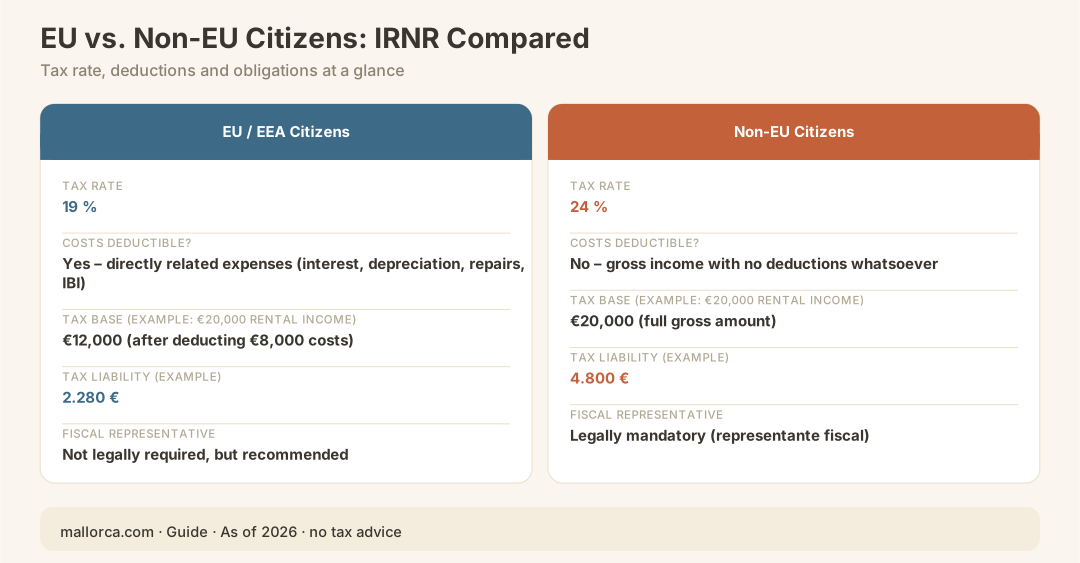
Anyone who lets their property – whether on a long-term or holiday basis – must pay tax on the actual income received. Here, a significant difference between EU and non-EU citizens comes into play:
EU/EEA citizens may deduct expenses directly related to the rental income (interest, depreciation, repairs, management costs, IBI) and are taxed only on the net income.
Non-EU citizens must pay tax on the gross income with no allowable deductions.
Item
EU/EEA owner
Non-EU owner
Gross rental income
20.000 €
20.000 €
Deductible costs (e.g. 8,000 €)
− 8,000 €
not deductible
Taxable base
12.000 €
20.000 €
Tax (19 % / 24 %)
2.280 €
4.800 €
Case 3: Capital Gain on Sale
When selling a Spanish property, IRNR is levied on the capital gain (sale price minus acquisition costs including purchase-related expenses). In this case, the buyer is legally required to withhold 3 % of the purchase price directly and remit it to the AEAT – as an advance payment against the seller's tax liability. If the actual tax due is less than this 3 %, the seller may reclaim the difference; if it is higher, an additional payment must be made. The return is also filed via Modelo 210, within four months of the sale.
2026 Tax Rates at a Glance
Country of residence
Tax rate
Costs deductible?
EU or EEA state (e.g. Germany, Austria)
19 %
Yes (for rental income)
Third countries outside the EU/EEA
24 %
No
Note regarding Switzerland: Switzerland is neither an EU nor an EEA member. Whether Swiss citizens resident in Switzerland are entitled to the 19 % rate or the 24 % rate depends on the tax classification of the individual case – if in doubt, a tax adviser with cross-border expertise should be consulted.
The Modelo 210: What You Need to File
The Modelo 210 is the sole form for IRNR – it covers all three types of income (owner-occupation, rental, sale), each with different codes and schedules. It can be submitted online via the AEAT portal; electronic submission generally requires a Spanish digital certificate (certificado electrónico) or an authorised tax adviser is required.
Mandatory details and documents:
Documents
Purpose
NIE number (Número de Identificación de Extranjero)
Mandatory for every tax return in Spain
IBI notice showing cadastral value and cadastral reference
Basis for calculating the Renta Imputada
Tenancy agreements / proof of payment
In the case of rental income
Purchase contract (escritura)
In the case of a sale
Tax identification number from your home country
Relevant for double taxation agreements
Certificate of residence from your home country's tax authority
Proof of non-resident status
If you do not yet have a NIE number, you will find everything you need in the guide to obtaining a NIE number on Mallorca.
2026 deadlines: the dates you need to know
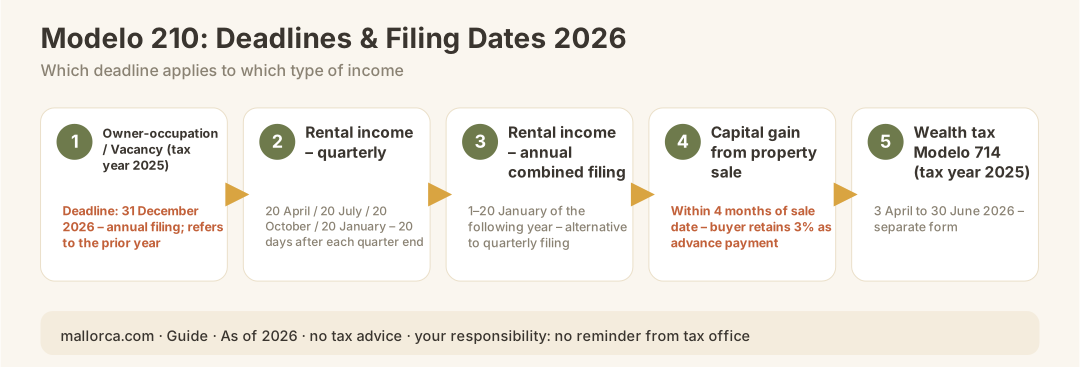
The Spanish tax system allows no grace periods and no automatic extensions. Anyone who files late will face penalties — even for just a few days' delay.
Type of income
Deadline
Note
Owner-occupation / deemed income (tax year 2025)
31. Dezember 2026
Annual filing; relates to the previous year
Rental income (quarterly)
20. April / 20. Juli / 20. Oktober / 20. Januar
20 days after the end of each quarter
Rental income (annual consolidated filing)
1.–20. Januar of the following year
Alternative to quarterly filing
Capital gain from property sale
Within 4 months of the date of sale
The buyer retains 3% as an advance payment
Wealth tax return (tax year 2025)
3 April – 30 June 2026
Separate form Modelo 714
Please note: For rental income, many tax advisers prefer quarterly filing, as it makes it easier to keep track and any errors come to light sooner. Which option makes more sense for you depends on the frequency and amount of your rental income.
Double taxation: what the Germany–Spain DTA covers
Germany and Spain have concluded a double taxation agreement (DTA). This means you do not pay tax on the same income twice in full. As a rule, the situs principle applies to property income — the right to tax lies with the country in which the property is located, i.e. Spain. Germany may, however, take the income into account under the so-called progression clause in order to increase the German tax rate on your remaining income.
What this means in practice:
The IRNR paid in Spain is generally credited against German tax or the Spanish income is exempt from German taxation.
You must nonetheless declare the Spanish income in your German tax return.
The precise treatment depends on your individual circumstances — a tax adviser with cross-border expertise is indispensable here.
Wealth tax (Impuesto sobre el Patrimonio): don't forget it
In addition to IRNR, non-residents with property assets in Spain may also be liable for wealth tax (Impuesto sobre el Patrimonio, IP). This is declared separately via Modelo 714.
Important: Spain's Supreme Court ruled in judgment 1402/2025 of November 2025 that non-residents may apply the same combined cap on IRNR and wealth tax as residents (IRPF/IRNR + IP must not exceed 60% of the tax base, with an IP reduction of up to 80% possible). The ruling creates legal certainty and can lead to substantial tax savings in individual cases — particularly for high-value properties in Mallorca.
The deadline for the 2025 wealth tax return runs from 3 April to 30 June 2026.
Liability and fiscal representative: who acts on your behalf
Non-residents from third countries (i.e. outside the EU/EEA) are legally required to appoint a fiscal representative (representante fiscal) resident in Spain, who acts as the point of contact with the Spanish tax authority. EU citizens are not formally required to appoint a fiscal representative, but it is common and recommended practice: a locally based tax adviser (asesor fiscal) knows the deadlines, special cases, and current changes — and keeps you out of the firing line from a liability perspective.
Note: If a tenant resident in Spain pays rent to a non-resident, they are in certain cases required to withhold a portion of the rental payment as withholding tax and remit it to the authorities. This is another reason why communication between tenant, landlord, and tax adviser should be well coordinated.
Most common mistakes with non-resident tax
In practice, the same mistakes crop up time and again. Here are the most dangerous ones:
Mistake
Consequence
Personal use not declared because "I don't rent it out"
Back payment of tax plus surcharges for previous years
Wrong percentage applied to the cadastral value (2 % instead of 1.1 %)
Overpayment or incorrect return
Deadline of 31.12. overlooked because no payment reminder is issued
Late-payment surcharge; in cases of prolonged default, substantial penalties
Non-EU citizen attempts to deduct costs
Incorrect return, back payment
No NIE number in place
Technical submission of the Modelo 210 not possible
Double-taxation-agreement exemption forgotten in Germany
Double taxation or trouble with the German tax authority
Cadastral value taken from an old notice instead of the current IBI notice
Incorrect basis of calculation
What comes next? The most important follow-on topics
Anyone who has their non-resident tax under control should clarify the following points next:
Consider residencia: Anyone who spends more than 183 days in Spain automatically becomes a tax resident — regardless of their intention. You can read about what this means in the guide Taxes as a resident (IRPF).
Health insurance: As a non-resident without Spanish social insurance, you will need private cover — more on this in the guide Health insurance in Spain.
Holiday letting: Anyone wishing to generate rental income must clarify not only the IRNR requirements but also the relevant licensing conditions — the Balearic Islands have had tightened regulations in place for several years now.
Checklist: submitting the Modelo 210 correctly
Work through this list before submitting your return or commissioning your tax adviser:
NIE number in place and valid
Current IBI notice obtained, showing cadastral value and cadastral reference
Tax status clarified: non-resident confirmed (stay < 183 days)
Type of income established (personal use / letting / sale / combination)
Correct percentage for deemed income determined (1.1 % or 2 %)
For letting: rental receipts and deductible costs documented (EU/EEA)
Deadline noted and entered in the calendar
German tax adviser informed about Spanish income (progression clause)
Bank details stored for tax direct debit or transfer prepared
In the event of a property sale: buyer's 3% retention documented
Conclusion
The non-resident tax in Spain is not a large sum – but one with real consequences if ignored. The combination of a self-initiative obligation, self-assessed tax liability, and strict deadlines makes it one of the most common sources of unnecessary fines for German Mallorca property owners. The good news: once you have a functioning system in place – a local tax adviser, NIE in the drawer, IBI notice archived annually – completing the Modelo 210 takes just a few minutes, or you can delegate it entirely.
For more complex situations (holiday letting, sale, high asset value, transition to residencia), individual advice is always worthwhile. Send us an enquiry – we'll connect you with the right experts on Mallorca.
Official Sources
AEAT (Agencia Estatal de Administración Tributaria) – Information on IRNR and online submission of the Modelo 210: https://www.agenciatributaria.es
Non-Resident Income Tax Act (LIRNR) – published in the BOE: https://www.boe.es
Ruling Tribunal Supremo 1402/2025 (equal treatment of non-residents regarding the wealth tax ceiling): published on the CGPJ portal https://www.poderjudicial.es
Do I need to submit the Modelo 210 even if I never rent out my Mallorca property?
Yes, absolutely. Spain taxes owner-occupied properties on a so-called deemed income (*Renta Imputada*), calculated on the basis of the cadastral value. The tax liability exists regardless of whether any rental income is generated. The deadline for the 2025 tax year is 31 December 2026.
How much is the non-resident tax for a German property owner?
As an EU citizen you pay 19 % on the assessment base. For owner-occupied use this often amounts to just a few hundred euros per year, depending on the cadastral value. For rental income, EU citizens may deduct directly related costs and are taxed only on the net income.
What happens if I fail to submit the Modelo 210 or submit it late?
The Spanish tax authority does not send reminders. Anyone who misses the deadline will incur late-payment surcharges on the tax liability. For prolonged failures to file, the tax authority may initiate formal proceedings — with significantly higher penalties than those applied when arrears are settled voluntarily.
What is the difference between EU and non-EU citizens under the IRNR?
EU and EEA citizens pay 19 % and may deduct directly related expenses from rental income. Non-EU citizens pay 24 % on gross income with no deductions whatsoever. In addition, they are generally required to appoint a fiscal representative in Spain.
How do I find the correct cadastral value for my property?
You can find the current cadastral value (*Valor Catastral*) and cadastral reference on your annual IBI bill (Spanish property tax). Alternatively, it can be looked up via the Sede Electrónica del Catastro.
Do I also have to pay wealth tax as a Mallorca property owner?
This depends on the total value of your assets situated in Spain. If it exceeds a certain allowance, wealth tax (*Impuesto sobre el Patrimonio*) may apply, which is declared separately via the Modelo 714. The Supreme Court confirmed in 2025 that non-residents are entitled to use the same maximum-tax-liability rule as residents — which can result in significant tax savings in individual cases.
Can I submit the Modelo 210 myself or do I need a tax adviser?
Submission is technically possible via the AEAT portal, but requires a Spanish digital certificate and a solid knowledge of the system. For straightforward cases (owner-occupation only, a single property) many owners manage to file independently. Where rental income, a sale, multiple properties or a complex tax status are involved, a local *asesor fiscal* is recommended.
How is the non-resident tax treated in Germany?
Spain holds the primary right to tax immovable property situated in Spain. Germany generally exempts this income from German taxation but takes it into account under the so-called progression clause: the Spanish income raises the German tax rate applied to the remaining income. You should therefore adjust your German tax returns accordingly.