
Early retirement Mallorca: Living as a person of independent means on investment income
You stopped working early, your portfolio generates enough income, and Mallorca is no longer just a holiday destination — it's a serious plan. This particular situation — early retirement in Mallorca, no earned income, living off dividends, interest, or withdrawals from a securities portfolio — comes with specific requirements that differ considerably from those facing traditional retirees or employees. This guide explains how to put your residency status on a solid footing, which visa you need, how Spain taxes your investment income, what the Modelo 720 has to do with your portfolio, and which ongoing costs you should realistically budget for. All information refers to the 2025/26 position and is based on verified sources.
Would you like to know whether the move genuinely makes sense for you from a tax perspective?
- 📩 Submit a personal enquiry — we connect you with vetted tax advisers and gestorías on Mallorca
- Taxes as a resident on Mallorca – an overview
Who counts as an early retiree or person of independent means for tax purposes?
The term 'early retiree' has no legal definition in Spain. For tax and residency purposes, only the source of your income matters. Anyone who lives entirely or predominantly from investment income — i.e. dividends, interest, capital gains, fund distributions, or withdrawals from an ETF portfolio — has no earned income (rentas del trabajo) in Spain. This has implications for:
- the visa or residence permit,
- the obligation to take out Spanish health insurance,
- the tax bracket within the IRPF (Impuesto sobre la Renta de las Personas Físicas),
- and the reporting obligations to the Spanish tax authority (AEAT/ATIB).
Anyone who also receives a statutory pension from Germany will find further information in the guide Taxing a German pension in Spain — this article focuses on living without ongoing pension payments.
Right of residence: which visa for EU citizens without earned income?
EU citizens — and that includes Germans and Austrians — enjoy freedom of movement within the EU. You do not need a visa to move to Mallorca. However, once you stay for more than three months or transfer your centre of life there, you must:
- apply for a NIE number (Número de Identificación de Extranjero),
- register as an EU citizen in the Central Foreigners' Register (Registro Central de Extranjeros) — the resulting document is known as the Certificado de Registro de Ciudadano de la Unión,
- register with the local residents' register (Padrón Municipal) — known as Empadronamiento).
Please note: Registering on the EU citizens' register is not an optional administrative step — it is a prerequisite for dealing with public authorities, opening bank accounts, obtaining a tax number, and accessing health insurance. Nothing moves forward without it.
For more detail on the exact process, see Applying for Residencia and Empadronamiento Mallorca.
For non-EU citizens (e.g. Swiss nationals without an EU passport, British citizens after Brexit), the Non-Lucrative Visa is the classic route when no earned income is planned. It permits long-term residency but prohibits any gainful employment in Spain. More on this: Non-Lucrative Visa Spain.
Tax residency in Spain: when do you become a resident?
Spain applies clear criteria for this. You are tax resident (residente fiscal) if at least one of the following conditions applies:
| Criterion | Description |
|---|---|
| 183-day rule | You spend more than 183 days in Spain during the calendar year — not necessarily consecutively |
| Centre of economic interests | The main focus of your economic interests is in Spain |
| Family ties | Your spouse (not permanently separated) or minor children have their place of residence in Spain |
Source: goring-online.com
As a tax resident you declare your worldwide income in Spain via the IRPF return (declaración de renta). Germany thereby loses its right to tax most categories of income — the double taxation agreement (DBA) between Germany and Spain governs who may tax what.
Please note: Anyone hoping to stay just below the 183 days threshold should be aware: Spain can still claim tax residency for fewer than 183 days if the centre of economic interests is clearly located in Spain. Simply counting days is not always a sufficient protective strategy. More on the 90/180-day rule.
IRPF: How capital income is taxed in Spain
As a Spanish tax resident, you do not pay a flat withholding tax on capital income (rentas del ahorro) in the German style; instead, you pay a progressive special rate within the IRPF. This rate applies to:
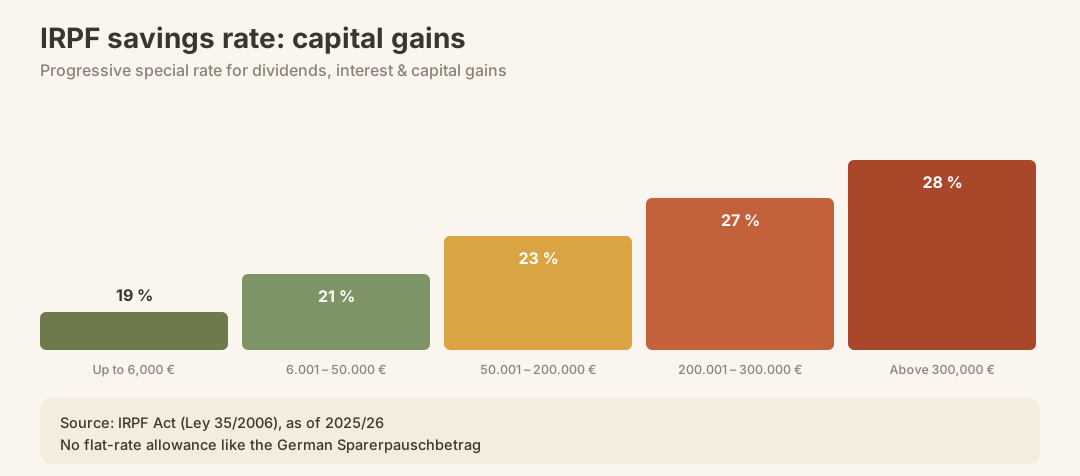
- Dividends and interest (rendimientos del capital mobiliario)
- realised capital gains from the sale of securities (ganancias patrimoniales)
- Distributions from funds and ETFs
| Taxable capital income (per year) | IRPF rate (savings rate) |
|---|---|
| Up to 6.000 € | 19 % |
| 6.001 € – 50.000 € | 21 % |
| 50.001 € – 200.000 € | 23 % |
| 200.001 € – 300.000 € | 27 % |
| Above 300.000 € | 28 % |
Source: goring-online.com – Tax rates Spain 2026
Important for private investors: Unlike the German saver's allowance, Spain has no comparable general tax-free allowance for capital income. There is, however, a general personal allowance (mínimo personal) within the IRPF, which accounts for the tax-free subsistence level.
Realised losses from the sale of securities can be offset against gains. The offsetting of losses between different types of income is restricted — individual tax advice from a gestoría.
Modelo 720: Reporting overseas assets — what private investors need to know
The Modelo 720 is one of the most important and potentially costly pitfalls for wealthy newcomers. As a Spanish tax resident, you are required to report overseas assets above certain thresholds to the AEAT. The reporting obligation applies to three categories:
| Category | Reporting obligation from |
|---|---|
| Bank accounts abroad | Balance or average value exceeding €50,000 |
| Securities, funds, life insurance policies abroad | Value exceeding €50,000 |
| Real estate abroad | Purchase value or cadastral value exceeding €50,000 |
Source: /de/ratgeber/auswandern/steuern-finanzen/modelo-720
Initial declaration: In the year following the start of tax residency (by 31 March). Subsequent declarations are only required if the value in a category has changed by more than €20,000 or a new category is added.
Anyone who fails to submit the Modelo 720 or submits it incorrectly risks substantial fines. Following a European Court of Justice ruling in 2022, the originally disproportionately high penalties were reformed, but the reporting obligation itself remains in place. Full details on this here: Modelo 720 reporting obligation.
Income tax return: deadlines and procedure in Mallorca
The Spanish income tax return (declaración de renta) for the previous year must be submitted annually within a fixed time window. According to Mallorca Zeitung, the deadline for the 2025 tax return began in early April 2026 and runs until the end of June 2026.
| Step | Details |
|---|---|
| Submission period | Generally early April to late June of the following year |
| Responsible authority | Agencia Tributaria (AEAT) / Agència Tributària de les Illes Balears (ATIB) |
| Submission | Online via Renta Web (AEAT portal) or using a Certificado Digital / Cl@ve |
| Advice | Gestoría or tax adviser recommended |
As a private individual without a payslip, you must declare all investment income yourself. A Certificado Digital makes communication with the AEAT considerably easier – find out how to apply for one at Applying for a Digital Certificate.
Health Insurance: The Critical Gap for Early Retirees
For early retirees, health insurance is often the most complex issue – not tax law. Those who are not yet receiving a statutory pension have no entitlement to the S1 form (the form that enables statutory pensioners from Germany to access the Spanish public health system).
| Situation | Health insurance option |
|---|---|
| Early retiree, not yet receiving a statutory pension | Private health insurance (mandatory for Non-Lucrative Visa; de facto also required for EU citizens) |
| Recipients of a statutory pension from Germany | S1 form possible → access to the Spanish health system (SNS) |
| Voluntarily insured under statutory health insurance in Germany | Check whether voluntary membership continues during a stay abroad |
| Privately insured in Germany | Clarify whether the policy is suitable for a permanent stay abroad |
Private health insurance in Spain typically costs several hundred euros per month per insured person, depending on age and plan. More on this: Health insurance Spain and S1 form Spain.
Please note: Without proof of health insurance, neither the Non-Lucrative Visa will be approved nor – in practice – will a residence permit be straightforwardly granted to EU citizens. Comprehensive private health insurance at Spanish level is a requirement, not an option.
Realistic Cost of Living for People of Independent Means on Mallorca
Mallorca is no longer an inexpensive island. Costs vary considerably depending on location, type of accommodation and lifestyle. As a rough guide for a couple with no earned income:
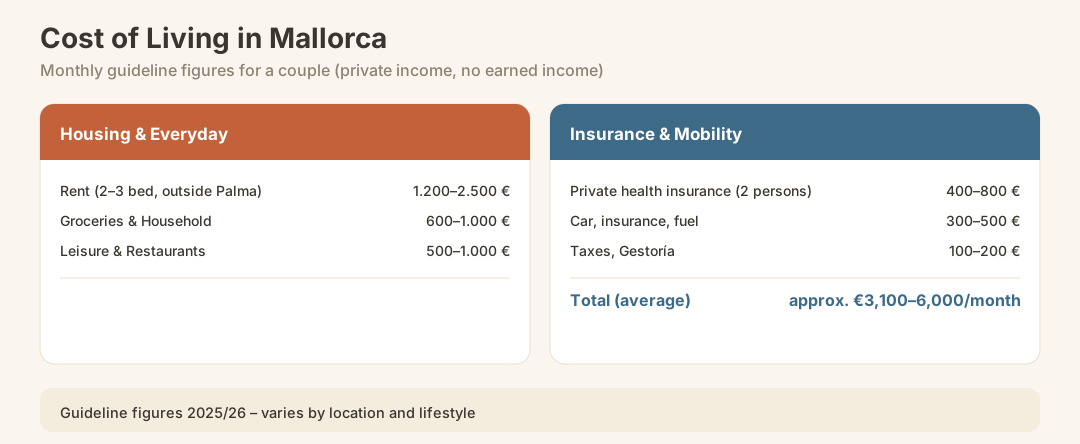
| Cost category | Monthly estimate (couple) |
|---|---|
| Rent (flat, 2–3 rooms, outside Palma) | 1.200–2.500 € |
| Food and household expenses | 600–1.000 € |
| Private health insurance (2 people) | 400–800 € |
| Car incl. insurance, fuel | 300–500 € |
| Taxes, accountancy, gestoría | 100–200 € |
| Leisure, dining out, miscellaneous | 500–1.000 € |
| Total (average) | approx. 3.100–6.000 €/month |
These figures are indicative. Someone living in a rental villa in the south-west of the island or owning their own home will budget differently from someone in a flat in Manacor. More on current prices: Cost of Living Mallorca.
German Investment Portfolio and Exit Tax: What Happens When You Move?
Anyone relocating their primary residence from Germany abroad while holding a securities portfolio should be aware of the German exit tax . Under certain conditions, Germany can levy a notional disposal tax on unrealised gains in substantial shareholdings (from a 1% stake in a capital company) upon departure.
For private investors with a standard portfolio (ETFs, shares with less than a 1% stake, bonds), the exit tax in the strict sense generally does not apply – however, Germany's limited tax liability on certain domestic income continues to run. Dividends from German shares, for example, may still be subject to withholding tax in Germany.
Note: Tax planning prior to the move – realising losses or gains, portfolio structure, the location of the portfolio – can have a significant impact. This is not a do-it-yourself task; advice from a consultant specialising in German-Spanish tax law is not a luxury here, but a necessity. A starting point: Taxes & Finance Mallorca.
The Most Common Mistakes Made by Early Retirees on Mallorca
Misunderstanding the 183-day rule as a magic threshold. Anyone whose economic centre of life is in Spain (property, portfolio with a Spanish bank, family) can become a tax resident even if they spend fewer days there.
Forgetting to submit Modelo 720 or submitting it too late. The deadline is 31 March of the year following tax residency. Missing it results in fines.
Underestimating health insurance. Without comprehensive private health insurance there is no right of residence – and on Mallorca, a single emergency call-out can quickly run into four figures.
Double taxation through incorrect deregistration practices. Anyone who fails to deregister in Germany and does not register in Spain may become liable to tax in both countries.
No bank account in Spain. A Spanish bank account is essential for rent, direct debits (electricity, water, insurance) and dealing with the authorities. How to open one: Opening a Bank Account in Spain.
Wanting to consider the Beckham Law as a private individual. The Beckham Law applies exclusively to individuals who have come to Spain under an employment contract or in a company management role – not to private individuals and early retirees without earned income. More: Beckham Law Spain.
No will in Spain. Anyone with assets in Spain should have a Spanish will drawn up. Without one, the EU Succession Regulation applies the law of the last place of habitual residence — which can have unexpected consequences.Spanish will.
What comes next? The first steps after moving
| Step | When | Where |
|---|---|---|
| Apply for NIE number | Before moving or immediately afterwards | National Foreigners' Office (Oficina de Extranjería), Palma |
| Apply for EU citizen certificate | Within 3 months of arrival | Oficina de Extranjería Mallorca |
| Empadronamiento | At the same time or shortly afterwards | Relevant Ayuntamiento (town hall) |
| Open a Spanish bank account | As early as possible | Spanish bank, with NIE and passport |
| Take out private health insurance | Before arrival or immediately afterwards | Spanish or international insurers |
| Prepare Modelo 720 | In the first year of tax residency | With a gestoría or tax adviser |
| First IRPF return | April–June of the following year | Online via AEAT or with a gestoría |
| Update German will / draw up Spanish will | In the first year | Spanish notary |
A complete overview of all official registration steps can be found in the Authorities & Registration Guide.
Checklist: Early retirees on Mallorca – the most important points at a glance
- NIE number applied for
- EU citizen certificate (Residencia) issued or Non-Lucrative Visa approved
- Empadronamiento completed at the relevant Ayuntamiento
- Spanish bank account opened
- Private health insurance taken out with no gaps in coverage
- Deregistration in Germany completed (residents' registration office + tax office)
- Tax adviser / Gestoría engaged for IRPF and Modelo 720
- Modelo 720 submitted on time in the first year of residency
- Portfolio structure reviewed for tax implications prior to the move
- Spanish will drawn up
- Certificado Digital / Cl@ve activated
Conclusion
Life as an early retiree or person of independent means on Mallorca is entirely feasible – but it requires more preparation than a standard retirement relocation. The tax side is particularly important: investment income is taxed progressively in Spain (19–28 %), the Modelo 720 requires full disclosure of your assets held abroad, and the IRPF return is an annual obligation. At the same time, there is no automatic entitlement to the public health system – a good private health insurance policy is therefore not an optional extra, but a prerequisite. Those who get these arrangements in place in good time will benefit from real advantages: a mild climate, excellent infrastructure, and a comparatively relaxed daily life on one of the most beautiful islands in Europe.
Official sources
- Agencia Tributaria (AEAT) – Spanish income tax, Modelo 720, IRPF: https://www.agenciatributaria.es
- Agència Tributària de les Illes Balears (ATIB) – Balearic regional taxes: https://www.atib.es
- Ministerio de Hacienda – Modelo 720: https://sede.agenciatributaria.gob.es
- Seguridad Social Española – health insurance and social security: https://www.seg-social.es
- Deutsche Rentenversicherung – pension payments abroad: https://www.deutsche-rentenversicherung.de
- Oficina de Extranjería Palma de Mallorca – Residence permit for EU citizens: https://www.inclusion.gob.es/web/migraciones/oficinas-de-extranjeria
- BOE – Ley 35/2006, IRPF Act: https://www.boe.es/buscar/act.php?id=BOE-A-2006-20764