
Gestoría Spain: Services, Costs and German-Speaking Contacts in Mallorca
Anyone emigrating to Mallorca will encounter a word early on that is unknown in Germany: Gestoría. Behind it lies a Spanish administrative agency that handles official errands, tax returns and bureaucratic procedures on your behalf – and which often becomes the most important point of contact for newcomers during the first few months. In this guide you will learn what a Gestoría Spanien differs from a tax adviser or a lawyer, what tasks it specifically takes on, what it all costs, when you additionally need an Asesor Fiscal and how to find a German-speaking specialist on Mallorca who knows both legal worlds.

Do you already know which specialist is right for your situation?
- 📩 Submit a personal enquiry — We will connect you with the right German-speaking Gestor or tax adviser on Mallorca
- All official-authority topics at a glance
What is a Gestoría – and what is it not?
A Gestoría is a private service company that specialises in administrative and bureaucratic tasks. In order to officially call itself a Gestoría in Spain, the office must be registered in the commercial register (Registro Mercantil). Staff are required to hold appropriate qualifications – typically a degree in law or economics.
It is important to distinguish it from two other professions:
| Term | Core function | Typical area of application |
|---|---|---|
| Gestoría / Gestor | Handles practical official errands and administrative formalities | NIE, Residencia, vehicle re-registration, Empadronamiento, straightforward tax returns |
| Asesoría / Asesor Fiscal | Strategic tax and financial advice, optimisation | IRPF optimisation, double-taxation agreements, wealth planning |
| Abogado (lawyer) | Legal advice, contract law, litigation | Property purchase (due diligence), inheritance law, court disputes |
Note: In practice the boundaries are fluid. Many offices on Mallorca offer Gestoría services and tax advice under one roof – particularly in German-speaking firms that specialise in international clients.
A Gestoría is liable for its work. Anyone who engages a licensed Gestor is therefore not left on their own if a mistake occurs – this distinguishes the Gestoría from an unlicensed service provider who merely helps with filling in forms.
When do you need a Gestoría on Mallorca?
Almost every step of emigrating triggers contact with the authorities. The overview below shows the processes for which a Gestoría is typically used:
| Process | Gestoría advisable? | Why |
|---|---|---|
| Applying for a NIE number | Yes | Securing a Cita Previa quickly, complete documentation |
| Residencia (TIE/Certificado) | Yes | Knowledge of forms, power of attorney possible |
| Empadronamiento (registration certificate) | Optional | Usually manageable yourself, but a gestoría saves time |
| Re-registering a vehicle | Yes | Many DGT forms, deadlines, tax calculation |
| Converting a driving licence | Yes | Translations, DGT procedures |
| Tax return (IRPF) | Recommended | Spanish-German tax law, double taxation agreement queries |
| Registering as autónomo | Yes | Alta with RETA, Modelos, quarterly submissions |
| Registering household help | Recommended | Social security obligations, correct contributions |
| Digital certificate (Cl@ve/Certificado Digital) | Optional | Worthwhile, saves future trips |
Please note: The gestoría can, with a power of attorney (poder notarial), handle many official procedures entirely on your behalf – you do not need to appear in person. This is particularly convenient in the early stages, when you are not yet permanently on the island.
Specific tasks: what does the gestoría handle in detail?
For private individuals
- Applying for and preparing the NIE number – including the Cita Previa at the National Police or the consulate
- Registration in the foreigners' register (Residencia, EU citizens: Certificado de Registro de Ciudadano de la Unión; Non-EU: TIE)
- Empadronamiento at the Ayuntamiento (municipal registration of residents)
- Re-registration of vehicles with the DGT and calculation of applicable taxes
- Application for the Certificado Digital / setting up Cl@ve
- Filing straightforward income tax returns (Modelo 100 / IRPF)
- Non-resident tax (Modelo 210) for property owners without residence in Spain
- Modelo 720 – reporting obligation for foreign assets exceeding 50.000 €
For businesses and the self-employed
- Registration as an Autónomo with the social security authority (RETA) and the tax office (AEAT)
- Ongoing bookkeeping and preparation of quarterly Modelos (303, 130, 111 …)
- Company formation (S.L.), registration in the commercial register
- Payroll accounting and employment contract law
- Support with property purchases (tax side; legal due diligence is handled by the solicitor)
Gestoría vs. tax adviser: who does what when it comes to tax matters?
For straightforward tax matters – such as filing the annual IRPF return as an employee or dealing with non-resident tax – a good gestoría is perfectly sufficient. Once things become more complex, you need an Asesor Fiscal or a firm that combines both:
| Tax matter | Gestoría sufficient | Asesor Fiscal / specialist firm required |
|---|---|---|
| Standard IRPF return | ✓ | |
| Non-resident tax (Modelo 210) | ✓ | |
| Taxing a German pension in Spain | Borderline case | ✓ Double taxation agreement |
| Modelo 720 Foreign assets | ✓ | ✓ for complex cases |
| Beckham Law (special regime) | ✓ | |
| Inheritance / gift | ✓ DTA Germany–Spain | |
| Property purchase via S.L. / tax structure | ✓ | |
| Cuota Autónomo ongoing | ✓ |
Note: Particularly when German and Spanish tax law intersect — in matters of double taxation agreements, inheritances involving property in both countries, or foreign capital investments — a German-speaking tax adviser in Mallorca is indispensable. They must be familiar with both legal systems and be able to weigh them against each other.
Costs: What does a gestoría in Mallorca charge?
Prices vary depending on the office, complexity, and whether you are enquiring as a private individual or a business. The following figures are drawn from available market data (as of 2026):
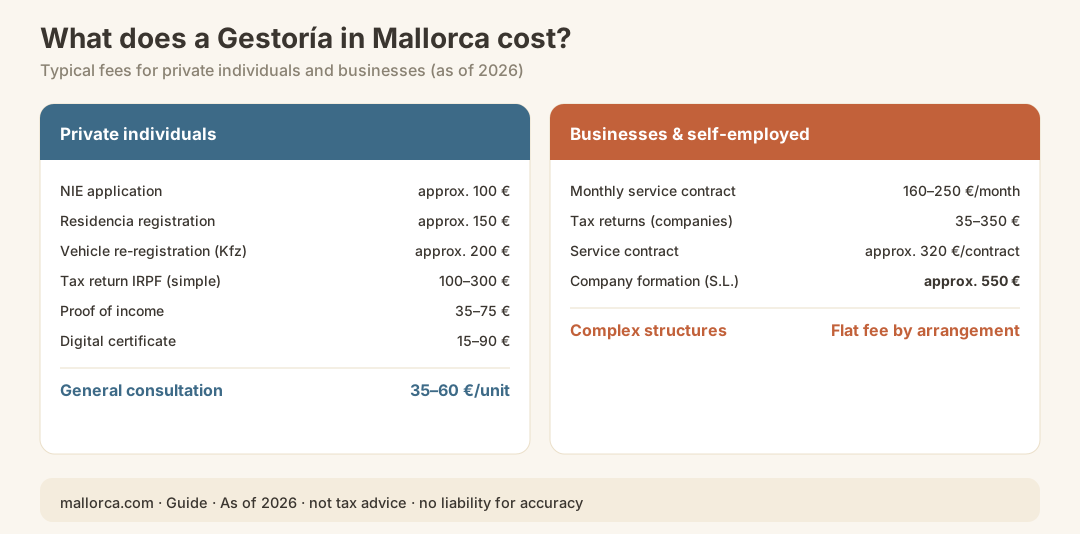
Costs for private individuals
| Service | Price range |
|---|---|
| NIE application | approx. 100 € |
| Residencia registration | approx. 150 € |
| Vehicle re-registration (car) | approx. 200 € |
| Tax return (IRPF, straightforward) | 100–300 € |
| Proof of income | 35–75 € |
| Preparation / submission of individual tax returns | 30–35 € |
| Digital certificate | 15–90 € |
| General administrative procedures and advice | 35–60 €/item |
Costs for businesses (e.g. property purchase via S.L.)
| Service | Price range |
|---|---|
| Monthly company management retainer | 160–250 €/month |
| Preparation / Submission of Tax Returns (Companies) | 35–350 € |
| Service Agreement / Commercial Contract | approx. 320 €/contract |
| Company Formation (S.L.) | approx. 550 € |
| Complex Tax Structure / Corporate Structuring | Flat fee by agreement |
Tip: For larger projects – company formation, tax-saving models for a property – you should always agree on a written fixed price. Hourly rates can add up quickly if the process takes longer than planned.
Gestoría fees for tax returns are generally tax-deductible as business expenses.
German-speaking gestorías and tax advisers on Mallorca
On Mallorca there are a notable number of offices that explicitly serve German-speaking clients. Three points of contact from our research:
| Office | Address / Contact | Focus |
|---|---|---|
| Gestoría Palma | Carrer de Joan Lluís Estelrich, 12, 1º C, 07003 Palma · +34 637 08 98 26 · gestoriapalma.com | Tax, administration, companies, private individuals |
| Joan Cerdà Associats | info@joancerda.com · +34 971 764 242 · joancerda.com | German-speaking tax advice, international investors, inheritance |
| Januar Consulting | +34 971 49 58 35 / +34 971 55 31 61 · januarconsulting.com | Tax law, property law, company formation, German-speaking clients |
Further firms such as Garcia Elsener (garciaelsener.com) or De Micco & Friends / LAWYERS & AUDITORS (palma@demicco.es) specialise in German-speaking clients and combine tax with legal advice.
Note: This list is based on publicly available information from our research and does not constitute a recommendation. Always obtain several quotes before engaging anyone.
The gestoría when buying a property: what does it do?
When buying a property on Mallorca, the gestoría and the lawyer work hand in hand – with clearly defined, separate roles:
- The lawyer (Abogado): Legal due diligence, contract review, land registry research, freedom from encumbrances, any disputes
- The gestoría / tax adviser: Tax structure of the purchase (private individual vs. S.L.), calculation and payment of the ITP (property transfer tax), advice on ongoing taxation, inheritance planning
Particularly when non-residents are buying, Spanish and German tax law as well as the double taxation agreement between the two countries must constantly be weighed against each other. A purely Spanish-speaking gestoría with no knowledge of Germany is generally not sufficient here.
Please note: The gestoría is not a legal substitute for a solicitor when purchasing a property. It handles the administrative and tax side — not the legal protection.
How to find a good gestoría: 7 criteria
- German-speaking staff — not just an information sheet in German, but genuine communication at eye level in your language
- Registration in the Registro Mercantil — a basic requirement in order to officially call itself a gestoría
- Clear fee structure — fixed prices for standard services, written fixed-price quotes for projects
- Experience with international clients — ideally with demonstrable experience working with German, Austrian or Swiss clients
- Google reviews and recommendations — expat groups and forums on Mallorca are a good source
- Accessibility — short response times by email or phone, no months-long wait to get an appointment
- Network — a good gestoría knows when it needs to bring in a solicitor or notary, and actively makes referrals
The most common mistakes when working with a gestoría
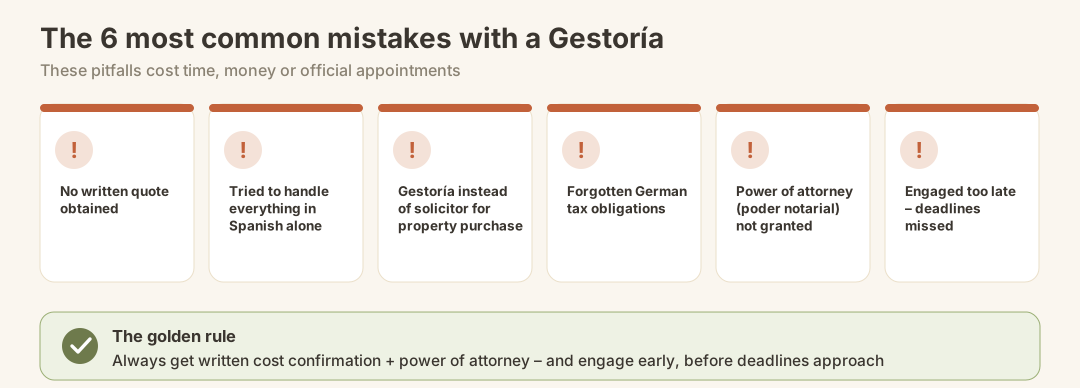
- Not obtaining a written quote: Verbal price agreements often end in surprises. Always have everything confirmed in writing.
- Trying to do everything yourself in Spanish: Form errors on the Residencia or NIE application cost time and require new appointments — and Citas Previas are hard to come by.
- Using a gestoría instead of a solicitor for a property purchase: Correct for the tax side; for the legal protection of the purchase contract you need an Abogado.
- Forgetting the German tax side: Anyone who remains liable to tax in Germany (e.g. through rental income there) needs a gestoría that knows both tax systems.
- Not granting power of attorney: Without a poder notarial you must appear in person for many official procedures — with power of attorney the gestor handles everything for you.
- Leaving it too late: Tax return deadlines in Spain are rigid. Those who miss them pay late payment surcharges.
What comes next? The next steps after the gestoría
With the right gestoría by your side, the bureaucracy of everyday life usually runs smoothly. What you should keep in mind afterwards:
- Annual tax return (IRPF): As a resident, you file it every year – typically from May until the end of June for the previous year. Details on income tax as a resident
- Modelo 720 – once only and when there are significant changes: obligation to declare overseas assets
- Sort out health insurance: Once you have your residencia, the question arises whether you are integrated into the public system or need a private solution. Health insurance in Spain
- Register your car: If you are bringing your German car with you – contact a gestoría in good time, as deadlines and procedures can vary. Registering a car in Spain
- Retirees: Anyone moving to Spain as a retiree must declare their German pension correctly in Spain. Paying tax on your pension in Spain
Checklist: Appointing a gestoría – how to go about it
- NIE number in place or application prepared (NIE number Mallorca)
- Clarification: Will I become a resident or non-resident? (Residencia)
- At least two quotes obtained from gestorías / tax advisers
- Written confirmation of costs for all planned services
- Power of attorney (poder notarial) granted at the notary if you cannot appear in person
- Tax situation in Germany coordinated with a German tax adviser
- Documents prepared: passport / national identity card, rental agreement or purchase contract, registration confirmation, pension notice if applicable
- Deadlines noted: IRPF (generally until the end of June), Modelo 720 (generally until the end of March), non-resident tax (Modelo 210, quarterly or annually depending on the circumstances)
Conclusion
A gestoría in Spain is not a luxury – it is a tool that saves you months of frustration, queuing, and form-filling errors. Particularly on Mallorca, where the concentration of German expatriates is high, there are several well-established offices that speak German and are familiar with both legal systems. You should understand the difference between a gestoría and a tax adviser: for straightforward administrative tasks and standard tax matters, a good gestor is sufficient. As soon as questions of double taxation, property structures, or inheritances come into play, you need a firm that combines both. Always ask for written quotes – and engage someone early, before the deadlines start looming.
Official sources
- AEAT – Agencia Estatal de Administración Tributaria (Spanish tax authority, forms, modelos, deadlines): https://www.aeat.es
- ATIB – Agència Tributària de les Illes Balears (Balearic tax authority, ITP, inheritance tax): https://www.atib.es
- DGT – Dirección General de Tráfico (vehicle re-registration, driving licence): https://www.dgt.es
- Policía Nacional – Oficinas de Extranjería (NIE, Residencia, TIE): https://www.interior.gob.es
- Registro Mercantil Central (registration of gestorías and companies): https://www.rmc.es
- BOE – Boletín Oficial del Estado (laws, regulations): https://www.boe.es