
Remote Work Mallorca: Infrastructure, Coworking Spaces and Digital Pathways
Remote work on Mallorca is no longer a niche phenomenon. Over the past few years, the largest of the Balearic Islands has established itself as a serious base for location-independent work — with reliable infrastructure, a growing coworking scene, and direct flight connections to almost every major European city. What sets Mallorca apart from other digital-expat hotspots is that you are working within the EU, under a European legal framework, without the usual long-haul compromises. In this guide you will find out which coworking spaces exist and where they are located, how fast the internet really is, which visa or residency status suits your situation, how taxation works as a resident or non-resident — and which mistakes you should avoid.
Would you like to plan your move or workation on Mallorca in concrete terms?
- 📩 Submit a personal enquiry — we will address your individual situation with local expertise
- Everything about the Relocation Service Mallorca
Why Mallorca works for remote work
Mallorca scores with a combination that many other islands cannot offer: European infrastructure, a mild climate with more than 300 days of sunshine per year, and a daily life that is genuinely worth living once work is done. Palma airport connects the island directly with most European cities, which is crucial for remote workers who occasionally need to attend client meetings or visit an office.
Add to this the well-developed infrastructure for location-independent work: coworking spaces are no longer found only in Palma city centre, but also in smaller towns and coastal resorts. Mobile coverage is rated as very good, and Wi-Fi is widely available in cafés and coworking hubs. Compared with non-European nomad hotspots, Mallorca offers you the benefit of EU data protection, Spanish banking, and a regulated social-security system — which makes a considerable difference for longer stays or a genuine relocation.
Please note: Internet quality varies depending on the neighbourhood and accommodation. In rural areas (e.g. Serra de Tramuntana) connectivity can be significantly weaker than in Palma. It is worth running a speed test on-site before signing a rental agreement.
Internet and connectivity: what to realistically expect
Mobile coverage is rated as excellent by independent sources — coverage and speeds are considered reliable, even outside Palma. Wi-Fi is widely available in coworking spaces and many cafés.
For a permanent residence, it is worth getting your own fibre or cable connection. You can find full details in the guide on internet connections on Mallorca.
| Connectivity type | Rating | Note |
|---|---|---|
| Mobile network (4G/5G) | Very good | Comprehensive coverage in populated areas |
| Wi-Fi in coworking spaces | Good to very good | Dedicated spaces have more reliable connections |
| Wi-Fi in cafés | Variable | Often insufficient for video conferencing |
| Fixed-line broadband (Palma) | Good | Fibre optic available in many districts |
| Rural areas | Limited | Check before renting |
For a local mobile phone contract, we recommend taking a look at our guide tomobile phone contracts in Spain.
Coworking spaces in Palma: the key addresses
Palma is the heart of the coworking scene on Mallorca. The spaces are concentrated mainly in the old town and the fashionable Santa Catalina district.
| Space | Address | Special feature |
|---|---|---|
| The Hub | C/ Caro 70, Santa Catalina, Palma | A recommended classic in a creative neighbourhood |
| Rayaworx | Santa Catalina, Palma | Known for its community and networking |
| Palmapolitan | C/ del Sindicat 74, Palma | Central location in the old town |
| La Guilda | C/ Torre de l'Amor 2, Palma | Coworking in a historic building |
| Casa Planas | Av. Sant Ferran 21, Palma | Part of the cultural centre |
| Nomadico Coworking | Mallorca (coliving complex) | Private area, from approx. 350 €/week incl. accommodation |
Tip: Spaces such as Nomadico combine coworking and coliving – you get a workspace, accommodation and community all in one package. This is a particularly efficient solution for workation stays (a few weeks to a few months).
Outside Palma, there are a handful of coworking options in coastal towns and smaller villages. The offering there is considerably more limited, however – for nomads who need a stable working environment, Palma remains the first choice.
The 7 best locations for a workation on Mallorca
Alongside the coworking space itself, the location of your accommodation plays a major role in both your quality of work and quality of life. Here is an overview of tried-and-tested locations:
| Location | Character | Ideal for |
|---|---|---|
| Palma Old Town | Urban, historic, vibrant | Networking, cultural life, short distances |
| Santa Catalina (Palma) | Creative, young, great food scene | Community, high density of coworking spaces |
| Pollença / Port de Pollença | Northern, peaceful, mountainous | Focused work, hiking, tranquillity |
| Sóller / Port de Sóller | Tramuntana charm, mountain village | Nature lovers, relaxation |
| Alcúdia | Historic old town plus proximity to the beach | Families, longer stays |
| Santanyí | South-eastern, rural, authentic | Retreat, fincas, slow living |
| Portixol / Es Molinar | Palma's beachside quarter | Cycling, sea views, close to the city |
For workations in fincas or villas outside the city, a reliable mobile hotspot is recommended as a backup, as fixed-line broadband connections are absent or slow in some rural properties.
Residency status: who is permitted to work, and how?
The legal basis for your remote-work stay depends on your nationality, the length of your stay, and your source of income.
EU citizens (Germany, Austria, Switzerland*)
EU nationals have the right to reside and work in Spain – without a visa. Anyone staying longer than three months must register as a resident. You can find the steps for doing so in the guide toResidencia in Spain.
*Swiss citizens enjoy similar rights to EU citizens under bilateral agreements, but should check the current regulations.
Non-EU citizens: Digital Nomad Visa
For non-EU nationals, Spain has introduced a dedicated Digital Nomad Visa (Visado para Nómadas Digitales). The key details:
| Criterion | Requirement |
|---|---|
| Minimum salary / income | approx. 2.849 €/month |
| Source of income | Employer or clients based outside Spain |
| Initial duration | Up to 3 years (renewable) |
| Access to Beckham Law | Yes, upon application |
| Processing | Spanish consulate in your country of origin or directly in Spain |
You can find the complete guide to theDigital Nomad Visa Spainin our guide.
The 90/180-day rule for non-EU citizens without a visa
Anyone who has not applied for a visa but is also not an EU citizen may stay in the Schengen Area for a maximum of 90 out of 180 days. Details on the90/180-day rule.
Taxes for Remote Workers: What You Need to Know
Tax matters are the most complex topic when it comes to remote work – and the one with the greatest financial consequences. Here are the most important basic structures:
When Do You Become Liable for Tax in Spain?
From a stay of more than 183 days in the calendar year, Spanish tax rules for residents apply (IRPF). As a resident, you pay tax on your worldwide income in Spain.
Beckham Law – Special Status for New Arrivals
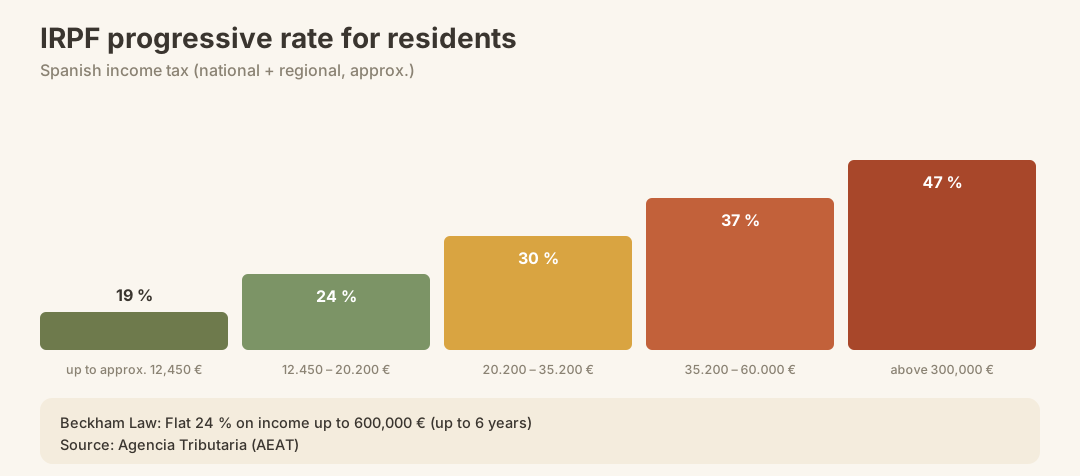
The so-called Beckham Law (Ley Beckham) allows qualifying newcomers – including holders of the Digital Nomad Visa – a flat tax rate of 24 % on Spanish income up to 600.000 €, instead of the progressive standard rate of 19–47 %. The regime applies for up to 6 years. More on this in the guide to the Beckham Law Spain.
Progressive IRPF Rate for Residents
| Income band | Tax rate (national + regional, approx.) |
|---|---|
| Up to approx. 12.450 € | 19 % |
| 12.450 – 20.200 € | 24 % |
| 20.200 – 35.200 € | 30 % |
| 35.200 – 60.000 € | 37 % |
| Above 300.000 € | 47 % |
The Balearic Islands' specific deductions and allowances can be found in the guide to IRPF deductions in the Balearen.
Autónomo: Self-Employment on Mallorca
Anyone working as a freelancer or self-employed person on Mallorca must register as an autónomo. This means monthly social security contributions of generally 230 to 500+ €, depending on income level, as well as the quarterly VAT advance return (Modelo 303) and income tax advance payment (Modelo 130). Details in the guide to Modelo 303 & 130 for Autónomos.
Please note: Tax liability and social security are separate systems in Spain. Even those who pay less income tax under the Beckham Law still owe the standard social security contributions as an Autónomo.
A comprehensive overview is provided in the guide Taxes & Finances on Mallorca.
Registration and Authorities: The Most Important Steps
Anyone staying for longer than three months must complete a number of administrative steps. This may sound like bureaucracy – and it is. But it is manageable.
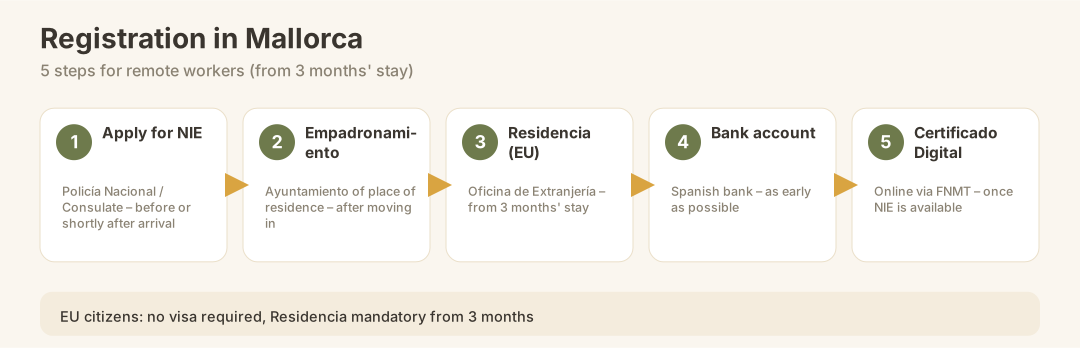
- Applying for your NIE (Número de Identificación de Extranjero): Tax identification number, a prerequisite for almost everything else.
- Empadronamiento (proof of registration): Registration with the relevant Ayuntamiento of your place of residence. More in the guide to Empadronamiento Mallorca.
- Apply for residencia (EU citizens): registration in the Central Register of Foreigners. Details on Residencia in Spain.
- Open a bank account: A Spanish account considerably simplifies rental agreements, dealings with authorities, and tax payments. Guide: Opening a bank account in Spain.
- Apply for a Certificado Digital / Cl@ve PIN: Digital signature for online dealings with authorities, essential for tax returns and applications. Guide: Certificado Digital & Cl@ve.
- Sort out health insurance: As a non-resident or autónomo without statutory cover, you will need private health insurance or an S1 form. More information at Health insurance in Spain.
| Step | Where | When |
|---|---|---|
| NIE | Policía Nacional / consulate | Before or shortly after arrival |
| Empadronamiento | Ayuntamiento of your place of residence | After moving in |
| Residencia (EU) | Oficina de Extranjería | From 3 months of residence |
| Bank account | Spanish bank | As early as possible |
| Certificado Digital | Online via FNMT or tax office | As soon as the NIE is available |
Health Insurance and Healthcare
For remote workers, health insurance is one of the first practical considerations. As an autónomo with compulsory social security contributions, you have access to the Spanish public health system. Anyone who does not earn income in Spain or holds a Non-Lucrative Visa requires private health insurance as a condition of their residency status.
A detailed comparison of private health insurance options can be found in the guide to private health insurance comparison Spain. For EU citizens with existing statutory health insurance in Germany, the S1 form may be an option.
Cost of Living for Remote Workers on Mallorca
Mallorca is no longer a budget destination — but compared to London, Munich or Zurich, it remains considerably more affordable when quality of life is taken into account. The biggest cost factors are accommodation and (during peak season) the rental market.
| Cost category | Range (monthly) | Note |
|---|---|---|
| Rent 1-bedroom flat Palma | approx. 900–1.500 € | More expensive in peak season, long-term rental cheaper |
| Coworking (day pass) | depending on space | Generally cheaper than a monthly flat rate |
| Coliving + Coworking | from approx. 350 €/week | Incl. accommodation, Nomadico model |
| Groceries / dining out | Moderate | Local markets considerably cheaper than tourist restaurants |
| Mobile (Spanish SIM) | Moderate | Several providers with unlimited data plans |
A comprehensive overview is provided in the guide to cost of living on Mallorca.
Most Common Mistakes When Working Remotely on Mallorca
The same avoidable mistakes come up time and again in practice:
- Ignoring tax residency: Anyone who spends more than 183 days on Mallorca without registering for tax purposes risks back payments and fines. The threshold applies per calendar year.
- Overlooking the autónomo requirement: Even those who work for clients abroad but live in Spain are generally required to register as autónomo.
- Not checking the internet quality of the accommodation: Many holiday flats only offer basic Wi-Fi. This is not always sufficient for video calls – always run a speed test before signing any contract.
- Misjudging visa requirements: Non-EU citizens who remain in the Schengen Area for more than 90 days without a visa are in breach of entry regulations.
- Forgetting Modelo 720: Residents with assets abroad exceeding 50.000 € are required to declare them. Guide: Modelo 720.
- Health insurance gap: Some remote workers believe the European Health Insurance Card (EHIC) is sufficient on a permanent basis – this is not the case for residents.
- Not using a gestoría: For autónomo registration, tax returns, and dealings with the authorities, a local gestoría is almost always worth it. More in the guide on Gestoría Spanien.
What comes next? Next steps after making your decision
If you have decided to try remote work on Mallorca or to relocate permanently, these are the logical next steps:
- Short stay (under 90 days, non-EU): No formalities required, but book a coworking space and suitable accommodation in advance.
- Workation (1–6 months, EU citizens): Empadronamiento recommended, apply for NIE, clarify tax advice for your home country.
- Permanent stay / actual relocation: Residencia, autónomo registration, Spanish bank account, health insurance, and apply for the Beckham Law if applicable.
- Non-EU permanently: Apply for a digital nomad visa, choose a tax regime, registration steps as above.
Our Auswandern-Leitfaden gives you a complete overview of the entire process.
Checklist: Starting Remote Work in Mallorca
- Residency status clarified (EU/non-EU, duration, visa)
- NIE applied for or in progress
- Accommodation with verified internet booked
- Coworking space or coliving reserved
- Spanish bank account opened or in progress
- Health insurance arranged (private or statutory)
- Tax advice obtained for home country and Spain
- Autónomo registration checked (if working freelance)
- Empadronamiento completed after moving in
- Certificado Digital / Cl@ve PIN applied for
Conclusion
Mallorca is no longer a romantic fantasy for remote work – the island has the infrastructure, the community and the climate to work productively on a permanent or temporary basis. The key lies in preparation: anyone who clarifies their residency status, tax obligations and connectivity in advance can hit the ground running from day one in one of the most beautiful working environments in Europe. EU citizens have it particularly straightforward – the hurdles are manageable, and the gain in quality of life is considerable. Non-EU citizens will find an attractive, legally sound route through the Digital Nomad Visa and the Beckham Law regime.
Official Sources
- Spanish immigration law / Digital Nomad Visa: Ministerio de Inclusión, Seguridad Social y Migraciones
- Spanish tax law (IRPF, Beckham Law, Modelo 720): Agencia Tributaria (AEAT)
- Balearic Tax Authority (ATIB): Agència Tributària de les Illes Balears
- Social security for Autónomos: Tesorería General de la Seguridad Social (TGSS)
- Residencia / NIE / Immigration Authority: Policía Nacional – Extranjería
- Certificado Digital (FNMT): Fábrica Nacional de Moneda y Timbre
- Empadronamiento Palma: Ajuntament de Palma