
Golden Visa Spain: abolished in 2025 – your alternatives for 2026
The Golden Visa Spain was for twelve years the most direct route for non-EU citizens to secure a Spanish residence permit through a property investment from €500,000. That came to an end on 3 April 2025: the Ley Orgánica 1/2025, published in the Official State Gazette BOE on 3 January 2025, terminated the programme with a three-month transitional period. In this guide you will find out what this means for visas already granted, which four alternative residence routes are realistic in 2026, how you can still buy and reside in Mallorca or mainland Spain as a property buyer – and which financial investment routes technically still exist. Specific thresholds, deadlines and official procedures included.

Are you planning to buy property in Mallorca and wondering which residence route still suits you?
- 📩 Submit a personal enquiry — we will connect you with vetted lawyers and property experts in Mallorca
- Overview: Visas & residency in Spain
What exactly was abolished – and what was not
The Golden Visa was based on Articles 63 to 67 of the Ley 14/2013 (Entrepreneurs and Investors Act). The Ley Orgánica 1/2025 struck out precisely these articles in its 21st final provision. Since 3 April 2025, no new applications are being accepted.
Important: What was abolished is primarily the property route – the pathway whereby the purchase of a property from €500,000 without a mortgage automatically conferred entitlement to a residence permit. The political rationale was clear: in Madrid, Barcelona, the Balearic Islands and the Canary Islands, cash purchases by foreign investors had placed enormous pressure on housing costs for the local population.
Spain is thereby following a European trend: Portugal, the Netherlands, Ireland, Austria and the United Kingdom had already ended similar programmes beforehand. Within the EU, Italy, Greece, Malta and Cyprus currently still offer comparable investor visas.
Note: The financial investment routes (government bonds, company shares, funds, bank deposits) of the former Article 63 have not yet been formally struck out in their entirety. However, they are processed through a specialised authority – more on this in the section "Capital investment routes".
What happens to existing Golden Visa holders?
Anyone who already held a Golden Visa before 3 April 2025 or had submitted a complete application is not automatically affected. Existing permits can be renewed under the rules previously in force – as a rule, ownership of the property must be maintained for this purpose.
| Situation | Consequence |
|---|---|
| Visa already granted before 3 April 2025 | Renewal under the previous rules possible |
| Application submitted in full before the cut-off date | Processing under the old law likely |
| Application submitted after 3 April 2025 | No Golden Visa possible any longer |
| Property purchase planned after the cut-off date | No right of residence arising from the purchase |
Caution: If you wish to renew your existing Golden Visa, you should seek legal assistance. The transitional provisions have not yet been fully clarified through administrative practice. A gestoría specialising in immigration law is the right point of contact here – more on this under Gestoría Spain.
Buying property without a Golden Visa: still entirely possible
One of the most important messages for prospective buyers: Purchasing property in Spain remains fully permitted for non-EU citizens. There are no restrictions on acquiring property. What has changed: the purchase alone no longer grants you a right of residence.
In practice, this means: you buy your house on Mallorca – and then combine that purchase with one of the alternative visa routes we present below. Many buyers do exactly this, and the combination works well, provided you are aware of and comply with the respective income and residency requirements of each visa category.
For the purchase itself you will still need a NIE number as well as a Spanish bank account – both of which are obtainable regardless of your residency status.
Alternative 1: The Non-Lucrative Visa (NLV) – the most popular choice
The Visado de Residencia No Lucrativa is for many buyers the most obvious alternative. It is aimed at people who wish to live in Spain but not work – such as retirees, early retirees, and those with investment income or rental income.
How it works
You demonstrate that you have sufficient financial means to live in Spain without employment income. The visa is initially granted for one year and can then be renewed as a residence permit for periods of two years at a time. After five years you are entitled to permanent Residencia, and after ten years to Spanish citizenship.
Financial requirements
The exact thresholds are based on the Spanish minimum reference income (IPREM) and are adjusted on a regular basis.
| Group | Minimum proof required |
|---|---|
| Applicant alone | Multiple of the IPREM per month (typically around 400 % of the IPREM) |
| Each additional family member | Additional percentage (typically around 100 % of the IPREM per person) |
Please note: The exact IPREM multipliers are sometimes interpreted differently by individual consulates. Have the current amounts confirmed by your solicitor or a gestoría before compiling your documentation.
Key restriction: no work permit
The NLV explicitly does not permit any gainful employment in Spain. Anyone working remotely for a foreign employer should carefully consider whether they fall within the scope of the Digital Nomad Visa (see Alternative 2) – or whether doing so conflicts with the NLV.
Works well in combination with the NLV: property ownership on Mallorca as a primary residence, rental income from a second property as proof of income (provided this is not classified as active business activity).
You can find out more about applying for Residencia under Residencia Spanien.
Alternative 2: The Digital Nomad Visa (DNV)
Spain has introduced, under the Ley de Startups (Ley 28/2022), a dedicated visa for digital nomads. It is aimed at people who work remotely for foreign companies or clients and wish to live in Spain while doing so.
Key features at a glance
| Feature | Contents |
|---|---|
| Target group | Remote workers and freelancers working for non-Spanish clients |
| Income threshold | Generally a minimum income requirement (figure varies depending on source) |
| Work permit | Yes – however, a maximum of 20 % of turnover may come from Spain |
| Initial duration | 1 year (visa), extendable to 3 years (residence permit) |
| Beckham Law | Compatible with the special tax regime |
The major advantage: the Digital Nomad Visa is with the Beckham Law combinable. This special tax regime allows newcomers, under certain conditions, to pay tax only on their Spanish income at a flat rate of 24 % – rather than being liable to tax on their worldwide income as a full resident. For further details, see the guide Beckham Law Spain.
Note: The 20 % rule (a maximum of 20 % of income from Spain) must be carefully monitored in practice. Anyone who accepts work from Spanish clients may inadvertently find themselves in conflict with the visa conditions.
Alternative 3: The Entrepreneur and Start-up Visa
The Entrepreneur Visa (also known as the Visado de Emprendedor) is aimed at founders and entrepreneurs who wish to build an innovative project in Spain. It is likewise part of the framework strengthened by the Ley de Startups.
Requirements
- Innovative business model with demonstrable relevance to the Spanish economy
- Job creation or economic relevance in the region concerned
- No fixed minimum capital – however, the project must be approved by the competent authority
The approval assessment is the decisive factor: not every business idea will be accepted. Projects with a recognisable technology dimension, scaling potential, or regional economic benefit have better prospects.
Anyone wishing to work as self-employed on Mallorca and become tax-resident there should also keep an eye on the transition to autónomo status in Spain.
Alternative 4: Capital investment routes – what still exists
Not all investment routes under the former Article 63 of the Ley 14/2013 were abolished. The financial investment routes continue to exist in modified form, but are handled through the Unidad de Grandes Empresas y Colectivos Estratégicos (UGE-CE) processed.
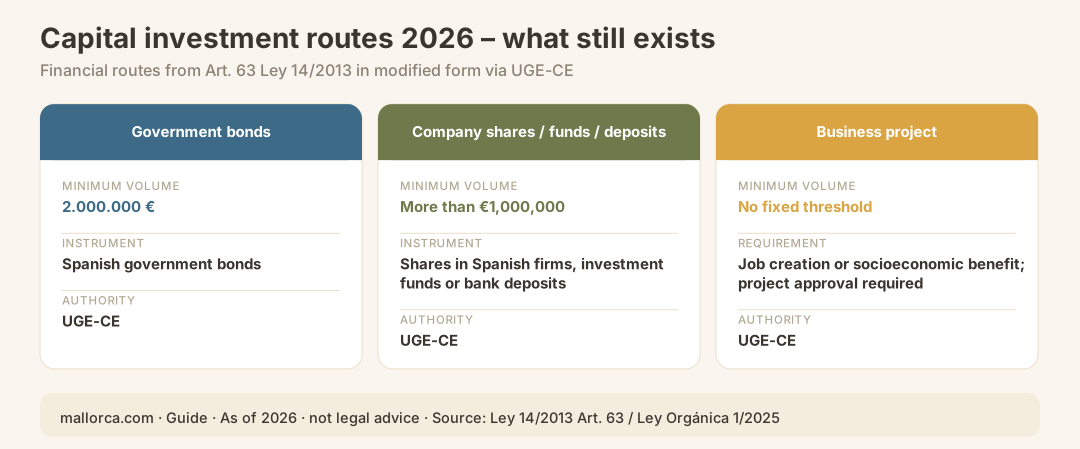
| Investment route | Minimum volume 2026 |
|---|---|
| Spanish government bonds | 2.000.000 € |
| Company shares / stocks of Spanish firms | More than 1.000.000 € |
| Investment funds registered in Spain | More than 1.000.000 € |
| Deposits with Spanish credit institutions | More than 1.000.000 € |
| Business project of general interest | No fixed threshold; project approval required |
The most flexible route on paper is the business project of general interest: Here there is no statutory minimum investment, but the project must demonstrably create jobs or deliver socio-economic benefit to the region.
Please note: These routes have not been formally abolished, but in practice the hurdles have risen considerably. Applications are no longer processed through the regular consulates, but exclusively through the UGE-CE. Legal representation is absolutely essential here.
The alternatives compared directly
| Visa category | Target group | Work permit | Minimum stay | Path to permanent residencia |
|---|---|---|---|---|
| Non-Lucrative Visa (NLV) | Retirees, passive income recipients | No | No minimum stay, but proof required | 5 years legally in Spain |
| Digital Nomad Visa | Remote workers for foreign clients | Yes (limited) | No mandatory stay, but tax-relevant | 5 years |
| Entrepreneur Visa | Founders of innovative projects | Yes | Project commitment | 5 years |
| Capital investment (UGE-CE) | High-net-worth investors | Conditional | Low | 5 years |
Mallorca in practice: What changes for buyers on the island?
Mallorca was one of the most frequently cited destinations for Golden Visa purchases – and was therefore among the places where political pressure to abolish the programme was particularly strong. The Balearic Islands were explicitly mentioned in the government's justification for ending the programme.
For you as a buyer, this means:
- Purchasing property remains entirely unrestricted. You need an NIE number, a bank account and a notary – that has always been the case.
- The question of residency is separate from the purchase. Which visa you apply for depends on your personal circumstances, not on the property.
- Tax obligations vary depending on your residency status. As a non-resident you pay the non-resident tax; as a resident you are subject to unlimited tax liability under IRPF as a resident.
- The Empadronamiento (municipal registration) is compulsory for all persons with a permanent residence in Mallorca, regardless of visa status, and is a prerequisite for many dealings with the authorities.
Tax implications of residency status – a brief overview
Choosing the right visa has direct tax consequences. Anyone who spends more than 183 days per year in Spain is automatically considered tax-resident – regardless of their visa type.
| Residency status | Tax liability | Relevant regulation |
|---|---|---|
| Non-resident | Spanish income and property value only | Modelo 210 (non-resident tax) |
| Resident (NLV, DNV, Entrepreneur) | Worldwide income (IRPF) | Spanish income tax |
| DNV + Beckham Law | Spanish income only, flat rate 24 % | Ley 28/2022 / Beckham regime |
| Foreign assets > 50.000 € | Reporting obligation | Modelo 720 |
A further consideration for German emigrants: taxing a German pension in Spain follows its own rules under the double taxation agreement – this should be clarified before the move.
Most common mistakes when searching for alternatives
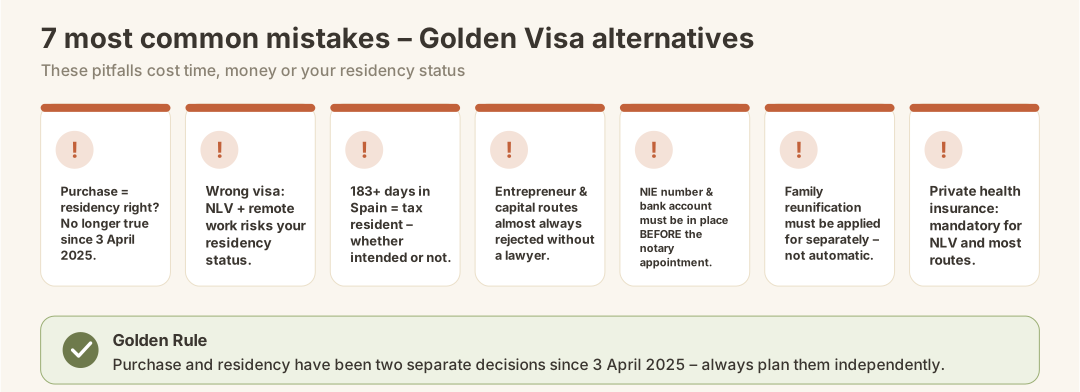
- Assuming that buying a property automatically grants the right of residence – this has no longer been the case since 3 April 2025.
- Choosing the wrong visa and then working in Spain – anyone working remotely on the NLV risks losing their residency status.
- Ignoring the question of tax residency – anyone who spends 183+ days in Spain becomes a tax resident, whether they intend to or not.
- Submitting an application without legal support – particularly with the Entrepreneur Visa and the capital-based routes, this almost always leads to rejections or lengthy delays.
- Applying for a NIE number and bank account only after the purchase has completed – both are required prior to signing before the notary. See NIE number Mallorca and opening a bank account in Spain.
- Forgetting family members – most visas allow for family reunification, but only if it is applied for separately. More information under family reunification Spain.
- Underestimating the proof of health insurance requirement – all visas except the employed worker visa require private Spanish health insurance. Details under health insurance Spain.
What comes next? Pathways to permanent residencia and citizenship
All of the alternatives mentioned above lead to the same long-term goal:
- After 5 years of legal residence in Spain: entitlement to Residencia permanente (permanent right of residence in the EU)
- After 10 years: the possibility of naturalisation (Spanish citizenship), provided further requirements are met
- Schengen freedom of movement: applies from the first valid Spanish residence permit
The difference from the Golden Visa: former holders were able to keep their time spent in Spain to a minimum. With the new routes – particularly the NLV – you are expected to actually live in Spain, as renewals are tied to demonstrable periods of residence.
Checklist: next steps for property buyers without a Golden Visa
- Apply for a NIE number (via the relevant Spanish consulate in your country of origin or at the Policía Nacional in Spain)
- Open a Spanish bank account (required for processing the purchase)
- Clarify your residency situation: which visa suits your profile?
- Compile proof of income and assets for the visa application
- Take out private health insurance for Spain (mandatory for the NLV and most other visa routes)
- Review your tax situation in advance (resident vs. non-resident, check the Beckham Law)
- Engage a lawyer or gestoría for the visa and property purchase
- Complete the empadronamiento after moving in
- Check Modelo 720 if assets held abroad exceed €50,000
Conclusion
The Spanish Golden Visa is history – but Spain as a destination for international property buyers is not. The crucial difference: purchasing and residency are now two separate decisions that must be planned independently. For most buyers from German-speaking countries, the Non-Lucrative Visa is the most realistic starting point. Those who work remotely have a genuine alternative in the Digital Nomad Visa – including an attractive tax option. Entrepreneurs and capital investors will also find workable routes among the remaining options, provided they work with professional guidance.
Buy in Mallorca, enjoy the sunshine, live there legally – it's entirely possible. It simply requires a little more planning today than it used to.
📩 Submit a personal enquiry now – we'll help you find the right path.
Official Sources
- Ley Orgánica 1/2025 (abolition of the Golden Visa, BOE of 3 January 2025): https://www.boe.es/buscar/act.php?id=BOE-A-2025-76
- Ley 14/2013 (original legal basis of the Golden Visa): https://www.boe.es/buscar/act.php?id=BOE-A-2013-10074
- Ley 28/2022 (Start-up Act, legal basis for the Digital Nomad Visa): BOE, December 2022
- AEAT (Spanish tax portal): https://www.aeat.es
- Secretaría de Estado de Migraciones (visa information): https://www.inclusion.gob.es
- PRIE – Programme for Investors and Entrepreneurs (Ministry of Economic Affairs): https://prie.comercio.gob.es
- Consell de Mallorca (Balearic authorities): https://www.conselldemallorca.net
- ATIB (Agència Tributària de les Illes Balears): https://www.atib.es