
Digital Nomad Visa Spain 2026: Requirements, Income & Beckham Tax
The Digital Nomad Visa Spain – officially the "Autorización de residencia para teletrabajo de carácter internacional" – has made it possible since January 2023 for non-EU citizens to live legally in Spain whilst working remotely for foreign employers or clients. It is governed by Law 28/2022, the Spanish Start-Up Act. What sets this residence permit apart from a conventional work visa: you are not working in Spain, but rather from Spain – for companies or clients based predominantly abroad. This guide sets out all the requirements for 2026, explains the current income thresholds following the SMI adjustment, walks you through the application process, and sheds light on how the Beckham Tax can dramatically reduce your tax burden – an aspect that most immigration checklists treat as an afterthought.

Are you planning your move to Mallorca or do you have questions about the visa application?
- 📩 Submit a personal enquiry — we connect you with vetted lawyers and gestorías on Mallorca
- An overview of all visa options
What exactly is the Digital Nomad Visa?
The visa is aimed at freelancers and permanently employed remote workers from outside the EU/EEA who wish to settle in Spain on a long-term or medium-term basis without placing any burden on the Spanish labour market. The key principle: The majority of your income must come from abroad. The law permits up to 20 % of total income to come from Spanish sources – useful if you occasionally work for a Spanish company, but your primary activity must remain international.
The residence permit is issued in two forms:
| Application | Initial duration | Extension |
|---|---|---|
| Spanish consulate abroad | 1 year | Yes, as a residence permit (3 years) |
| Within Spain (tourist visa, max. 3 months after entry) | 3 years | Yes |
| After 5 years in total | Long-term residence possible | — |
After five years of legal residence you can apply for the permanent long-term residence permit (Residencia de larga duración).
Please note: The Digital Nomad Visa does not automatically make you a Spanish tax resident. Tax residency is determined by different criteria – more on this in the tax section.
Who is eligible to apply?
The visa is open exclusively to non-EU/EEA citizens. EU citizens – including Germans, Austrians, and Swiss nationals (Switzerland is non-EU!) – have different rights:
- Germans and Austrians as EU citizens do not require a visa, but merely a Residencia.
- Swiss nationals are non-EU and may apply for the Digital Nomad Visa.
- US citizens, Canadians, British nationals post-Brexit, Australians, and other non-EU nationals are the primary target group.
For the substantive eligibility criteria, the law (Art. 74 bis of the Emprendedores Act) requires:
- Academic or professional qualification: university degree, postgraduate qualification, vocational training, or a Business School qualification or at least 3 years of verifiable professional experience in your field.
- Employees: At least 3 months of existing employment with the current employer; the employment relationship must explicitly permit remote working.
- Self-employed: Evidence of client relationships outside Spain from the past 3 months, including the planned working arrangements.
Income thresholds 2026: the current figures
The minimum income threshold is tied to the Spanish minimum wage (SMI) and is updated on a regular basis. Following the SMI increase in 2026, the following figures apply:
| Household composition | Minimum monthly salary (gross) |
|---|---|
| Single person | € 2.849 (200 % of the SMI) |
| + 1 dependent person (e.g. spouse/civil partner) | + € 916 |
| + each additional dependent person (child, etc.) | + € 305 |
Please note: The exact figure depends on the officially set SMI for the current year. Always check the current value at www.mites.gob.es.
If you are unable to demonstrate the minimum income requirement entirely from ongoing earnings, the UGE (Unidad de Grandes Empresas) will, under certain conditions, accept savings as a supplement – however, the authorities are increasingly requiring thorough documentation.
The 8 most important documents for the application
The UGE (the specialist unit responsible for Digital Nomad applications) tightened its assessment standards in 2026. The following documents are generally required:
- Valid passport (a minimum of 1 year's remaining validity is recommended)
- Proof of employment (employment contract with an explicit remote clause) or, if self-employed: client contracts/invoices from the last 3 months
- Proof of income (payslips, bank statements, tax returns)
- Proof of qualifications (university degree or proof of professional experience, 3 years)
- Proof of health insurance – full private health cover for Spain with no excess (the public system is not yet available to applicants)
- Criminal record certificate (no older than 3 months, apostilled)
- Social security certificate / Certificate of Coverage – for US citizens: Certificate of Coverage + Letter of Displacement (in agreement with the US Embassy / Spanish authorities)
- Photographs in passport format
Please note: The UGE rejects applications where the job description implies physical presence, on-site management, or production supervision. The position must be clearly identifiable as 100 % remote.
For further details on health insurance, see our guide Health Insurance Spain.
Submitting your application: consulate vs. in-country
You essentially have two options:
Option 1: Apply at the Spanish consulate abroad
- Submit your application at the Spanish consulate responsible for your place of residence
- Processing time: 15 to 45 working days
- You will initially receive a visa valid for 1 year
- After entering Spain, you must apply for your residence card (TIE) at the immigration authority within 30 days
Option 2: Apply from within Spain (via the UGE)
- Possible within the first 3 months of entering visa-free as a tourist
- Submit directly to the UGE (Unidad de Grandes Empresas y Colectivos Estratégicos)
- If approved, you will immediately receive a 3-year residence permit
- Advantage: longer initial period of stay; disadvantage: you are already in Spain and must bridge the waiting period
After entry: don't forget your obligations
| Obligation | Deadline / Note |
|---|---|
| Apply for TIE (Foreigner's Identity Card) | Within 30 days of entry |
| Empadronamiento (municipal registration) | As soon as a permanent residence is established |
| Social security registration | Promptly after approval (UGE actively checks) |
| NIE number | The basis for all dealings with the authorities – more on the NIE |
Please note: In 2026, the UGE established its own Unidad de Control (control unit), which checks after approval whether you have actually registered with social security. Anyone who fails to do so risks having their permit revoked.
Tax liability: when do you become a Spanish tax resident?
Many applicants overlook this point: The visa and tax residency are two separate things. Spain is considered your tax domicile if you:
- spend more than 183 days in Spain in the calendar year, or
- have the centre of your economic interests in Spain.
As a tax resident, you would in principle be liable to tax on your worldwide income – at progressive rates of up to 47 %. This is where the Beckham tax comes into play.
You can find detailed information on standard tax liability as a resident in our guide Taxes as a Resident (IRPF).
The Beckham Tax (Régimen de Impatriados): the decisive tax advantage
The so-called Beckham tax – officially the "Régimen Fiscal Especial para Trabajadores Desplazados a España" – is a special tax regime originally introduced in 2005 and extended to digital nomads by the Start-Up Act of 2022. Holders of the Digital Nomad Visa can apply for it.
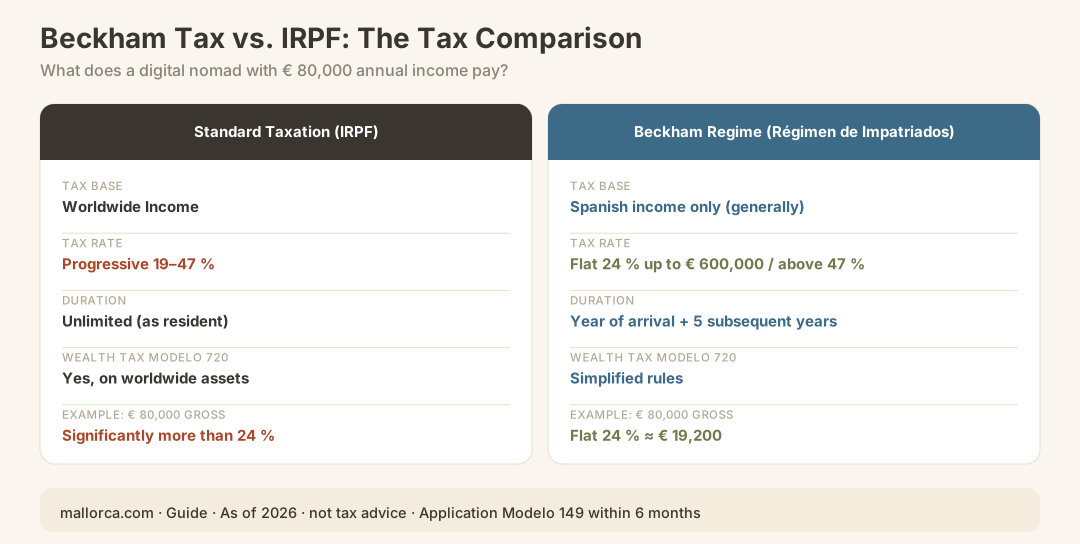
What the Beckham tax means in practice
| Feature | Standard taxation (IRPF) | Beckham regime |
|---|---|---|
| Tax base | Worldwide income | Spanish income only (as a rule) |
| Tax rate | Progressive 19–47 % | Flat 24 % up to € 600,000 |
| Above that | — | 47 % |
| Duration | Unlimited (as a resident) | Year of arrival + 5 subsequent years |
| Wealth tax (Modelo 720) | Yes, on worldwide assets | Simplified rules |
The advantage is clear: someone earning, for example, € 80,000 gross per year pays a flat 24 % under the Beckham regime (approximately € 19,200), whereas the progressive standard system can cost considerably more depending on deductions.
Requirements for the Beckham tax
- You were not tax-resident in Spain during the 5 years prior to moving to Spain.
- You have an employment contract with a domestic or foreign company (which must operate in Spain or have a permanent establishment there) – or you benefit from the extended provisions of the Start-Up Act as the holder of a Digital Nomad Visa.
- You carry out your principal activity in Spain (for Digital Nomads: the activity is performed from Spain).
- The application must be submitted within 6 months of commencing the activity in Spain (form Modelo 149).
Please note: Self-employed individuals (autónomos) who retain their visa as freelancers may under certain circumstances not be eligible to apply for the Beckham tax. Those entering as employees have a clear advantage here. This point must be assessed on an individual basis – US citizens frequently encounter social security hurdles that require a restructuring of the employment relationship.
You can find our comprehensive in-depth guide to Beckham Law here: Beckham Law Spain.
Family reunification: dependants relocating together
Partners and minor children may enter as dependants under the Digital Nomad Visa. The income thresholds increase accordingly (see table above). Separate rules apply to family reunification; more details can be found in the guide Family Reunification Spain.
If your children are to attend school in Mallorca, our guide Schools in Mallorca for German-speaking children.
Most Common Mistakes When Applying for a Visa
From the experience of the UGE and specialist law firms, the following mistakes crop up time and again:
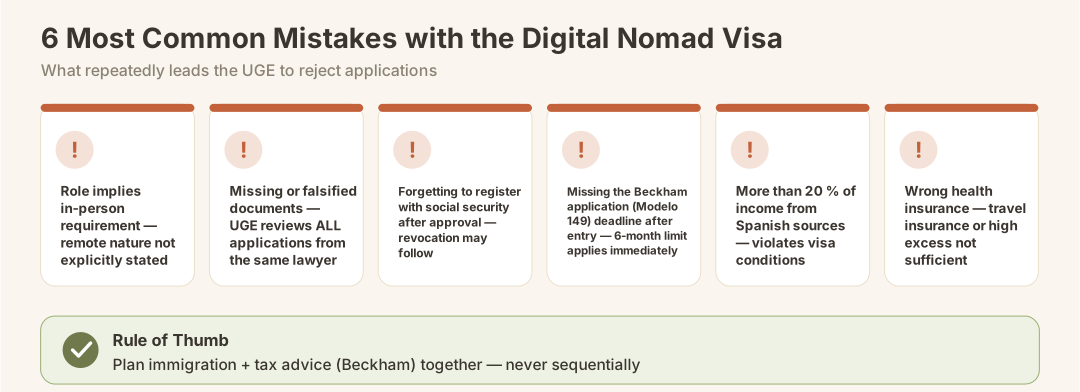
Job description not clearly worded enough. The UGE rejects any position that implies physical presence. The remote nature of the role must be explicit and unambiguous from both the title and the description.
Missing or forged documents. The UGE has set up a dedicated control unit. If a forged document is discovered with a solicitor or agent, all ongoing applications from that representative will be reviewed and cancelled where applicable.
No social security registration after approval. Many successful applicants overlook this step — with the consequence that approval can be revoked retrospectively.
Immigration and tax matters not coordinated. Anyone who only starts thinking about the Beckham tax after entering the country loses valuable months. The application must be submitted within 6 months of commencing work.
More than 20 % of income from Spain. Even a single Spanish invoice too many can breach the visa conditions.
Incorrect health insurance. A basic travel insurance policy or one with a high excess will be rejected. You need a comprehensive private health insurance policy with no co-payment.
Cost Overview
| Item | Indicative figure |
|---|---|
| Consulate fee (visa) | Varies by country, typically € 60–80 |
| TIE (foreigner's identity card) | Approx. € 15–20 (Tasa 790) |
| Solicitor / gestoría (initial consultation + application) | € 1.000–3.000 depending on the firm and complexity |
| Apostille for documents | Varies by country of origin |
| Private health insurance | From approx. € 50–150/month depending on age and provider |
Please note: The legal costs are a rough guide based on typical market rates — obtain at least two quotes. A gestoría on Mallorca can simplify the process considerably.
What comes next? Living on Mallorca as a digital nomad
Once you have the visa in hand, the real planning of day-to-day life begins:
- Opening a bank account: Many dealings with authorities are simply not possible without a Spanish account. Opening a bank account in Spain
- Planning your cost of living realistically: Mallorca is more expensive than the Spanish mainland. Cost of Living in Mallorca
- Modelo 720: As a tax resident, you must declare foreign assets exceeding € 50.000. Modelo 720 Reporting Obligation
- Autónomo or employed? Anyone working freelance should review the Cuota. Cuota Autónomo Spain
- Taxes & Finances Overview: Taxes & Finances Summary
Checklist: Before You Apply
- Nationality: Non-EU/EEA confirmed
- Proof of income ≥ € 2.849/month (plus dependants if applicable) prepared
- Proof of qualifications (degree or 3 years of professional experience) available
- Employment contract / client contracts with an explicit remote-work clause
- Share from Spanish sources ≤ 20 % verified
- Private health insurance without an excess taken out
- Criminal records certificate obtained (don't forget the Apostille)
- Social Security Certificate / Certificate of Coverage arranged (US citizens)
- Tax advice on the Beckham tax sought before application submission booked
- Lawyer / Gestoría selected (check references, heed fraud warnings)
- Accommodation for Empadronamiento already being sought
Conclusion
The Digital Nomad Visa Spain is a serious, legally sound route for non-EU citizens to work permanently from Mallorca or the Spanish mainland. The requirements are manageable: you need a solid income (from € 2.849/month), clear remote-work contracts, the right insurance cover, and thorough documentation. Anyone who combines immigration and tax strategy from the outset can cap their effective tax rate at a flat 24 % under the Beckham tax — for six years. The biggest mistake is putting off tax planning until after you arrive; the 6-month window for the Beckham application starts ticking the moment you begin working.
Get professional help early — and get started.
Official Sources
- Law 28/2022 (Ley de Startups / Start-Up Act): https://www.boe.es/buscar/act.php?id=BOE-A-2022-21739
- UGE-CE – Unidad de Grandes Empresas y Colectivos Estratégicos (competent authority): https://www.inclusion.gob.es/web/migraciones/w/uge-ce
- PRIE – Portal for International Remote Work (Ministerio de Comercio): https://prie.comercio.gob.es/en-us/paginas/teletrabajadores-caracter-internacional.aspx
- AEAT – Régimen de Impatriados (Beckham tax, Modelo 149): https://www.agenciatributaria.es
- Current Spanish minimum wage (SMI): https://www.mites.gob.es
- Royal Decree 687/2005 (Beckham Law, original version): https://www.boe.es/buscar/doc.php?id=BOE-A-2005-9875