
Cala Ferrera, Mallorca – Travel Guide for Holidays and Daily Life

Places to stay in Cala Ferrera
AdTo load the accommodation map by our partner Stay22, we need your consent for marketing cookies. Your consent applies to all marketing content on mallorca.com.
Cala Ferrera is both a small coastal settlement and a sheltered bathing cove in eastern Mallorca. It lies directly beside Cala d’Or but belongs to the municipality of Felanitx. This boundary is barely noticeable in the streetscape, yet it is important for orientation: Cala Ferrera feels like part of the continuous holiday area but has its own location and identity centred on its deeply indented cove.
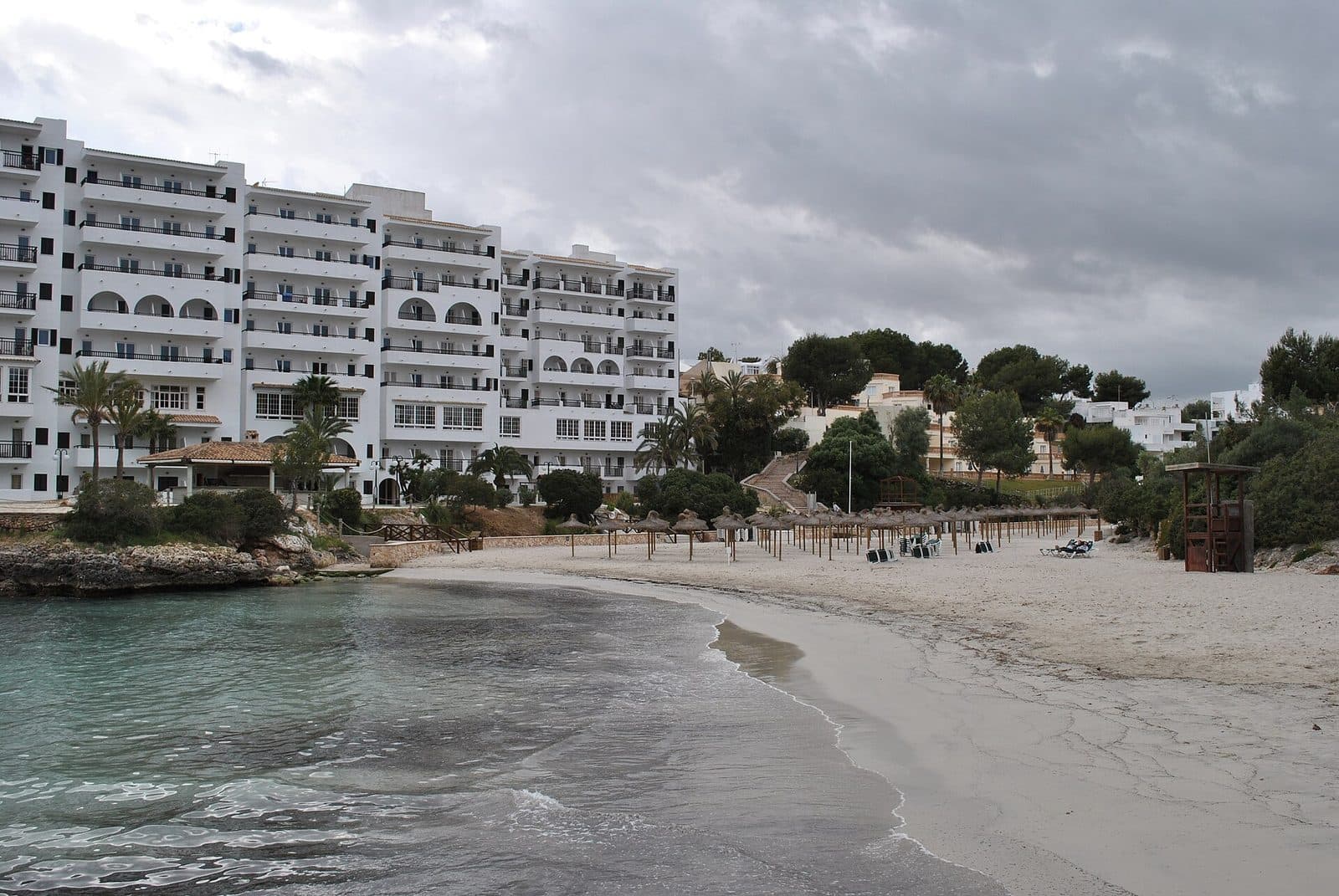
The water is the main focus. Hotels, apartments, restaurants and holiday infrastructure are grouped above the beach and along the access roads. The rocky sides of the cove shelter the sea, while the sand slopes gently into the water. This makes Cala Ferrera particularly appealing to families, relaxed swimmers and travellers who prefer a well-developed cove to a remote natural coastline.
Cala Ferrera is primarily a destination for swimming and excursions. Its appeal comes from the shape of the cove, the rocky flanks, the clear water and the proximity of other coves around Cala d’Or. The area is therefore better suited to half a day or a full day at the beach than to a conventional town tour.
Cala Ferrera also needs to be assessed differently as a place to live than a village in the island’s interior. Hospitality and accommodation shape the local business landscape, the routes to the beach are short, and several bus stops serve the surrounding residential area. For year-round daily life, however, it is important to check exactly which services are accessible during your own months of residence and which errands need to be handled in the wider Cala d’Or or Felanitx area.
Sights in Cala Ferrera
Cala Ferrera cove
The main attraction is Cala Ferrera itself. The sea extends far inland between two rocky arms before the cove ends at a sandy beach. This enclosed shape makes it feel considerably more intimate than a long, open coastal beach. From above, it is easy to see how closely the natural landscape and holiday development interlock here: rocks and pines stand on one side, while hotels, apartments and paths to the water occupy the other.
The rocky flanks protect the inner part of the cove from wind and stronger waves. The water is therefore often described as calm and displays clear blue and turquoise tones in suitable light. The most appealing view is not necessarily found directly on the sand, but when moving between beach level and the higher streets and access points. From there, the view opens lengthwise through the cove towards the sea.
Cala Ferrera is not an untouched natural cove. Boats may anchor in the bay, tourist facilities line the shore, and during the main season it is one of the busier beaches in the area. Yet this easy accessibility is precisely what gives it practical value: enjoying the scenery requires neither a hike nor a descent along unpaved paths.
Cala Ferrera beach
At the inner end of the cove lies a light sandy beach with a gently sloping entrance to the water. The sheltered setting and shallow entry are key reasons for its popularity with families. At the same time, the beach is compact enough for its atmosphere to change quickly during the main season: what feels peaceful in the early morning can become noticeably busier later.
The facilities are typical of a developed holiday beach. Confirmed amenities include lifeguards, toilets, showers and the rental of sun loungers and parasols. There is also a beach bar and a range of water-based activities. This infrastructure makes a longer stay easier but clearly distinguishes Cala Ferrera from Mallorca’s remote coves, where visitors must arrange all food, shade and safety precautions themselves.
The sand and gentle entrance are not the only swimming areas. Rocky terrain begins along the sides and offers different perspectives of the cove. The ground there is naturally more uneven than on the main beach. For straightforward access to the sea, the supervised sandy section remains the obvious choice.
Rocky flanks and small cavities
Rock walls and smaller cave-like hollows appear around the edges of Cala Ferrera. They give the cove its distinctive frame and are particularly easy to appreciate from the water. When snorkelling or paddling, the transitions between the sandy seabed, rock and shaded edges become clearer than they are from the beach.
The rocks are also associated with Psicobloc, the practice of climbing above deep water. This does not mean, however, that the entire cove is a secured climbing facility. Visitors who simply come to swim should primarily regard the rocky areas as landscape features and use the regular beach paths to enter the water.
For photographs, it is worth choosing a viewpoint above the beach. From there, the elongated shape of the cove becomes visible, while photographs taken directly from the sand more strongly convey the character of a family-friendly holiday beach. The shore is generally less busy in the morning; later, swimmers, pedal boats and anchored boats become more prominent.
Holiday architecture around the cove
The defining ensemble consists of lower-rise holiday buildings, hotels, apartments, terraces and access paths above the cove. It reflects the development of Mallorca’s east coast as a holiday destination without itself being a historic architectural monument.
This development is useful for orientation: the beach is not hidden behind a long natural passage but lies directly below the residential area. Cala Ferrera is accessed via roads, steps, paths and individual sightlines towards the water.
Food and drink
The beach bar at Cala Ferrera
The beach bar is the most immediate place for food and drink beside the water. Its value lies less in a distinctive culinary programme than in its location: drinks or a break can be incorporated into a beach day without having to leave the cove entirely. For families and guests carrying water sports equipment, this is more practical than a longer walk through the residential area.
On busy days, the beach bar should not be confused with a quiet restaurant away from beach activity. Functionally, it belongs to the beach and follows its rhythm. In the morning, the focus is on serving the first beachgoers; later, wet swimwear, families and water sports enthusiasts shape the scene. Those who want a longer, quieter meal will find a wider selection of restaurants above the cove and towards Cala d’Or.
Restaurants in the residential area
Restaurants and other hospitality businesses are among the most strongly represented sectors in Cala Ferrera. This shows how clearly the area is geared towards guests and holiday stays. Many routes between accommodation, beach and restaurant remain short, so a beach holiday does not necessarily require driving for every meal.
The restaurants are not arranged around a historic market square. They are located along the streets of the holiday area, beside accommodation and along the connections towards Cala d’Or. For visitors, this means that an evening restaurant visit is more likely to form part of a walk through the resort than a stroll through an old town. The greater concentration in neighbouring Cala d’Or expands the choice without depriving Cala Ferrera of its role as a quieter base.
For planning purposes, the seasonal focus is more important than finding a single famous establishment. The strong presence of hotels and restaurants indicates a pronounced holiday rhythm. Anyone visiting outside the main travel period or living here permanently should check preferred venues and their current opening times individually rather than assuming that the same options are available throughout the year.
Combining food with a beach day or excursion
Cala Ferrera is particularly well suited to a simple daily schedule: visit the cove in the morning, take a break on the beach or above the shore, then change location to Cala d’Or in the evening. There, a walk through the central streets or a visit to the marina can be combined with dinner. Cala Ferrera remains the beachside base.
Anyone coming only for a short swim does not need to bring extensive provisions because a beach bar and restaurants are accessible. Nevertheless, carrying some water is sensible, especially if the stay also includes paddling, snorkelling or a walk to neighbouring coves. The well-developed facilities should not obscure the fact that shaded places on the beach may be limited when it is busy.
The enduring character lies in the beachside holiday dining and the immediate proximity to the larger selection in Cala d’Or. This is convenient for travellers; for residents, the decisive factor is which establishments actually remain usable throughout their personal annual routine.
Eating, drinking and staying in Cala Ferrera
The best-rated businesses from our directory, ordered by Google rating — not by advertising.
Activities and excursions
Swimming and bathing in Cala Ferrera
Swimming is the most obvious activity. The rocky sides shelter the inner part of the cove, and the beach slopes gently into the water. Cala Ferrera is therefore suitable both for short swimming breaks and for a longer day by the sea. Families benefit from the beach’s manageable layout and lifeguard service, but children should be supervised constantly near the water, as at any beach.
Early in the day, the cove generally shows its quieter side. This is particularly pleasant for people who want to swim without pedal boats and more intensive beach activity. As it becomes busier, swimmers, water sports equipment and anchored boats share the same relatively enclosed space. Remaining within marked or clearly recognisable swimming areas is then the simplest choice.
Snorkelling along the rocky edges
The transitions from sand to the rocky sides make Cala Ferrera more interesting for snorkellers than a uniform open sandy beach. Rock formations and shaded inlets can be explored along the edges. The clear water for which the cove is known improves visibility in calm conditions.
The sandy central area is primarily used for swimming, while the side zones offer more varied scenery. Uneven rocks and boat traffic must be expected there. Fins, a mask and highly visible equipment are therefore more sensible than entering the water spontaneously without orientation. When it is very busy, snorkelling should remain closer to the safer shore area.
Kayaking, canoeing and pedal boats
Kayaks or canoes and pedal boats are available at Cala Ferrera. They provide a view back towards the beach and the buildings above the cove. Even within the inlet, the perspective changes considerably: from the water, the rocky sides appear higher and the small cavities become more prominent.
The sheltered shape makes initial paddling experiences easier, but it does not replace checking current conditions. Beyond the inner part of the cove, the coast is more exposed and boat traffic may increase. Anyone planning only a relaxed trip will already find enough to see within Cala Ferrera and does not need to venture far out to sea.
Diving and Psicobloc
Diving equipment rental is listed for the beach. The rocky surroundings provide a logical starting point for underwater exploration. The equipment, supervision or qualifications required should be clarified directly with the relevant provider; the beach’s easy accessibility says nothing about the difficulty of a specific dive.
The rocky flanks are also used for Psicobloc. This form of climbing ends in the water and requires experience in assessing the rock, jump height and water depth. For most visitors, it remains an observable sporting feature of the cove. An ordinary beach day requires no contact with the climbing areas.
Beach volleyball
There is a beach volleyball court on the beach. It provides a sporting alternative to swimming, but consideration for other guests is necessary on a busy beach. Those who specifically want to play are generally better off in the morning than during the busiest period. For families with older children or small groups, volleyball can easily be combined with swimming and a break at the beach bar.
Cala d’Or and its marina
Cala d’Or borders Cala Ferrera directly and is the most obvious destination for a change of location. Its central streets, additional bathing coves and marina add variety to a stay without turning it into a full island excursion. The transition is particularly useful in the evening: Cala Ferrera provides the beach day, while Cala d’Or offers the longer walk and wider choice of restaurants.
The municipal boundary should not cause confusion. Cala Ferrera belongs to Felanitx, while large parts of Cala d’Or belong to Santanyí. In daily life, however, the area feels largely continuous. For walking routes, bus journeys or finding restaurants, the practical proximity is more important than the administrative dividing line.
Other coves on the east coast
Several small bathing coves lie around Cala d’Or, allowing Cala Ferrera to serve as a starting point for a coastal day with different places to swim. Their character remains similar: rocky inlets, clear water and developed tourist surroundings. Anyone seeking a large open stretch of sand or complete seclusion should choose a different kind of coastal destination.
Organised excursions to more distant destinations such as the Drachenhöhlen, Palma or the west coast are also offered from the holiday area. They are less important for assessing Cala Ferrera itself than the nearby coastline. The area works best as a base for water activities and short journeys, not as a central location for daily trips to every part of the island.
Beaches in Cala Ferrera
5 beaches and coves with their own page belong to Cala Ferrera.
Travel and transport
By car from Palma Airport
From Palma Airport, the road route follows the Ma-19, then the Ma-5120 and the Ma-14 to Cala Ferrera. The distance is 59 kilometres by road, and the drive takes around 56 minutes. In practical terms, the destination can be reached from the airport without driving through central Palma, but it lies far enough east for the journey to be planned as a separate part of the trip.
The Ma-19 covers the first longer section of the route. The Ma-5120 and Ma-14 then lead through the east or southeast of the island towards the coastal area. For the final section, precise navigation to the accommodation or beach access is helpful because Cala Ferrera forms part of a densely developed holiday area with several coves and similar-looking side streets.
By car from Palma
Cala Ferrera is 65 kilometres by road from central Palma. The drive takes around 66 minutes and also follows the Ma-19, Ma-5120 and Ma-14. It is therefore possible to reach Palma for occasional appointments, but Cala Ferrera is not a typical commuter address close to the city. Anyone travelling regularly to the capital should consider not only the basic driving time but also the journey to the specific workplace and the search for parking in Palma.
For day visitors, the route is straightforward: travel from Palma to the east coast in the morning and return in the afternoon or evening. An early departure is advisable during the main summer travel period because not only the main road but also the final streets within the holiday area and the search for parking near the cove may take time.
Parking near the cove
Parking is available in the surrounding streets and on smaller areas near the beach. Cala Ferrera is not characterised by a large beach car park guaranteed to accommodate all visitors. Anyone needing the shortest possible route to the sand should arrive early and pay attention to signs, access points and private areas when choosing a space.
A legal parking space slightly farther away may be more convenient than repeatedly circling directly above the beach. Because the cove cuts into the residential area, the final stretch often follows pavements, steps or sloping access routes. For pushchairs and people with limited mobility, it is worth inspecting the specific beach access before unloading.
Getting around by bus
Several bus stops are located within the surrounding residential area and connect Cala Ferrera to the public transport network. The specific routes and stops are displayed separately in the timetable module on the destination page. For visitors without a hire car, the important point is that the area is not accessible solely by taxi or hotel transfer.
In daily life, using the bus requires more planning than living in a larger town. Accommodation, the beach and the appropriate stop may be on different sides of the cove. For journeys with luggage, pushchairs or shopping, both the connection and the walking route at the departure point and destination should therefore be checked.
Walking around the holiday area
Within Cala Ferrera, the beach, accommodation, restaurants and a small supermarket can generally be reached on foot if the location of the accommodation is chosen carefully. However, the rocky shape of the coastline means that a destination on the opposite side of the cove may be farther away by road than it appears from the water.
Cala d’Or is also a relevant nearby destination for walks and short changes of location. The continuous development makes orientation easier, although not every route is a waterfront promenade. Pavements and road connections partly run behind the coves. For the return journey in the evening, a map view and a clear address are more helpful than navigating solely by the sea.
Bus lines to Cala Ferrera at a glance
| Line | Route | Departures/day | First | Last |
|---|---|---|---|---|
| 515 | Cala d'Or - Campos | 134 | 05:40 | 23:20 |
| 428 | Cala d'Or - Portocristo | 62 | 09:32 | 22:04 |
| 514 | Cala d'Or - Felanitx - Porreres | 33 | 06:30 | 21:05 |
| 521 | Cala d'Or - Cala Mondragó | 33 | 08:20 | 21:05 |
| 515e | Cala d'Or - Palma | 25 | 09:10 | 20:35 |
From the official GTFS feeds (TIB/SFM), no real-time data. The figures cover all stops in the town; weekend and holiday services differ — check with the operator before travelling.
Getting there by bus
Av. Calonge 2 (57050) · 0.7 km as the crow flies
- 428Cala d'Or - Portocristo · Daily
- 514Cala d'Or - Felanitx - Porreres · Daily
- 515Cala d'Or - Campos · Daily
- 515eCala d'Or - Palma · Mon-Fri
Av. Calonge 1 (57049) · 0.7 km as the crow flies
- 428Cala d'Or - Portocristo · Daily
- 515Cala d'Or - Campos · Daily
- 515eCala d'Or - Palma · Mon-Fri
- 521Cala d'Or - Cala Mondragó · Daily
Cala Esmeralda (57017) · 0.7 km as the crow flies
- 428Cala d'Or - Portocristo · Daily
- 515Cala d'Or - Campos · Daily
- 515eCala d'Or - Palma · Mon-Fri
Marina de Cala d'Or 2 (57010) · 1.2 km as the crow flies
- 428Cala d'Or - Portocristo · Daily
- 515Cala d'Or - Campos · Daily
- 515eCala d'Or - Palma · Mon-Fri
- 521Cala d'Or - Cala Mondragó · Daily
Timetable data: official GTFS feeds (TIB/EMT), no real-time — check with the operator before travelling.
Living in Cala Ferrera
Daily life in a tourism-oriented coastal settlement
Daily life takes place in a coastal settlement where hotels, accommodation and hospitality are the strongest business sectors. For residents, this means short routes to leisure facilities and the sea, but also street life that is clearly oriented towards holidaymakers.
In summer, beach activity, hotel arrivals, restaurant visits and water sports take centre stage. Outside the main travel period, this tourist rhythm becomes less pronounced. This should not automatically be interpreted either as complete winter inactivity or as an unchanged year-round offering. For permanent living, it is essential to check personally important shops and services across several seasons.
Local amenities around the cove
A small supermarket near Cala Ferrera covers immediate beach and holiday needs. Together with restaurants and the beach bar, this is generally sufficient for a short stay. A permanent household has different requirements, however: larger shopping trips, postal matters, bank appointments, medical care and school journeys should be planned for the specific address within the wider Cala d’Or and Felanitx area.
Particularly with a home directly beside the beach, a distinction must be made between tourist convenience and complete everyday provision. Numerous restaurants outside the door do not replace a central service hub. Anyone wishing to live without a car should therefore place particular emphasis on the walking route to a grocery shop, the appropriate bus stop and regularly required services.
Homes near the beach and in side streets
Locations near the beach offer the quickest access to the water and the strongest holiday atmosphere. However, beachgoers, deliveries, restaurant activity and the search for parking are also particularly noticeable there. Homes in streets set farther back may be less directly involved in the activity but require a longer or steeper route to the cove.
The shape of the coastline affects routes more strongly than a simple distance measurement. Two buildings overlooking the same cove may have very different road connections. Before making a permanent housing decision, the actual building entrance, gradient, steps, parking options and walking routes to daily destinations should therefore be checked, rather than considering only the view from the balcony.
Living without a car
A car-free stay is possible if the home, shops, beach and bus stop are sensibly located in relation to one another. This is comparatively easy for holidaymakers: most daily journeys lead to the water, a restaurant or the accommodation. Residents must also organise medical appointments, larger shopping trips, administrative errands and journeys outside the holiday area.
Several nearby stops improve the situation but do not provide the frequency and travel times of an urban connection. Anyone wishing to live permanently without a car should test-plan daily life using the bus services they will actually need. An e-bike or bicycle can make short journeys easier, although the roads around the coves and tourist traffic require care.
Commuting to Palma
The drive to central Palma covers 65 kilometres by road and takes around 66 minutes via the Ma-14, Ma-5120 and Ma-19. This is manageable for occasional appointments. Daily commuting, however, takes up considerable time for the outward and return journeys alone, even before urban travel or parking searches are added.
Cala Ferrera is therefore better suited to people whose workplace is in eastern Mallorca, who mainly work from home or who only need to travel to Palma occasionally. Anyone who must be present in the capital at fixed times every day should test the route during their personal working hours rather than deciding solely on the scenic quality of the location.
Who Cala Ferrera suits as a place to live
The settlement appeals to people who value proximity to the sea and short routes to a sheltered bathing cove more highly than life in a traditional town centre. It may also be a sensible location for those who appreciate the dining options of a holiday area and use Cala d’Or as an extended part of their everyday surroundings.
Cala Ferrera is less suitable for anyone expecting the same level of urban activity throughout the year, a broad network of public facilities outside the front door or a quick daily connection to Palma. Families and people with regular medical needs should individually establish the exact routes to schools, childcare, pharmacies and medical practices before choosing a home.
Practical information for your visit
The best time of day
Early morning is recommended for a peaceful view of the cove and a better chance of finding parking. This is when the shape of Cala Ferrera can be appreciated most clearly, before beach activity, water sports equipment and arriving day visitors occupy more of the space. Those primarily interested in swimming and using the facilities can instead plan a longer stay into the afternoon.
The sheltered setting does not mean that the beach is empty or quiet at every time of day. Cala Ferrera is considered a popular and heavily visited holiday beach. During the main season, plans should therefore not be based on the expectation of parking spontaneously beside the entrance and finding any preferred place by the water.
How much time to allow
For a simple look at the cove and beach, a short walk from the upper residential area to the water is sufficient. Anyone wishing to swim, snorkel or use a pedal boat or kayak should allow half a day. A full day is worthwhile if it also includes a longer break, beach volleyball or an evening visit to Cala d’Or.
A conventional tour of sights, by contrast, is completed quickly because Cala Ferrera does not offer a sequence of historic buildings or museums. The length of the stay comes from swimming and water-based activities, not from an extensive sightseeing route.
What to bring
Water shoes are not essential for the sandy beach but may be useful along the rocky edges. Snorkelling equipment is particularly worthwhile around the transitions between sand and rock. Despite the beach bar and small supermarket, bringing your own drinking water is sensible, as is sun protection. Rental parasols are not a substitute for taking personal precautions against strong sunlight.
Anyone wishing to take photographs should not go only to the sand. The higher access points and streets offer the best overview of the cove’s elongated shape. From the water, meanwhile, the rock walls and small cavities become more prominent.
Good combinations
The simplest combination is with Cala d’Or. A beach day in Cala Ferrera can be combined there with a walk through the central streets, visits to other coves or the marina. This does not require a major island excursion, and the choice of restaurants becomes considerably wider.
For a market visit, the Sunday market in central Cala d’Or is a good option. It sells fresh food, Mallorcan products, ceramics, jewellery, textiles and typical holiday essentials. The market is not part of the cove itself, but its proximity makes it easy to combine with a stay in Cala Ferrera.
What Cala Ferrera is not
Cala Ferrera is neither a remote natural beach nor a historic coastal town. It has tourist infrastructure, hotels, restaurants, water sports and, on busy days, a corresponding amount of activity. Those seeking complete solitude are more likely to see its easy accessibility as a disadvantage.
Nor should visitors expect an extensive programme of monumental sights. The cove is the destination. Its strengths lie in the sheltered water, gentle entrance, rocky edges and combination of beach access with nearby amenities. With these expectations, Cala Ferrera is an uncomplicated place for a beach day and a practical base on Mallorca’s east coast.
Local businesses and services
The best-covered sectors in our directory for Cala Ferrera — each with address, contact details and opening hours.
Run a business here? Add it to the directory for free and be found on this page. Add your business
Latest news from Felanitx
- Mallorca traditional boats: Minister defends aid
- Mallorca wooden boats: €700 berths leave 60 at risk
- 27 Mallorca towns lack Alcover and La Balanguera
- Mallorca electric cars and fire demo fill Palma