
S'Horta, Mallorca: Village Life Between Felanitx and the Coast

Places to stay in S'Horta
AdTo load the accommodation map by our partner Stay22, we need your consent for marketing cookies. Your consent applies to all marketing content on mallorca.com.
S'Horta is a small, rural village in southeastern Mallorca, a few kilometres inland from the coast between Felanitx, Portocolom and Cala d'Or. The village itself is not a classic sightseeing destination with a long list of monuments. Instead, its appeal lies in the combination of a functioning village centre, an agricultural hinterland and short journeys to some of the region's best-known coves.
For visitors, S'Horta is particularly worthwhile as a peaceful base. In the morning, you can observe village life around the church and Plaça, after which Cala Sa Nau, Cala Mitjana, Portocolom or the Vall d'Or golf course are within easy reach. During the weekly market, the village centre is livelier than on ordinary weekdays.
S'Horta also has a distinct character as a place to live. Traditional village houses stand close together along the streets in the centre, while outside it, fincas, country houses and properties surrounded by almond and olive groves shape the landscape. A bakery, supermarket, pharmacy, restaurants and the market cover some daily needs; for a wider selection, Felanitx remains the main point of reference.
S'Horta is therefore particularly suitable for people who want to explore the southeast without staying directly in a holiday resort. Visitors should not expect a historical open-air museum or extensive nightlife, but rather a manageable village whose daily life remains visibly connected to its agricultural hinterland.
History of S'Horta
The historical place names
The history of its name reveals much about the village's independent identity. S'Horta was formerly known both by its present name and as Es Bubots; the form l'Horta is also commonly used. At the beginning of the 20th century, an attempt was made to establish the name Sant Isidre. However, the population did not adopt it permanently, so S'Horta or l'Horta remained in everyday use.
Nevertheless, Sant Isidre did not disappear from the local identity. As the patron saint of farmers, he is at the heart of the major spring celebrations, and the central Plaça also bears his name. The history of the name thus links two aspects: the traditional place name prevailed, while the religious and agricultural significance of Sant Isidre remained visible elsewhere.
Agriculture as the foundation of the village
S'Horta's layout can be explained by its location between the main town of Felanitx and the southeastern coast. Even today, roads from the compact centre quickly lead out to fincas, natural-stone houses and farmland. Olive and orange trees are also documented at the historic Possessió de s'Horta estate; regional festivities continue to emphasise the connection with agriculture.
These origins have shaped the village more strongly than any single historical event. The church, the Plaça, the traditional houses and the surrounding countryside form a type of settlement typical of southeastern Mallorca.
Possessió de s'Horta
The first known historical reference to the Possessió de s'Horta dates from 1329. A Possessió was a large Mallorcan country estate combining residential buildings, working land and agricultural production. The property is therefore important evidence of how long the landscape around S'Horta has been shaped by large estates and their cultivation.
Today, the Possessió is used as a historic property. It is not a freely accessible municipal attraction, but a privately operated venue for stays and events. It nevertheless remains significant to the history of S'Horta: its long documented existence predates the modern tourist development of the nearby coast by centuries.
Things to See in S'Horta
Village church and Plaça Sant Isidre
The church and Plaça Sant Isidre are landmarks in the village centre and together form its geographical and social heart. The market, festivals and some of the restaurants are concentrated here; it is also the best place to appreciate just how small and compact S'Horta really is.
The church should be viewed less as an individual art-historical attraction than as part of the village ensemble. Its significance becomes particularly clear during the Sant Isidre and Cinquagesma celebrations, when religious tradition, music, dance and communal meals come together in the streets. On ordinary days, by contrast, the square feels considerably quieter.
The Plaça is a good starting point for a walk. Short streets lead from here through the older centre, with closely spaced village houses and courtyards that are often only partly visible from outside. The architecture is predominantly practical and understated; this is precisely why S'Horta does not feel like a setting staged for visitors.
Possessió de s'Horta
The Possessió de s'Horta represents the history of the large country estates of southeastern Mallorca. The historic property is surrounded by olive and orange trees and faces towards the sea. Its first documented mention dates from 1329.
As the estate is privately used, it is unsuitable for an impromptu sightseeing stop and should not be confused with a museum or publicly accessible manor house. Its wider context is what makes it interesting: the Possessió demonstrates that the village's history is closely linked to landownership, agriculture and scattered estates beyond the village centre.
The landscape between the village centre and fincas
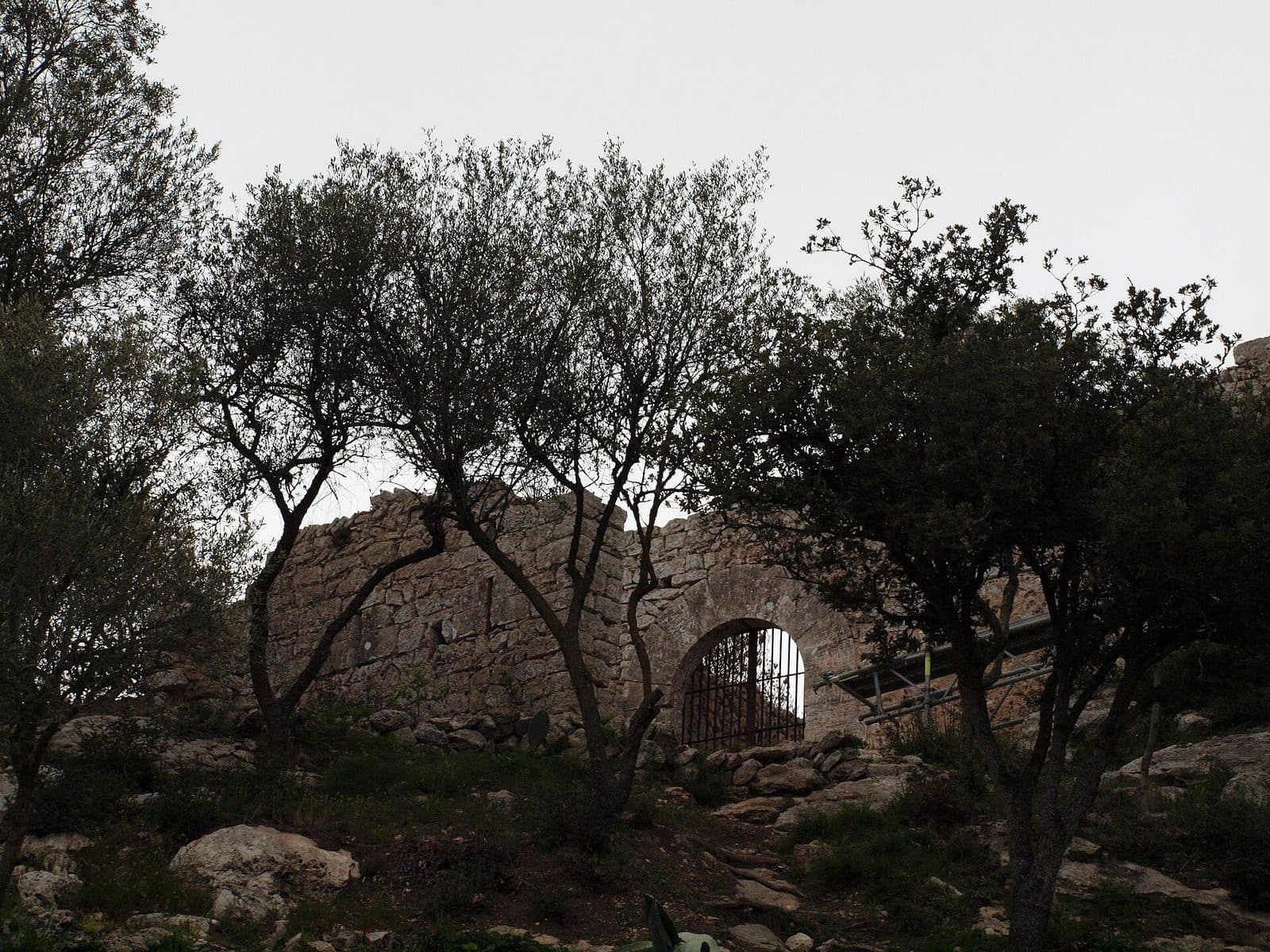
S'Horta's true attraction is the transition from the compact settlement to the open cultivated landscape. Just beyond the last houses, natural-stone walls, entrances to country homes and almond, olive and other Mediterranean trees dominate the scenery. From elevated locations, views open up towards the coast and sea.
For visitors, this means that S'Horta cannot be fully understood simply by walking to the church. Only by continuing by car or walking along suitable minor roads does it become clear why the area is sought after for fincas. Consideration is important: many tracks provide access to private properties and are not designated walking routes. Gates, driveways and enclosed land should not be entered.
Santuari de Sant Salvador near Felanitx
The Santuari de Sant Salvador is not part of S'Horta, but it is a historic excursion destination in the surrounding region. The sanctuary stands on the mountain of the same name near Felanitx. From S'Horta, a visit can easily be combined with Felanitx.
Sights in S'Horta
The Weekly Market
Mercat setmanal de s'Horta
The weekly market takes place in the village centre and is one of the best opportunities to experience S'Horta as more than somewhere to pass through. The documented range includes food, plants, flowers, clothing and shoes. Regional products such as fruit and vegetables, olives, cheese, cured meats, bread, pastries and olive oil are also available. The exact selection may vary from week to week; the emphasis is more on practical shopping than on a large spectacle for tour groups.
Market trading is documented from 8 to 13. Anyone looking for the best selection and a lively atmosphere should come in the morning. Towards the end of the market, it becomes quieter, and some goods may already have sold out. A market visit can easily be combined with breakfast or coffee in the village centre before continuing to a cove or Portocolom.
The market serves a second purpose in everyday life: it supplements the village's permanent basic amenities and creates a fixed weekly occasion. It is therefore not only a place to shop but also a social meeting point. Visitors should not, however, expect an extensive arts and crafts market. S'Horta remains a modest village market whose strength lies in its everyday atmosphere.
There is more activity than usual in the centre during the weekly market. Direct access to the Plaça may therefore be less convenient, and nearby parking spaces are in greater demand. Rather than driving right up to the market stalls, it is sensible to use a permitted parking space on one of the adjoining streets and walk the final few metres.
Activities and Excursions
Cala Sa Nau
Cala Sa Nau is one of the nearest coves for a swimming trip from S'Horta and lies east of the village. S'Horta serves as a base rather than a beach resort: after visiting the village or market, the route leads through the rural coastal hinterland down to the sea.
Cala Mitjana
Cala Mitjana is also named as a cove near S'Horta.
Portocolom
Portocolom is nearby and can be combined with a visit to S'Horta.
Cala d'Or
Cala d'Or is close to S'Horta. Anyone living in S'Horta can therefore quickly reach a wider range of leisure activities before returning to considerably quieter surroundings. The connection is also practical for visitors: S'Horta can be explored in the morning or during the market before continuing the day on the coast. Conversely, the village offers guests from Cala d'Or a brief insight into rural Mallorca.
Vall d'Or Golf
The Vall d'Or golf course is close to S'Horta and is one of the area's defining leisure facilities. The course offers views of the sea and surrounding landscape. For golfers, S'Horta is therefore a natural place to live or stay on holiday without itself taking on the character of a golf resort.
The proximity of the course also influences the area's international profile. Holiday homes and fincas around the village appeal not only to beachgoers but also to people who want to combine golf, rural living and short journeys to the coast.
Cycling and walking
The network of minor roads around S'Horta passes through a varied hilly landscape and is suitable for sporty cycling tours. Destinations such as Felanitx, Portocolom, the coastal coves and the area around Sant Salvador allow for a variety of circular routes. On narrow country roads, however, cyclists should expect car traffic, property entrances and blind bends.
When walking, it is important to distinguish between public paths and private driveways. The finca landscape is not freely accessible, and not every farm track may be used. For longer walks, routes checked in advance are more advisable than turning off spontaneously. A short walk through the village centre and along public minor roads, however, is enough to become familiar with the landscape and settlement pattern.
Festivals and Events
Festes de Sant Isidre i Cinquagesma
The Festes de Sant Isidre i Cinquagesma are popular recurring celebrations in S'Horta. For 2026, they have been announced for the second half of May and honour Sant Isidre, the patron saint of farmers. The theme directly reflects the history of the village and its surroundings; here, agriculture is not merely a decorative motif but part of the local identity.
The programme combines religious celebrations with community and cultural events. Documented activities include Masses, Mallorcan folk dancing in the form of ball de bot, music, children's activities, cycling, communal paella meals and a pamboliada. There is also the Cinquagesma fair, during which events spread across the Plaça and the village streets.
For visitors, this is a lively time to discover S'Horta. A place that seems very quiet on ordinary days becomes a stage for families, musicians and guests. The events are not aimed exclusively at tourists but emerge from village life itself. For this very reason, visitors should expect busy streets and temporary changes to access and parking.
The exact dates and programme vary from year to year. For 2026, the timing in the second half of May and the combination of Sant Isidre with Cinquagesma are documented. Anyone travelling specifically for a concert, Mass or folk dance should check the programme for the relevant year; those who simply want to experience the festive atmosphere will find several different events during this period.
The weekly market as a regular meeting point
The weekly market is not a fiesta, but it fulfils a similarly important social role throughout the year. Outside the major spring celebrations, it provides a reliable opportunity to see the village centre at its liveliest. Market stalls, shopping and café visits bring together people from the village and surrounding countryside.
For travellers who are not in Mallorca in May, the market is therefore an alternative to attending a festival. The experience is smaller and more everyday, but that is precisely why it shows how S'Horta functions outside special events.
Getting There and Getting Around
By car from the airport
From Palma Airport, the road route to S'Horta follows the Ma-19, Ma-5120 and Ma-14. The journey is 50 kilometres by road and takes around 50 minutes. Initially, the route follows the fast connection through the south or southeast; on the final sections, the road network becomes more regional and leads through the Felanitx area towards the village.
In practical terms, S'Horta can be reached from the airport without driving through central Palma, but it lies far enough into the east of the island that a spontaneous short detour after landing takes almost an hour. For a finca holiday or excursions to several coves, a car is the most flexible option.
By car from Palma
The distance from central Palma is 56 kilometres by road. Via the Ma-19, Ma-5120 and Ma-14, the journey takes around 59 minutes. This is quite manageable for occasional appointments in the capital; daily commuting, however, takes up a considerable part of the day even before allowing for travel at the destination.
Anyone who regularly drives to Palma should also bear in mind that S'Horta is not directly beside a motorway junction. Part of every journey is along regional roads. The connection is clear and straightforward, but it does not have the character of a commuter town immediately adjoining Palma.
Regional road connections
Felanitx is the main transport hub in the hinterland. From there, roads branch out towards S'Horta, Portocolom and other places in the southeast. Towards the coast, there are short connections to Cala d'Or, the coves and Vall d'Or golf course. This makes S'Horta well suited to journeys within the region, even though almost every destination requires a separate stretch of road.
Distances within the village centre are short and easy to cover on foot. Outside it, however, an extensive finca landscape begins almost immediately. Accommodation listed as being in S'Horta may therefore lie well beyond the compact settlement. Before arrival, travellers should check not only the place name but also the precise access route to their accommodation.
Bus
The known bus stops are by neighbouring Es Carritxó, meaning public transport can be used for some journeys but does not offer the same door-to-door flexibility as a car. Particularly when staying outside the village centre, it is also necessary to determine how to reach the bus stop.
For a single market or restaurant visit, the bus may be an alternative if the outward and return times are suitable. For changing beaches, shopping, golf or regular appointments in Felanitx and Palma, having your own car is considerably more practical in everyday life. This is especially true in the evening and for scattered fincas.
Bus lines to S'Horta at a glance
| Line | Route | Departures/day | First | Last |
|---|---|---|---|---|
| 514 | Cala d'Or - Felanitx - Porreres | 33 | 06:42 | 21:17 |
From the official GTFS feeds (TIB/SFM), no real-time data. The figures cover all stops in the town; weekend and holiday services differ — check with the operator before travelling.
Getting there by bus
Es Carritxó 1 (22042) · 2.0 km as the crow flies
- 514Cala d'Or - Felanitx - Porreres · Daily
Es Carritxó 2 (22043) · 2.0 km as the crow flies
- 514Cala d'Or - Felanitx - Porreres · Daily
Timetable data: official GTFS feeds (TIB/EMT), no real-time — check with the operator before travelling.
Living in S'Horta
Basic amenities in the village
S'Horta has practical but limited basic amenities. A bakery, supermarket and pharmacy are documented, along with bars, restaurants and the weekly market. It is therefore unnecessary to drive to a larger town every time you need bread, groceries, small errands or many spontaneous purchases.
Nevertheless, the range should not be confused with that of a regional centre. For extensive shopping, specialised services and many regular appointments, Felanitx remains the nearest convenient option. Anyone considering moving should therefore plan everyday life as a combination of short journeys within the village and recurring trips into the surrounding area.
Village houses and residential areas in the countryside
Traditional village and town houses dominate the centre, often with courtyards, high-ceilinged rooms and Mallorcan natural-stone features. Development is denser, and the Plaça, bakery, market and restaurants are only a short walk away. In return, neighbouring houses and street life are closer than they would be at a finca.
Outside the village centre, country houses and fincas shape the residential market. Peace, land and scenery are the main attractions there, but dependence on a car also increases. In practice, an address listed under S'Horta may be several minutes' drive from the village. Access, lighting, distance from shops and accessibility in bad weather are therefore just as important as the house itself.
Long-established residents and newcomers
S'Horta remains a Mallorcan village with a local population, market and its own festivals. At the same time, it is also described as having an international community. German and British newcomers are explicitly mentioned as part of this established international presence.
The result is not a pure holiday resort but a village with two parallel ways of life: a locally rooted community and a group of residents, second-home owners and holiday guests. These groups come into contact particularly on the Plaça, at the market and during the Sant Isidre celebrations. People living here permanently are more likely to make connections through recurring everyday places and events than along a tourist promenade.
Everyday life
The pharmacy, food shops, market and local festivals are part of the village's structure and serve residents as well as visitors. Felanitx is accessible to residents as the larger centre for everyday needs. Anyone expecting daily choice, nightlife or uninterrupted urban services will need to travel more frequently.
Commuting and living without a car
The drive to central Palma via the Ma-19, Ma-5120 and Ma-14 takes around 59 minutes over 56 kilometres by road. Occasional commuting is realistic, but daily commuting requires careful time management. For jobs in Felanitx, on the southeastern coast or around Cala d'Or, S'Horta is better situated regionally than it is for a daily workplace in Palma.
A completely car-free daily life is mainly possible in the village centre, provided the basic amenities are sufficient and journeys are planned carefully. For medical appointments, larger shopping trips, visits to public authorities, more specialised services or journeys to the coast, the location of the bus stops by neighbouring Es Carritxó becomes noticeable. At a finca outside the centre, a car is almost indispensable, as even the route to the shops or bus stop may follow country roads.
Who S'Horta suits as a place to live
The village suits people who place greater value on manageable village life, proximity to nature and quick regional journeys than on urban infrastructure. Families and permanent residents benefit from the basic amenities and active community life; before moving, however, schools, medical care and daily commutes should be assessed individually for the specific address.
S'Horta also offers clearly distinct residential settings for people choosing between a village house and a finca. In the centre, daily life is more walkable and socially visible. In the surrounding countryside, there is more privacy and scenery, but a car, property maintenance and forward planning become more important.
Practical Information for Your Visit
The best time for a walk
The weekly market is particularly suitable for a first visit because it brings the otherwise quiet village centre to life. Anyone wishing to view the architecture and streets with as little disturbance as possible should instead choose an ordinary morning. The early hours can easily be combined with the market, coffee and an onward journey.
During the Festes de Sant Isidre i Cinquagesma announced for the second half of May 2026, S'Horta is at its most sociable. A visit is then expressly worthwhile because of the programme. At the same time, access, parking and freedom of movement in the centre are less predictable than on normal days.
Time required and what to expect
A compact walk is sufficient for the Plaça, church and adjoining streets. The village should not be planned as a full-day sightseeing destination. Its value lies in providing context for the region and in combining it with the market, countryside, golf or coast.
S'Horta has neither a long shopping street nor a harbour promenade or extensive nightlife. This is precisely why the village makes a peaceful contrast to Cala d'Or. The most interesting feature is the transition between the small centre and the finca landscape immediately beyond it.
Parking and orientation
The Plaça is the natural point of reference. On market days and during the spring festivities, visitors should not try to drive directly into the centre. A permitted parking space on an adjoining street avoids manoeuvring close to stalls and event areas. Entrances to homes and properties must remain clear.
Precise navigation is important for destinations outside the centre. The place name S'Horta refers not only to the compact settlement but is also used for accommodation in the surrounding countryside. House names and finca entrances may be easier to miss than addresses within an urban street network.
Useful combinations
On market days, a good sequence is the market, coffee in the village and then the coast. Cala Sa Nau and Cala Mitjana are nearby coves, while Cala d'Or and Portocolom are nearby places. Anyone more interested in history and scenery can combine S'Horta with Felanitx and the Santuari de Sant Salvador.
Golfers can combine a walk around the village with Vall d'Or Golf. Cyclists are more likely to use S'Horta as a stop or place to pass through on a tour of the southeast. For families, the best place to continue depends on the type of excursion they want.
Eating, drinking and staying in S'Horta
The best-rated businesses from our directory, ordered by Google rating — not by advertising.
Latest news from Felanitx
- Mallorca traditional boats: Minister defends aid
- Mallorca wooden boats: €700 berths leave 60 at risk
- 27 Mallorca towns lack Alcover and La Balanguera
- Mallorca electric cars and fire demo fill Palma