
Puigpunyent, Mallorca: Travel Guide to the Village and Area

Places to stay in Puigpunyent
AdTo load the accommodation map by our partner Stay22, we need your consent for marketing cookies. Your consent applies to all marketing content on mallorca.com.
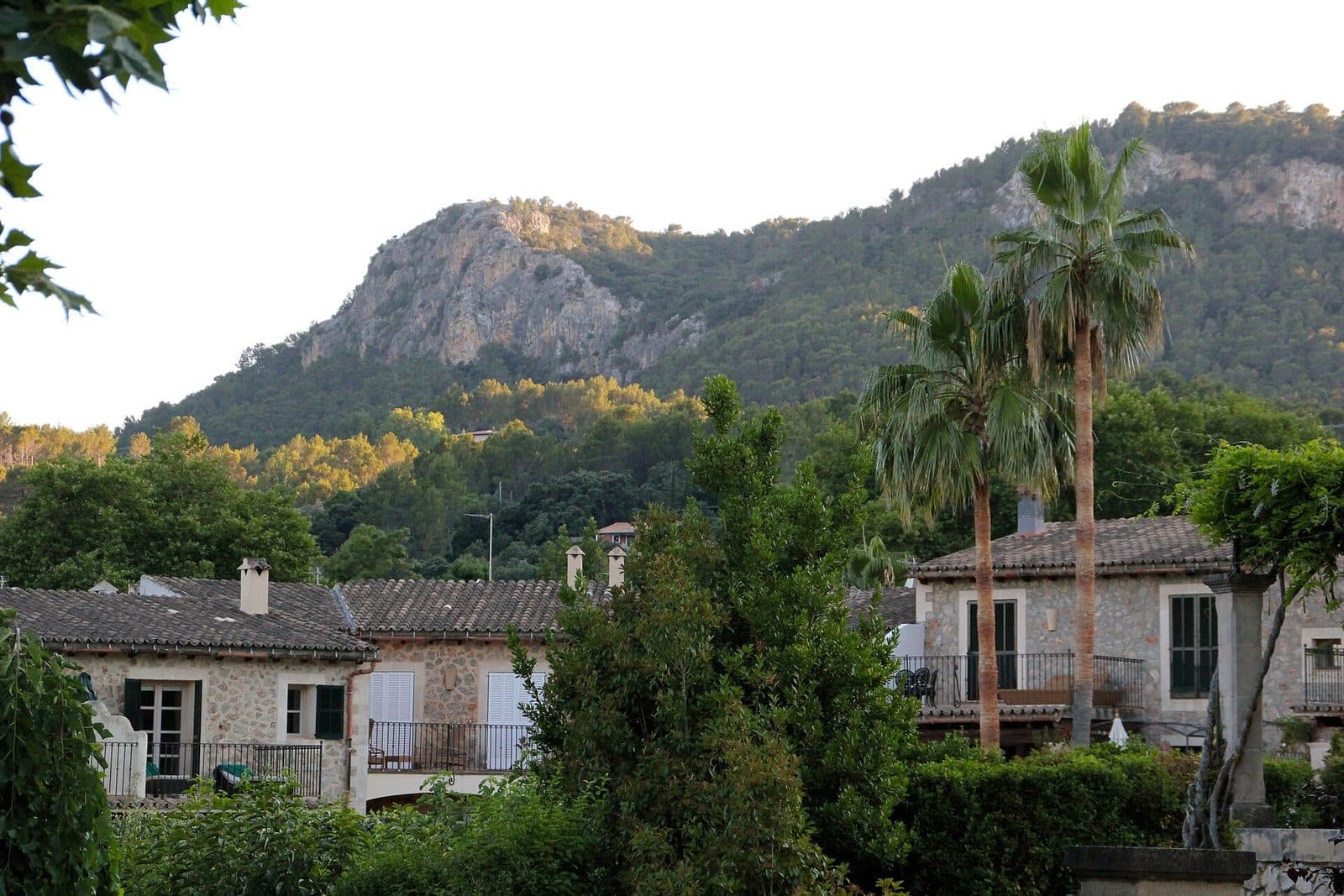
Puigpunyent lies where southwest Mallorca rises towards the Serra de Tramuntana. The small main village sits in a green valley between wooded slopes, terraced fields and old country estates. Palma is close enough for a half-day trip or a regular commute, yet feels surprisingly far away among the mountains.
As a traditional sightseeing destination, Puigpunyent is not defined by a long series of monuments open to visitors. Instead, its appeal lies in the interplay of village, cultural landscape and paths: a church with an unusual connection to Palma Cathedral, prehistoric sites, historic water systems, dry-stone walls and the widely visible Puig de Galatzó. Much of this becomes easier to understand when a visit does not end in the church square but includes a walk or hike.
Puigpunyent is particularly well suited to hikers, cyclists and travellers looking for an inhabited Tramuntana village rather than a tourist-oriented excursion destination. The municipality also has a distinct character as a place to live: rural surroundings, a short connection to the capital, a local school community and several population centres, including Galilea and Son Serralta.
History of Puigpunyent
Prehistoric and ancient traces
The settlement history of the municipality reaches far beyond the present-day village. More than fifty archaeological sites are known within the municipal area, dating from prehistory through Roman times to the Islamic period. Particularly notable are the talaiots of Serral de les Abelles, the Casa del Gegant and the necropolis of Casat Nou. They show that the valley was already inhabited long before a Christian village centre emerged.
These sites should be understood less as a self-contained open-air archaeological museum than as part of a landscape used over a long period. Traces of settlements, burial grounds and megalithic structures are scattered throughout the municipality. The historical dimension is therefore only partly visible during a short walk around the village centre and continues beyond the built-up streets.
Islamic water management
During the Islamic period, the use of water was expanded significantly. Springs, channels and mills made more intensive cultivation of the valley possible. Parts of this historic infrastructure have survived in the landscape. The hydraulic system of Son Nét, with several grain mills and a paper mill, is especially important; further traces of water engineering can be found near des Ratxo and Son Noguera de Superna.
Water management also explains the form of the cultural landscape. Land on the slopes was secured by dry-stone walls, while water from contained springs was channelled to fields and mills. Puigpunyent therefore owes its character not only to its natural setting but also to a mountain landscape shaped over centuries.
Country estates, terraces and village development
Large Mallorcan country estates, known as possessions, shaped agriculture, routes and the settlement pattern. A network of public paths connected these estates with Puigpunyent, Galilea, Son Serralta and neighbouring municipalities. Alongside cart tracks, old bridleways and mule paths have survived, in places retaining paving, steps and other structural remains.
This form of land use also produced numerous ethnological features: lime and gypsum kilns, mountain cisterns, charcoal-burning sites and facilities once used for bird trapping. The terraces of Son Forteza, Son Nét and Sa Coma are among the clearest examples. They held the soil in place on the slopes and created farmland, primarily for olive trees.
The ecclesiastical centre
The present parish church of Assumpció de la Mare de Déu dates from the eighteenth century. It gave the village a clearly defined religious and spatial centre. Its main altar has a special connection to Palma: it formerly stood in the cathedral there. The church, square and adjoining streets still form the heart of the village, where daily life, the market and festivals come together.
Sights in Puigpunyent
Església de l’Assumpció de la Mare de Déu
The parish church is the most important building in the village centre. The eighteenth-century structure appears modest compared with the island’s large churches, but for that very reason it suits the scale of the village. Inside, the main altar is particularly noteworthy, as it originally belonged to Palma Cathedral. Since village churches are not necessarily accessible at all times, visitors should not assume that the interior will always be open.
Plaça de l’Església and the old village centre
The area around the church shows Puigpunyent’s village character most clearly. Natural-stone façades, narrow streets and the proximity of the mountain slopes define the atmosphere. The square is not a monumental urban ensemble but a social centre where a market visit, a café break and a short walk through the village come together. It is the best starting point for getting oriented.
Talaiots of Serral de les Abelles
The talaiots of Serral de les Abelles are among the municipality’s most outstanding prehistoric remains. They point to Mallorca’s Talaiotic culture and show how early the sheltered parts of the valley were used. Their value also lies in their landscape context: Puigpunyent’s archaeology is distributed across the municipality rather than concentrated in the village centre.
Casa del Gegant and the necropolis of Casat Nou
The Casa del Gegant and the necropolis of Casat Nou are two further named sites from the municipality’s early history. Together with the talaiots, they help explain the exceptionally high density of archaeological locations. Before visiting, it is advisable to check whether access and a suitable route are available, since sites in a rural municipality are not automatically presented like a museum.
Terraces of Son Forteza, Son Nét and Sa Coma
The dry-stone terraces are not a single attraction with an entrance but an essential element of the historic landscape. Walls divide the slopes into narrow areas of usable land and protect the soil from slipping. Around Son Forteza, Son Nét and Sa Coma in particular, it is possible to see how closely agriculture, water management and mountain relief worked together.
Hydraulic system of Son Nét
The water system of Son Nét is one of the municipality’s most important examples of historic engineering. Contained springs, channels, several grain mills and a paper mill recall a time when water not only supplied fields but also powered machinery. Similar remains near des Ratxo and Son Noguera de Superna extend this picture beyond a single country estate.
Historic possessions
The large country estates around Puigpunyent shape the valley with their houses, fields, access roads and water systems. Their architecture is considered particularly representative of Mallorcan possessions. However, because some are privately used properties or accommodation businesses, there is no general right of access. Even from the public path network, they provide an impression of the former economic order.
Puig de Galatzó
Puig de Galatzó dominates the mountain scenery in the west of the municipality. Rather than a viewpoint for a casual photo stop, it is a destination for demanding mountain hikes. The summit area offers extensive views across the southwestern part of the Serra de Tramuntana and towards the coast. A planned route, suitable footwear and conditions appropriate to the season are more important for the ascent than an extended walk around the village.
La Reserva Puig de Galatzó
La Reserva lies at the foot of Puig de Galatzó and is a natural area with trails through Mediterranean mountain scenery. Opening status, access conditions and the activities currently available should be checked before travelling, as the grounds are outside the village centre itself.
Sights in Puigpunyent
The Weekly Market
Market on Plaça de l’Església
The weekly market takes place in the centre around Plaça de l’Església and the adjoining streets. It is small enough to remain part of ordinary village life. This is precisely where its appeal lies: residents do their shopping, meet acquaintances and combine a visit to the market with coffee in the square.
The main focus is on regional and seasonal food. Products on offer include fruit and vegetables, cheese, cured meats, olives and baked goods. Depending on the traders, clothing, household items and handmade products may also be available. The selection can change from week to week; anyone expecting a large craft or souvenir market should bear the size of the village in mind.
For visitors, market morning is the liveliest time for a first walk around. Those who arrive early can watch the stalls being set up and will usually find a wider choice of food. Later, the social character becomes more prominent. Because the stalls are concentrated in the central area, normal access or the search for parking around the square may be restricted. Parking a little outside the centre avoids unnecessary manoeuvring.
The market combines well with the church and a walk through the nearby streets. On its own, it is rather small for a full-day excursion; the journey is more worthwhile when combined with a hike, a cycling trip or a visit to other parts of the municipality.
Markets in Puigpunyent
One market with dates, opening hours and what is on sale, in the market calendar.
Food and Drink
Cuisine from a cultivated mountain landscape
Puigpunyent’s culinary identity begins not with individual restaurant names but with the landscape. Dry-stone terraces were primarily used for growing olives, other crops were irrigated in the valley, and historic mills processed agricultural produce. Vineyards and olive groves remain visible parts of the municipality today. Regional and seasonal products also define the weekly market’s selection.
For visitors, this means that Puigpunyent is better suited to a quiet meal or a break in the village than to lively streets lined with restaurants. Establishments are spread across the small village centre and country estates within the municipality. Opening days and kitchen hours should be checked in advance, as proximity to Palma does not mean that a mountain village offers the same choice as the capital at every time of day.
Bodega Son Puig
Bodega Son Puig represents winegrowing in the valley. It is one of the municipality’s better-known businesses and shows that the surroundings are shaped by more than olives and woodland. Anyone interested in Mallorcan wine will find a tangible connection between vines, a country estate and local production here. Visits or tastings should not be assumed to be available spontaneously but arranged directly with the producer.
Bodega Son Vich de Superna
Son Vich de Superna is another well-known bodega in the municipality. The addition of Superna indicates a rural location outside the compact village centre. The winery therefore fits Puigpunyent’s historic structure, in which agricultural estates were connected to the settlements by paths. For a dedicated wine excursion, a vehicle is more practical than a visit planned entirely on foot.
Tafona de Conques
Tafona de Conques continues the valley’s tradition of olives and oil. A tafona is an oil mill, so the name directly represents a branch of production that would be difficult to imagine without the terraced olive-growing areas. Conques is not directly beside the church square but within the municipality’s wider settlement area. Whether and in what form a visit is possible should be clarified in advance.
Market produce and a village break
The weekly market brings together the island’s produce in a practical, everyday setting: seasonal fruit and vegetables, olives, cheese, cured meats and baked goods. The market is therefore better suited to shopping or preparing a picnic than to searching for elaborately presented specialities. Stopping afterwards at a bar or café offers a chance to experience the village at its most sociable during the market.
When choosing somewhere to eat, it makes more sense to consider location and the day’s itinerary than to look for a long restaurant strip. A meal in the village works well with a walk around the centre; dining options on country estates can be combined with a drive through the valley. Hikers should obtain provisions and water before leaving the village centre, since continuous supplies cannot be expected along historic mountain paths.
Eating, drinking and staying in Puigpunyent
The best-rated businesses from our directory, ordered by Google rating — not by advertising.
Restaurants
Cafés and bakeries
Activities and Excursions
Hiking on old paths
Puigpunyent has a dense network of historic connecting routes. They once led to country estates, fields, neighbouring villages and workplaces in the mountains. Surviving routes include bridleways and mule paths where paving, steps and other old structural features are still visible in places. Other paths reach former charcoal-burning sites, mountain cisterns or dry-stone structures.
These paths make the municipality particularly interesting for hikers, but they require careful route selection. A historically documented path is not automatically marked throughout or publicly accessible to its final section. Up-to-date route descriptions are therefore more important than a rough line on an old map.
Ascent of Puig de Galatzó
Puig de Galatzó is the most striking mountain destination in the area. The ascent enters genuine mountain terrain and should not be confused with a walk from the church. In return, the route rewards hikers with a sweeping perspective over southwest Mallorca. Good fitness, sturdy footwear, sufficient water and planning appropriate to the weather are essential.
Those not aiming for the summit can choose shorter routes through the valley’s wooded and terraced areas. These also reveal historic Puigpunyent more clearly than a visit limited to the village centre: walls, water channels, old working sites and country estates form a coherent picture along the way.
Cycling between Palma and the Tramuntana
The location between the capital and the mountains makes Puigpunyent a destination for sporty cyclists. From Palma, the road climbs into the valley; from there, routes continue through the southwestern Tramuntana region. The terrain, bends and motor traffic require attention. A bicycle is useful for leisurely everyday journeys within the village, but using it as a substitute for a car across the entire municipality requires good fitness.
Galilea and Son Serralta
Besides the main village, the municipality also includes Galilea and Son Serralta. Galilea lies higher on the slope and offers a different perspective on the mountain landscape, while Son Serralta forms another part of the dispersed settlement pattern. A drive through the municipality shows more clearly than a single stop how life is distributed between the valley, hillside locations and country estates.
Excursion to Palma or the coast
Palma is close enough to combine Puigpunyent with the old town or a stroll through the city. In the other direction, roads lead through the southwest to coastal resorts and coves. Puigpunyent itself has no beach, so swimming requires a separate journey. For a balanced day trip, a sequence of village, hike and late meal makes more sense than rushing between the mountains and the beach.
Festivals and Events
Sant Antoni
Sant Antoni reveals a particularly lively side of Puigpunyent in the middle of winter. The programme includes bonfires, communal grilling, folk dancing and dimonis, who move through the event area with fire and drums during a correfoc. The Beneïdes, the blessing of animals and decorated carts, are also part of the celebrations. The main setting is around the municipal administration square and the church.
The festival is more than a performance for visitors. The school, local groups and associations take part; communal food and dancing turn the evening into a gathering for the municipality. Anyone wishing to watch the correfoc should expect sparks, smoke and loud noise and avoid delicate clothing. For families, the quieter programme items and the Beneïdes are often more accessible than the fire run itself.
Summer cultural programme
During the summer events calendar, squares and streets become cultural venues. Programmes have included poetry events, art in public spaces, exhibitions, concerts and the communal decoration of village streets. This temporarily changes the otherwise quiet centre considerably: culture does not take place only in enclosed halls but becomes visible between the church, squares and residential streets.
Specific dates and programme items change from year to year. The current events calendar is therefore essential when planning a trip. On festival days, visitors should also expect road closures and less parking in the centre. On foot, however, the compact event area is easy to explore.
Getting There and Around
By car from Palma
Puigpunyent lies west of Palma on the southern edge of the Serra de Tramuntana. The road leads from the urban area into increasingly rural surroundings and climbs into the mountain-framed valley. The distance from the capital is about fifteen kilometres; with clear roads, the journey is often said to take around a quarter of an hour. Rush-hour traffic and the route through Palma can noticeably increase the actual travel time.
A car is particularly practical if the itinerary includes Galilea, Son Serralta, wineries, La Reserva or hiking trailheads as well as the main village. The municipality covers a larger area than the small village centre suggests. On minor roads, expect bends, gradients, cyclists and narrow sections.
By bus
Puigpunyent and Galilea are served by public buses. For a visit to the village centre, the bus can be a sensible alternative to driving, provided outbound and return journeys are coordinated in advance. This is particularly important at weekends and outside peak travel times. Current routes, stops and departures are shown separately on the page.
For hikes with different starting and finishing points, the bus is practical only if the timetable fits the route precisely. Spontaneous changes are more difficult to manage in a small mountain village than in Palma. Anyone travelling with luggage, children or to a country estate outside the centre should plan the final section separately.
On foot in the village centre
Within the compact village centre, the church, square and nearby streets are easy to explore on foot; distances between the different population centres and rural destinations are considerably longer and steeper.
Parking in the village
Road space in the centre is limited. Markets, festivals and events can alter access and occupy the nearest parking spaces. It is often more practical to park at the edge of the built-up area and walk the final few minutes. Entrances to properties and tight bends must remain clear. For mountain hikes, visitors should also check whether legal parking is available at the relevant trailhead.
Bus lines to Puigpunyent at a glance
| Line | Route | Departures/day | First | Last |
|---|---|---|---|---|
| 201 | Galilea - Palma | 71 | 06:45 | 21:45 |
From the official GTFS feeds (TIB/SFM), no real-time data. The figures cover all stops in the town; weekend and holiday services differ — check with the operator before travelling.
Getting there by bus
Conques 1 (45007) · 0.7 km as the crow flies
- 201Galilea - Palma · Daily
Conques 2 (45008) · 0.7 km as the crow flies
- 201Galilea - Palma · Daily
Galilea (45004) · 1.3 km as the crow flies
- 201Galilea - Palma · Daily
Puigpunyent (45019) · 2.3 km as the crow flies
- 201Galilea - Palma · Daily
Timetable data: official GTFS feeds (TIB/EMT), no real-time — check with the operator before travelling.
Living in Puigpunyent
Daily life between village and capital
Puigpunyent combines a rural residential setting with a comparatively short distance from Palma. This appeals to people who need to travel regularly to the capital but do not want to live within the continuous urban area. The road journey remains part of everyday life: anyone living outside the main village or working irregular hours depends far more heavily on a private vehicle than someone near the central bus stop.
The municipality consists of more than the main village. Galilea, Son Serralta, country estates and scattered houses create very different living situations. In the village centre, the square, market and bus stop are closer together. Hillside and outlying locations offer more space and a direct connection to the landscape but also involve longer journeys, gradients and greater dependence on a car.
School and local community
CEIP Puig de na Fàtima gives community life a clearly visible educational centre. The close connection between the school and village society is evident during festivals: pupils, students and families take part in communal meals and raise funds for school activities. For families, these local roots are an important difference from a settlement made up purely of holiday homes.
A growing international resident population has been documented. Proximity to Palma and the scenic location encourage this movement. Nevertheless, Puigpunyent remains a small community where events, the market and public squares function more strongly as meeting places than anonymous shopping or leisure centres.
Amenities and everyday journeys
The weekly market covers some shopping needs with seasonal food and is also a social occasion. For a comprehensive range of urban amenities, Palma remains important because of the short road connection. Before choosing a home, prospective residents should therefore consider not only the distance from the capital but also the specific route to the bus stop, village centre and regularly needed facilities.
Without a car, everyday life is easiest to organise from a central location. Bus connections make journeys to Palma possible but require more planning than an urban high-frequency service. In Galilea, Son Serralta and remote finca locations, even the distance to the bus stop can make a decisive difference. Cyclists must take gradients and winding roads into account in daily traffic.
Puigpunyent in winter
Puigpunyent is not a seasonal holiday destination that becomes completely quiet after summer. The school, community life, market and winter festivals continue. With bonfires, Beneïdes, dancing and the participation of local groups, Sant Antoni is firmly rooted in the colder season. For a permanent home, orientation, access and distance from the village centre are therefore just as important as a beautiful view.
Who Puigpunyent suits as a place to live
Puigpunyent is particularly suitable for people who want to combine nature, a manageable community and proximity to Palma. Central locations can also work for residents who regularly use the bus. Outlying locations are better suited to households able to organise transport and deliberately seeking a rural lifestyle. The village is less suitable for anyone who wants to complete every errand on foot or expects a lively urban nightlife outside their front door.
Practical Information for Your Visit
Time required and planning your day
A short walk is enough for the church, square and nearby streets. A realistic visit, however, only gains depth when it includes the market, a stop for food or drink, or a walk into the cultural landscape. At least half a day should be allowed. A hike to Puig de Galatzó or a visit to La Reserva is a main activity in its own right rather than merely an extension of a walk through the village.
The best time of day
The centre is livelier on market morning but also busier. Anyone interested only in the architecture and village streets will find more peace outside market and event times.
Preparing for walks and visits
Sturdy shoes are advisable as soon as you leave the paved village centre. Historic paving, steps and dry-stone paths can be uneven. Water and provisions should be obtained before a longer excursion. Access to archaeological sites, country estates, bodegas and the parish church is not guaranteed at all times, so checking current visiting opportunities is an essential part of preparation.
Useful combinations
Puigpunyent combines particularly well with Galilea, a hike or a culinary destination within the municipality. Palma is a suitable addition if the intention is to contrast the village and the capital. A beach visit, by contrast, requires an additional journey and should not be scheduled as tightly as if Puigpunyent were on the coast.
What not to expect
Puigpunyent has no beach of its own. Nor do its archaeological and ethnological remains form a centrally organised museum. The village rewards visitors who read the landscape and include its paths; it is less suited to a simple checklist of easily accessible attractions.
Local businesses and services
The best-covered sectors in our directory for Puigpunyent — each with address, contact details and opening hours.
Run a business here? Add it to the directory for free and be found on this page. Add your business
Latest news from Puigpunyent
- Mallorca water boost: €5.58m for 11 Tramuntana towns
- Mallorca Socialists put Estrades in charge at Puigpunyent
- Mallorca has 7 of Spain’s 10 most expensive homes