
Can Fàbregues in Palma: Discover a Historic Manor
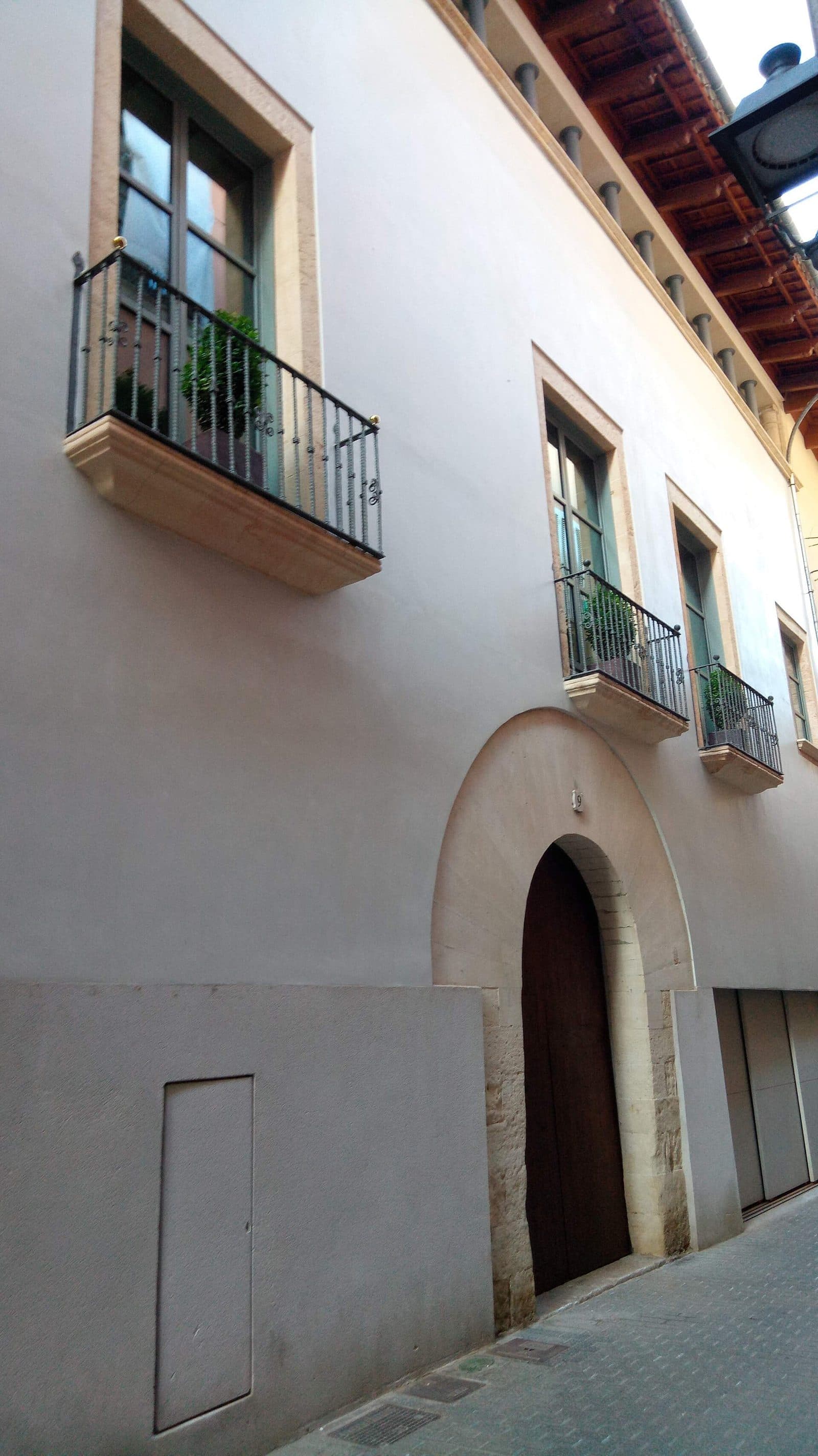

Can Fàbregues is one of those historic houses in Palma where the island’s history is revealed not through a single grand statement, but through layers of traces. Medieval origins, its development into a stately estate, and later alterations come together in a building that displays several periods of Mallorcan architecture.
The building is especially worthwhile for visitors who want to explore Palma’s historic residential culture beyond the major monuments. While the cathedral and palace tell stories of religious and political power, Can Fàbregues offers a closer look at the domestic and economic world of wealthy families. The sturdy sandstone walls and central courtyard follow a building tradition that endured on Mallorca for a long time.
The proportions of the house, the relationship between its enclosed exterior and protected interior, and the traces of different architectural styles are particularly important. Anyone who enjoys reading such details as others read a history book will find here a quieter but revealing element in Palma’s historic fabric.
Before visiting, check whether and in what form the interior can be viewed. Reliable general opening hours and admission conditions are not available. The house is therefore best planned as a carefully prepared stop on a walk through the old town, rather than as a museum guaranteed to be open for a spontaneous visit.
History and Significance
The name reaches far back into the past. In Catalan, “Fàbrega” refers to a forge or a place where metal was worked. The traditional interpretation therefore links Can Fàbregues with an early craft-related use before the property became a stately residence. This change in meaning is particularly revealing: a name evoking work, fire, and metal developed into the name of a house that later embodied wealth and social standing.
The Late Medieval Beginnings
The origins of Can Fàbregues are placed in the late medieval period. At the time, Mallorca was characterized by larger estates belonging to noble families or wealthy merchants. Such properties were neither purely residences nor merely utilitarian agricultural buildings. They combined ownership, production, and representation, visibly demonstrating who controlled land, income, and economic influence.
Against this background, Can Fàbregues should be understood as part of Mallorca’s evolving culture of houses and estates. The building was not created as an isolated monument for later observers, but as the functioning center of a property. Massive walls and a central courtyard were integral to this architecture.
Agriculture and Trade
In the early modern period, the estate gained economic importance. Olives, almonds, grain, and wine are recorded among its products. They were used both for local consumption and for trade. Can Fàbregues was therefore part of an economic system that shaped Mallorca’s landscape for centuries: landownership supplied food and trade goods, while the manor represented social status.
This role explains the robust construction better than any purely stylistic label. A house of this kind had to protect, organize, and endure. Its architecture was designed for permanence while remaining open to change when new owners, economic success, or evolving residential expectations required expansion.
Alterations and Growing Prosperity
Later renovations and enlargements reflect the house’s increasing prosperity. Trade in almonds and olive oil formed an especially important part of Mallorca’s economic background. The architecture was not completely replaced. Instead, new forms were layered over older sections, leaving Gothic, Renaissance, and Baroque elements visible alongside one another.
This is where the true significance of Can Fàbregues lies. The house represents not just a single period, but the long-term adaptability of Mallorcan manor houses. It preserves the memory of craftsmanship, agriculture, trade, and prestigious living in a building altered over generations.
What to See
The first impression comes less from ornamental abundance than from mass and enclosure. Sturdy sandstone walls give Can Fàbregues its calm, fortified appearance. Behind them lies a spatial arrangement characteristic of traditional larger estates on Mallorca: the house appears restrained on the outside, while its interior is focused on a protected center.
The Sandstone Walls
Sturdy sandstone walls define the building. When viewing it, it is therefore worth looking beyond decorative forms: the walls are among its defining architectural features and also became the dignified outer skin of a stately house.
The Clastra
The spatial heart is the central clastra, the courtyard typical of Mallorcan manor houses. Here, the effect of the building is reversed: the enclosed exterior gives way to an inward-facing area that forms the center around which the different parts of the house are arranged. The courtyard is therefore a key architectural feature of the estate and more important to understanding Can Fàbregues than any single decorative detail.
If the courtyard is accessible during a visit, begin from a position near its center. From there, you can take in the central clastra before focusing on the individual details. The courtyard is effectively the key to reading the house’s underlying design.
Gothic Elements
At Can Fàbregues, Gothic elements can be seen alongside Renaissance and Baroque influences. This is not the monumental Gothic architecture of a church, but rather forms incorporated into residential and agricultural architecture.
Their juxtaposition with Renaissance and Baroque features makes these elements particularly interesting. When viewing Can Fàbregues, it is therefore better to look for the interaction between the different architectural styles than for a completely unified stylistic composition.
Renaissance and Baroque
Renaissance and Baroque influences stand alongside Gothic elements and create the building’s distinctive appeal. Gothic, Renaissance, and Baroque features do not appear as separate exhibition chapters, but as components of a house used over a long period. Can Fàbregues is therefore best explored slowly: first the building as a whole, then the courtyard, and finally the juxtaposition of its different architectural styles.
Visiting Can Fàbregues
At Can Fàbregues, preparation determines what you will actually be able to see. Current opening hours and admission conditions should be checked immediately before visiting. Without confirmed access, you should not assume that the interiors or courtyard can be entered at any time as they could in a regular museum.
As an Architectural Stop
Viewing the building from outside can also be worthwhile when Can Fàbregues is included in a walk through historic Palma. Rather than simply photographing the façade and moving on, first take in the enclosed effect of the walls and then imagine the arrangement behind them around the clastra. The contrast between the public street frontage and the private center is fundamental to this type of house.
For an exterior-only stop, a manageable portion of a city walk is sufficient. If access is confirmed, the duration will depend on which areas are open and whether explanations are provided. Do not expect a fixed route with a reliably predictable visiting time.
If Interior Access Is Available
If the route into the courtyard is open, the true spatial experience of the house begins. It makes sense to move from the whole to the details. First, take in the arrangement of the building sections around the clastra; then examine the masonry, openings, and stylistic influences. This approach prevents the house from being reduced to isolated decorative features.
Can Fàbregues appeals primarily to visitors interested in history and architecture. Its attraction lies in the historic building itself and in the question of how an economically used estate became a prestigious manor house over several periods.
At the Pace of the Old Town
Can Fàbregues is a historic stop among Palma’s major landmarks. Even so, your daily schedule should not rely on supposedly quiet periods unless access has been confirmed. It is more practical to keep the walk flexible, allowing enough attention for the building without reserving an inflexible museum block.
Visitors primarily interested in the façade’s details will benefit from coming without time pressure. The eye needs a moment to discover the different layers within the restrained exterior. Can Fàbregues rewards a second look more than a quick check off a sightseeing list.
Getting There and Parking
From Palma Airport, the usual route first follows the Ma-19 into the island’s capital. Palma is 11 kilometers away by road, and the drive takes around 20 minutes. These details apply specifically to the route as far as Palma, not directly to Can Fàbregues. For the final section through the city, traffic conditions, one-way streets, and possible access restrictions must be taken into account.
By Car
Palma’s historic urban layout was not designed to allow direct vehicle access to every old building. In the old town, narrow streets, pedestrian areas, and one-way systems meet zones with restricted access. Pay particular attention to ACIRE signs, as they mark areas that not every vehicle may enter without authorization.
Rather than trying to force your navigation system to guide you directly to the building’s frontage, using a parking garage on the edge of the historic center is usually the more convenient option. From there, continue on foot. This also suits the nature of the visit: Can Fàbregues works better as a stop on a walk through the old town than as an isolated destination reached only for a brief photo stop.
Anyone parking on the street must observe the colored markings and the applicable regulations. Free spaces in the center can be difficult to find, while reserved or regulated areas can easily cause misunderstandings. A centrally located parking garage avoids searching through narrower streets and helps prevent accidental entry into restricted areas.
By Bus and on Foot
Several bus stops in the central city area allow you to continue on foot. These include stops at Plaça de Cort, Plaça d’en Coll, Plaça de sa Quartera, and Plaça del Mercat. Which one is most convenient for a particular journey depends on the route you are using and the currently confirmed location of the entrance.
Arriving on foot has one advantage: Palma’s historic scale remains intact. Instead of getting out directly in front of a single building, you approach through a cityscape where old residences, squares, and public monuments reveal different sides of the same history. An up-to-date map should still be used for final navigation, as the only address provided is Palma.
Bus lines to Can Fàbregues at a glance
| Line | Route | Departures/day | First | Last |
|---|---|---|---|---|
| 1 | Portopí - Sindicat | 6 | 07:15 | 09:15 |
| 3 | Pont d'Inca / Joan Carles I | 6 | 07:37 | 09:46 |
| 25 | s'Arenal - Pl. Reina | Catedral | 6 | 09:35 | 12:41 |
| 46 | la Bonanova - Gènova - Sindicat (dreta) | 6 | 07:20 | 09:15 |
| 47 | Gènova - la Bonanova - Sindicat (esquerra) | 6 | 07:30 | 08:53 |
| 20 | Portopí - Son Espases | 2 | 07:17 | 07:19 |
From the official GTFS feeds (TIB/SFM), no real-time data. The figures cover all stops in the town; weekend and holiday services differ — check with the operator before travelling.
Getting there by bus
662-pl. de Cort · 0.1 km as the crow flies
- CCCircular Centre Ciutat · 08:00–08:00 · Daily
663-pl. d'en Coll · 0.2 km as the crow flies
- CCCircular Centre Ciutat · 08:00–08:00 · Daily
664-pl. de sa Quartera · 0.2 km as the crow flies
- CCCircular Centre Ciutat · 08:00–08:00 · Daily
106-pl. del Mercat · 0.3 km as the crow flies
- 3Pont d'Inca / Joan Carles I · 08:00–08:00 · Daily
- 4Ses Illetes - Pl. Columnes · 08:00–08:00 · Daily
- 7Son Gotleu - Son Serra - Sa Vileta / Son Vida · 08:00–08:00 · Daily
- 20Portopí - Son Espases · 06:06–22:40 · Daily
52-pl. del Mercat · 0.4 km as the crow flies
- 4Ses Illetes - Pl. Columnes · 08:00–08:00 · Daily
- 7Son Gotleu - Son Serra - Sa Vileta / Son Vida · 08:00–08:00 · Daily
- 20Portopí - Son Espases · 06:06–22:40 · Daily
- 35Aquàrium - Pl. Reina | Catedral · 06:21–22:41 · Daily
983-Jutjats Nous · 0.4 km as the crow flies
- CCCircular Centre Ciutat · 08:00–08:00 · Daily
453-pl. de la Reina - Catedral · 0.4 km as the crow flies
- 25s'Arenal - Pl. Reina | Catedral · 06:36–21:01 · Daily
457-Escola Graduada · 0.4 km as the crow flies
- 31Sant Jordi - Sindicat · 08:00–08:00 · Daily
- N1Portopí - Porta des Camp · 08:00–08:00 · Daily
1-Sindicat - Àrea d'intercanvi Sindicat · 0.4 km as the crow flies
- 46la Bonanova - Gènova - Sindicat (dreta) · 08:00–08:00 · Daily
- 47Gènova - la Bonanova - Sindicat (esquerra) · 08:00–08:00 · Daily
6-Sindicat - Àrea d'intercanvi Sindicat · 0.5 km as the crow flies
- 1Portopí - Sindicat · 08:00–08:00 · Daily
986-pl. de la Reina - Catedral · 0.5 km as the crow flies
- 35Aquàrium - Pl. Reina | Catedral · 06:21–22:41 · Daily
- CCCircular Centre Ciutat · 08:00–08:00 · Daily
105-pl. de Joan Carles I - Catedral · 0.5 km as the crow flies
- 3Pont d'Inca / Joan Carles I · 08:00–08:00 · Daily
- 4Ses Illetes - Pl. Columnes · 08:00–08:00 · Daily
- 7Son Gotleu - Son Serra - Sa Vileta / Son Vida · 08:00–08:00 · Daily
- 20Portopí - Son Espases · 06:06–22:40 · Daily
Timetable data: official GTFS feeds (TIB/EMT), no real-time — check with the operator before travelling.
Nearby Sights
Palma provides the ideal setting for Can Fàbregues. Over many centuries, the city was shaped by Mediterranean trade, changing rulers, and wealthy families. Its old residences tell a different story from the major religious and defensive buildings: one of private status, property, economic foundations, and the way social advancement could be translated into stone.
The Historic Old Town
A walk through the old town is the most natural combination. Plaça de Cort, Plaça d’en Coll, Plaça de sa Quartera, and Plaça del Mercat mark central areas between which Palma’s historic layers can be explored on foot. Can Fàbregues fits into this setting as an example of prestigious residential architecture without competing for attention with the larger monuments.
Comparing it with other old house façades and courtyards is particularly rewarding. This reveals that the clastra is not an isolated or accidental motif, but part of a widespread Mallorcan building tradition. Can Fàbregues becomes more meaningful when it is viewed not in isolation, but in comparison with the surrounding urban fabric.
Cathedral and Almudaina
La Seu Cathedral and the Royal Palace of La Almudaina provide a public, monumental counterpoint. There, religious and political power appear on a grand scale; Can Fàbregues instead introduces the world of a private manor house with economic roots. The combination shows the different ways architecture in Palma expressed power and prosperity.
For a day in the city, this combination is especially coherent because it avoids repetition. The cathedral represents sacred monumentality, the Almudaina royal history, and Can Fàbregues the culture of a stately estate that evolved over a long period.
Sea and City Fortifications
After exploring the narrow streets of the center, consider heading toward Parc de la Mar, the harbor, or Es Baluard. The transition from enclosed old-town spaces to the open edge of the bay changes the perspective on Palma. It also serves as a reminder that the city’s economic development and the wealth of its houses were closely connected with Palma’s role as a Mediterranean port.
Can Fàbregues does not need to dominate the entire day. Its strength lies in being a concentrated historic stop between better-known sights. Visitors who include it in a themed walk focusing on city palaces, courtyards, and trading history will understand more than an isolated visit could convey.
The place it belongs to
Palma in the place guidePractical Visitor Information
The most important preparation is to check current access and incorporate the visit flexibly into a walk through the old town. This ensures that the journey remains worthwhile even if the building can only be viewed from outside.
Footwear and City Walks
Comfortable footwear is useful for walking through Palma’s historic center. The visit itself is not a hike, but the sight is best combined on foot with squares, old lanes, and other historic buildings. Anyone leaving a car in a parking garage or arriving by bus will cover the final section through the city on foot anyway.
Keep an up-to-date digital map available for navigation. The general location given as Palma is not sufficient to reliably find a specific entrance or visiting opportunity without further guidance. Confirming the location of the entrance in advance avoids unnecessary detours through restricted or confusing streets.
Visiting with Children
For children, the appeal depends greatly on their interest in old houses. Can Fàbregues primarily offers architecture and historical context, not necessarily an interactive exhibition. The stop becomes more engaging when the clastra is explained as the center of earlier household life or when everyone looks together for Gothic, Renaissance, and Baroque influences.
Families should plan the visit as part of a varied walk through the city. A short, focused architectural stop is easier to combine with squares, a break, and the open space at Parc de la Mar than a full-day itinerary devoted exclusively to the manor house.
What to Expect
The main features are sandstone walls, the layout around a central courtyard, and the juxtaposition of Gothic, Renaissance, and Baroque influences. Do not expect the dramatic spatial impact of a cathedral or the military architecture of a castle. Can Fàbregues tells a quieter story: that of an estate combining economic function, family ownership, and prestigious living.
That is precisely why it is worth adjusting your perspective on site. Instead of looking for a single spectacular highlight, pay attention to the material, spatial organization, and phases of alteration. The building reveals itself as a historic whole—and as a reminder that Palma’s history is preserved not only in its most famous monuments.