
Sineu, Mallorca – Market Town and Historic Island Centre

Places to stay in Sineu
AdTo load the accommodation map by our partner Stay22, we need your consent for marketing cookies. Your consent applies to all marketing content on mallorca.com.
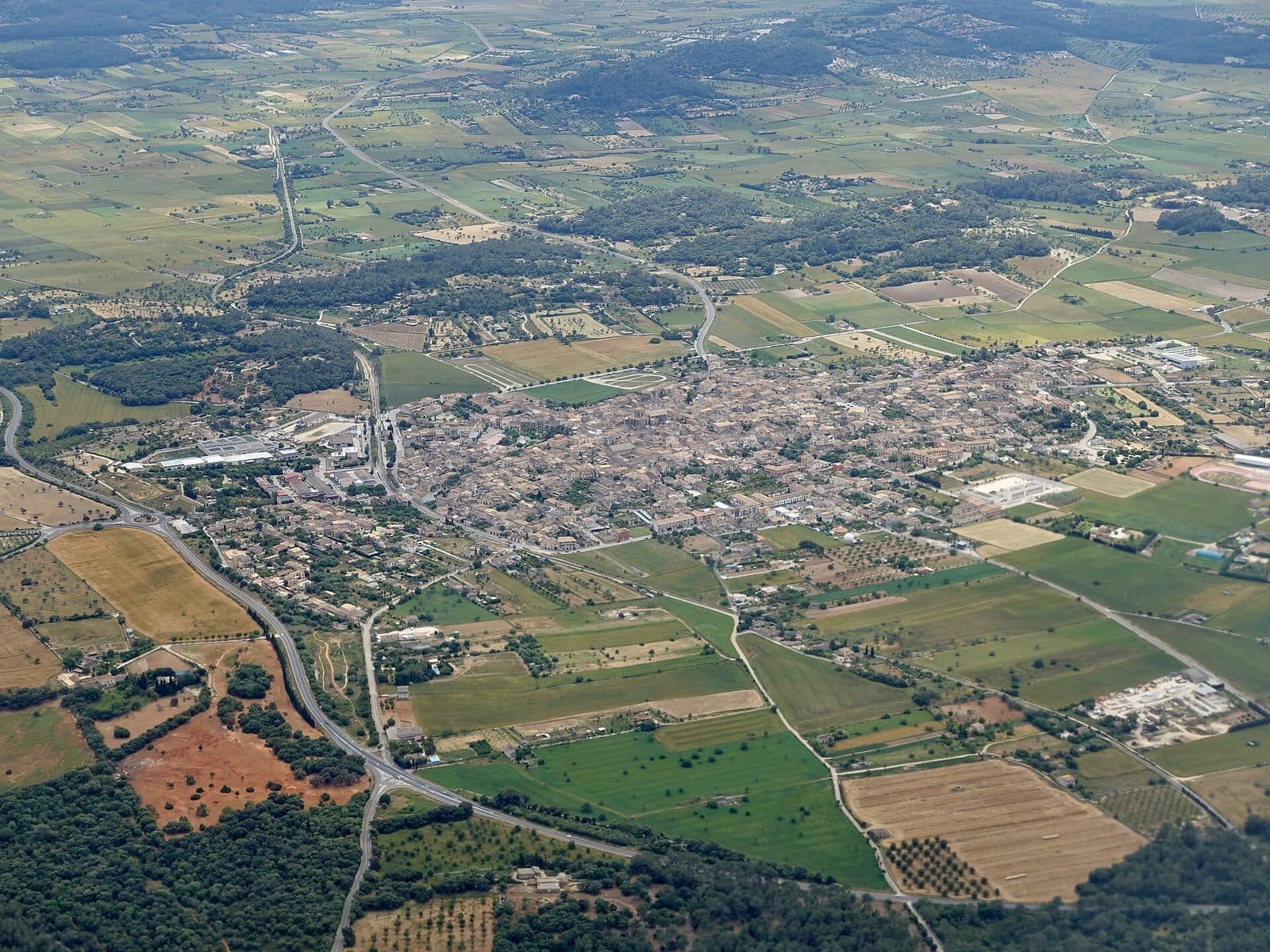
Sineu lies where Mallorca becomes expansive and agricultural: on the plain of Es Pla, far from beachfront promenades and large holiday resorts. The town is not a backdrop designed solely for visitors. It is a market town, a place to live and a regional meeting point all at once. This explains why the old town can feel almost silent on ordinary days before changing completely for the weekly market.
The main reason to visit is the remarkably cohesive historic centre. Pale natural stone, narrow lanes, manor houses, monasteries and the widely visible parish church tell of a past that was unusually significant for a town of this size. Sineu is best explored on foot: not through a single main attraction, but through squares, church façades and the old town's narrow streets.
Anyone wishing to discover rural Mallorca will find more than an excursion destination here. Restaurants, grocery shops, cafés, bakeries and other everyday businesses shape the town just as much as its accommodation. Outside market hours, Sineu remains considerably quieter than the coastal resorts.
Sineu also has a distinct character as a place to live. Its central location appeals to people who want to live in a manageable small town. At the same time, daily life involves travelling beyond the town for many more specialised needs, and a car can remain practical despite the availability of public transport.
History of Sineu
Sinium and Yitnau
Sineu's history reaches back to antiquity. The name Sinium is recorded from Roman times; during the Moorish era, the town was called Yitnau. Its location in Es Pla remained decisive in later centuries as well: Sineu was never a port or seaside resort, but a centre for the island's interior.
The former place name is not the only reminder of the Islamic period. The later Convent of the Immaculate Conception was built over a Moorish fortification whose origins are traced back to the eighth century. The present building complex therefore overlays several historical layers. It is precisely this reuse of older sites that helps explain why Sineu's history does not appear neatly separated into different eras in its streetscape.
Royal Residence in the Middle Ages
In the thirteenth century, the town was granted the status of a royal residence. A palace was built for King Jaume II in 1309.
The royal past explains the remarkable number of prestigious buildings in such a small country town. Manor houses, religious institutions, the rectory and the historic hospital point to a place that at times brought together political, ecclesiastical and economic functions for central Mallorca. The medieval streets of the old town remain recognisable today.
Market Town of Es Pla
More enduring than its role as a residence was Sineu's importance to agriculture and trade. The weekly market connected the town with the farms and villages of the plain. Livestock, agricultural produce, tools and everyday goods made Sineu a meeting place where people not only sold items but also negotiated, carried out repairs and exchanged news.
This function continues to shape the town more strongly than any single historical episode. The old town's squares still serve as social spaces, and the market spreads far into its streets and lanes. Sineu's present-day character therefore arose from two strands: the architectural legacy of a distinguished medieval past and its continuous role as a place of work and trade for the island's rural centre.
Things to See in Sineu
Santa Maria Parish Church
Santa Maria dominates Sineu's skyline. Its bell tower is particularly striking, divided into several sections with balconies and a pointed top. The church stands in the upper part of the old town and therefore also serves as a landmark: many market lanes and footpaths lead towards its surroundings. In front of the church stands the winged lion, which appears as a symbol of Sineu.
Convent de la Immaculada Concepció
The Convent of the Immaculate Conception was built on the site of a Moorish fortification whose origins are traced back to the eighth century.
Convent de Sant Francesc
The Franciscan Convent de Sant Francesc is one of Sineu's sights.
Plaça des Fossar
Plaça des Fossar is one of the most important places to spend time in the centre. Cafés with outdoor seating make it a good starting or finishing point for a walk. On quiet days, everyday life in Sineu can be observed here; during the market, the square becomes part of a much larger network of stalls and streams of visitors.
Hospital de Sineu and Rectory
The historic hospital and the rectory are among the buildings that make Sineu's former status as a regional centre visible. They are less spectacular than the parish church but important to the overall character of the old town.
Pontet de Santa Bàrbara
The small Pontet de Santa Bàrbara bridge is one of Sineu's sights.
Boundary Crosses
The boundary crosses are among Sineu's sights. They recall that Sineu has always been connected to the surrounding farmland and that the town did not simply end at its rows of houses.
Windmills of Sineu
Several windmills form part of the townscape. Not all are still in use; some stand empty or serve as storage spaces. Nevertheless, they are important landmarks. Together with the broad views across Es Pla, they form part of the image of central Mallorca.
Manor Houses and Old Town Lanes
Sineu's true strength lies between its individually named sights. Former manor houses can be found behind plain natural-stone façades. A walk should therefore not follow only the direct route between the church and the convent. The branching lanes often reveal the medieval character of the centre most clearly.
Sights in Sineu
The Weekly Market
Around the Church and Old Town
The weekly market is not confined to a single hall or enclosed square. It stretches around Santa Maria across squares, streets and smaller lanes. This changes the perception of the entire centre: routes that are normally quiet and manageable become busy market thoroughfares. The heart of the activity lies around the church, but the stalls extend considerably farther into the old town.
The market is one of Mallorca's best-known rural markets. Its importance rests not only on its size, but also on the connection between a visitor-oriented market and agricultural trade. Farmers from the surrounding area continue to use it as a meeting point. The livestock section distinguishes Sineu from many markets that focus almost entirely on food, textiles and souvenirs.
Food, Animals and Crafts
The stalls offer fruit, vegetables, meat, fish, spices and other regional foods. These are joined by ceramics, leather goods, linen, embroidery, basketry and wickerwork, clothing and goods aimed at tourists. The market is therefore neither purely a farmers' market nor merely a craft market. Its different sections appeal to very different visitors.
The trading of livestock makes its agricultural origins particularly visible. Sounds, smells and the practical handling of animals are part of the activity there. Families should be prepared for the fact that this section is not a staged petting zoo, but has grown out of a genuine rural trading tradition.
A Different Town on Market Day
Considerably more people come to Sineu on market day than at other times. Trains and buses can be very busy, and the central parking areas fill up early. Anyone mainly wishing to shop and experience lively Sineu has chosen the right day. Those who want to photograph architecture, examine façades and explore the old town in peace should also visit on an ordinary weekday.
After shopping, some of the activity shifts to the cafés and traditional restaurants. The market is therefore not an isolated morning event, but influences the rhythm of the restaurants and the entire town centre. This transition from trade to eating together is precisely what preserves its character as a regional meeting point.
Markets in Sineu
One market with dates, opening hours and what is on sale, in the market calendar.
Food and Drink
The Tradition of the Cellers
Sineu has traditional restaurants known as cellers. Traders and farmers visit these restaurants after the market.
Market, Agriculture and the Menu
On market day, the restaurants become active earlier and are livelier than on quiet days. Market visitors, traders and tour groups then meet in the same streets. For a relaxed lunch, it makes sense not to wait until the market stalls close and many people head towards the restaurants at the same time before looking for a table.
Plaça des Fossar and Café Culture
Plaça des Fossar is the most reliable place to observe public life over coffee or a light snack. Several independent cafés use the square for outdoor seating. Its appeal lies less in any single famous venue than in its location: from here, it is easy to follow the movement between market lanes, the church and residential streets.
Cafés and bakeries are also part of the town's everyday amenities.
Dining Without a Coastal Backdrop
Sineu offers neither harbour views nor beachfront terraces. The appropriate setting consists of natural-stone interiors, squares and narrow old town streets. This makes the town particularly appealing to those who see food as part of an excursion into rural Mallorca.
Eating, drinking and staying in Sineu
The best-rated businesses from our directory, ordered by Google rating — not by advertising.
Restaurants
- Frontón Sineu4.9· 59 reviews
- Restaurant Pizzeria Bella Sineu4.8· 374 reviews
- Mater Sineu Cafetería4.8· 101 reviews
- Kebab S'aturada4.8· 72 reviews
- La Cocina - Tapas restaurante y bar Sineu4.7· 347 reviews
- Officine194.6· 139 reviews
- ES CÓS restaurant4.5· 1053 reviews
- Restaurant el Molí d'en Pau4.5· 803 reviews
- El Rey De La Tapa - Tapas y Paellas en Sineu4.5· 592 reviews
- Can Pep Sineu4.5· 558 reviews
- Pizzeria Xiroi4.5· 338 reviews
- Rostisseria Sineu4.5· 49 reviews
Cafés and bakeries
- S'ERA Forn Artesà4.9· 92 reviews
- BOU Café Mallorca4.7· 15 reviews
- Sa Mola 134.6· 512 reviews
- Forn Can Toni4.6· 185 reviews
- Can Caragol Bakery4.6· 88 reviews
- Cafe Bistro Mara4.4· 260 reviews
- El Faro Sineu4.4· 72 reviews
- Bar Sa Serradora4.3· 110 reviews
- Bar Can Mikaleix4.2· 162 reviews
- Panord forn Sineu3.8· 269 reviews
Bars
Hotels and fincas
- Ten Mallorca5.0· 160 reviews
- Es Picarol Sineu5.0· 92 reviews
- CAS CATALÀ4.9· 119 reviews
- Hotel Can Serrete4.8· 205 reviews
- Sa Barcella4.8· 145 reviews
- Hotel Can Joan Capó - Adults Only4.8· 127 reviews
- Finca Sa Bastida Luxury Retreat & Spa4.7· 40 reviews
- Son Cleda Boutique Hotel4.5· 25 reviews
- Hotel i Celler Can Font - Restaurante y hotel en Sineu - Mallorca4.2· 519 reviews
- Agroturisme Sa Casa Rotja4.1· 170 reviews
Shopping and Crafts
Crafts at the Market
The most visible selection of crafts appears at the weekly market. Ceramics, leather goods, embroidery, linen, baskets and other wickerwork stand alongside food, clothing and souvenirs. Anyone specifically looking for local crafts should ask about their origin, material and place of production rather than relying solely on a traditional appearance.
The market is particularly suitable for comparing different goods in one place. The boundaries between everyday products and items for travellers are fluid. Basketry, textiles and food are offered at the market.
Food for Everyday Needs
Sineu also serves as a local supply centre outside the market. Supermarkets and grocery shops are among the sectors clearly represented in the town. For residents, this means everyday shopping does not necessarily require a journey to a larger town. For holidaymakers staying in fincas in the surrounding area, Sineu is also a practical place to buy provisions and combine shopping with a café visit.
The shops that remain open throughout the week are more important to understanding the town than a short market excursion might suggest. While the market attracts large numbers of visitors, these businesses maintain the normal weekly rhythm. As a result, the centre remains a functioning urban space and is not shaped exclusively by accommodation or restaurants.
Fashion and Small Shops
Fashion and clothing businesses are noticeably represented in the local commercial landscape. Nevertheless, visitors should not expect a traditional shopping district with long retail streets. Shopping in Sineu is therefore more likely to form part of a walk than a separate shopping day.
For larger purchases, the selection is naturally more limited than in Palma or the island's larger centres. The advantage lies in the short distances within the town. Many errands can be combined on foot once the car has been parked or the railway station left behind.
Local businesses and services
The best-covered sectors in our directory for Sineu — each with address, contact details and opening hours.
- Restaurant / Gastronomy25 listings
- Supermarket18 listings
- Hotel / Accommodation14 listings
- Fashion & Clothing13 listings
- Sports & Fitness12 listings
- Hairdresser / Beauty11 listings
Run a business here? Add it to the directory for free and be found on this page. Add your business
Activities and Excursions
Walking Through Sineu
The main activity in the town is a self-guided walk through the old town. A useful route leads from Plaça des Fossar to Santa Maria Parish Church, continues to the Convent of the Immaculate Conception and then follows side streets to the Franciscan convent. Along the way, the hospital, rectory and manor houses become parts of a coherent townscape.
Those who also include the windmills, boundary crosses and Pontet de Santa Bàrbara can add further sights to the walk. Sturdy footwear is advisable despite the manageable distances, as old paving, slopes and uneven pavements form part of the historic centre.
Costitx and the Planetarium
Costitx also lies in the centre of the island and is a good addition to an excursion through Es Pla. Nearby is Mallorca's astronomical centre, which operates as an observatory and planetarium. The contrast is appealing: Sineu focuses on medieval urban history and market tradition, while Costitx looks towards the night sky and scientific education.
Inca and Central Mallorca
Inca lies north of Sineu and is a suitable place to continue the journey.
Combining the Coast with a Day Trip
From its central location, both the Bay of Alcúdia in the north and destinations on the east coast can be reached. However, Sineu itself has no beach. Anyone wishing to combine the old town and the sea in one day should make Sineu the first stop and then continue to the coast. Such a combination is less flexible by public transport and should be planned using the current connections.
Festivals and Events
Agricultural Fair in May
One of the island's major agricultural fairs takes place in Sineu on the first Sunday in May. On a particularly large scale, it continues the town's role as a centre of rural Mallorca. Agriculture is the main focus.
For visitors, the fair offers an opportunity to experience the economic foundations of Es Pla in a visible way. At the same time, the town will be crowded, with more traffic and heavily used parking areas. Anyone coming solely for the architecture would be better choosing another day; those wishing to understand Sineu's regional importance can experience it especially directly during the fair.
La Mucada
La Mucada is a young, satirical folk festival celebrated in August that stands in clear contrast to the historic agricultural tradition. Its central features are the characters Much and Muca, imaginative costumes and the colour pink. The festival deliberately uses exaggeration, parody and local references and, despite its comparatively recent history, has developed into a major crowd-puller.
The programme includes a morning procession with bicycles and decorated vehicles to Puig de Reig, playful competitions and satirical ceremonies. After returning to the town, ironic prayers and a festive speech at the town hall follow. Some elements may initially seem puzzling to outsiders because the festival thrives on local jokes and its own rituals. It is precisely this self-created festive culture that distinguishes La Mucada from interchangeable summer events.
Two Sides of the Town
The agricultural fair and La Mucada reveal very different sides of Sineu. The fair draws on trade, livestock farming and the working life of Es Pla. La Mucada thrives on contemporary humour, costumes and a strong sense of local identity. What both events have in common is that they take over the small town centre completely and attract far more people than an ordinary day.
Anyone travelling to Sineu for these events should not plan it as a quiet sightseeing destination. Traffic routes, parking and access to individual buildings may change because of the festivities. In return, visitors can experience how the historic squares are not museum spaces but continue to be used for the town's public life.
Getting There and Getting Around
By Train
Sineu has a railway station and is therefore comparatively easy to reach without a car for a town of its size. Within the old town, a vehicle tends to be more of a hindrance anyway.
On busy market days, trains can be considerably more crowded than usual. Visitors should not automatically expect the return journey to be as quiet as it would be on an ordinary weekday. Timetables and possible changes should be checked before travelling.
By Car
From Palma, Sineu is reached via the roads of central Mallorca; the Ma-3011 is one of the direct routes used. The drive leads from the more densely developed area around the bay into the open landscape of Es Pla. Inca lies to the north, while other country roads branch off from Sineu towards villages in the island's centre and the eastern side.
Travelling by car is particularly practical when combining Sineu with Costitx, Inca, a country estate or the coast. The streets in the historic centre are narrow, and it is rarely worth searching for a parking space as close to the church as possible. It is more practical to park at the edge of the centre and cover the remaining distance on foot.
Parking and Market Days
There is a larger parking area in the centre, but on busy days it is used by hire cars, coaches and vehicles from the surrounding area. Arriving early makes the search easier. Those arriving later should allow extra walking time and avoid trying to work their way through already crowded old town streets towards the market.
Outside major events, traffic conditions are considerably more relaxed. The differences are so pronounced that market day and an ordinary weekday offer almost two distinct arrival experiences. This rhythm is important in residents' daily lives: regular journeys are easier to plan when market and festival dates are taken into account.
Buses and Getting Around Town
In addition to the railway, Sineu is served by regional buses. Current routes, stops and departures can be found in the timetable information on the relevant website. The latest stop information is essential for orientation.
Almost everything in the centre itself can be reached on foot. A car remains useful, however, for remote fincas, larger shopping trips or flexible excursions. Sineu can therefore be visited without a car, but should not be compared with a densely connected urban neighbourhood.
Bus lines to Sineu at a glance
| Line | Route | Departures/day | First | Last |
|---|---|---|---|---|
| 432 | Sineu - Algaida | 142 | 06:20 | 22:20 |
| T3 | Palma - Manacor | 77 | 06:37 | 23:11 |
| 441 | Ariany - Maria - Sineu | 37 | 06:25 | 22:42 |
| 442 | Sant Joan | 32 | 07:00 | 21:57 |
From the official GTFS feeds (TIB/SFM), no real-time data. The figures cover all stops in the town; weekend and holiday services differ — check with the operator before travelling.
Getting there by bus
IES Sineu 2 (60007) · 0.8 km as the crow flies
- 432Sineu - Algaida · Daily
IES Sineu 1 (60006) · 0.8 km as the crow flies
- 432Sineu - Algaida · Daily
Sineu Estació (220) · 1.0 km as the crow flies
- T3Palma - Manacor · Daily
Estació Sineu (60005) · 1.0 km as the crow flies
- 432Sineu - Algaida · Daily
- 441Ariany - Maria - Sineu · Daily
- 442Sant Joan · Daily
Timetable data: official GTFS feeds (TIB/EMT), no real-time — check with the operator before travelling.
Living in Sineu
Everyday Life Rather Than a Holiday Resort
Sineu has accommodation and a well-developed restaurant scene, but it is not defined by a beach or hotel season. The town centre remains a residential area and a place for everyday services. Cafés, bakeries, grocery shops, fashion retailers, and sports and fitness businesses indicate an infrastructure not aimed exclusively at day visitors.
The weekly market takes place on Wednesdays. The railway, shopping facilities and the town's role for the surrounding agricultural area all form part of its profile.
Living in the Old Town
The old town offers short distances, historic façades and immediate proximity to squares, restaurants and the market. At the same time, old houses and narrow streets bring typical practical considerations: access, parking, natural light and structural condition vary greatly from those in modern residential areas. Noise and restricted access should also be expected on market days and during festivals.
The central location is appealing to people who enjoy shopping on foot and participating in public life. Those prioritising peace, straightforward parking or generous outdoor areas are more likely to look on the outskirts or in the municipality's rural areas. From there, however, the distances to shops and the railway station increase.
Outskirts and Rural Surroundings
Development becomes less dense towards the edges, while windmills and open views across Es Pla become more prominent. Beyond the compact town centre, cultivated land shapes the landscape. These residential areas convey a stronger sense of rural Mallorca but generally require greater mobility in daily life.
The surroundings are not an isolated mountain landscape, but a cultivated plain. Agricultural traffic, seasonal work and the sounds of a productive rural area are part of it. Anyone looking for a finca should therefore assess the location not only by its views and driving time, but also by access and its actual proximity to services in the town.
Local Rhythm and New Residents
Sineu has preserved its character as a Mallorcan residential and market town, while its accommodation and restaurants show that visitors and newcomers are part of present-day local life. The old town is not an enclosed historical backdrop. Homes, businesses, the railway station and events generate different patterns of movement throughout the day.
The town is particularly suitable for people who want to combine rural surroundings with a compact centre. Sineu is less appropriate for those expecting daily access to the sea, metropolitan services or extensive nightlife. Its central location makes many journeys easier but does not replace the amenities of a larger town.
Practical Information for Your Visit
Market Experience or Quiet Old Town
The most important decision concerns not the season, but the character of the day you visit. During the weekly market, Sineu is loud, crowded and focused on trade. On an ordinary morning, façades and squares can be viewed in considerably greater peace. Anyone wishing to experience both should not regard a market visit as a complete picture of the town.
The period before the strongest midday heat is suitable for photographs and a focused architectural walk. The lanes offer some shade, but the routes to the windmills and outlying areas are more exposed. During major festivals, the event itself takes priority; a conventional sightseeing plan then makes little sense.
Length of a Walking Tour
Half a day is sufficient for the church, main squares and a short walk through the old town. Those including both convents, the historic hospital, rectory, bridge, boundary crosses and windmills should allow more time. Lunch in a celler or a break on Plaça des Fossar can easily turn the walk into a complete day trip in its own right.
Its value lies in the townscape, the market tradition and slow exploration.
Shoes, Children and the Livestock Market
Old paving, occasional slopes and uneven pavements make comfortable shoes advisable. Children may find the market, animals and winding old town lanes exciting. In the livestock section, however, it is appropriate to keep a safe distance from working activities and animals. Pushchairs can manage the main routes but become awkward in dense market crowds and on uneven side streets.
Outside market hours, the centre is manageable and comparatively easy to explore on foot. For families, Sineu works best as a varied cultural and market excursion combined with a café break or another destination in Es Pla.
Useful Combinations
Costitx and the astronomical centre fit thematically with a day in the island's interior. Inca is another suitable destination. By car, it is also possible to continue to the Bay of Alcúdia or the east coast after a morning in Sineu.
Those arriving by train will find it easiest to make Sineu the main destination and plan the day around the connections. Too many rural stops are difficult to combine without a car. This is precisely why the town is attractive to rail travellers: the old town, market and restaurants make a complete day trip possible without a driving tour.
Latest news from Sineu
- 27 Mallorca towns lack Alcover and La Balanguera
- Seven Mallorca shows: Fira Tàrrega takes the stage
- Endangered Mallorca horse takes centre stage in Sineu
- Palma protest: up to 19,000 demand Sánchez quit