
poblat pretalaiòtic des Figueral near Son Serra de Marina
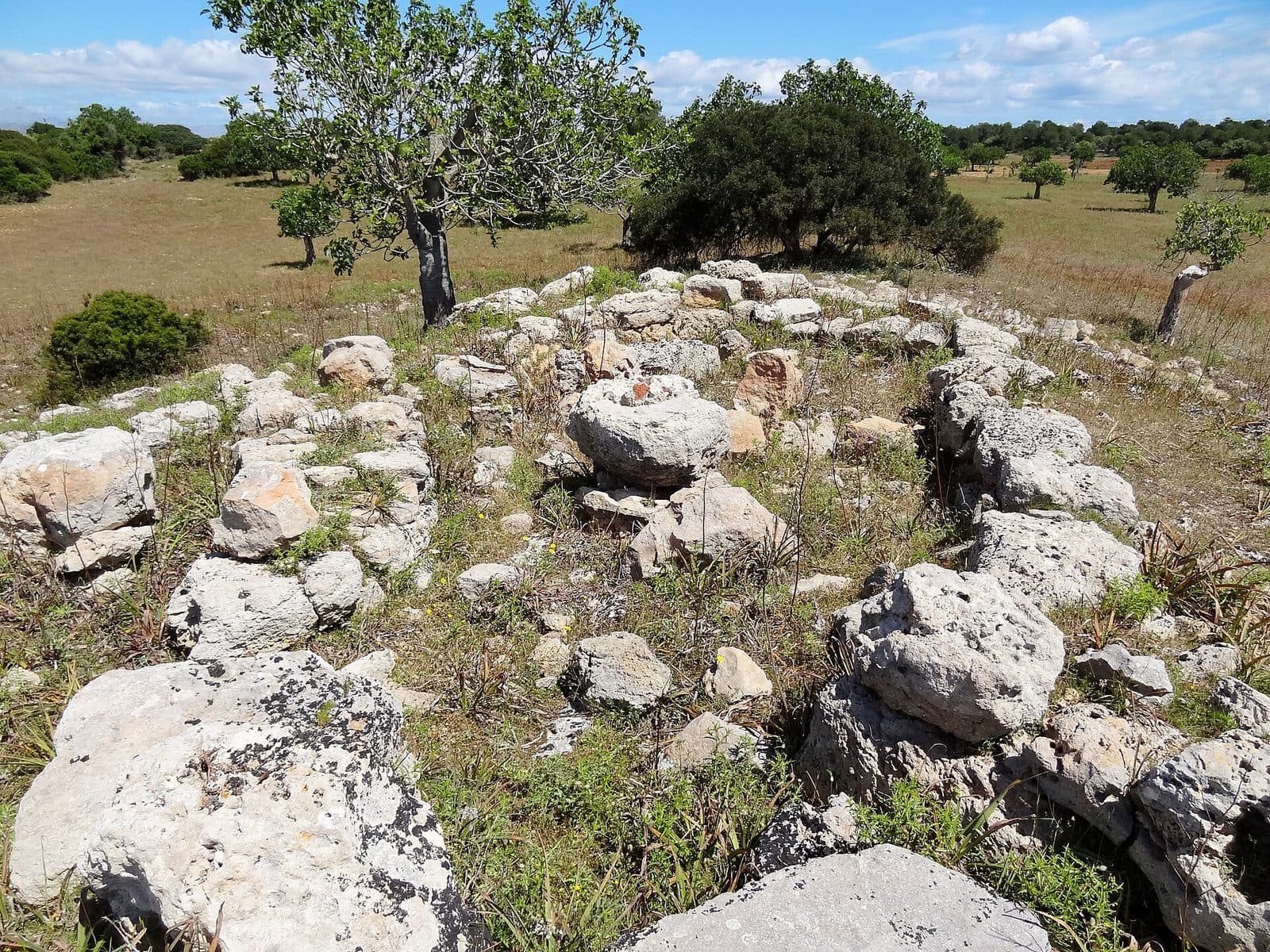

The poblat pretalaiòtic des Figueral is an archaeological site near Son Serra de Marina in the north of the island. Its remains are a reminder that this coastal landscape was inhabited long before the present-day town existed. The Catalan name explicitly describes a pre-Talaiotic settlement; in archaeological contexts, the site is also known as Es Figueral de Son Real. A visit thus opens up a historical perspective centred on its archaeological classification as a pre-Talaiotic settlement.
The site is particularly suitable for those interested in cultural history and travellers who wish to add an archaeological stop to a stay on the north coast. The experience requires curiosity: visitors should expect to encounter an archaeological site whose significance derives from its classification as a pre-Talaiotic settlement.
Son Serra de Marina provides an appealing starting point. The modern coastal town only emerged during urbanisation in the 1950s, while the poblat pretalaiòtic des Figueral points to a far more distant past. A vast historical arc connects the two: from a prehistoric habitat to a modern town visited mainly for its beach, natural surroundings and water sports.
History and significance
The site’s name already contains the crucial clue: “Poblat” means a settlement, while “pretalaiòtic” places it in the period before the Talaiotic culture. This is important because Mallorca’s prehistory was long divided into periods based on its most striking monuments, the talaiots. Their name derives from the Catalan word “talaia”, which is associated with views, observation and watchtowers. These tower-like structures gave rise to the terms pre-Talaiotic, Talaiotic and post-Talaiotic.
A period before the talaiots
The term pre-Talaiotic does not simply mean “very old”. It places the poblat pretalaiòtic des Figueral in relation to a profound transformation in Balearic settlement patterns and building traditions. During the Talaiotic period, Mallorca and Menorca were characterised by large towers built from massive stones. Researchers date the Talaiotic culture approximately from the middle of the 10th to the middle of the 6th century BC; technologically, it belongs to the Late Bronze Age and Early Iron Age.
Its name places the Figueral before this horizon. That is precisely where its value lies: the site draws attention not only to the island’s famous monumental structures but also to the developments that preceded them, and thus to a phase before the Talaiotic culture.
Talaiotic village communities
For the subsequent Talaiotic period, researchers describe small village communities that practised agriculture and livestock farming and produced mainly for their own needs. At the same time, the monumental communal buildings indicate increasing social differentiation. The poblat pretalaiòtic des Figueral is particularly interesting when examining this development because it recalls the earlier part of the island’s settlement history.
The familiar equation of Mallorcan prehistory with talaiots is too narrow here. The site represents precisely the world that preceded the tower architecture after which the period was named. Its historical appeal lies in this transition and in the question of how settlements were organised before large monuments emerged as widely visible communal focal points.
Landscape as part of history
Prehistoric architecture in Mallorca cannot be understood in isolation from its surroundings. Recent research into the Talaiotic culture explicitly examines how location and architectural form together determined the visibility of monuments. According to this research, the large towers were not merely massive buildings; their position in the landscape also gave them an impact, and they may have served as gathering places.
The Figueral, by contrast, is classified as a pre-Talaiotic settlement. Today, the poblat pretalaiòtic des Figueral is an archaeological site whose significance comes from its scholarly classification and the knowledge that this area formed part of an inhabited cultural landscape long before the coast was developed in modern times.
What to see
At the Figueral, the focus is on its archaeological classification as a pre-Talaiotic settlement site. The Catalan name identifies the place as a “poblat pretalaiòtic”, establishing the essential perspective from which to view it.
The settlement as a whole
The Catalan term “poblat” is the best starting point when viewing the site. It directs attention to its classification as a settlement. What matters here is the identification of the place as a pre-Talaiotic settlement site.
Pre-Talaiotic rather than Talaiotic
Its most important distinguishing feature is its chronological and cultural classification. Many visitors immediately associate Mallorca’s prehistory with the massive, tower-like talaiots. The name poblat pretalaiòtic des Figueral, by contrast, already warns visitors not to transfer that expectation to this site. It represents an earlier settlement phase and should be viewed from that perspective.
This makes the site a good place to understand archaeological terminology in practice. Here, “pre-Talaiotic” is not an abstract label in a textbook but describes a different position within the development of Mallorcan settlements. Anyone who later visits a Talaiotic site can compare the two impressions and more easily understand why the construction of monumental towers is regarded as such a profound transformation.
Stone, terrain and scale
The crucial point is the site’s archaeological classification as a pre-Talaiotic settlement. This forms an essential part of the visitor experience.
Reading the surroundings
At the Figueral, two periods exist side by side. The archaeological site points to early settlement, while Son Serra de Marina only began to acquire its present form during urbanisation in the 1950s. This contrast is more vivid than any timeline: within a confined area, a prehistoric settlement tradition meets a comparatively young coastal town. The Figueral therefore rewards careful observation; its strength lies in its archaeological classification as a pre-Talaiotic settlement site.
Visiting the site
It is best to explore the site without rushing, as the focus is on its archaeological classification as a pre-Talaiotic settlement.
Time for a closer look
No fixed visit duration can be inferred from the character of the site. Those who merely want a brief impression will stay considerably less time than visitors wishing to explore its archaeological classification in greater depth. Flexible planning without an appointment immediately afterwards is therefore advisable. The visit works well as a focused archaeological stop during an excursion to Son Serra de Marina.
The experience is particularly rewarding with some prior knowledge of the terms “pre-Talaiotic” and “Talaiotic”. Simply knowing that monumental towers characterised the Talaiotic culture during the first half of the first millennium BC changes how the site is perceived. The Figueral can then be understood as evidence of an earlier stage in settlement development.
Check current visiting conditions
Confirmed opening hours and admission conditions are not available. As access arrangements at archaeological sites can change, current conditions should be checked before travelling. This is particularly important if the Figueral is the main reason for a longer excursion. The text deliberately avoids quoting times or prices taken from other sources that may now be outdated.
There is no reliable information about typical visitor numbers at different times of day. Anyone hoping to experience the site in peace should therefore not base the visit on a supposedly guaranteed “quiet hour”, but should instead allow sufficient flexibility. Son Serra de Marina is visited mainly for its beach and water sports, but their popularity does not provide a reliable indication of conditions at the archaeological site.
Getting there and parking
The reliably calculated routes lead as far as Son Serra de Marina, not directly to the archaeological remains. This is important when planning: after reaching the coastal town, the precise approach or access to the poblat pretalaiòtic des Figueral must be determined using up-to-date navigation. A general statement about the final section would be less helpful than this clear distinction.
From Palma Airport
From Palma Airport, the route initially follows the Ma-30, then the Ma-13 and finally the Ma-3400 towards Son Serra de Marina. The road distance to the town is 67 kilometres, and the journey takes around 71 minutes. This time ends in Son Serra de Marina and does not include finding the way along the final section to the archaeological site.
The route crosses a large part of the island. Accordingly, the schedule should include extra time for leaving the airport, traffic and finding the correct access point. Anyone driving directly after landing should also bear in mind that an archaeological site deserves a more attentive visit than a rushed stop with luggage and a tight schedule.
From central Palma
From central Palma, the journey to Son Serra de Marina covers 64 kilometres by road and takes around 75 minutes. The route follows the Ma-13, Ma-3400 and Ma-3440. Here too, the stated distance and driving time refer specifically to the coastal town. Additional time should be allowed for continuing by car or on foot to the Figueral.
A comparison of the two routes shows that the shorter distance from central Palma does not automatically mean a shorter journey time. Urban traffic and the specific road layout affect the duration. For practical planning, the stated driving time is therefore more informative than the distance alone.
The final section and parking
No reliable information is available about a dedicated car park directly at the site. Vehicles should only be left where signs and local regulations clearly permit parking. Access points, paths and agricultural areas must not be blocked. Particularly at a less developed archaeological destination, it is sensible not to assume that there will be a visitor car park directly by the entrance.
No bus stop is recorded in the immediate vicinity. Travel plans should therefore not rely solely on a supposedly nearby stop. Anyone wishing to use public transport must separately check the current connection to Son Serra de Marina and the onward route to the site. Clarifying the final section in advance is particularly important for a visit with a tight schedule.
Nearby
Thousands of years of settlement history separate the Figueral from present-day Son Serra de Marina. The contrast is particularly striking because the coastal town itself is comparatively young. More extensive urbanisation began in the 1950s; within a few years, it developed into a retreat for island residents. Hotels shape the town far less than they do many other Mallorcan holiday resorts.
Son Serra de Marina
Son Serra de Marina belongs to the municipality of Santa Margalida and is visited mainly for its coastal landscape. The beach is the town’s main attraction. Surfing, kitesurfing and windsurfing play an important role there, while the absence of a large hotel skyline keeps the character of more heavily developed resorts at bay.
After the focused exploration of an archaeological site, the coast offers a clear change of perspective. The visit can therefore be combined effectively with time at the beach without forcing both destinations into a single activity. At the Figueral, the focus is on its archaeological classification as a pre-Talaiotic settlement site; by the sea, the view opens across the bay and the northern coastal landscape.
The archaeological landscape of Son Real
The wider Son Real area is known for several archaeological locations. These include the archaeological museum and interpretation centre, other prehistoric sites and the necropolis of Son Real. They should not be regarded as mere extensions of the Figueral, but they can add historical depth to the visit. Together, these places demonstrate that the northern coastal zone was used and shaped over a long period.
For a combined archaeology day, a clear sequence is helpful. The Figueral can first be viewed as a pre-Talaiotic settlement; additional sites and museum information can then provide the broader chronological context. Alternatively, anyone beginning at an interpretation centre will arrive at the site already equipped with terminology and comparative images. The two approaches shape perception in different ways.
Nature and coast
The surroundings of Son Serra de Marina are appreciated for their comparatively peaceful, natural feel. The beach, dune areas and proximity to the landscape of Son Real provide a contrast to densely developed holiday resorts. Water sports can be very prominent in suitable conditions, but the town is not solely a sports destination.
The combination of archaeology and coast is particularly coherent here because both present the same area from different perspectives. The sea does not automatically explain the prehistoric settlement, and today’s landscape should not be projected unchanged into the past. Nevertheless, it becomes clear that people knew, used and made this part of Mallorca their home long before modern urbanisation.
The place it belongs to
Son Serra de Marina in the place guidePractical information for your visit
The Figueral is a destination for attentive observers, not for quickly ticking off an attraction on a sightseeing list. Visitors benefit most from knowing in advance that “pre-Talaiotic” is an archaeological classification rather than the name of a particular building type. This avoids the false expectation that a large talaiot must form the centrepiece of the site.
What to expect at the site
An archaeological site conveys history differently from a reconstructed village. Before visiting, it is worth briefly learning about Mallorcan prehistory. The distinction between the earlier pre-Talaiotic phase and the later Talaiotic culture with its monumental towers is particularly helpful. More prior knowledge is not essential. This contrast alone prevents the Figueral from being judged by the standards of another period.
Preparation and respect
As current access conditions are not available, they should be checked before travelling. The same applies to the exact location of the access point and a permitted place to leave a vehicle. The stated routes and driving times only extend to Son Serra de Marina; they are no substitute for navigation to the archaeological site.
The archaeological site should be treated respectfully and must not be damaged. Local protection and visitor regulations must be observed. Even minor interventions can damage archaeological contexts that may appear insignificant to non-specialists. Considerate behaviour protects the site and also makes it easier for other visitors to observe it.
Visiting with children
The distinction between the earlier pre-Talaiotic phase and the later Talaiotic culture with its monumental towers provides an accessible starting point for learning about Mallorcan prehistory. Families should check in advance whether the current access conditions and terrain are suitable for their children’s ages and interests. During a longer stay on the north coast, the archaeological visit can then be combined with Son Serra de Marina and its beach.
Local insider tips
Read the name correctly
“Pretalaiòtic” is the key to the visit: the site is not one of the typical talaiot destinations with a monumental tower. Anyone who understands this distinction beforehand will recognise the historical value of the older settlement more clearly.
Combine archaeology and coast
After the Figueral, Son Serra de Marina provides a fitting contrast. The young coastal town, which has grown since the 1950s, is known for its beach and water sports and vividly illustrates the vast chronological distance from the prehistoric settlement.
Check the final section in advance
The reliable driving information ends in Son Serra de Marina. Check the exact access to the site and a permitted place to leave your vehicle using up-to-date navigation before travelling, rather than assuming there will be a signposted visitor car park.