
Tramuntana Lighthouse near Sant Elm
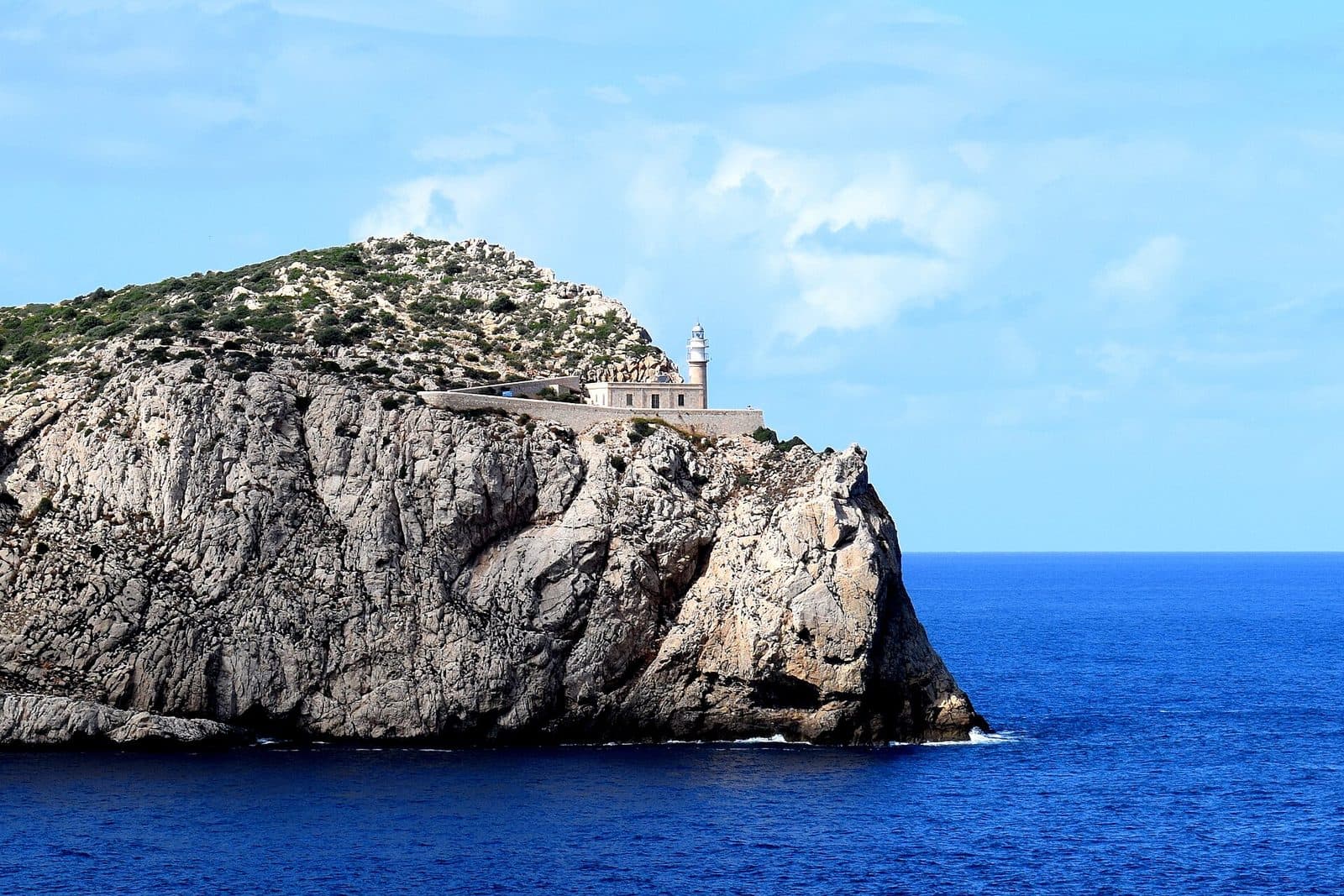

Here, Tramuntana does not refer to Mallorca’s mountain range but to the lighthouse at Cap de Tramuntana in the north of Sa Dragonera. The uninhabited, protected island lies off the coast of Sant Elm in southwestern Mallorca, separated from the main island by a narrow sea passage. The lighthouse is therefore part of the maritime landscape off Sant Elm, but it stands neither in the village nor on Mallorca’s main island.
This location is precisely what makes it so appealing. Tramuntana is not a conventional visitor attraction where tour buses stop and visitors naturally walk through the interior. Instead, the structure marks a remote point at the north end of Sa Dragonera. From Sant Elm, the wider picture comes into view first: the village coastline, the water between, and the long silhouette of the offshore island. The trip is therefore especially worthwhile for people who see lighthouses as part of a landscape, enjoy looking out to sea, or want to combine time in Sant Elm with Sa Dragonera. At Tramuntana, the focus is on its location, orientation, and the character of a remote navigational aid.
What to See
Cap de Tramuntana
The defining feature of this attraction is its position. The lighthouse stands at Cap de Tramuntana in the north of Sa Dragonera, not on the promenade in Sant Elm. The island lies off the coast of Mallorca and is said to be 700 metres from the main island. However, this figure does not describe a walking route or the distance from the village centre to the lighthouse, but the physical separation between Sa Dragonera and Mallorca.
At the cape, it becomes clear why lighthouses should rarely be viewed simply as individual buildings. The coastline, the sea, and the exposed position all shape how the structure is perceived. Tramuntana forms a reference point on the island’s northern side, while Sant Elm on the opposite coast is the land-based starting point for approaching Sa Dragonera. The experience comes from this sequence: first the village, then the expanse of water, beyond it the island, and finally the lighthouse’s remote location.
Reliable details about the building material, tower height, lantern room, or interior are not among the confirmed information available here. For planning a visit, it is therefore more important to understand what can actually be expected: a maritime destination in a protected island landscape, not a comprehensively documented architectural attraction. Even from Sant Elm, Sa Dragonera as a whole is initially the main focus; the lighthouse at its north end should not be mistaken for a building directly opposite on the shoreline.
Sa Dragonera
Sa Dragonera dominates the entire view from Sant Elm. The island is uninhabited and protected as a nature reserve. From the village, its proximity can seem almost effortless, but the water creates a clear boundary: neither the island nor its lighthouse can be reached by road or bridge. Anyone simply walking through Sant Elm therefore visits the coastal landscape facing the lighthouse, but not the site of the structure itself.
Taking this separation into account prevents a common planning mistake. On maps, Tramuntana may appear to be a nearby destination close to Sant Elm. Once there, however, it becomes clear that a distinct island passage lies between the coastal village and Sa Dragonera. To get closer, a visit to Sa Dragonera must be organised as a separate excursion. Boat trips to the island are offered from Sant Elm; whether the northern lighthouse can also be reached depends on the routes currently accessible and the excursion chosen, and should be confirmed in advance.
The View from Sant Elm
The most immediate way to experience the landscape is from the coast of Sant Elm. From the beaches and waterfront, the view extends directly towards Sa Dragonera and the smaller offshore island of Es Pantaleu. This places Tramuntana in its geographical context even if no crossing is planned. For a short visit, this is often more rewarding than searching for a supposed road route to the lighthouse.
The view also reveals something about the former importance of this stretch of coast. Sant Elm was long shaped by fishing, while the sheltered waters between the coast and the island served as an anchorage. Today, the scene is defined by the beach, restaurants, walks, and excursions to Sa Dragonera. Within it, the lighthouse remains a quiet reference point at the island’s edge rather than a showpiece detached from the village.
Visiting Tramuntana
View from the Village or Island Excursion
Before travelling, decide what kind of visit you have in mind. To see Sa Dragonera and its maritime surroundings, spending time on the coast of Sant Elm is sufficient. The waterfront is part of the village, and views of the island accompany a walk beside the water. Anyone wishing to experience Tramuntana from closer range must separately plan a crossing to Sa Dragonera and any onward route available there.
This distinction is important because the time required is entirely different. A viewpoint stop in Sant Elm can be incorporated into a walk around the village or time at the beach. A boat trip to the protected island, by contrast, is a separate excursion whose duration depends on the connection, weather, landing arrangements, and accessible route. Giving a standard visit duration for the lighthouse would therefore be misleading.
Crowds and Season
Sant Elm is exceptionally quiet outside the summer season; in summer, considerably more day visitors arrive for the beaches, restaurants, and trips to Sa Dragonera. Anyone wishing to enjoy the island view with as little activity as possible will therefore usually find a quieter atmosphere outside the peak summer period. At the same time, Sant Elm is highly seasonal, and some restaurants remain closed in winter.
Visitor numbers are not the only consideration for an excursion to Sa Dragonera. Boat connections and possible landings depend on current conditions, with wind and sea conditions potentially more important for an island destination than choosing a particular time of day. Before travelling, visitors should therefore check whether crossings are operating and which parts of the island can actually be reached.
Access and Expectations
No reliable general opening hours or admission price are available for Tramuntana. Current information should be checked immediately before visiting, especially if the plan involves not only seeing the view from Sant Elm but also approaching the lighthouse on Sa Dragonera. The fact that it is a lighthouse does not automatically mean that the tower or its interior is open to the public.
A visit should therefore not be planned around an expected interior tour. The reliable core of the experience is the lighthouse’s location at the northern end of Sa Dragonera and the relationship between the island, the sea, and Sant Elm. With this in mind, Tramuntana can be experienced as part of a coastal landscape. Anyone specifically seeking a tower that can be entered, an exhibition, or fixed guided-tour times should have these details explicitly confirmed before departure.
Getting There and Parking
From Palma to Sant Elm
The journey by road initially ends in Sant Elm, not at the lighthouse. It is 37 kilometres by road from central Palma, and the drive takes around 44 minutes. The route follows the Ma-1 and then the Ma-1030. The final stretch approaches the coastal village along a winding road through the mountainous landscape near S’Arracó.
After arrival, Sa Dragonera remains separated from the village by the sea. There is no road from the car park to Cap de Tramuntana and no bridge to the island. To enjoy the view, walk to the coast of Sant Elm. If visiting the island, a separate stage follows, involving a suitable boat connection and confirmation of which routes are accessible on the day of the visit.
From Palma Airport to Sant Elm
The distance from Palma Airport to Sant Elm is 47 kilometres by road. The journey takes around 45 minutes and follows Ma-20, Ma-1, and Ma-1030. These details also apply expressly only as far as Sant Elm. They should not be interpreted as the driving distance to the lighthouse, since Tramuntana stands on Sa Dragonera.
It is therefore advisable to divide the journey clearly into separate stages: first the drive to the coastal village, followed, depending on the plan, by a walk to the waterfront or an organised crossing. Leave enough time between a scheduled arrival in Sant Elm and any possible boat departure, as the approach road is winding and finding a parking space can take longer in summer.
Parking in Sant Elm
A paid car park is described behind the bathing bay. Another free parking option is located 200 metres away. These spaces serve visitors to Sant Elm and the coast; they are not parking spaces directly beside the lighthouse. In summer, beachgoers, restaurant guests, and participants in boat excursions compete for the available spaces, so parking may be more difficult than outside the season.
Anyone who needs to catch a boat should allow enough time to find a parking space and walk to the departure point. Without a fixed departure time, planning is more relaxed: leave the vehicle in the village, then walk to the waterfront for views of Sa Dragonera. No bus stop in the immediate vicinity of the lighthouse is recorded and, because of its island location, one would not provide direct access in any case. Current public transport connections to Sant Elm and timetables should be checked.
Bus lines to Tramuntana at a glance
| Line | Route | Departures/day | First | Last |
|---|---|---|---|---|
| 121 | Sant Elm - Andratx | 49 | 07:10 | 21:30 |
From the official GTFS feeds (TIB/SFM), no real-time data. The figures cover all stops in the town; weekend and holiday services differ — check with the operator before travelling.
Getting there by bus
S'Algar (5017) · 2.1 km as the crow flies
- 121Sant Elm - Andratx · Daily
Timetable data: official GTFS feeds (TIB/EMT), no real-time — check with the operator before travelling.
Nearby
Sant Elm
Sant Elm was originally a fishing village and is now a small, seasonal coastal resort. The foothills of the mountainous landscape rise behind the village, while Sa Dragonera lies offshore. This position gives a visit its distinctive rhythm: even without a crossing, the island remains present during walks, from the beach, and from many places beside the water.
Historically, this stretch of coast was also known as La Palomera. The forces of King Jaume I anchored here before landing at Santa Ponça in 1229. Es Pantaleu, the small island off the coast, is associated with this episode. This does not provide a construction history for the lighthouse itself, but it does offer the historical context of a sea passage that served as an anchorage and navigational area long before today’s excursion traffic.
Life in the village is concentrated primarily along the coast. Restaurants, bars, and smaller shops are located near the beach; outside the summer season, it becomes considerably quieter. Anyone wishing to experience Tramuntana only within its landscape setting can therefore combine the view, a walk, and a break beside the water without artificially extending the visit into a full-day itinerary.
Sa Gran and Sa Petita
The two sandy beaches of Sa Gran and Sa Petita make it possible to combine views of the offshore island with a swimming break. Sa Gran is the livelier beach area, while Sa Petita offers a smaller stretch of coast nearby. From this side of Sant Elm, it is particularly clear how close Sa Dragonera appears and how decisively the water nevertheless interrupts any direct land connection.
For families, the beach at Sant Elm is especially appealing because it slopes gently into the water. A beach day is therefore a sensible addition if not everyone in the group wants to take a boat trip or a longer island excursion. However, time at the beach should not be equated with a visit to the lighthouse: Tramuntana remains at the north end of Sa Dragonera.
La Trapa and the Coastal Landscape
The surroundings of Sant Elm are also known for hiking routes and natural attractions. La Trapa, founded by a monastic community in 1810, lies within the wider coastal landscape and is often associated with views of Sa Dragonera. The historic watchtower at Cala en Basset is another reminder of the coast’s former protection against pirates and privateers.
These destinations combine well thematically with Tramuntana but should be planned as separate outings. They help explain why this part of Mallorca is characterised by viewpoints, sea routes, and historic navigational landmarks. Anyone simply seeking a relaxing day can instead remain in Sant Elm, look towards Sa Dragonera across the water, and decide independently whether a crossing makes sense.
The place it belongs to
Sant Elm in the place guidePractical Visitor Information
A Lighthouse on an Island
The most common planning mistake results from describing the lighthouse as being “near Sant Elm.” Although Tramuntana belongs to the excursion landscape off the coastal village, it stands on Sa Dragonera. A navigation system that simply directs visitors to Sant Elm therefore takes them to the opposite coast, not to the structure itself. The final stage is not a drive: getting closer requires a suitable crossing and an accessible route on the island.
It is equally important to distinguish the lighthouse from the mountain range of the same name. Anyone searching for “Tramuntana Mallorca” will usually find information about Serra de Tramuntana. The place described here, however, is the lighthouse at Cap de Tramuntana.
Preparing for the Crossing
Normal clothing for a coastal village is sufficient for a viewpoint stop in Sant Elm. For a planned trip to Sa Dragonera, however, equipment should be chosen according to the routes currently open. Definitive information about the crossing, landing, and access should be obtained before visiting. This is particularly important for families, people with limited mobility, and anyone expecting to tour the interior. The family-friendly conditions on the beach at Sant Elm provide no indication of the routes to the northern lighthouse.
What Not to Expect
Tramuntana is not an easily accessible roadside lighthouse with parking at the door. Instead, it suits travellers who want to see a remote landmark in its geographical context and are willing to distinguish between the view from Mallorca, a visit to the island, and a possible approach to the cape.
Visitors who arrive with these expectations will avoid disappointment. The coast of Sant Elm alone conveys the distinctive setting: a former fishing village on one side, the uninhabited island on the other, and the sea as a clear boundary between them. Tramuntana remains the destination at the northern edge of Sa Dragonera—visible and accessible in different ways, but for that very reason a striking part of this coastal landscape.
Local insider tips
Do Not Confuse It with the Mountains
When searching, always add “lighthouse,” “Cap de Tramuntana,” or “Sa Dragonera.” Otherwise, maps and search results lead almost exclusively to Serra de Tramuntana, which shares the same name.
Understand the Location First
Before making elaborate excursion plans, it is worth viewing Sa Dragonera from the coast of Sant Elm. It immediately becomes clear that the lighthouse stands on an offshore island, not at the end of a village road.
Quieter Outside Summer
Sant Elm receives many day visitors in summer. Outside the peak season, the village is considerably quieter, although restaurant services and excursion connections may also be limited then.
Combine It with the Beach
Anyone not crossing to Sa Dragonera can combine the island view with Sa Gran or Sa Petita. The beach area that slopes gently into the water is especially suitable for an outing with children.
Confirm the Exact Boat Destination
A crossing to Sa Dragonera does not automatically mean that Cap de Tramuntana will also be reached. Before departure, ask specifically about landing arrangements, accessible routes, and the northern lighthouse.