
Sant Elm: Coastal Village between Sa Dragonera and Tramuntana
.jpg)
Places to stay in Sant Elm
AdTo load the accommodation map by our partner Stay22, we need your consent for marketing cookies. Your consent applies to all marketing content on mallorca.com.
Sant Elm lies where Mallorca's southwest coast meets the foothills of the Serra de Tramuntana. The silhouette of Sa Dragonera stretches across the horizon in front of the village, while wooded slopes rise behind it. This distinctive location shapes almost everything: the view from the beach, the hiking trails, the boat trips and even the feeling of having reached the end of the road.
The former fishing village has become a small holiday resort with hotels, apartments, summer residences and a remarkably strong dining scene. Even so, Sant Elm has neither the size nor the dense development of the better-known holiday resorts in the southwest. The village remains manageable, the coast is ever-present, and many visitors come not for an extensive sightseeing itinerary but for the beach, lunch by the sea or a trip to Sa Dragonera and La Trapa.
For families, the village's sandy beaches are the most straightforward attraction. Hikers will find more challenging destinations at the southwestern end of the Tramuntana, while nature lovers value Sant Elm primarily as a gateway to Sa Dragonera Natural Park. Those looking for traces of history will find them not in a self-contained old town, but scattered between the coast, a former sailors' hospital, monastery ruins and old watchtowers.
As a place to live, Sant Elm follows a pronounced annual rhythm. In summer, day visitors, holiday residents and boat traffic bring the streets and restaurants to life; in winter, many restaurants close temporarily and the village becomes considerably quieter. Anyone wishing to live here permanently is therefore choosing not only proximity to the sea, but also a small, seasonal coastal village at the outer edge of the road network.
History of Sant Elm
Before its present name came into common use, the coastal settlement was known as La Palomera. Its sheltered position opposite Sa Dragonera made it an anchorage long before the advent of modern tourism. Sant Elm is particularly closely associated with the conquest of Mallorca by King James I: his troops anchored here before landing at Santa Ponça in 1229. Local tradition highlights the small islet of Es Pantaleu off the coast as the first point where the expedition set foot on land.
The name Sant Elm refers to the patron saint of sailors. A complex dedicated to the saint was established in the Middle Ages; the building now known as Torre de Sant Elm emerged from this historical context. Its history as a sailors' hospital shows that the coast was important not only militarily and nautically, but also as a place of refuge and care for people at sea.
For much of the 20th century, Sant Elm depended mainly on fishing and salting the catch. This explains why the village's maritime past is more evident than any agricultural tradition. Small houses along the coast and its still-prominent fish cuisine recall a working community by the sea rather than a historic market town.
Tourism changed both land use and the population. Holiday homes, apartments, small hotels, restaurants and bars replaced the formerly dominant fishing economy. However, development remained spatially limited: Sant Elm became a summer and excursion destination without expanding into a large holiday resort. It is precisely this transition from fishing village to seasonal coastal settlement that defines its present character.
The hinterland tells its own story as well. In La Trapa, a monastic community founded a monastery in 1810 in a secluded position above the coast. The defensive towers of Cala en Basset and Llebeig, in turn, belong to a network of structures intended to warn of attacks by pirates and corsairs and protect the coastal areas. Sant Elm's past is therefore best understood as the history of an exposed landscape dependent on the sea.
Things to See in Sant Elm
Torre de Sant Elm
Torre de Sant Elm is the village's most important historic building. Despite being described as a tower, it is a medieval complex associated with a chapel dedicated to the patron saint of sailors and a former sailors' hospital. It represents the nautical role of this coastal settlement while also recalling the era of King Jaume II.
The building is interesting less for its monumental scale than for its location and significance. From here, it is possible to understand why sailors sought protection on this stretch of coast and why the saint's name was eventually adopted by the entire settlement.
Sa Dragonera
The elongated island of Sa Dragonera lies directly off Sant Elm and dominates almost every view of the sea. It is uninhabited and protected as a natural park. Its distinctive ridgeline makes it not only a scenic landmark but also the village's most important excursion destination.
Marked trails cross the island's rugged coastal landscape and lead to viewpoints. Its wildlife includes Balearic lizards. Because the crossing begins in Sant Elm, the village is one of the most practical starting points for visitors who want to do more than simply view Sa Dragonera from Mallorca.
Es Pantaleu
The small rocky islet of Es Pantaleu lies between the village beach and Sa Dragonera. It forms the near foreground of the broad Dragonera panorama and is closely associated with the memory of King James I's expedition. According to tradition, the Christian troops first set foot on land here before the fleet continued to Santa Ponça.
In today's village scenery, Es Pantaleu serves primarily as a point of orientation. From the beach and coastal area, it appears significantly closer than Sa Dragonera and gives the bay its layered sense of depth.
Sa Gran
Sa Gran is the larger of the village's two sandy beaches and extends for more than 180 metres. It lies directly beside the developed section of the coast, making it easy to combine swimming, a walk through the village and a restaurant visit without covering long distances. The view stretches across Es Pantaleu to the silhouette of Sa Dragonera.
The beach is the main reason Sant Elm attracts so many day visitors in summer. Unlike secluded coves, Sa Gran requires no hike, while the islands, boats and nearby Tramuntana slopes give the setting a much more scenic character than a purely urban beach.
Sa Petita
Sa Petita is Sant Elm's smaller sandy beach. It shares the same outlook over the sheltered sea passage and the offshore islands but feels more intimate than Sa Gran. A walk through the village should include both stretches of beach, as each offers a different perspective on the coast.
Cala es Conills
Cala es Conills reveals a different side of the coastal landscape. Instead of a fine sandy beach, it has a pebbly shoreline. Visitors who do not want to associate Sant Elm solely with its main beach will find here a glimpse of the southwest's rockier, more natural coast.
La Trapa
La Trapa lies beyond the compact village area in the mountains above the coast. The remains of the monastery founded in 1810 are a hiking destination and part of a protected natural area. Its appeal comes from the combination of ruins, secluded surroundings and sweeping views of Sa Dragonera.
La Trapa is not a sight for a short stroll in street shoes. A visit requires a dedicated hiking plan and shows how abruptly the Tramuntana mountains begin behind Sant Elm.
Torre de Cala en Basset
The watchtower of Cala en Basset stands on the coast north of Sant Elm. It is one of the historic defensive structures intended to guard against attacks by pirates and corsairs. Today, it is a prominent hiking destination above the cove of the same name, combining coastal history with a scenic route.
Torre de Llebeig
Torre de Llebeig is located on Sa Dragonera. It too formed part of the former coastal defence system. Visitors to the island therefore encounter not only a nature reserve, but also traces of an era when the strait off Sant Elm had to be watched and protected.
Sights in Sant Elm
Food and Drink
Sant Elm's dining scene is not merely an incidental amenity for beachgoers, but a central part of the village. Restaurants and bars are a prominent feature of the coastal area, and many visitors deliberately combine their excursion with lunch or dinner. The view of Es Pantaleu and Sa Dragonera is often just as important as the menu.
The local culinary tradition can be explained by the village's fishing history. Fishing and fish preservation provided livelihoods for many years, making fish, seafood and Mediterranean dishes natural choices. Today, the range extends from classic coastal cuisine to modern interpretations combining produce from the sea, Mallorcan ingredients and meat dishes.
Es Raor
Es Raor operates in an old fisherman's house whose history goes back more than three centuries. The building gives the restaurant a direct connection to Sant Elm's maritime past. Its cuisine combines Mediterranean produce with island ingredients and Mallorcan stocks, but presents them in a contemporary style rather than as unchanged traditional cooking.
The restaurant also continues the culinary history of the previously well-known El Pescador, which operated at this location for more than 25 years. This makes Es Raor more than an interchangeable coastal restaurant: the building, its predecessor and the current concept form a demonstrable continuity within the village's restaurant culture.
Fish Cuisine by the Sea
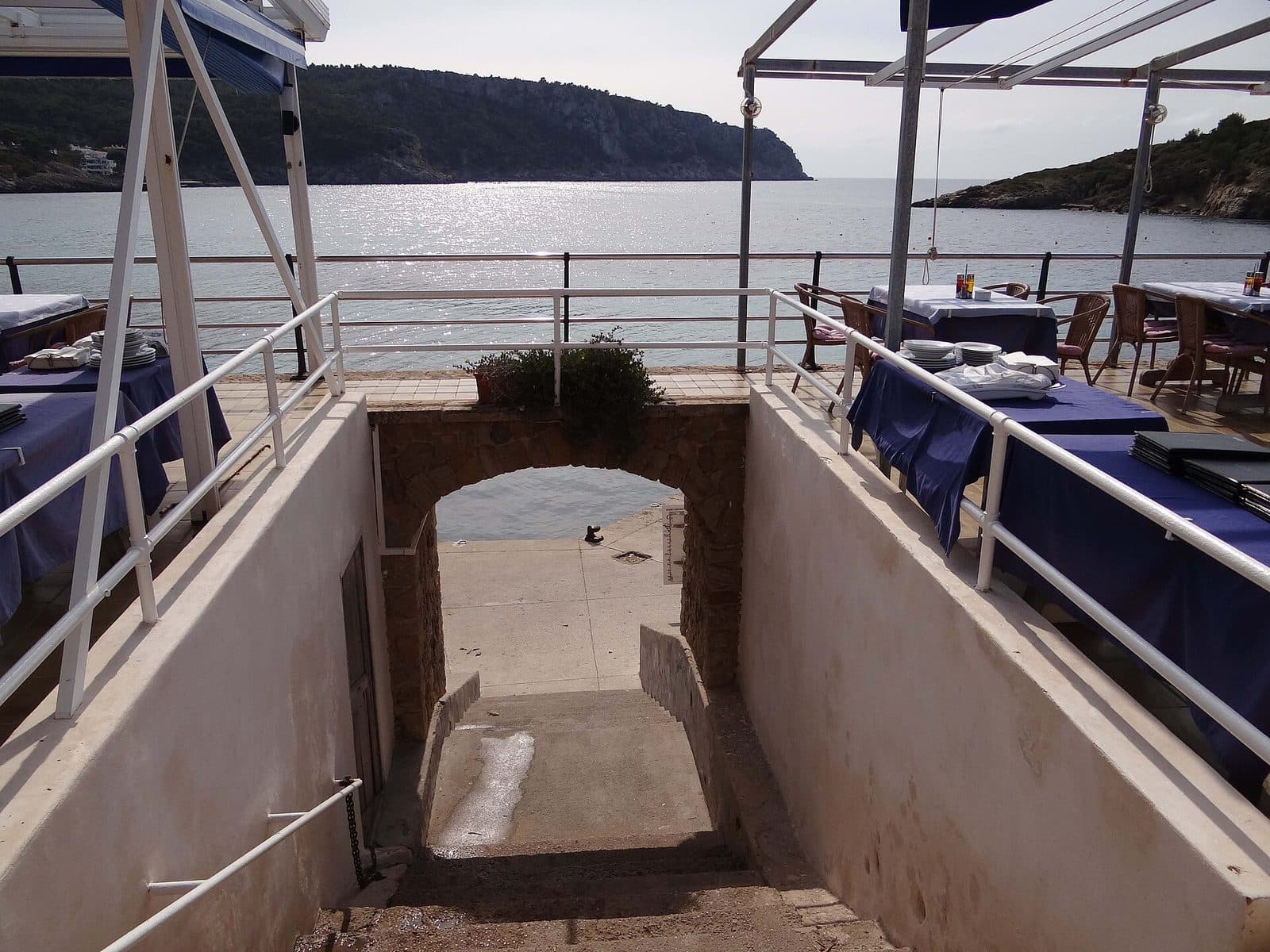
The setting remains influential beyond any single restaurant. Numerous restaurants face the sea and Sa Dragonera, making the meal part of the scenic experience. At lunchtime in particular, a beach visit or boat trip can be combined directly with the village's cuisine; in the evening, the view across the strait becomes the focus.
However, the wide selection should not be mistaken for consistent year-round operation. Sant Elm depends heavily on the summer season, and many restaurants use winter for their annual break. Outside the main season, which establishments are actually open is therefore more important to residents and visitors than the sheer number of restaurants.
Bars and Small Coastal Venues
Alongside restaurants, bars and smaller places to stop for refreshments are part of the village scene. They are concentrated in the livelier area between the beach, main street and sea. The dining scene is geared more towards beach days, excursions, hikes and meals with a view than an extensive programme of evening entertainment.
Eating, drinking and staying in Sant Elm
The best-rated businesses from our directory, ordered by Google rating — not by advertising.
Restaurants
Activities and Excursions
Boat Trip to Sa Dragonera
The crossing to Sa Dragonera is the signature excursion from Sant Elm. The destination is a protected natural area with marked hiking trails, viewpoints and distinctive wildlife. Depending on the chosen route, the island is suitable for a half-day or full-day excursion; it should not be regarded as a brief harbour cruise.
Because Sa Dragonera is uninhabited, its appeal lies precisely in its contrast with the busy coastal village. After arrival, visitors spread out along trails through an open, sun-exposed landscape. Sturdy footwear, water and timing that allows for the return crossing are therefore more useful than beach equipment alone. Whether crossings operate depends on the seasonal schedule and sea conditions.
Hike to La Trapa
The route to La Trapa leads from the holiday village into the mountains of the southwestern Tramuntana. Its destination is the remains of the monastery founded by monks and the view of Sa Dragonera. Few other activities around Sant Elm combine nature, history and coastal scenery so closely.
The route is not simply an extended village walk. Ascents, rocky terrain and the exposed landscape require suitable footwear, fitness and preparation. Anyone planning only a beach day should not fit La Trapa in as an afterthought, but treat it as the day's main destination.
Torre de Cala en Basset
Another hike leads to the watchtower of Cala en Basset. The route explores the rockier coast north of the village and ends at a historic observation point above the sea. The tower vividly illustrates how the beauty of this exposed coastline was once closely connected with the threat of attack.
The cove of the same name has a pebble beach and differs significantly from Sa Gran and Sa Petita. Anyone heading there should prepare for an excursion into nature rather than the amenities of a developed village beach.
GR 221
Sant Elm lies at the southwestern starting point of the GR 221 long-distance hiking trail. Known as the Dry Stone Route, it runs through the Serra de Tramuntana to northern Mallorca. For a stay in Sant Elm, the beginning is particularly interesting: even the first stages reveal the transition from the coastal settlement into the mountains.
The long-distance trail also explains why hikers are regularly seen in the village alongside beachgoers. Completing the entire route requires separate planning for stages and overnight accommodation; for a day trip, individual sections or destinations such as La Trapa can be selected.
Swimming at Sa Gran and Sa Petita
For families and visitors without sporting ambitions, Sa Gran and Sa Petita are the easiest destinations. Both sandy beaches lie within the village and offer unobstructed views of the offshore islands. Sa Gran is the larger and busier section, while Sa Petita provides a smaller alternative.
Especially in summer, Sant Elm should not be mistaken for a secluded cove. The village attracts day visitors, and the beaches are its most immediate draw. Those looking for a more rugged coastline will find it at Cala es Conills and Cala en Basset.
Water Sports and Coastal Experiences
The sheltered passage between Mallorca, Es Pantaleu and Sa Dragonera makes the sea a natural setting for activities. Alongside boat trips, various water sports are enjoyed in Sant Elm. The available options depend heavily on the season and weather.
Even without an organised activity, this stretch of coast is worth exploring on foot. Between the houses and along the livelier parts of the village, views of the sea repeatedly open up. The experience is less about a long promenade lined with sights than about changing perspectives on beaches, islands and boats.
Beaches in Sant Elm
3 beaches and coves with their own page belong to Sant Elm.
Festivals and Events
Festes de Sant Elm
Sant Elm's local festival is intended equally for residents, holiday-home owners and visitors. The municipality publishes a new programme each time, which may include cultural events, music and community activities. Because the content and individual dates change, anyone planning a visit specifically for the festival should consult the current programme.
Moros i Cristians
On the first weekend in August, a historical re-enactment on the main beach commemorates the landing associated with King James I. It is based on the tradition that his fleet anchored off Sant Elm and touched Es Pantaleu before continuing to Santa Ponça. The portrayal of Moors and Christians transforms this medieval chapter into a public beach event.
The setting is an essential part of the festival: Es Pantaleu is visible in the bay from the beach, directly connecting the historical narrative with the present-day landscape. Anyone visiting Sant Elm at this time should expect not an ordinary quiet beach day, but one of the liveliest moments in the local calendar.
Upcoming dates
Getting There and Around
By Car
Sant Elm is reached via the Ma-1030. The road runs from Andratx through s’Arracó and the wooded, mountainous foothills of the Tramuntana. The final section is winding and clearly conveys that Sant Elm does not lie on a continuous coastal route, but at the end of an access road.
From Palma and the airport, the usual route initially follows the main roads of the southwest towards Andratx. The journey from the airport is said to take around 50 minutes, although heavy traffic in the southwest and the slower mountain road can affect travel time. The final kilometres are not suited to a rushed schedule.
A car is particularly practical if Sant Elm is to be combined with Andratx, s’Arracó or other destinations in the southwest. Within the small village, however, the beach, coastal area, restaurants and boat departure point are close enough together to leave the car parked.
By Bus
Sant Elm is connected to the regional bus network. This makes visiting without a hire car entirely possible, especially as there are no great distances to cover within the village itself. However, coordinating with the current timetable is crucial: the village lies at the outer end of the route and does not offer the flexibility of a major transport hub.
When combining a bus journey with a boat trip, sufficient time should be allowed between returning from the sea and the bus departure. The same applies to hikes, whose duration cannot always be predicted precisely. The specific routes and stops are displayed separately on this page.
Rail and Getting Around the Village
A car is hardly needed in the centre. The small shopping area, restaurants, beaches and coastal views can all be connected on foot. Journeys to La Trapa, Cala en Basset and longer sections of the GR 221 also begin in or near the village, but then continue along hiking trails for which ordinary town shoes are inadequate.
Bus lines to Sant Elm at a glance
| Line | Route | Departures/day | First | Last |
|---|---|---|---|---|
| 121 | Sant Elm - Andratx | 147 | 07:10 | 21:38 |
From the official GTFS feeds (TIB/SFM), no real-time data. The figures cover all stops in the town; weekend and holiday services differ — check with the operator before travelling.
Getting there by bus
S'Algar (5017) · 0.3 km as the crow flies
- 121Sant Elm - Andratx · Daily
Sant Elm 2 (5014) · 0.5 km as the crow flies
- 121Sant Elm - Andratx · Daily
Sant Elm 1 (5015) · 0.5 km as the crow flies
- 121Sant Elm - Andratx · Daily
Cementeri de s'Arracó (5029) · 2.6 km as the crow flies
- 121Sant Elm - Andratx · Daily
Timetable data: official GTFS feeds (TIB/EMT), no real-time — check with the operator before travelling.
Living in Sant Elm
Daily Life between Peak Season and Winter
Sant Elm has permanent residents, but is strongly shaped by holiday apartments, summer residences and small hotels. This creates a marked seasonal change. In summer, day visitors, beachgoers, hikers and passengers on the Dragonera boats fill the village. In winter, it becomes very quiet, and numerous restaurants close for their annual break.
For permanent residents, this tranquillity can be a major advantage, but it also means less choice and fewer spontaneous everyday options outside the main season. Anyone considering Sant Elm as a place to live should therefore not experience the village only on a lively summer day. A winter visit provides a much more realistic picture of how greatly street life and dining options recede.
Local Amenities
The village has a small shopping area as well as restaurants and other food establishments. These cover some immediate needs but cannot be compared with the infrastructure of a larger municipal centre. Sant Elm is geared primarily towards residential life, holidays, the beach and dining; Andratx and s’Arracó, located along the access route, remain important reference points for needs beyond this limited local offering.
Daily life without a car therefore requires careful organisation. Distances within Sant Elm are short, and the existing bus stops provide connections towards neighbouring communities. Larger shopping trips, several appointments in one day or journeys outside suitable bus times are considerably easier with a private vehicle.
Commuting to Palma
The drive from the airport to Sant Elm is given as around 50 minutes; Palma lies along the same general route through the southwest. For commuters, however, a single ideal journey time matters less than the combination of the winding Ma-1030, the route through s’Arracó and Andratx, and traffic on the approaches to the capital.
Daily commuting by car is possible, but requires a willingness to cover a longer distance than from the more densely populated coastal resorts nearer Palma. Without a car, dependence on timetables and connecting services increases. This disadvantage matters less for occasional journeys; anyone required to work on site every day should test the route at their personal commuting times.
Residential Areas and Village Character
The housing stock consists mainly of holiday homes, apartments, residences and smaller houses. Locations near the beach and coastal area offer short walks to restaurants and the sea, but also experience the greatest influx of day visitors in summer. Houses and apartments towards the slopes are more strongly shaped by the transition to the Tramuntana and lie away from the immediate beach activity.
Alongside long-established inhabitants, international residents and second-home owners live in the village. As a result, the social density changes with the seasons: the temporary population increases significantly in summer, while permanent residents shape village life in winter. Anyone seeking year-round neighbourly life, a broad range of services and urban spontaneity will judge Sant Elm differently from someone who prefers coastal tranquillity and a compact setting.
Living without a Car
A car-free lifestyle is not impossible because Sant Elm is accessible by bus and the village itself is easy to navigate on foot. The beach, restaurants and small shopping area all lie within a compact area. The challenge begins with regular journeys beyond Sant Elm.
A car provides considerably more independence for commuters, households with frequent errands and people who depend on a wide range of services. Those who mainly work from home, rarely need to travel to the capital and can organise daily life around timetables have more favourable circumstances. The quiet winter season should be chosen just as consciously as the attractive seaside location.
Practical Information for Your Visit
Plan the Excursion around the Main Destination
Sant Elm can be visited in very different ways. A compact stay is sufficient for the beach and a meal, while Sa Dragonera or La Trapa can each become the focus of a half-day or full-day excursion. Anyone trying to fit everything into a short window underestimates either the boat journey or the demands of the hiking trails.
For a trip to Dragonera, the island connection should be confirmed first; a walk through the village can take place before or afterwards. For La Trapa and Cala en Basset, by contrast, it is advisable to plan the day from the outset around the route, weather and return time. The beach and a restaurant can then be an optional addition rather than the day's central schedule.
Distinguish Summer Activity from Winter Quiet
The widest choice of restaurants, boat trips and tourist activities is available during the summer season. At the same time, Sant Elm is significantly busier with day visitors. Anyone primarily interested in the landscape and village scenery should consider visiting outside the busiest summer beach periods, while accepting that fewer places and services may be open.
In winter, the village is particularly quiet, and many restaurants take a break. This is appealing for walks and for people deliberately seeking tranquillity, but it is not suited to a visit based on the expectation of spontaneously choosing among numerous restaurants and excursion options.
Choose Equipment to Suit the Coastal Destination
Sa Gran and Sa Petita are easily accessible sandy beaches in the village. Cala es Conills and Cala en Basset are more pebbly and natural. For La Trapa, Torre de Cala en Basset and sections of the GR 221, sturdy shoes, water and a realistic assessment of personal fitness are essential preparations.
Hiking trails and nature observation are also the focus on Sa Dragonera. Beachwear alone is not adequate for the excursion. Because the island is protected and uninhabited, everything needed for the planned stay should be taken along and brought back again.
What to Expect from the Village
The village's appeal lies in the direct combination of beach, sea views, natural park, hiking trails and maritime history. A walk therefore focuses on the coast, Torre de Sant Elm, the beaches and the views towards the islands.
Good combinations include Sa Dragonera followed by a meal, La Trapa with a quiet finish at the beach, or Sant Elm with s’Arracó and Andratx along the access route. Anyone expecting only a long shopping street or an extensive sightseeing programme, however, is choosing the wrong focus.
Local businesses and services
The best-covered sectors in our directory for Sant Elm — each with address, contact details and opening hours.
Run a business here? Add it to the directory for free and be found on this page. Add your business
Latest news from Andratx
- 27 Mallorca towns lack Alcover and La Balanguera
- Mallorca electric cars and fire demo fill Palma
- Balearics rental searches: 26% come from abroad
- Palma road closures: motorbike ride diverts buses