
Mallorca water temperature in December: 16°C & city winter
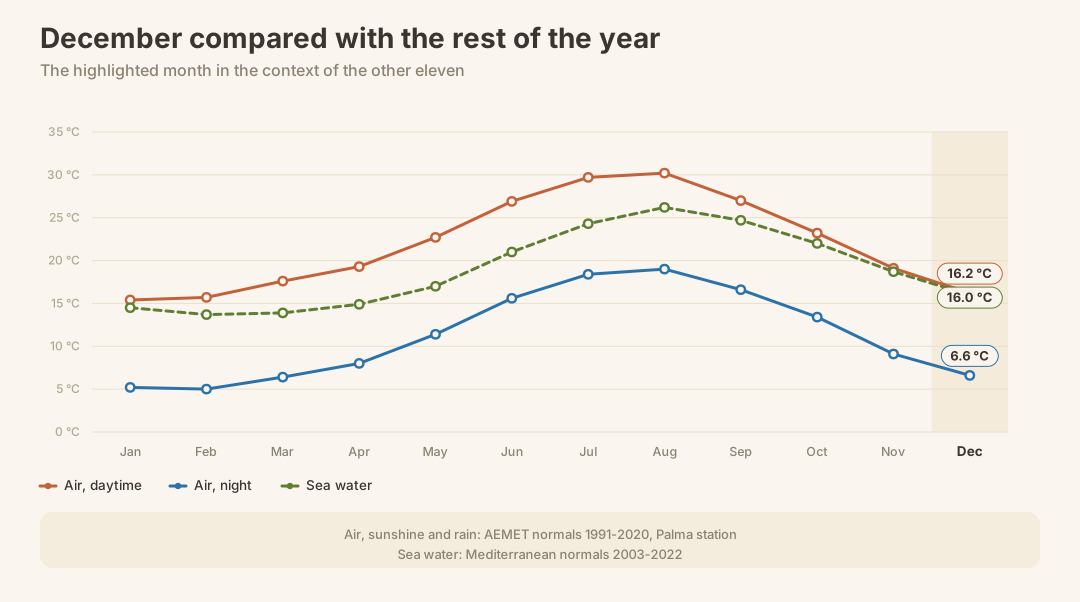
Palma normals as an island-wide approximation: In December, the average daytime high is 16.2 °C and the sea is 16 °C, with 6 rain days and 4.9 hours of sunshine per day.
By December, the beach season on Mallorca has long since officially closed, yet the sea itself keeps no calendar. It cools more slowly than the air does, and so remains noticeably milder for weeks after the first cool autumn wind than one might expect. Whether that is enough for a proper swimming day or only for a brief, bold plunge is what this article sets out to clarify – along with the question of why the water always lags behind the air, where around the island the warmest spots are to be found, and what still makes December worthwhile below the surface.
Water temperature in December
The answer up front: swimming is possible off Mallorca's coast in December, but only for those who don't mind cool water. The sea averages 16.0 °C this month – a temperature most people no longer find pleasant, but rather cool to cold. By comparison, most bathers only speak of comfortably warm water once temperatures reach the levels Mallorca doesn't see until late spring. Anything below that is described as fresh to unpleasant, and December sits squarely in that zone. It's enough for a brief, invigorating dip, but for extended swimming without a wetsuit, most people will find it uncomfortably cold.
Still, December on Mallorca is no bleak winter month. The island rightly counts as one of the mildest coastal regions in Europe at this time of year – frost is practically unheard of on the coast, and even on cloudy days temperatures often remain pleasant enough for long walks by the water. What does become scarce, however, is daylight: with 9.2 h, the days are short, the sun stays low even at midday, and dusk sets in early. Visitors to the island in December tend to think of the sea more as a backdrop for a stroll along the promenade than as a place for a whole afternoon in the water.
Palma reveals a different side of itself at this time of year: the Christmas markets around the cathedral and in the lanes of the old town create an atmosphere that has little to do with a beach holiday, yet shows just how versatile the island can be outside the summer season. At the same time, snow is quite possible in the Tramuntana above certain altitudes – a contrast that surprises many first-time visitors, strolling along the coast in a jumper while, just a few kilometres away, snow lies on the mountains. This span between mild coastal climate and wintry mountain weather is one of the reasons December on Mallorca is climatically more interesting than the simple question of swimming suitability would suggest.
Why the sea lags behind the air
The reason the Mediterranean remains relatively mild in December, even though the air has long turned autumnal and wintry, lies in a simple physical property: water has a far higher heat capacity than air. Warming or cooling a given amount of water requires much more energy than the same temperature change in air would demand. While the air temperature over the island can shift markedly within a few days after a change in the weather, the sea reacts sluggishly – it stores summer's warmth for months and releases it only slowly.
This inertia is clearly visible over the course of the year. Air temperature peaks as early as high summer: the warmest air month reaches 30.2 °C. The sea, by contrast, takes longer to absorb this warmth and reaches its own maximum with a delay: the warmest water month comes in at 24.7 °C, a good month after the air's peak. The same holds true in reverse during winter – the water doesn't cool at the same pace as the air but lags behind here too, which is exactly why the sea feels milder in December than the air temperature alone would suggest.
This shift is most obvious in spring, when the gap between air and water is at its widest. In April, for instance, the air already climbs to 19.3 °C, while the sea, at 14.9 °C, still lags noticeably behind the season – an effect many spring visitors underestimate when they set off to swim in summery warm air only to be caught out by a still-cold sea. In autumn and early winter, this relationship reverses: the air cools faster than the sea does, so that in December the water remains comparatively mild relative to the air temperature. Once you understand this mechanism, you can make sense of any month's water temperature without having to look up the exact figures each time – the rule is simply this: the sea always reacts with a delay, never instantly.
Where the water is warmest in December
Even though the island as a whole yields a single set of water temperature readings, the sea around Mallorca is by no means uniformly warm in December. How quickly a stretch of coast stores and releases heat depends heavily on the shape of the bay and the depth of the water. Shallow, sheltered bays warm up faster in summer and also cool down faster in winter, because there is less water volume available to store the summer warmth. Deep, open stretches of coast react more sluggishly in both directions – they don't get quite as warm in summer, but they hold on to that warmth longer in winter.
In the south and east of the island, around the shallow sandy bays near Colônia de Sant Jordi, at Playa de Palma, or along the resorts of the east coast between Cala Millor and Portocristo, this very effect means the water tends to stay somewhat milder in late autumn and early winter than elsewhere. The bays here are in many places shallower, the bodies of water smaller, and the residual warmth of summer tends to linger a little longer in these sheltered basins.
On the north-west coast, along the steeply falling cliffs of the Tramuntana between Sóller and Banyalbufar, the situation is reversed: here the water is considerably deeper, and the exposed location also brings more mixing through wind and currents. As a result, summer's warmth dissipates more quickly, and the sea here tends to be cooler in December than in the sheltered bays of the south and east.
One caveat is important here: there are no dedicated, verified measurement series for individual bays or beaches, only figures for the island as a whole. The differences described above rest on general oceanographic relationships between water depth, bay shape and exposure – they represent a reliable tendency, but not a basis for exact degree figures at any particular beach.
December's sea compared with the rest of the year
Looking at the year as a whole, December, at 16.0 °C, sits well below the warmest water month of the year, which reaches 24.7 °C. The gap to the coldest water month, however, is smaller: in February or March, when the sea passes through its low point, the temperature drops to 13.7 °C – only a few degrees below the December figure. This shows that December is already on the downward slope, but the true low point of winter still lies ahead.
More interesting than the comparison with the extremes is a look at the month that sits directly opposite in the calendar year: June, six months removed from December. Purely arithmetically, both months are equally distant from the summer and winter peaks, and yet the water behaves quite differently in each. In June, the water temperature stands at 21.0 °C – often not all that far above the December figure, even though June already lies in the midst of calendar early summer. The reason, again, is thermal inertia: in June the sea has not yet fully absorbed the warmth of the incipient summer, while in December it has not yet fully lost the residual warmth of the summer just gone. This asymmetry between spring and late autumn is one of the most striking features of the Mediterranean's water year.
Averaged over the whole year, the water temperature stands at 18.9 °C, and December sits clearly below that – a sign that it belongs to the cooler half of the year without yet marking its low point. Anyone wanting to understand the sea in its full range would do well, then, not to view December in isolation, but as a point on a curve that peaks in late summer and only reaches its low point in early spring – considerably later than a glance at the calendar alone would suggest.
Swimming, snorkelling, diving: what's worthwhile now
With a water temperature of 16.0 °C, the sea in December sits in a range where an ordinary swimsuit or pair of trunks will only serve most people for very brief spells in the water. A quick dip in and straight back out is easily manageable, but longer, relaxed swimming quickly becomes unpleasant for many, since the body cools rapidly at this temperature. Anyone wanting to stay in the water longer, for instance to snorkel along the rocky coastline, is far better served with a wetsuit – not out of excessive caution, but simply because the temperature lies below the comfort zone in which most people can manage without cold protection.
For divers, December mainly changes the equipment required, not necessarily the experience underwater. A semi-dry or dry suit is the obvious choice at this time of year, since longer dives at the current water temperature become uncomfortable, and over time even risky, without adequate cold protection. Underwater visibility, meanwhile, tends to benefit from the cooler season: plankton density is lower in winter than during the warm summer months, when algae and plankton blooms often cloud the water. As a result, the water is frequently clearer in December than at the height of summer, even though winter storms can churn up the sea and reduce visibility on individual days.
In short, December is less suited to extended days at the beach, but well suited to anyone willing to go in with the right gear: a short, refreshing dip without a wetsuit is entirely feasible, serious snorkelling and diving succeed with cold protection, and anyone who brings both – a wetsuit and a little willingness to embrace the cool – will be rewarded with a sea that is often surprisingly clear, in a way summer simply cannot offer.
Frequently asked questions
How cold is the sea in Mallorca in December?
Is December the coldest month for the sea in Mallorca?
Is any watersport still worthwhile in Mallorca in December?
When will the sea start warming up again after December?
What's on in Mallorca in December
Events
- Weekly Market in PorreresPorreres
- Weekly Market in LlosetaLloseta
- MovicantoDeià
- Puerto Portals Winter Series
- CHRISTMAS SHOWSant Llorenç des Cardassar
- EMMA ChristmasArtà
Worth doing now
- Leave swimming to the wetsuit crowd and enjoy a scenic coastal walk instead.
- Warm up afterwards with lunch at a cosy beachfront restaurant.