
Mallorca water temperature in November: bathing time at an end
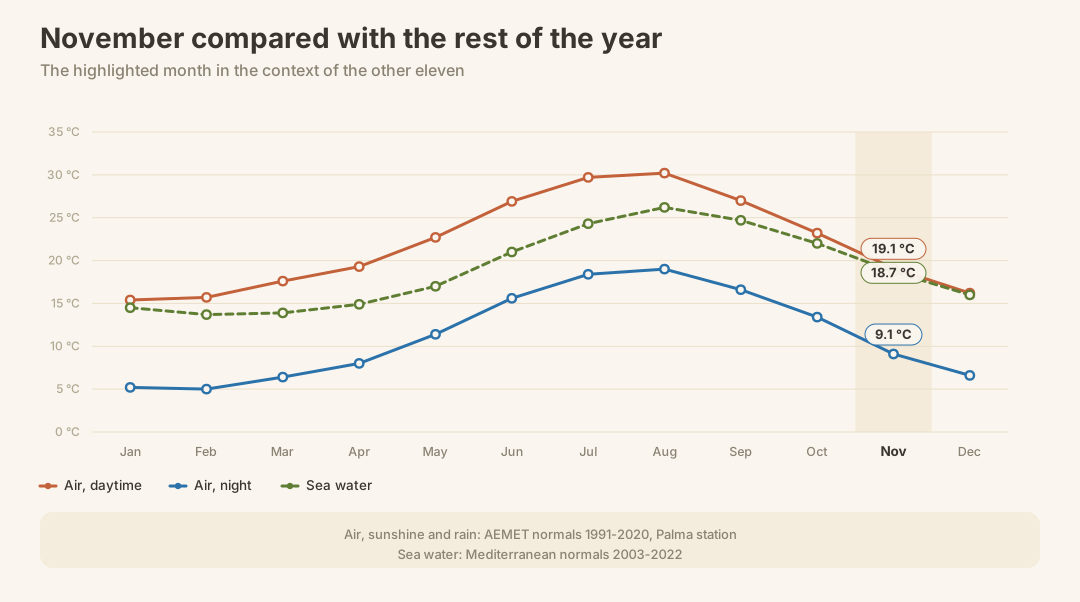
Palma normals as an island-wide approximation: In November, the average daytime high is 19.1 °C and the sea is 18.7 °C, with 6 rain days and 5.4 hours of sunshine per day.
In November the Mediterranean around Mallorca cools noticeably, yet the swimming season is not quite over. Anyone wondering whether a dip in the sea is still worthwhile this month, or whether the island now invites hiking rather than swimming, will find the answer here – with the measured water temperature, an explanation for its lag behind the air, a look at the differences between the various stretches of coast, and a placing of it all within the sea's annual cycle.
Water temperature in November
The short answer first: swimming is still possible in November, but it already feels noticeably fresher than in late summer. The sea around Mallorca averages 18.7 °C this month. That falls right at the threshold where perceptions diverge – hardened swimmers and those who go into the sea regularly throughout the year still call this pleasant, while anyone coming straight from the warmth of summer tends to find it cool to fresh. Still, the island in November is far from the kind of genuine cold that would rule out swimming altogether. The real difference compared with the summer months lies mainly in how long you stay in the water: a short, refreshing dip still feels good, but anyone wanting to splash about for hours as in high summer will soon notice the body cooling down.
The month itself is a transition, and this shows not only in the water but in the whole character of the island. By day, temperatures still climb to a mild 19.1 °C, dropping to 9.1 °C at night – a range that is ideal for walks, hikes and excursions, without the summer heat holding things back. The sun shines for an average of 5.4 h, providing plenty of bright hours even as the days grow shorter overall. Rain falls on 6 rainy days – usually in passing showers rather than settling in for days on end. In between there are often surprisingly sunny, clear days that are well suited to excursions.
What stands out most in November is just how much the length of daylight has changed compared with summer. With only 9.8 h of daylight left, dusk moves noticeably closer to the afternoon than one is used to from the long summer evenings. This also affects planning: anyone still keen to swim should make use of the midday hours, when the air temperature reaches its daily peak and a swim afterwards leaves you less chilled.
For most travellers, the focus shifts this month from the coast to the inland areas anyway. The temperatures are ideal for hiking in the Serra de Tramuntana, exploring the island's towns and villages, or cycling through the interior, without being slowed down by summer heat. Anyone still keen to go into the water should plan it as a short, deliberate swim rather than hours of sunbathing in the sea as in July or August – the air is simply no longer warm enough to quickly warm the body back up after swimming. Having a towel and dry clothes within reach already makes a noticeable difference.
Why the sea lags behind the air
The fact that the water is still comparatively mild in November, while the air already feels autumnal, has a simple physical explanation: water stores heat far more efficiently than air. Raising the temperature of a given quantity of water by one degree requires many times the energy needed to achieve the same rise in air. This property, known as heat capacity, means the sea does not respond to individual warm or cold days but to the sum of many weeks and months. It warms slowly over the whole of spring and summer, then releases that stored energy just as slowly afterwards, often across the entire autumn.
This inertia can be clearly seen in the way the respective warmest months are shifted. The air usually reaches its peak as early as August, with values around 30.2 °C. The sea, by contrast, takes longer to convert the absorbed solar energy into warmth, and does not reach its warmest phase until September, by which point air temperatures are already easing slightly. At that point the water measures 24.7 °C – often even more than in August, the supposed height of summer, when it stands at 26.2 °C. Anyone travelling to the coast in September will therefore quite often find the warmest bathing water of the whole year, even though summer is already drawing to a close on the calendar.
This lag becomes most apparent, however, not in autumn but in spring. While the air already climbs to 19.3 °C in April and the sun visibly gains strength, the sea has by no means shaken off the cold of winter and reaches only 14.9 °C. The gap between air and water is wider at this time of year than in any other month – an effect that surprises many spring visitors, who expect an equally mild sea after warm days on land and instead find unexpectedly cold water. The reason is that the air responds within a few sunny days, while the sea still carries the cold of the entire winter within it and can only shed this gradually, over weeks.
In November the situation is, in a sense, the reverse of spring: the air is already cooling noticeably, but the sea holds on to the warmth stored over summer for a few more weeks before winter gradually takes hold there too. This asymmetry between spring and autumn – in spring the water lags behind the warm air, in autumn the cooling air lags behind the still-warm water – is a direct consequence of the same physical inertia, and explains why autumn swimming on Mallorca is often more pleasant than the calendar month would suggest.
Where the water is warmest in November
Even though the island seems small and manageable in climatic terms, water temperature varies noticeably from one stretch of coast to another – and these differences become more apparent in late autumn than in high summer, when the sun shines with roughly equal strength everywhere. Shallow, sheltered bays warm up faster over the course of the year and also retain their stored heat for longer, because a smaller volume of water responds more quickly to sunlight and mixes less with cooler deep water. In November, once the general cooling has already set in, this advantage becomes especially noticeable.
This applies above all to the bays in the south and east of the island. Playa de Palma and the adjoining Bay of Palma, the broad sandy beaches around Cala Millor and Cala d'Or, and the large, gently shelving Bay of Alcúdia in the north-east are among the stretches where the water tends to stay mild longest in late autumn. These bays are also often shielded by headlands or offshore islands from strong mixing with the open sea, which reinforces the effect further.
On the north-west coast, conditions are noticeably different. Off the Serra de Tramuntana the seabed drops away steeply in many places, the water is deep and open to the sea, which means it mixes more with cooler layers and stays cooler overall. Places such as Port de Sóller, the rugged coastline near Sa Calobra, or the area around Banyalbufar therefore lie on the noticeably cooler side of the island in late autumn. Anyone wanting to swim in this region should expect lower temperatures than in the south-east.
For individual bays and beaches, however, there are no separate measurement series beyond the island-wide averages – so the differences described between the various coastal stretches can only be described qualitatively, not backed up with verified figures for every single beach. As a rough rule of thumb, though: the flatter, more sheltered and sandier a bay, the more a swim is still likely to be worthwhile there in November, while open, deep and rocky coastal stretches in the north-west already feel distinctly fresher and rougher.
November's sea compared with the rest of the year
To put November properly into context, it helps to look at the sea's entire annual cycle around Mallorca. At 18.7 °C, the month sits noticeably below the year's peak, which is usually recorded in September and reaches 24.7 °C there. At the same time, November still lies clearly above the year's low point, which typically occurs in February or March at 13.7 °C. November thus marks a midpoint on the year's downward slope – carried by the residual warmth of summer, yet already noticeably on the way towards winter.
This relationship becomes especially revealing when compared with the month that lies at a similar distance from the warmest month, but on the other side of the year. Symmetrical to November, counted from the temperature peak in September, is July, when the water measures 24.3 °C. The fact that these two figures lie so close together, even though one month falls in the middle of summer and the other deep in autumn, demonstrates the sea's inertia more vividly than any other comparison: the water knows no calendar, responding only to the accumulated warmth of the preceding weeks. A swim in July and a swim in November can therefore feel surprisingly similar in terms of pure water temperature – even though conditions on land, from air temperature to daylight hours, could hardly be more different.
For the annual picture as a whole, this yields a clear result: averaged over the year, the water temperature stands at 18.9 °C, while the actual annual mean air temperature is 16.6 °C. November sits closer to the water's annual average than to either of its two extremes – neither especially warm nor especially cold, but a month of transition reflecting the calm between summer heat and winter cold. Anyone wanting to read the sea as an indicator of the season will therefore find in November more of a transitional phase than a marked turning point.
Swimming, snorkelling, diving: what is worthwhile now
Whether an ordinary swimsuit is enough or a wetsuit makes sense depends directly on the measured water temperature, not on subjective impressions. At 18.7 °C in November, normal swimwear is usually still sufficient for a short swim on a sunny day – provided you are not planning a long stay in the water and head back to land fairly promptly afterwards so as not to get chilled. For anyone wanting to swim, snorkel or even dive for longer, a thin wetsuit is advisable, since the body noticeably cools down over extended periods in the water at this temperature, even if the water itself does not feel cold on entry. Anyone who has already snorkelled with a wetsuit in October or September will not notice much difference in November – the water temperature drops only gradually from month to month, not in sudden steps.
When snorkelling and diving, visibility underwater matters alongside the temperature itself, and in November this depends heavily on the weather above the surface. On the 6 rainy days with rainfall, run-off water can make visibility murkier in places near the coast, particularly close to river mouths and after heavier showers, when sediment is washed from land into the sea. On calm, sunny days between rain spells, however, visibility is often still very good, since the water is less affected by the algae and plankton growth that clouds visibility in some bays during high summer. Anyone wanting to dive is therefore better off planning flexibly and making use of the more stable weather windows between rainy days, rather than committing to a fixed date.
Overall, November is better suited to short, deliberate water activities than to extended beach days with hours of sunbathing in the sea. A swim around midday, when the air temperature reaches its daily peak, feels distinctly more pleasant than an early morning or late evening dip. Combined with a snorkelling session in a wetsuit in one of the sheltered, shallower bays in the south or east of the island, this is how to get the best out of the month without the gradually falling temperatures becoming a real obstacle. For keen divers, who usually wear a wetsuit anyway, November changes little – the slightly cooler water temperature is more than made up for by the often clear visibility and the generally calmer off-season atmosphere at many dive sites.
Frequently asked questions
Is the sea still warm enough to swim in Mallorca in November?
How quickly does the sea cool down in November?
Do you need a wetsuit for watersports in Mallorca in November?
Does the sea get colder still after November?
What's on in Mallorca in November
Events
- Competition showcase 2026Santa María del Camí
- 1st Theoretical-Practical Research Days in Body ExpressionPalma
- Calvià Emprèn forumCalvià
- Sunday FITZPalma
- Ritual ProjectsPetra
- Excursion to Finca de Son MesquidassaValldemossa
Worth doing now
- Take a brisk, wetsuit-optional swim before the water turns properly cold.
- Focus on coastal walks and sightseeing rather than long beach days this month.