
Remortgaging or taking a mortgage payment holiday in Spain
If you want to change the terms of your mortgage in Spain, it helps to make one distinction first: do you want the loan to be cheaper or more predictable in the long term, or do you need temporary relief from the monthly payments? For the first goal, you could change the terms with your current lender (novación) or switch to another lender (subrogación de acreedor). If you are facing a temporary shortfall, you could instead discuss a carencia: an agreed payment holiday or adjustment to your repayments.
These options have different effects on the outstanding balance, loan term and total cost. A lower monthly payment does not necessarily mean a cheaper loan. Here you’ll find out what to ask before switching lenders, how to raise the possibility of a payment holiday and why ‘free refinancing’ is not a claim you can rely on across the board. Even if your property is on Mallorca, your specific loan agreement determines which changes are possible and worthwhile.

What are the options for changing a Spanish mortgage?
In Spanish mortgage terminology, novación means changing the existing agreement with your current lender. With a subrogación de acreedor, another lender takes over as creditor. A carencia, by contrast, aims to provide temporary relief from payments. It is neither a change of lender nor a write-off of the outstanding balance.
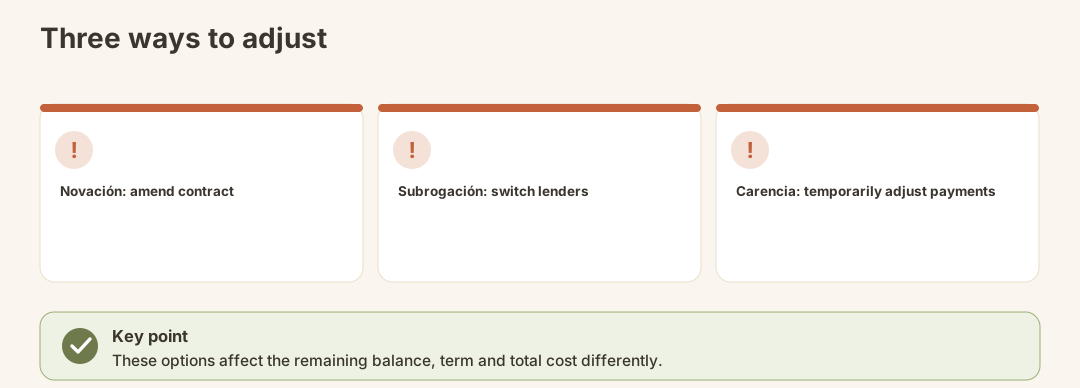

| Option | What changes | Question to ask before deciding |
|---|---|---|
| Novación | The terms of the existing loan with your current lender | Which terms of the agreement will change, and what will the total cost be? |
| Subrogación de acreedor | The lender changes | Do the benefits of the new offer outweigh the costs of switching? |
| Carencia | Payments are adjusted for an agreed period | Which payments will still be due, and what will happen to the instalments and loan term afterwards? |
Note: Transferring an existing loan, changing its terms and paying it off with a new loan are not the same thing. Make sure you get a clear explanation of the proposed arrangement before you sign.
When is it worth refinancing your mortgage in Spain?
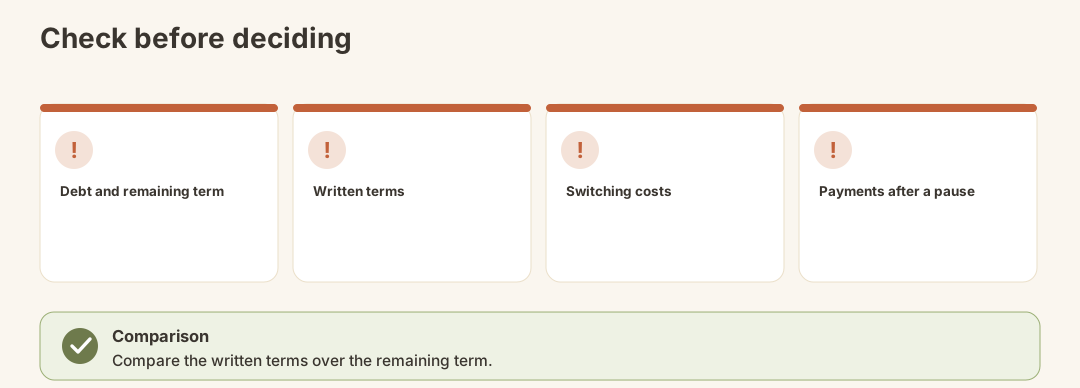
A switch is particularly worth considering if your current interest rate or fixed-rate period no longer suits your plans. But the comparison should not stop at the rate on offer: your outstanding balance, remaining term, any early repayment charges under your current contract, the cost of a new valuation and the terms of the new offer all matter.
First, ask your current lender for a written offer to change your mortgage terms. That way, you can see whether a novación would achieve your goal without changing lenders. When comparing fixed and variable interest rates, consider the risk you are willing to take in future – not just your next monthly payment.
A payment holiday addresses a different problem. If your payments are only temporarily unaffordable, it can give you some breathing room. But it is no substitute for comparing long-term borrowing costs.
How much does a subrogación cost – and is it free?
Only call a change of lender “free” once you have written details of every cost for your mortgage and the specific offer. Whether you face an early repayment charge depends on your contract terms and how the switch is legally structured. A new property valuation may also be required.
| What to check | Guide | What you should clarify |
|---|---|---|
| Property valuation (tasación) | Around €300–€500 is often given as a guide | Who arranges and pays for the valuation, even if the switch does not go ahead? |
| Charge under your current contract | There is no standard amount for every mortgage | Which clause applies to your outstanding balance and your switch? |
| Other costs and arrangements | Depends on whether the mortgage is transferred, changed or replaced with a new one | What costs does the specific offer list? |
The valuation range is a guide, not a guaranteed fee. If you mainly want to know how making an overpayment would compare with switching, see our guide to repayment schedules and overpayments.
What taxes apply when switching banks?
Simply changing lenders is not the same as taking out a new mortgage. That is why it would be misleading to claim that every form of “refinancing” has the same tax consequences. If the existing loan is repaid and replaced with new financing, the question of tax on documented legal acts (AJD) may be treated differently than it would be for a transfer.
Find out in advance which transaction will actually be formalised in a notarial deed and which taxes or charges the parties involved expect to apply. You can find more about this tax under AJD in Spain.
Please note: This article provides general information, not legal, tax or financial advice or a loan recommendation. The term “refinancing” alone does not establish either a tax exemption or a specific tax liability.
How does switching to another lender work?
Following these steps will help you compare offers and spot potential costs early:
- Review your existing agreement: Note the outstanding balance, interest rate, remaining term and provisions for early repayment.
- Define your goal: Do you want to reduce your monthly payments, limit interest rate changes or alter other terms?
- Get written offers: Ask your existing lender about changing the agreement, and also consider an offer to switch lenders.
- Compare the total costs: Look beyond the monthly payment to include the valuation, any potential early repayment charges and the terms over the remaining loan period.
- Clarify the arrangement: Ask for confirmation of whether the plan involves a subrogación, an additional change to the agreement or a new loan.
- Only then make a decision: Check that the final documents match the offer you compared.
The existing lender has 15 days mentioned. Do not treat this as a blanket deadline for every step in your case; ask for the procedure that applies to your situation to be explained in writing.
How do you request a carencia or payment holiday?
Contact the lender before you miss an agreed payment. Explain why you need temporary relief and when you expect to be able to resume your regular payments. Then ask for a written proposal showing not only the reduced payment but also what happens after the payment holiday.
Spanish lenders generally grant such arrangements for no more than one to two years. You are not entitled to this, and it is not a general guarantee. What matters is what you agree with the lender.
| Question for the lender | Why it matters |
|---|---|
| Which parts of the payment are suspended or reduced during the carencia? | A ‘payment holiday’ does not tell you what will still be payable. |
| How much will you pay during the agreed period? | You need a reliable plan for the period when money is tight. |
| How will the outstanding balance, instalments and loan term change afterwards? | A lower payment now can affect what you have to pay later. |
| What changes will be agreed in writing? | Verbal assurances are not enough for your financial planning. |
Important: Carencia does not automatically mean an interest-free loan or that outstanding payments are waived. Check the agreed terms carefully.
What documents and figures should you have ready?
For a discussion about novación, subrogación or carencia a clear assessment is more useful than rushing to settle on a target monthly payment. Have your loan agreement, current repayment schedule and proof of the outstanding balance ready. Also note the regular payments you currently have to make and what you would like to change.
When comparing offers, ask for a breakdown of payments over the remaining term. If you take a payment holiday, you also need the figures for the period after the holiday. A tasación may be needed for a new property valuation.
Most common mistakes
- Comparing only the next monthly payment. A lower payment does not tell you how much the loan will cost overall.
- Treating a switch of lender and a new loan as the same thing. The legal arrangement matters for the process and any associated costs.
- Mistaking a payment holiday for debt forgiveness. What matters is the written agreement on what remains payable and what happens later.
- Asking about valuation costs too late. Before commissioning the valuation, establish who pays if the switch does not go ahead.
- Accepting a counteroffer without a full comparison. Compare the final terms, not just a headline interest rate.
What happens next?
After a change to your loan agreement or a switch of lender, check the new repayment schedule against the signed documents and keep both. After an agreed carencia, it is particularly important to know when the later payment amount takes effect and to factor it into your plans in good time.
If you repay the loan in full instead, repayment is not the same as removing the registered mortgage. Further steps and proof that the debt has been settled are needed to remove it. This is particularly relevant if you want to sell the property later.
Checklist before you decide
- I know the outstanding balance, interest rate and remaining term of my loan.
- I know whether I need different terms permanently or only temporary relief.
- I have checked the terms for early repayment in my agreement.
- I have written terms for every option I am seriously considering.
- The valuation and any additional costs are included in the comparison.
- With a carencia I know what I would pay during and after the payment holiday.
- I know whether the proposed arrangement is a contract amendment, a transfer or a new loan.
Conclusion
There are several ways to adjust a Spanish mortgage. A novación changes your existing contract, a subrogación de acreedor changes your lender, and a carencia provides an agreed reduction in payments. The right option is determined not by the lowest advertised payment, but by comparing the written terms over the remaining mortgage term. If you are struggling to make payments, the most important next step is to speak to your lender before you miss one.
Official sources
- Boletín Oficial del Estado (BOE) – official publication of Ley 5/2019 on mortgage lending.