
ITP Balearic 2026: Tax Rates, New Value Thresholds and Bonifications for First Home Purchases
The ITP Balearic Islands 2026 is the single largest cost factor for every property buyer in Mallorca, Menorca, Ibiza or Formentera after the purchase price itself. Depending on the purchase price bracket, it can amount to between 8 % and 13 % of the transaction value — and since 1 March 2026 new value thresholds have applied that significantly broaden access to certain tax concessions. In this guide you will learn how the progressive banding works, when ITP applies and when VAT is due instead, which reduced rates apply when purchasing your own primary residence, what the calculation looks like in practice — and which mistakes typically prove costly. All figures refer to the legal position as at 2026; for individual cases we always recommend personalised tax advice.

Do you already know which ITP rate applies to your desired property — and whether you qualify for a reduction?
- 📩 Submit a personal enquiry — We will clarify your specific situation with a local tax adviser
- Overview of all purchase ancillary costs
What ITP is — and when it applies
The Impuesto sobre Transmisiones Patrimoniales (ITP) is a regional tax on property transfers. In the Balearic Islands it is administered by the ATIB (Agència Tributària de les Illes Balears). It becomes due whenever an existing property — that is, not a new-build first sale — changes ownership and the transaction is not subject to VAT.
Who pays? The buyer exclusively. The seller is not affected by ITP, but may have other tax obligations (Plusvalía, income tax on the gain).
When is ITP due? The tax must be declared and paid to the ATIB within 30 working days of the notary appointment. An extension of the deadline is possible but must be requested before it expires.
Please note: Anyone who misses the deadline risks surcharges of 5 % to 20 % on the tax liability, depending on how late the voluntary payment is made — plus interest on arrears.
ITP or IVA? The crucial distinction
Before the amount of tax can even be calculated, it must be established whether the purchase is subject to ITP at all or instead to VAT (IVA). A common mistake is to skip this check.
| Property type | Tax liability | Tax rate |
|---|---|---|
| Existing property from a private individual | ITP | 8 %–13 % (progressive) |
| New-build first purchase from a developer | IVA + AJD | 10 % IVA + AJD (variable) |
| Commercial property (subject to IVA) | IVA + AJD | 21 % IVA + AJD |
| Second-hand property from a company (IVA exemption waiver possible) | ITP or IVA | depending on the option chosen |
The classification is not always straightforward: if, for example, you are buying a flat from a limited company (SL) that originally acted as a property developer and has waived the IVA exemption, IVA may apply instead of ITP. Your lawyer or tax adviser must clarify this in advance — not at the notary's office.
The Balearic ITP Bands for 2026
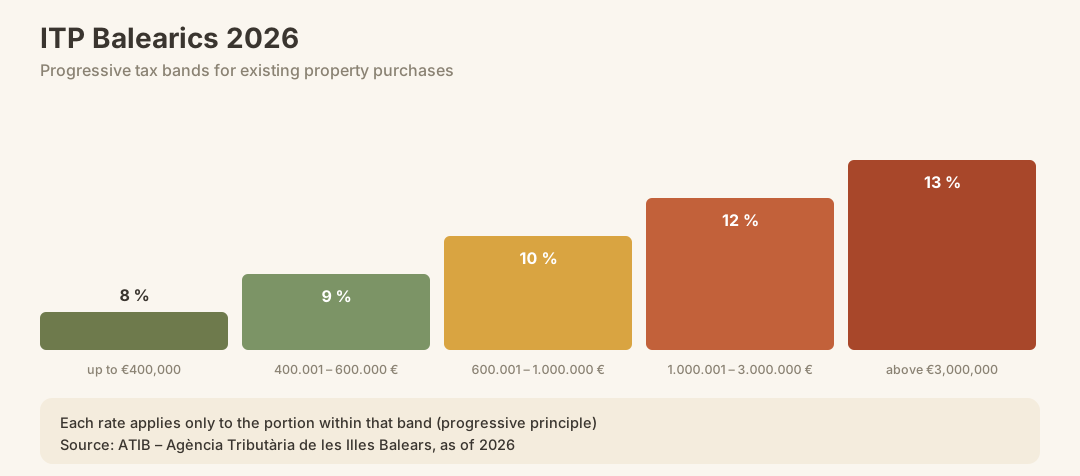
The Balearen apply a progressive tiered model: each rate applies only to the portion of the purchase price falling within the relevant band, not to the total price. This follows the same principle as income tax.
| Purchase price band | ITP rate |
|---|---|
| Up to 400.000 € | 8 % |
| 400.001 € – 600.000 € | 9 % |
| 600.001 € – 1.000.000 € | 10 % |
| 1.000.001 € – 3.000.000 € | 12 % |
| Over 3.000.000 € | 13 % |
Please note: The upper band thresholds may vary slightly depending on the source. The figures given here are based on the rates published for 2026 (sources [7], [9]); binding information is provided by the ATIB.
Worked example: purchase of a resale flat for 750.000 €
| Band | Amount within band | Rate | Tax |
|---|---|---|---|
| Up to 400.000 € | 400.000 € | 8 % | 32.000 € |
| 400.001–600.000 € | 200.000 € | 9 % | 18.000 € |
| 600.001–750.000 € | 150.000 € | 10 % | 15.000 € |
| Total | 750.000 € | Ø 8,67 % | 65.000 € |
Worked example: purchase of a villa for 1.500.000 €
| Band | Amount within band | Rate | Tax |
|---|---|---|---|
| Up to €400,000 | 400.000 € | 8 % | 32.000 € |
| 400.001–600.000 € | 200.000 € | 9 % | 18.000 € |
| 600.001–1.000.000 € | 400.000 € | 10 % | 40.000 € |
| 1.000.001–1.500.000 € | 500.000 € | 12 % | 60.000 € |
| Total | 1.500.000 € | Ø 10.0% | 150.000 € |
The new value threshold from 1 March 2026
The most important change of 2026: Since 1 March 2026 the property value thresholds that govern access to certain tax reliefs have been raised across the Balearen.
For Mallorca the new threshold is 307.089 €.
In practical terms, this means that more buyers than before can benefit from reduced rates or bonifications in the first place, because their property falls below this threshold or the qualifying portion extends up to this limit.
Please note: The increase in the value threshold does not mean that the entire purchase price is taxed at the reduced rate. The relief applies only to the portion of the property value up to the threshold — the portion above it is taxed at the standard progressive rate. This is precisely where most misunderstandings arise.
Reduced ITP rates: who benefits?
Balearic tax law provides for several situations in which a reduced ITP rate can be applied. The most common concern the purchase of a primary residence (primera vivienda habitual).
| Eligible group | Reduced rate (as a rule) | Special conditions |
|---|---|---|
| First-home purchase in general (below value threshold) | Reduced | Primary residence, value threshold must be met |
| Young buyers (under 36 years of age) | Reduced | Income limits apply |
| Buyers with a recognised disability | Reduced | Degree of disability is the determining factor |
| Large families (familia numerosa) | Reduced | Title must be present |
Please note: The exact reduced rates and the respective income thresholds are set by Balearic tax law and may be adjusted annually. Always have the applicability checked by an adviser specialising in Balearic tax law — the ATIB tends to show little leniency when it comes to retrospective corrections.
Tax base: purchase price or reference value?
Since 2022, it applies throughout Spain that ITP is calculated on the higher value of the purchase price and the official Valor de Referencia (reference value). The reference value is set by the land registry (Catastro) and is based on market data.
Practical consequence: If the purchase price is below the reference value, the reference value is nonetheless used as the tax base. In Mallorca, where purchase prices are often very high, the reference value is in many cases lower than the market price — in which case the purchase price applies. However, where negotiated prices are below market level, this can lead to an unpleasant surprise.
| Situation | Tax base |
|---|---|
| Purchase price > reference value | Purchase price |
| Purchase price < reference value | Reference value |
| Reference value not available | Purchase price (or minimum value set by ATIB) |
You can check the reference value of a specific property in advance via the Catastro online portal (sede.catastro.gob.es).
New-build: when IVA applies instead of ITP
If you purchase a property directly from the developer as a first acquisition, no ITP is payable — instead the following applies:
- 10 % IVA (VAT) on the purchase price
- AJD (stamp duty / Actos Jurídicos Documentados): The rate varies depending on the Autonomous Community; in the Balearics it is worth noting, but remains well below the ITP
Note: For subsidised housing (VPO / VPP), a reduced IVA rate of 4 % may apply — however, this is subject to strict conditions and is rarely relevant on the open market in Mallorca.
The total burden on new builds is often similarly high to that of the ITP, because the 10 % IVA applies to the entire purchase price and is not progressive. A comparison is worthwhile in every case.
Step by step: how to handle the ITP correctly
- Before the notary appointment: Have it checked whether ITP or IVA applies; obtain the reference value; check for any bonifications.
- At the notary: The escritura (notarised deed of purchase) is signed and notarised. The notary passes the data to the land registry but does not pay the tax on your behalf.
- Within 30 working days: Submit the self-assessment (Modelo 600) to the ATIB and pay the tax.
- Payment: Bank transfer to the ATIB account or payment at an authorised bank. Keep the receipt.
- Land registry entry: The ATIB receipt is presented to the land registry (Registro de la Propiedad) — without payment of tax, no entry will be made.
- Review by ATIB: The authority may, within the statute of limitations (generally 4 years), review the declared value and raise an additional demand.
Total purchase costs: the complete overview
The ITP is the largest, but not the only, cost factor. As a rule of thumb in the Balearics:
| Type of cost | Existing property | New build |
|---|---|---|
| ITP / IVA | 8 %–13 % (progressive) | 10 % IVA |
| AJD (stamp duty) | not applicable for ITP | variable |
| Notary fees | approx. 0.2%–0.5% | approx. 0.2%–0.5% |
| Land registry fees | approx. 0.1%–0.25% | approx. 0.1%–0.25% |
| Legal/tax advisory costs | individual | individual |
| Total ancillary costs (guideline figure) | 12–14 % | 12–13 % |
For a resale property on Mallorca under €400,000 this means: in addition to the purchase price, you should have around 12% extra in liquid funds — on a property costing €350,000 that works out at approximately €42,000 in ancillary costs.
The most common mistakes — and how to avoid them
Mistake 1: Calculating ITP on the purchase price rather than the correct assessment base If the reference value exceeds the purchase price, tax is levied on the purchase price — and the ATIB will subsequently claim the difference.
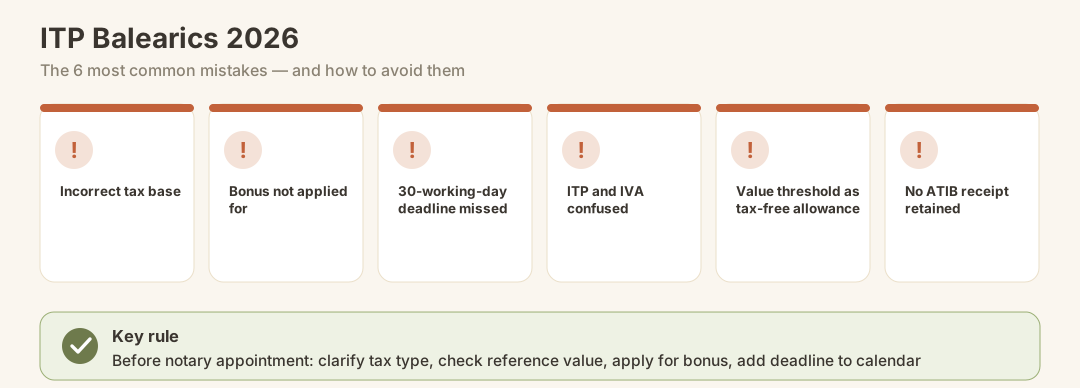
Mistake 2: Failing to apply for bonificaciones in advance Reduced rates are not granted automatically. You must actively claim them as part of the self-assessment process and provide proof that the qualifying conditions are met.
Mistake 3: Underestimating the 30-working-day deadline Buyers who purchase during a holiday and then return to Germany quickly lose track of time. Granting a power of attorney to a local tax adviser protects against costly surcharges.
Mistake 4: Confusing ITP and IVA Anyone who mistakenly pays ITP on a new-build developer purchase (or vice versa) faces a serious problem — unwinding the transaction is cumbersome and not always fully possible.
Mistake 5: Treating the new value threshold as a tax exemption The threshold of €307,089 (from March 2026) opens access to concessions — it does not mean that no tax whatsoever is due up to that amount.
Mistake 6: Not keeping the receipt for the land registry entry Without proof of payment to the ATIB, registration in the Registro de la Propiedad is blocked.
What comes next? Ongoing tax obligations after the purchase
ITP is a one-off tax. After the purchase, regular obligations apply:
- IBI (Impuesto sobre Bienes Inmuebles): Annual property tax, levied by the local council, typically due in autumn.
- Wealth Tax (Impuesto sobre el Patrimonio): Worth checking if you have a high net worth in the Balearic Islands.
- Non-Resident Tax (Modelo 210): Anyone who remains liable for tax in Germany and does not rent out the property owes a notional rental income tax.
- Community Charges (Comunidad de Propietarios): Payable monthly for apartments in shared ownership.
You can find more on this in our guide to IBI Tax Spain and to Wealth Tax.
Checklist: ITP Balearic Islands — before the notary appointment
- Checked: ITP or IVA? (Existing property vs. new build, private seller vs. company)
- Reference value (Valor de Referencia) checked with the Catastro
- Progressive ITP calculation carried out (in stages, not as a flat rate)
- Check: Does the new value threshold of 307.089 € apply (from March 2026)?
- Check: Is a reduction possible? (Age, primary residence, disability, large family)
- Tax adviser or solicitor engaged for Modelo 600
- Liquidity for ancillary costs (approx. 12–14 % of the purchase price) available
- Deadline of 30 working days after the notary appointment noted in the calendar
- ATIB payment receipt retained for land registry entry
Conclusion
The ITP on the Balearic Islands has become more accessible in 2026 for a wider range of buyers — where tax concessions are concerned — thanks to the raised value threshold (307.089 € on Mallorca, valid from 1 March 2026). However, this does not change the underlying progressive structure: rates of between 8 % and 13 % are possible, and for a typical Mallorca property priced at 800.000 €, the ITP can quickly add up to 70.000 € or more. Those who understand the details — the assessment basis, reductions, the ITP/IVA distinction, and payment deadlines — will pay no more than necessary and avoid subsequent demands from the ATIB. Seeking early advice from an expert specialising in Balearic tax law is not an optional extra here, but an absolute necessity.
Continue planning your purchase with our guide to the full process of buying property in Spain or get an overview of all purchase costs on Mallorca.
Official Sources
- ATIB – Agència Tributària de les Illes Balears (Balearic tax authority, responsible for ITP, Modelo 600): www.atib.es
- BOE – Boletín Oficial del Estado (national legislation, ITP framework act Ley del Impuesto sobre Transmisiones Patrimoniales y Actos Jurídicos Documentados): www.boe.es
- BOIB – Butlletí Oficial de les Illes Balears (Balearic tax legislation and amendments): www.boib.cat
- Sede Electrónica del Catastro (look up reference value / Valor de Referencia): sede.catastro.gob.es
- Registro de la Propiedad (Balearic land registries, registration following ITP payment): www.registradores.org