
Buying Your First Home in Mallorca: Your Complete Buying Guide 2026
Anyone looking to buy their first property in Mallorca – in Spanish, comprar primera vivienda – faces one of the most expensive markets in Spain. At the same time, the Govern de les Illes Balears has put together one of the most comprehensive support packages for first-time buyers in the entire country: tiered ITP rates, substantial tax exemptions, state guarantees through the IBAVI, and direct grants. If you understand the system, you can save a considerable amount when purchasing a €300,000 flat. This guide walks you through the entire buying process – from budgeting and the reservation contract through to the notarial appointment and handover of keys – with concrete figures, current thresholds, and the relevant authorities, as of 2026.

Do you already know which ITP reduction you're entitled to – and whether your desired property falls below the new threshold?
- 📩 Submit a personal enquiry — We'll assess free of charge which tax advantages apply in your case.
- An overview of all purchase ancillary costs
What buying actually costs: the three budget boxes
The most common planning mistake is equating the asking price with the total budget. In practice, your capital is split into three separate boxes, all of which need to work simultaneously:
| Budget box | What it includes | Rule of thumb |
|---|---|---|
| Monthly repayment | Mortgage repayment including all ongoing debts | ≤ 30–35 % of net income |
| Equity / deposit | The portion the bank does not finance | At least 20 % of the purchase price |
| Taxes & ancillary costs | ITP/IVA, AJD, notary, land registry, gestoria | approx. 10–14 % of the purchase price |
Please note: Banks in Spain typically finance up to 80 % of the purchase price (or the appraised value, whichever is lower). For the remaining 20 % plus the ancillary costs, you will need liquid equity – in total, around 30–34 % of the purchase price before you even approach a bank.
Practical example, Palma 2026: According to market data, the price per square metre in Palma at the end of 2025 was around €5,086/m² (source: idealista). A 60 m² apartment therefore costs roughly €305,000. Equity required (20 % deposit + approx. 12 % ancillary costs): approx. €97,600.
ITP or IVA? The crucial distinction
Before you calculate anything else, you need to know which type of tax applies – it determines the entire scale of your ancillary costs.
| Property type | Tax | Rate in the Balearen |
|---|---|---|
| Second-hand property (resale) | ITP (Impuesto sobre Transmisiones Patrimoniales) | 8–13 % progressive |
| New-build (first sale by developer) | IVA (VAT) | 10 % |
| New-build (first sale) – stamp duty | AJD (Actos Jurídicos Documentados) | 1,5 % |
The crucial difference: If you buy from a developer, you pay 10% IVA + 1.5% AJD, totalling 11.5%. If you buy an existing property, the progressive ITP applies — and that is where the most important first-buyer bonifications come into effect.
Caution: An incorrect classification (e.g. a developer sale that is mistakenly treated as subject to ITP) can shift the entire tax liability. If in doubt, have this clarified by a tax adviser or the ATIB (Agència Tributària de les Illes Balears).
ITP in the Balearic Islands 2026: The Progressive Tax Rates in Detail
The ITP in the Balearic Islands is structured progressively — meaning the overall price is not multiplied by a single flat rate; instead, each value band carries its own rate.
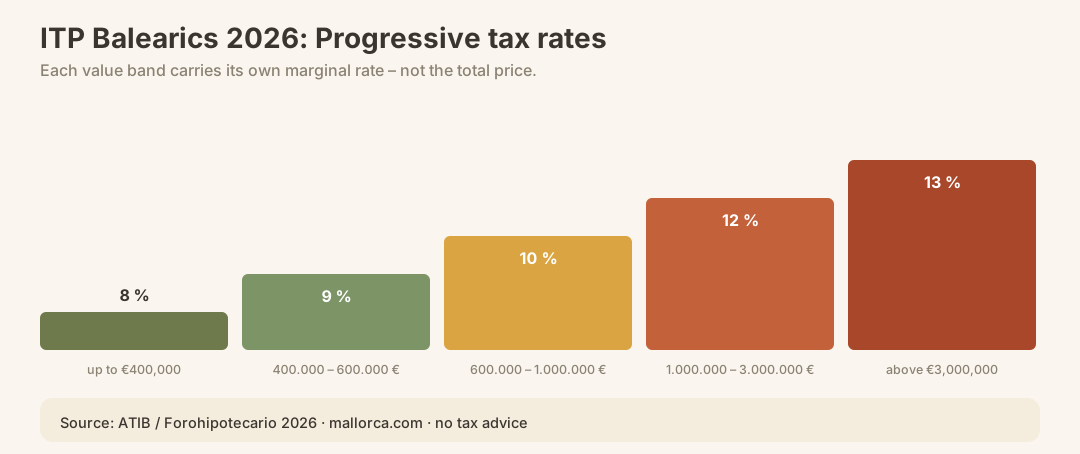
| Property value from (€) | Cuota íntegra (€) | Up to the amount (€) | Marginal rate |
|---|---|---|---|
| 0 | 0 | 400.000 | 8 % |
| 400.000,01 | 32.000 | 600.000 | 9 % |
| 600.000,01 | 50.000 | 1.000.000 | 10 % |
| 1.000.000,01 | 90.000 | 3.000.000 | 12 % |
| 3.000.000,01 | 210.000 | above | 13 % |
Source: Forohipotecario / ATIB 2026
Please note: The exact threshold values (in particular from €1,000,000 upwards) are subject to change. For binding figures, the current ATIB guidelines are always authoritative.
Worked example: When purchasing a resale property for €500,000, the following applies: €400,000 × 8% = €32,000 + €100,000 × 9% = €9,000 → ITP total: €41,000.
The New ITP Threshold Values from March 2026: What Has Changed
This is the most important change for first-time buyers this year. Since 1 March 2026, new value limits apply in Mallorca for access to reduced ITP rates and bonifications.
| Aspect | Previous value | New value (from 01.03.2026) |
|---|---|---|
| Access threshold for relief (Mallorca) | 270.151,20 € | 307.089 € |
| Maximum bonification cap | 270.151,20 € | €270,151.20 (unchanged) |
| Planned upper limit for stressed-market areas | — | up to €378,000 (in preparation) |
What this means: The higher threshold opens access to relief for more buyers. However — and this is the point that is often overlooked — the reduced rates or the bonification continue to apply only up to €270,151.20. The amount between this cap and the new access limit is taxed at the standard rate of 8%.
Bonifications for First-Time Buyers: Who Receives What?
This is where the real savings potential lies. The Balearic tax system provides different levels of relief depending on the buyer's profile.
| Buyer profile | ITP advantage | Key requirements |
|---|---|---|
| Standard first-time purchase — primary residence | Reduced rate | Residence in the Balearic Islands, no other property ownership |
| Young buyers (jóvenes) | up to 100 % ITP exemption | Age limit and income limit (exact figures: ATIB) |
| People with disabilities | up to 100 % ITP exemption | Recognised degree of disability |
| Large families (familias numerosas) | up to 100 % ITP exemption | familia numerosa certificate, valid at the time of purchase |
| Single-parent families (familias monoparentales) | Reduction | Corresponding recognition required |
Please note: The 100 % exemption does not automatically apply to the entire purchase price; it relates to the portion up to the applicable relief cap (270.151,20 €). Regular ITP applies to any amount above this. For the precise income and age thresholds, the current information published by ATIB is always authoritative — these are reviewed and updated on a regular basis.
IBAVI guarantee scheme and further financing assistance
The Institut Balear de l'Habitatge (IBAVI) operates a guarantee scheme that enables young buyers to finance up to 100 % of the purchase price — i.e. without a conventional equity deposit. In addition, there is an ICO guarantee mechanism at national level.
| Support programme | Provider | Key benefit |
|---|---|---|
| IBAVI guarantee scheme (aval hipotecari) | Govern de les Illes Balears / IBAVI | Up to 100 % financing of the purchase price |
| Direct grant for primary residence | Govern Baleares | Up to 10.000 € one-off payment |
| ICO guarantee | Spanish state / ICO | National supplement, subject to certain age and income limits |
Please note: Combining the IBAVI guarantee with an ITP exemption may be possible in certain circumstances, but requires that all conditions are met simultaneously. Contact IBAVI directly (ibavi.caib.es) for current application deadlines and income thresholds.
You can find more on mortgage structures in Mallorca in our guide to property financing in Mallorca.
The purchase process step by step
Buying a property in Mallorca follows a clearly defined process. Deviations are possible, but rare.
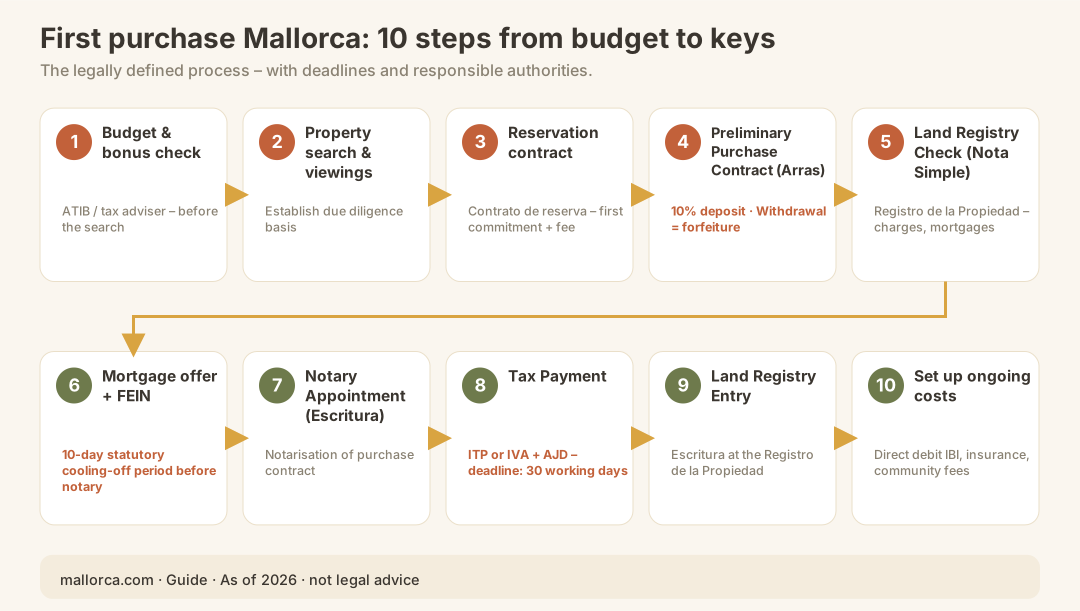
- Budget and Eligibility Check: Clarify whether you qualify for ITP concessions (ATIB, tax adviser). Apply for your NIE if you do not yet have one.
- Property Search and Viewings: Market research, viewings, establishing the basis for due diligence. Useful: Property Viewing Checklist.
- Reservation Agreement (contrato de reserva): First written commitment, typically accompanied by a reservation fee. Details in the guide to the Reservation Agreement Spain.
- Preliminary Purchase Contract (contrato de arras): Deposit of typically 10 % of the purchase price. If the buyer withdraws: loss of the arras. If the seller withdraws: repayment of double the amount.
- Land Registry Check and Due Diligence: Inspection of the Nota Simple at the Registro de la Propiedad – encumbrances, mortgages, ownership status. Guide: Checking the Land Registry in Spain.
- Mortgage Offer and FEIN: The bank issues the FEIN (Ficha Europea de Información Normalizada); statutory waiting period of 10 days before the notary appointment.
- Notary Appointment (escritura de compraventa): Notarisation of the purchase contract. Notary Spain – how the appointment works.
- Tax Payment: ITP (resale) or IVA + AJD (new build) must be paid to ATIB within 30 working days of notarisation. Submit any concession applications at the same time.
- Land Registry Registration: Submission of the escritura to the relevant Registro de la Propiedad.
- Setting Up Ongoing Costs: Set up direct debits for IBI, contents and buildings insurance, and community fees.
Please note: The 30-working-day deadline for ITP payment is a strict cut-off – late payments are subject to surcharges and interest.
Which Documents You Will Need
For Spanish residents, the list of documents is manageable, but it must be complete.
| Document | Issued by | Purpose |
|---|---|---|
| DNI / NIE + passport | Police / immigration authority | Identification at every stage |
| Spanish tax number (NIF) | AEAT | Tax payment, land registry |
| Spanish bank account | Any Spanish bank | Payment, ongoing costs |
| Nota Simple | Registro de la Propiedad | Proof of ownership, freedom from encumbrances |
| Energy certificate (Certificado energético) | Certified technicians | Mandatory for sale and rental |
| Empadronamiento (if applying for the discount) | Ayuntamiento | Proof of primary residence in the Balearics |
| Proof of income | Employer / AEAT | Mortgage application, discount eligibility check |
On the subject of Energiezertifikat Spanien there is a dedicated guide.
Most common mistakes when buying for the first time in Mallorca
Time and again, the same avoidable mistakes emerge from our advisory practice:
- Forgetting the discount or applying for it incorrectly: Anyone who pays ITP without submitting the exemption application at the same time forfeits their entitlement. Applying retrospectively is extremely difficult.
- Underestimating the threshold: Many buyers still assume the old limit of 270.151,20 € applies. From March 2026, 307.089 € is the qualifying threshold in Mallorca – this opens up more room to manoeuvre, but does not change the ceiling for full relief.
- Failing to check the Nota Simple: Encumbrances, mortgages, or unresolved inheritance situations in the land registry crop up regularly. Anyone who skips this step buys the problems along with the property.
- Missing the 30 working-day deadline: The ITP payment following the escritura is subject to a strict deadline. Delays at the gestoría or with the ATIB tax office can prove costly.
- Signing the arras contract without a solicitor: The preliminary contract is binding. A mistake here can cost the entire deposit amount.
- Underestimated additional costs: Anyone who only budgets for the ITP but forgets the AJD (for a mortgage), notary fees, land registry fees, and gestoría fee will end up several percentage points short.
What comes next? Ongoing costs as an owner
The purchase is complete – but with it begin new recurring obligations:
| Cost / Tax | Frequency | Responsible party |
|---|---|---|
| IBI (Impuesto sobre Bienes Inmuebles) | Annually | Respective municipality |
| Basura (refuse collection charge) | Annually / half-yearly | Respective municipality |
| Comunidad de propietarios | Monthly / annually | Property management |
| Contents and buildings insurance | Annually | Own choice |
| Wealth tax (Impuesto sobre el Patrimonio) | Annually (above the allowance threshold) | ATIB |
For details on the annual property tax, read the guide on IBI tax Spain, and for insurance coverage the guide on home insurance Spain.
If you intend to let the property later, be aware of the strict rules surrounding the ETV licence Mallorca – Decreto 4/2025 has significantly restricted the granting of new licences for holiday rentals. This does not apply to conventional long-term letting, however – find out more in the guide on long-term rental Mallorca.
Checklist: first-time purchase Mallorca 2026
Print this list out and tick off each point before moving on to the next phase:
Before the search
- Three budget boxes calculated (monthly repayment, equity, additional costs)
- Discount eligibility requirements checked with ATIB
- NIE / NIF obtained and up to date
- Spanish bank account opened
- Proof of income and tax assessments ready
- IBAVI funding option checked (if age requirements are met)
At the time of purchase
- Nota Simple obtained and reviewed
- Energy certificate received from the seller
- Arras contract reviewed with a solicitor
- Mortgage comparison including FEIN awaited (10 days)
- Attended notary appointment with all documents
- ITP reduction application submitted simultaneously with tax payment
After the escritura
- ITP / IVA + AJD paid to ATIB within 30 working days
- Land registry entry initiated
- IBI, insurance, community fees set up by direct debit
- Empadronamiento registered at new address
Conclusion
Approaching your first property purchase on Mallorca with a clear head means above all: understanding the tax system before you begin your search. The good news is that anyone who meets the requirements for the ITP reduction — whether as a young buyer, with a disability certificate, or as a large family — can benefit from significant tax advantages when purchasing a resale property up to the reduction cap of 270.151,20 €. From March 2026, the new threshold of 307.089 € will also open access to these benefits for more people. On top of that, IBAVI guarantees and direct grants of up to 10.000 € are available. All of this makes buying your first property on Mallorca considerably more affordable for residents than it might initially appear — despite high market prices — provided the planning is in place from the very start.
Official sources
- ATIB – Agència Tributària de les Illes Balears (ITP rates, reduction applications, forms): www.atib.es
- IBAVI – Institut Balear de l'Habitatge (guarantees, direct grants, Hipoteca Jove): ibavi.caib.es
- AEAT – Agencia Estatal de Administración Tributaria (national tax framework, Modelo 210): sede.agenciatributaria.gob.es
- Registro de la Propiedad de Mallorca (land registry entry, Nota Simple): www.registradores.org
- BOE / BOIB (Decret 4/2025, Balearic tax legislation): www.boib.caib.es