
Property Finance Mallorca: Spanish Mortgage for Foreigners
Anyone looking to buy a property on Mallorca faces a fundamental question early on: should I finance through a Spanish bank directly on the island – or take out a loan in Germany? The answer depends on your tax residency, the purchase price, the level of interest rate security you want, and your willingness to navigate a Spanish banking process. This guide walks you through both routes step by step: how much equity you actually need, what documents Spanish banks require, how Spanish mortgage law differs from German lending, and which mistakes could cost you your financing in the worst case. By the end, you'll know exactly what to expect – and what not to.

Want to know which financing option is the better fit for your specific purchase?
- 📩 Submit a personal enquiry — We'll connect you with experienced financing specialists on Mallorca
- All the information on the buying process
The Mallorca Property Market in 2026: What This Means for Your Financing
Before we get into the technical details, it's worth taking a look at the market – because it largely determines how much you'll need to finance. According to Engel & Völkers, average asking prices on Mallorca in mid-2026 were around 4,704 €/m² for houses and around 5,384 €/m² for apartments. In prime locations such as Puerto Andratx, prices of up to around 8,687 €/m² were already being quoted in 2024.
| Year | Avg. house price/m² | Change vs. previous year | Avg. apartment price/m² | Change vs. previous year |
|---|---|---|---|---|
| 2022 | 3.688 € | – | n/a | – |
| 2023 | 3.932 € | +6.6 % | 4.009 € | +9.6 % |
| 2024 | 4.113 € | +4.6 % | 4.537 € | +13.2 % |
| 2025 | 4.489 € | +9.2 % | 5.095 € | +12.3 % |
| 2026 | 4.704 € | +4.8 % | 5.384 € | +5.7 % |
Source: Engel & Völkers, asking prices on property portals, as of June 2026
What this means in practice: for a 150 m² apartment at average prices (approx. 807,000 €), as a non-resident you'll need to have between around 240,000 and 325,000 € ready for the deposit alone (30–40 %) – before purchase costs. The price level makes sound financing planning an absolute necessity, not an option.
Note: According to notary statistics from January 2026, transactions in the Balearic Islands fell by 13.9 % year-on-year in November 2025. The market is slowing down – which gives you as a buyer slightly more room to negotiate, without prices falling across the board.
The Two Financing Routes: Spanish Bank vs. German Bank
Broadly speaking, you have two options. Each has clear advantages and disadvantages that go well beyond the interest rate.
Route 1: Spanish Bank
Spanish banks finance the property directly on the island. The mortgage is registered in the Spanish land registry (Registro de la Propiedad), with the property serving as security. Spanish institutions know the local market, carry out their own valuation (tasación) and can make decisions more quickly.
Typical terms for non-residents (2026):
- Loan-to-value ratio: up to 70% of the lower value between the purchase price and the bank valuation
- Interest rate type: often variable based on Euribor, with fixed-rate options increasingly available
- Term: 10 to 25 years
- Special feature: banks often tie the loan to additional products (insurance, account opening, etc.)
Option 2: German Bank
Some German banks and savings banks are willing to finance a Mallorca property – either using a German land charge on another property or directly with the Spanish property as security. According to Dr. Klein, PSD Bank Rhein-Ruhr, for example, offers financing specifically tailored to Mallorca and Ibiza.
Typical terms for German banks:
- Interest rate type: annuity loan with a fixed interest rate, typically with a 10-year fixed period
- Loan-to-value ratio: generally up to 70%, in individual cases potentially higher
- Advantage: German law, familiar terms, no unfamiliar additional products
- Disadvantage: many banks do not know the Mallorcan market well enough and either decline or value the property conservatively
| Criterion | Spanish Bank | German Bank |
|---|---|---|
| Max. lending (non-resident) | 70 % | Generally 70%, possibly more |
| Interest rate type | Variable (Euribor) or fixed | Usually fixed, 10-year fixed period |
| Term | 10–25 years | 10–25 years |
| Additional products | Frequently required | Usually not |
| Market knowledge | High | Often limited |
| Language barrier | Possible | None |
| Property valuation | Local appraisal (tasación) | From Germany – often conservative |
Tip: Another option is to finance a property in Mallorca through a German building society You then receive a classic annuity loan with a ten-year fixed interest rate. However, many German institutions show little interest in overseas financing due to a lack of market knowledge.
Equity: how much you really need
This is the point that many buyers underestimate. As a non-resident in Spain, Spanish banks will finance a maximum of 70% of the purchase price or the bank valuation – whichever is lower. As a tax resident, this figure can rise to as much as 80%.
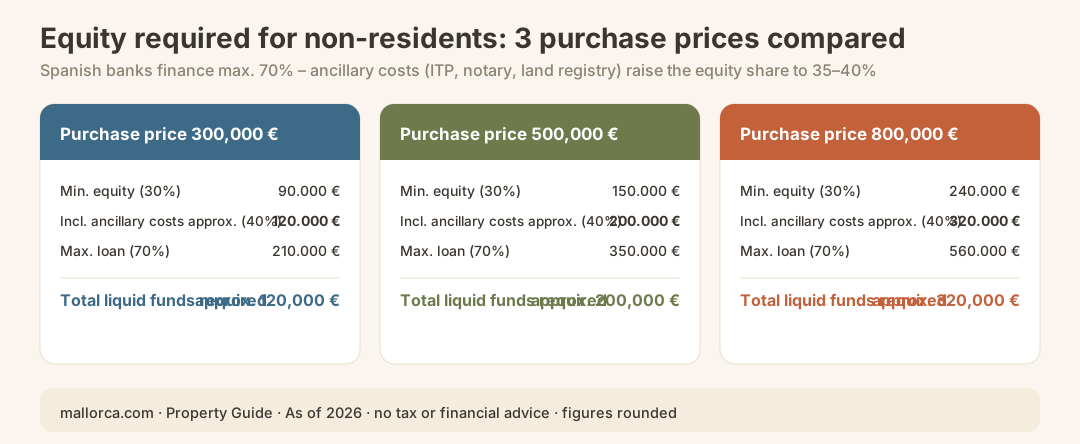
This means: as a non-resident, you will need at least a minimum of 30% equity of the purchase price. When you add the additional purchase costs in Mallorca – ITP (property transfer tax), notary fees, land registry entry, estate agent commission – the actual equity requirement quickly rises to 35–40% of the purchase price.
| Purchase price | Min. equity (30%) | Including additional costs approx. (40%) | Max. loan (70%) |
|---|---|---|---|
| 300.000 € | 90.000 € | 120.000 € | 210.000 € |
| 500.000 € | 150.000 € | 200.000 € | 350.000 € |
| 800.000 € | 240.000 € | 320.000 € | 560.000 € |
| 1.200.000 € | 360.000 € | 480.000 € | 840.000 € |
Please note: Spanish banks assess the value of a property through their own valuation report (tasación). If the valuation comes in below the purchase price, the lower figure is used as the basis – your equity requirement increases accordingly.
The importance of tax residency
Spanish banks fundamentally distinguish between residents (tax domicile in Spain) and non-residents. This has a direct impact on lending conditions:
- Non-residents generally receive a lower loan-to-value ratio (max. 70%), tend to face higher interest rates, and are required to provide more documentation.
- Residents can obtain up to 80% loan-to-value and benefit from somewhat more favourable conditions.
Tax residency also plays a role from a fiscal perspective: non-residents pay IRNR (Impuesto sobre la Renta de No Residentes) on rental income, while residents pay standard income tax. Anyone establishing a permanent residence in Mallorca should seek advice on the tax implications in advance – this forms part of the overall financial calculation.
What documents you need – step by step
The list of documents required for a mortgage in Spain as a foreign national is longer than in Germany. Allow plenty of lead time – in our experience, at least four to eight weeks to gather everything together.
Mandatory documents for non-residents at Spanish banks:
- NIE (Número de Identificación de Extranjero) – the Spanish tax identification number for foreign nationals; without an NIE, nothing can proceed
- Valid passport or national identity card
- Recent proof of income (payslips from the last 3–6 months or tax assessment)
- Recent bank statements (generally 3–6 months)
- Proof of available equity (bank statements, investment account statements)
- Credit report from your home country (e.g. a Schufa report from Germany)
- Employment contract or business registration / company documents for the self-employed
- Preliminary contract (contrato de arras or contrato privado) of the property
- Energy certificate of the property (mandatory for all sales; more on this in the Guide to Energy Certificates in Spain)
- Land registry extract (nota simple) of the property
Please note: All documents not issued in Spanish must generally be translated by a sworn translator (traductor jurado). This also applies to credit reports and pay slips.
The process: from mortgage application to signing
The process in Spain works somewhat differently from what you may be used to. Here are the key stages:
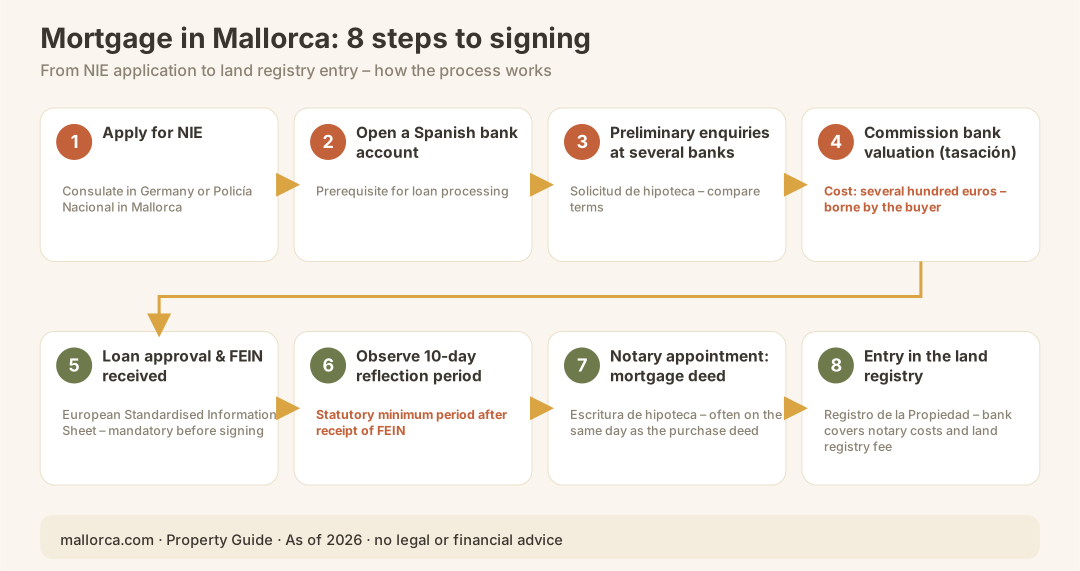
- Apply for your NIE – at the Spanish consulate in your home country or directly in Mallorca at the Policía Nacional; without an NIE you cannot open a bank account or obtain a mortgage
- Open a Spanish bank account – most banks require a local account for the loan to be processed
- Submit preliminary enquiries to several banks (solicitud de hipoteca) – compare the terms on offer
- Commission a bank valuation (tasación) – the bank appoints an approved valuer; the costs (several hundred euros depending on the property value) are usually borne by the buyer
- Receive loan approval and the FEIN – the Ficha Europea de Información Normalizada is the standardised European information sheet that you must receive before signing
- Observe the statutory cooling-off period – once you have received the FEIN you have at least 10 days to reflect before you can sign the mortgage (required by law)
- Notary appointment for the mortgage – the mortgage deed (escritura de hipoteca) is executed separately before a notary, often on the same day as the purchase deed
- Registration in the land registry – the bank registers the mortgage in the Spanish land registry (Registro de la Propiedad) register
Please note: In Spain, since the Mortgage Law reform (Ley 5/2019), there are clear consumer protection rules. The bank must disclose all costs to you before the notary appointment. The bank selects the notary for the mortgage deed — however, you have the right to schedule the notary appointment separately from the purchase deed.
Variable vs. fixed rate: which suits you?
In Spain, variable-rate mortgages have traditionally been more widespread than in Germany. The variable interest rate is usually based on the Euribor (12-month rate) plus a fixed margin set by the bank. If the Euribor rises, your monthly repayment rises too.
Fixed-rate mortgages (hipoteca fija) are now available in Spain and have become more attractive to many buyers following the interest rate rises of recent years.
| Interest model | Advantage | Disadvantage | Recommendation |
|---|---|---|---|
| Variable rate (Euribor + margin) | Often a lower initial rate | Fluctuating repayments, planning uncertainty | If you want to repay or pay off the loan early |
| Fixed rate (hipoteca fija) | Payment certainty throughout the entire term | Slightly higher initial rate | If you want long-term financing and security |
| Mixed rate (hipoteca mixta) | Fixed for the first few years, then variable | More complex to compare | Only with careful calculation |
German banks typically offer the classic annuity loan with a 10-year fixed interest period — this broadly corresponds to a hipoteca mixta with a long fixed-rate component, but is clearly regulated under German law.
Additional costs of a mortgage: where Spain does things differently
One important difference from German mortgages: Spanish banks frequently tie loans to additional products and services. This can significantly affect the effective interest rate (TAE – Tasa Anual Equivalente).
Typical add-on products:
- Buildings and life insurance taken out through the bank
- Opening and managing a current account
- Bank credit card
- Pension products or savings plans
Please note: You are not obliged to take out all the additional products. However, they generally improve the interest rate on offer. Always ask for the TAE to be shown — not just the nominal rate — so you can fairly compare offers from different banks.
In addition, there are costs associated with the mortgage itself: the bank valuation (tasación) is paid by you as the buyer. The costs of registering the mortgage in the land registry and the notary fees for the mortgage deed have been borne by the bank — not the buyer — since the 2019 reform.
The most common mistakes in property financing on Mallorca
In practice, the same picture emerges time and again: most problems arise from mistakes that can easily be avoided with a little preparation.
1. Underestimating the equity requirement Buyers calculate 20% equity as they would in Germany — and forget that Spanish banks only finance 70% for non-residents, plus purchasing costs. The result: the financing falls through shortly before the notary appointment.
2. Applying for the NIE too late No NIE means no bank account, and no bank account means no mortgage. Depending on the consulate and the time of year, the application process can take several weeks. Start early.
3. Failing to account for the bank valuation The bank finances not the purchase price but the valuation figure — and that can sometimes be lower. Anyone who fails to factor this in may need to come up with additional equity at short notice.
4. Approaching only one bank Terms and conditions can vary noticeably between different banks on Mallorca. Obtain several offers and compare the TAE.
5. Failing to check the legal status of the property A mortgage is of no use to you if the property has encumbrances or unresolved ownership issues in the land registry. Checking the land registry extract is essential before you accept a financing offer.
6. Ignoring the cooling-off period The statutory cooling-off period of at least 10 days between receiving the FEIN and signing is mandatory. Factor it into your schedule — pressure from the seller or the bank changes nothing.
7. Failing to calculate the tax implications A mortgage is not a purely banking product. Interest payments, property transfer tax, wealth tax, and potentially IRNR all need to be included in the overall calculation. Anyone planning to let or sell the property later should factor in the taxes on property sales from the very beginning.
What comes next? Mortgage, purchase, and land registry
The mortgage has been signed — but the process is not yet complete. After the notary appointment (for both the purchase and the mortgage), both deeds must be entered in the Registro de la Propiedad. Only once registered is your ownership and the charge officially recorded.
In addition:
- Pay taxes: Transfer tax (ITP) on resale properties, or AJD on new builds, is due no later than 30 days after the notary appointment
- Transfer utility contracts: Electricity, water, internet into your name
- Set up mortgage payments: Spanish banks debit the instalment from a local account
Anyone who later wishes to pay off the mortgage or sell the property must have the mortgage removed from the land registry (cancelación registral) – this too is a separate notary appointment and incurs fees.
You can find more about the entire purchase process in the guide Rechtsprozess Immobilienkauf and further details on ancillary costs under Kaufnebenkosten Mallorca.
Checklist: Property financing in Mallorca
Use this list as a practical roadmap – tick off each point before you sign a purchase contract:
- Equity established (min. 30–40 % of the purchase price incl. ancillary costs)
- NIE applied for (consulate or Mallorca)
- Spanish bank account opened or in progress
- At least three bank offers obtained (Spanish and, where applicable, German)
- TAE (effective annual interest rate) of all offers compared – not just the nominal rate
- Add-on products and their costs listed for each offer
- Bank valuation (tasación) commissioned or costs budgeted for
- Land registry extract (nota simple) of the property checked
- Energy certificate of the property in hand
- FEIN received and 10-day reflection period factored in
- Notary appointment for mortgage deed and purchase deed coordinated
- Tax implications (ITP/AJD, IRNR, wealth tax) calculated in advance
Conclusion
Financing a property in Mallorca is no dark art – but it works differently from Germany. Anyone coming as a non-resident must bring more equity (30–40 %), absolutely requires a NIE, and should expect a longer documentation phase. The advantage of a Spanish bank is its market knowledge and speed; the advantage of a German bank is the familiar interest structure without hidden product tie-ins.
Given average prices of around 4.700 to 5.400 €/m² in 2026, the absolute sums involved are considerable – good advice is therefore not an option but a prerequisite. Always combine financing planning with a thorough legal review of the property: check the land registry, understand the purchase process and factor in the Kaufnebenkosten realistically – then the path to owning a property in Mallorca is clearly structured and plannable.
Official sources
- Banco de España – Mortgage law, consumer protection, FEIN requirement: https://www.bde.es
- Ley 5/2019 reguladora de los contratos de crédito inmobiliario (Spanish Mortgage Law): https://www.boe.es/buscar/act.php?id=BOE-A-2019-3814
- Registro de la Propiedad / Colegio de Registradores (Land Registry Spain): https://www.registradores.org
- ATIB – Agència Tributària de les Illes Balears (Property Transfer Tax ITP Balearic Islands): https://www.atib.es
- AEAT – Agencia Estatal de Administración Tributaria (NIE, IRNR, tax law): https://www.agenciatributaria.es
- Consell de Mallorca – Departament de Territori (planning and land-use regulations): https://www.conselldemallorca.net
- Notariado.org – Statistical portal of Spanish notaries (transaction data Balearic Islands): https://www.notariado.org