
Power of Attorney Spain Notary: Buying Property & Dealing with Authorities Remotely
You've found your dream property on Mallorca but can't fly to Spain for every appointment with the authorities or the notary?Poder Notarial – the notarised power of attorney (Spain notary) – is exactly what you need for this. It allows you to authorise a trusted person – usually a lawyer or gestor – to sign contracts on your behalf, apply for your NIE, handle inheritances, or take care of land-registry formalities. What many people don't realise: the power of attorney can also be drawn up before a German notary – with an apostille and translation it is fully valid in Spain. In this guide you'll find out what types of power of attorney exist, how the process works from Germany to Spain, what you'll pay, and which mistakes you should definitely avoid.

Would you like to arrange your property purchase or a bureaucratic matter on Mallorca by power of attorney?
- 📩 Submit a personal enquiry — We connect you with vetted lawyers and gestores on Mallorca
- Overview: buying property on Mallorca
What is a Poder Notarial and when do you need one?
A Poder Notarial is a public deed executed before a notary by which you transfer to another person – the authorised representative (Apoderado) – the right to carry out certain legal transactions on your behalf. Spanish law generally permits representation by proxy, with the exception of strictly personal legal acts such as marriage.
If someone acts on your behalf without a valid power of attorney, the legal transaction is void – unless you expressly ratify it afterwards. For all procedures that require notarial certification (property purchase, acceptance of an inheritance, land-registry entry), the power of attorney must itself be notarially executed. The reason is the so-called principle of formal equivalence: because the legal transaction itself is notarially certified, the power of attorney must take the same form.
Typical use cases in German–Spanish legal dealings:
| Use case | Type of power of attorney | Notarial form required? |
|---|---|---|
| Property purchase/sale | Special power of attorney (Poder Especial) | Yes |
| Acceptance of inheritance / estate administration | Special power of attorney | Yes |
| NIE application | Special power of attorney | Yes (Apoderamiento) |
| Opening / managing a bank account | Special power of attorney | Yes |
| Company formation / corporate law | Special or general power of attorney | Yes |
| Owners' association meeting | Private written power of attorney | No |
| Vehicle re-registration with the Spanish traffic authority | Private written power of attorney | No |
Note: A private written power of attorney is sufficient for attending owners' meetings or re-registering a vehicle. For all land registry and inheritance matters, the notarised form is mandatory.
The two most important types of power of attorney: special and general
Special Power of Attorney (Poder Especial / Poder Notarial Especial)
The special power of attorney is tailored to a clearly defined scope of tasks – for example, the purchase of a specific property, applying for the NIE, or handling a particular inheritance matter. Spanish law requires that the legal transaction be described in detail . A general statement such as "I grant power of attorney for all my personal affairs" is not sufficient in Spain – quite unlike the position under German law.
The special power of attorney typically includes provisions on:
- whether the authorised person may grant sub-powers of attorney,
- whether they are exempt from the prohibition on self-dealing,
- for which specific subject matter (property with cadastral reference or land registry number) the power of attorney applies.
General Power of Attorney (Poder General)
The general power of attorney grants extensive authority for various property-related acts. It is common between spouses or in ongoing business dealings. As a German general power of attorney cannot be applied directly in Spain, a general power of attorney must also meet the substantive requirements of Spanish law and clearly specify the areas of authority.
Please note: A general power of attorney issued in Germany without adaptation to Spanish law will generally not be accepted by Spanish notaries or the land registry. Always have the text prepared by a lawyer well versed in Spanish law or the instructed firm.
How to create the power of attorney from Germany: two legal routes
In principle, you have two options for creating a notarised power of attorney that is valid in Spain without travelling to Mallorca.
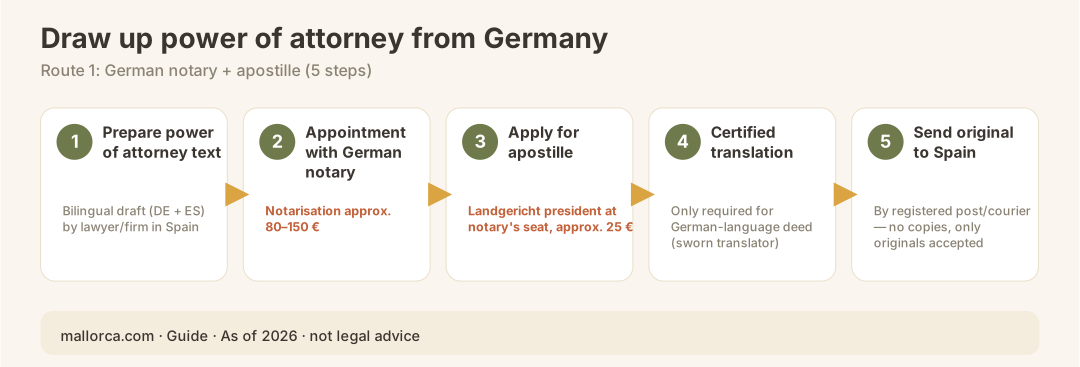
Route 1: German notary + apostille + translation
This is the most common route. Spanish law recognises foreign public documents provided they have been properly notarised, comply with the law of the country in which they were drawn up, bear an apostille and are submitted in the Spanish language.
Step by step:
- Have the power of attorney text prepared: A lawyer experienced in Spanish law or the instructed firm in Spain draws up a bilingual draft (German + Spanish) or a text solely in Spanish. Many firms specialising in German-Spanish legal matters forward the draft to the Spanish notary in advance to avoid any formal issues at the subsequent notary appointment.
- Appointment with the German notary: You go to a German notary of your choice and have the power of attorney notarised. The notary must be able to understand or notarise the Spanish power of attorney text – some notarial offices specialise in international documents.
- Applying for an Apostille: The Apostille under the Hague Convention is issued by the President of the Regional Court at the seat of the certifying notary. It certifies the authenticity of the notarial document for use in international legal transactions.
- Certified Translation: If the document is drawn up in German, it requires a certified translation into Spanish by a sworn translator. If it is notarised bilingually or purely in Spanish, this step is not required.
- Sending the Original with Apostille to Spain: The original (not a copy) with the Apostille affixed is sent by registered post or courier to the authorised representative in Spain.
Option 2: Spanish Honorary Consul in Germany
Alternatively, you can have the power of attorney notarised directly before a Spanish Honorary Consul in Germany. The advantage: the document created in this way is regarded as a Spanish consular document and requires no Apostille. This saves time and costs. The prerequisite is that a Spanish honorary consulate near you is responsible for notarisations and that appointments are available.
| Criterion | Option 1: German Notary + Apostille | Option 2: Honorary Consul |
|---|---|---|
| Apostille required | Yes | No |
| Translation required | Possibly yes | No (Spanish) |
| Flexibility in choice of notary | High | Limited (consulate locations) |
| Typical total costs | 250–550 € | Lower, depending on consulate |
| Time required | Somewhat longer | Often faster |
Cost overview: what you need to budget for
The total costs depend on whether you choose Option 1 or Option 2 and whether you engage an external authorised representative (lawyer, gestor) in Spain.
| Cost item | Guide price |
|---|---|
| German notary fee (power of attorney) | approx. 80–150 € |
| Apostille (presiding judge of the regional court) | approx. 25 € |
| Certified translation (if required) | depending on scope |
| Authorised representative in Spain (lawyer/gestor) | approx. 150–400 € |
| Total (Option 1, incl. authorised representative) | approx. 250–550 € |
Note: If you are on Mallorca at the time of granting the power of attorney, it can be executed directly before a local Spanish notary. This saves the cost of an apostille and translation.
The notary fees for the actual deed of sale (Escritura) in Spain are separate from this. Find out more in our guide to purchase ancillary costs on Mallorca.
The power of attorney in property purchases: what the authorised representative may do
When buying a property on Mallorca or elsewhere in Spain, the special power of attorney is the most important instrument if you are unable to attend the notary appointment in person. A well-drafted purchase power of attorney typically enables the authorised representative to:
- Sign the reservation contract and the arras preliminary contract
- Sign the Escritura Pública (public deed of sale)
- Hand over the purchase price and receive receipts
- Submit tax declarations in connection with the purchase (e.g. ITP)
- Arrange the land registry entry
- Where applicable, take out or discharge a mortgage
Important: Make sure the power of attorney is worded with sufficient precision. If certain authorisations are missing from the text, the notary may refuse to certify the deed or the appointment may have to be postponed. Where a date has been agreed in advance in the arras contract, this can give rise to contractual penalties and claims for damages.
For a comprehensive overview of the property purchase process, we recommend our guide on the legal process for buying property in Spain.
Power of attorney for the NIE application (apoderamiento)
Anyone wishing to apply for a Spanish tax identification number (NIE) without travelling to Mallorca in person uses a special form of power of attorney: the Apoderamiento. The process follows the same principle as the purchase power of attorney, but is specifically tailored to the NIE application.
What the NIE power of attorney must contain:
- Full details of the principal: name, date of birth, passport number, address
- Full details of the authorised representative: name, NIE/DNI, address, profession in Spain
- Explicit authorisation for the NIE application with the competent Spanish authority
| Step | What happens |
|---|---|
| Have the power of attorney text drafted | Lawyer/gestor provides a draft |
| Submit to a German notary | Notarisation (bilingual or in Spanish) |
| Apply for the apostille | Regional Court President, approx. €25 |
| Send the original to Spain | By registered post/courier |
| Authorised representative books a Cita Previa | Appointment at the immigration office |
| NIE is issued | Authorised representative collects the document |
Total time from notary appointment to receipt of NIE: typically 4–8 weeks.
Power of attorney for estate administration in Mallorca
In the event of an inheritance, the power of attorney is often particularly time-critical: the Spanish inheritance tax must be declared within 6 months of the death, and the land registry transfer to the heirs requires a notarised acceptance of inheritance. Since the acceptance of inheritance itself must be notarised in Spain, the principle of formal equivalence applies: the power of attorney for estate administration must likewise be drawn up before a notary.
The power of attorney for estate administration typically covers:
- Acceptance or renunciation of the inheritance
- Signing the notarial deed of inheritance (Escritura de Aceptación de Herencia)
- Submission of the inheritance tax return
- Application for the land registry transfer
- If applicable, sale of estate assets
You can find more information on deadlines and tax rates in the Balearic Islands in the guide on Inheritance & Gifts Balearic Islands.
Notarisation with a German notary: what you need to bring
To ensure your notary appointment in Germany goes smoothly, you should have the following documents to hand:
- Valid passport or national identity card (in the original)
- Prepared power of attorney text (ideally provided by the opposing party's solicitor or your law firm in Spain)
- Details of the authorised representative: full name, Spanish NIE or DNI, address, occupation
- Details of the subject matter of the contract (for a property purchase: address, land registry number/Referencia Catastral of the property)
- Details of the scope of authority: is the authorised representative permitted to grant sub-powers of attorney? Is he/she exempt from the prohibition on self-dealing?
Note: Some law firms specialising in German-Spanish legal transactions maintain contacts with German notaries who notarise documents in Spanish. This considerably simplifies the process and makes a certified translation unnecessary. Trusted notaries for such documents can be found in, among other cities, Munich, Stuttgart, Frankfurt, Cologne, Hamburg and Berlin.
Can the property purchase be notarised entirely before a German notary?
Yes – and this is less widely known than it ought to be. The Spanish Supreme Court (Tribunal Supremo) confirmed by its judgment of 19 June 2012 (STS 998/2011) at the highest judicial level that a property purchase in Spain can in principle also be validly notarised before a German notary if both parties so wish.
Requirements for recognition of the German deed in Spain (Art. 3 and 4 Ley Hipotecaria, Art. 1216 Código Civil):
| Requirement | Explanation |
|---|---|
| Proper notarisation | Complies with German notarial law |
| Apostille | Issued by the President of the Regional Court |
| Spanish-language submission | Certified translation or bilingual deed |
| Substantive conformity | No circumvention of mandatory Spanish provisions |
In practice, this route is particularly useful when both buyer and seller are located in Germany and an authorised representative based in Spain is only required for individual administrative steps. The actual purchase contract can thus be concluded in familiar surroundings. For more on the notarial process in Spain: Notary for a property purchase in Spain.
Most common mistakes with a power of attorney for a Spanish notary
These mistakes occur time and again – and can prove costly:
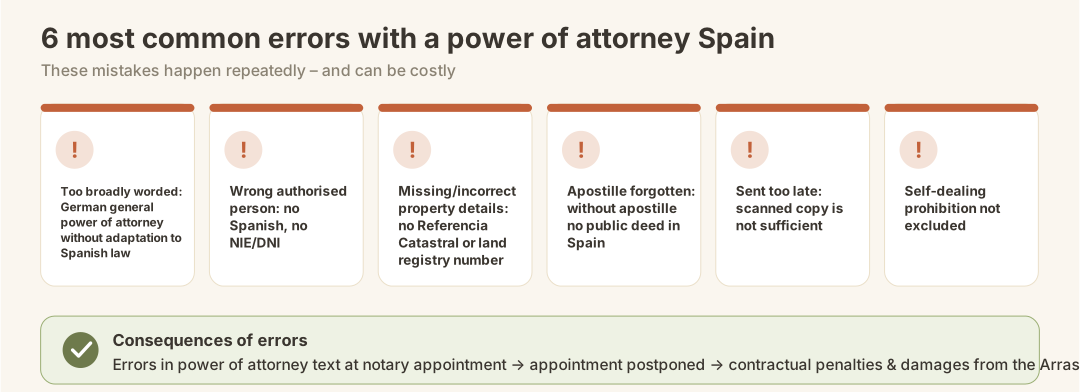
- Drafted too broadly: A German general power of attorney without adaptation to Spanish law will be rejected by Spanish notaries. Every authority granted must be specified in concrete terms.
- Wrong authorised representative: Authorising someone who does not speak Spanish or does not hold a Spanish NIE/DNI risks complications at the notary appointment.
- Missing or incorrect property details: Without the correct Referencia Catastral or land registry number, the notary cannot assign the power of attorney to the specific property being purchased.
- Apostille overlooked: Without an apostille, the German deed does not constitute a public document in Spain and will not be recognised by the land registry.
- Transmitted too late: The original power of attorney must be received in Spain in good time before the notary appointment. A scanned copy is not sufficient.
- Self-dealing prohibition not excluded: If the authorised representative is simultaneously acting on the opposing side of the transaction, an explicit exclusion of the self-dealing prohibition is required.
- Power of attorney after the death of the principal: An ordinary power of attorney lapses upon the death of the principal – cases in which third parties continue to act in good faith can become complicated.
What comes next? The next steps after granting the power of attorney
Once your authorised representative holds the power of attorney, they can act on your behalf. Depending on the circumstances, the following next steps apply:
When purchasing a property:
- Signing the reservation contract and the Arras preliminary contract
- Land registry search (Nota Simple)
- Signing the escritura before the Spanish notary
- Payment of purchase ancillary costs (ITP, notary fees, land registry fees) – details: Purchase ancillary costs Mallorca
- Land registry entry
When applying for a NIE:
- Appointment (Cita Previa) at the foreigners' registration office
- Submission of documents, issue of the NIE
When handling an inheritance:
- Notarial acceptance of the inheritance
- Submission of the inheritance tax return (deadline: 6 months)
- Transfer of the land registry entry to the heirs
Checklist: preparing the power of attorney for a Spanish notary
Use this checklist before you visit the notary:
- Have the power of attorney text prepared by a lawyer experienced in Spanish law
- Draft sent to the Spanish notary (or the buyer's/seller's lawyer) in advance and confirmed
- Valid passport or national identity card available
- Full details of the authorised representative (name, NIE/DNI, address) at hand
- Specific details of the subject matter of the contract (property address, cadastral reference) entered
- Provisions on sub-authorisation and self-dealing included in the text
- Notary appointment in Germany booked (preferably at a notary's office specialising in international documents)
- Apostille applied for from the President of the Regional Court (approx. 25 €)
- Certified translation commissioned if the deed was drawn up in German
- Original sent by registered post/courier to the authorised representative in Spain in good time
- Acknowledgement of receipt obtained from the authorised representative
Conclusion: with the right power of attorney you save time, money and stress
The Poder Notarial is one of the most useful instruments in Spanish property and inheritance law – provided it is carefully drafted. The most common problems arise not from the instrument itself, but from overly general wording, a missing apostille, or omitted details regarding the subject matter of the contract. Always have the power of attorney text prepared by someone who is familiar with both legal systems, and send the original in good time. Anyone who bears this in mind can handle their property purchase, NIE application, or inheritance proceedings on Mallorca entirely from abroad – without time pressure and without costly corrections.
Official sources
- Ley Hipotecaria (Art. 3 and 4): Spanish Land Registry Act – requirements for documents eligible for registration in the Land Registry: https://www.boe.es/buscar/act.php?id=BOE-A-1946-2453
- Código Civil Español (Art. 1216 ff.): Definition of the escritura pública and the law governing powers of attorney: https://www.boe.es/buscar/act.php?id=BOE-A-1889-4763
- Haager Apostillen-Übereinkommen: Basis for the international recognition of notarial deeds: https://www.hcch.net/de/instruments/conventions/full-text/?cid=41
- Consejo General del Notariado (Spain): Notary search and information on the Spanish notarial system: https://www.notariado.org
- Agencia Tributaria Balear (ATIB): Responsible for Balearic taxes (ITP, inheritance tax): https://www.atib.es
- Registro de la Propiedad (Land Registry Spain): https://www.registradores.org